AI-NATIVE SERIES · PLAY-ENGINEERING, EPISODE 1 OF 4
Play-Engineering: Play Finds the Mechanism, Engineering Tests It on a Second Case
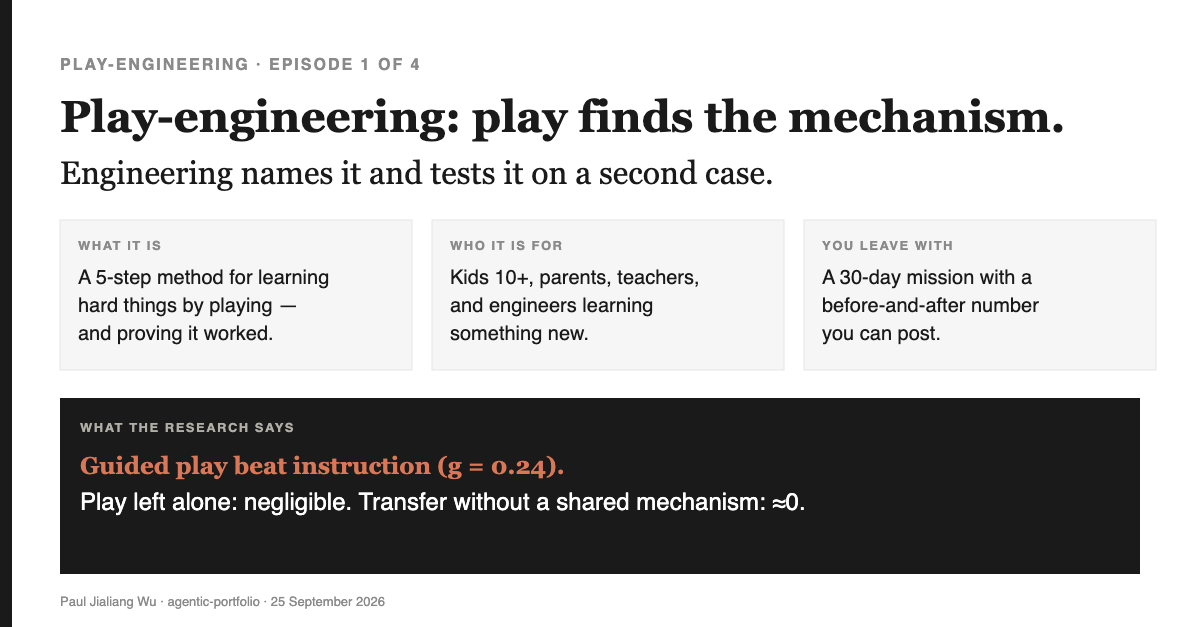
What this is. Play-engineering is a way to learn hard things — and to invent new ones — by playing first and then doing the one step most play skips: naming the mechanism you discovered and testing it on a second, different case. It started as a joke I made in an interview. The research says the joke has a serious core, and also that two things I believed about it were wrong.
Why it matters. Kids (and adults) quit hard subjects because practice feels like punishment, and they stay stuck because play alone doesn't reliably make them better. In a review of 6,096 athletes, play the kids led themselves had a negligible effect on how good they became (Güllich et al., 2022). Guided play is different: in young children it beat direct instruction on early maths (g = 0.24, Skene et al., 2022). The difference is the engineering half — and that half is teachable.
What you can do after. Run a 30-day mission a 10-year-old can do: find one mechanism in two games, name it in one sentence, and measure how many tries a brand-new move takes before and after. Post your number in the comments — that's how you contribute to the field this series is inviting you to build.
Play-Engineering — the series spine
- Play finds the mechanism — what play-engineering is this episode
- The fuel — fascination, not scores episode 2
- Sci-fi to prototype — story, mechanism, toy, test, second case episode 3
- The restoration playbook — visions into 30-day projects episode 4
How to read the numbers: g and d measure how big a difference is — about 0.2 is small, 0.5 medium, 0.8 large. "SD" (standard deviation) is the same kind of unit.
The one question this episode answersWhat is play-engineering, and what can play do that drills can't?
This piece does not answer what keeps you playing for years — that is episode 2, fascination — or how to turn a sci-fi gadget into a prototype, which is episode 3, or how a vision of a restored world becomes a plan, which is episode 4.
What play-engineering covers, and who it's for
This series is for anyone aged about ten and up who wants to learn something difficult, or build something that doesn't exist yet — and for the parents, teachers and engineers who want to help them. It has four episodes. This one defines play-engineering and tests it against the evidence. The others cover what keeps you going (episode 2), how to turn science fiction into a prototype (episode 3), and how to turn a biblical vision of a restored world into a plan you can measure (episode 4).
A little honesty up front, because the whole series depends on it. "Play-engineering" began as a joke. A graduate student studying engineers who climb interviewed me, and I told her I had co-founded "play engineering" with her at Stanford. Nobody founded anything. But when I explained what I meant, the joke turned out to contain a real idea, so I checked it against the research. Some of it held. Some of it didn't. You will see both, because a method that can't tell you when it's wrong isn't engineering.
One picture will carry all four episodes, so let me introduce it as a tool first.
One picture for the whole series: the sparring room
In my first year of college I joined the martial arts club, and the coach taught me forms — beautiful, choreographed sequences you perform for judges. I practised one punch, alone, every afternoon. Then one day a visiting student from Japan, a head taller than me, watched me and asked: do you want to spar? I didn't know what sparring was. I said yes.
For the first ten or fifteen minutes he kicked me wherever he liked. Then, slowly, I started to read his kicks. I caught his foot, tried to pull him down, failed. After a few more rounds I found it: pull him toward me, let him adjust his balance to resist — and then swing him to the side. By the end of half an hour I wasn't winning, but I could handle every kick he had. I learned more in that half hour than in weeks of forms.
That room maps exactly onto what the research says about learning:
| In the sparring room | In play-engineering |
|---|---|
| Forms performed for judges | Practice aimed at a score — marks, stars, prizes |
| A sparring round | Play: you choose your moves, the outcome is real, it's fun |
| The coach who sets the rules of the round | Guided play: an adult designs the game, you keep the choices (Weisberg et al., 2016) |
| Finally reading his kick | Finding the mechanism — the cause under the move |
| "Pull, let him adjust, then swing" | Naming the mechanism in one sentence |
| Trying it on a different partner | Testing it on a second case |
| How many rounds until a new partner's kick stops landing | The measurement: tries until a new move works |
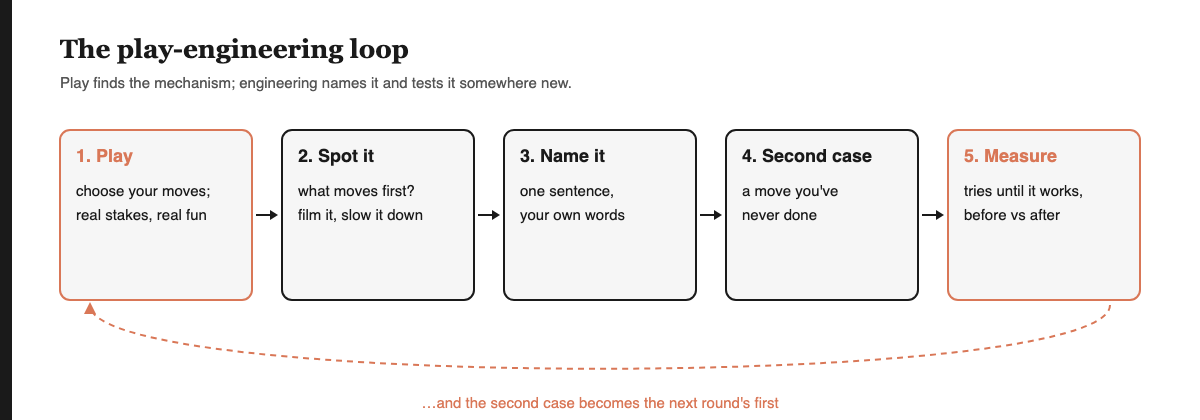
So here is play-engineering in one line: play finds the mechanism; engineering names it and tests it on a second case.
Four of my stories, and what the evidence says about each
I told the interviewer four stories to explain the idea. Here they are again, this time with the research next to them — including where it disagrees with me.
1. The climbing wall is a chess board. My first real climb was outdoors, at the end of a summer class in graduate school. The first wall wasn't steep, but I was exhausted at the top — not from difficulty, from fear. The next day the wall was much steeper and it felt easier, because my nervous system had adjusted to the height. Today I climb in a gym near my office, because climbing asks for two things at once: control of your body, and a plan, like chess — and when the plan fails halfway up, you invent a new one on the wall. That's play with real stakes and instant feedback. It's the kind of play the research likes.
2. Soccer: near transfer in a costume. (Two words first: near transfer means using a skill somewhere similar; far transfer means using it somewhere unrelated.) At a family outing, the kids' team was crushing the parents, and a mum asked me to sub in. I had kicked a soccer ball maybe five times in my life. In the next fifteen minutes I scored four or five goals. My explanation at the time was "martial arts transfers to soccer." The research says that's too big a claim. When scientists test whether training one skill improves an unrelated one, and the comparison group also trains something, the effect nearly vanishes: 0.03 standard deviations for music training and 0.05 for memory training (Sala & Gobet, 2017). What does transfer is a shared mechanism. A kick, a punch and a throw all use the same sequence — hips and trunk first, then the limb, like a whip (biomechanists call it proximal-to-distal). I received the ball with my body and struck it from my core, the way I'd throw a kick. That's not "martial arts to soccer." It's one mechanism, used twice. Near transfer, wearing a far-transfer costume. And there's a second piece of evidence on my side: adult world-class athletes did more multisport practice as kids, and specialised later, than national-level athletes (Güllich et al., 2022) — many games, many chances to find a shared mechanism.
3. Swimming: the jump — and the honest caveat. For years my freestyle was clumsy. This summer, after practising how martial arts turns the spine, I stopped pulling with my arms and kicking with my legs and started turning from my core — and within a day or two my freestyle jumped, like a step function. That's a real experience, and motor-learning research does describe sudden reorganisations like it. But it is one person, with no comparison group, and in swimming the body's roll is partly driven by the water itself. So I count it as an analogy that helped me, not as proof.
4. The line I have to take back. I told the interviewer that about 80% of learning isn't logical or language-based — it's physical and emotional. I searched for a source. There isn't one. It sits next to the "learning styles" myth, which careful reviews found no good evidence for (Pashler et al., 2008). What is real is narrower and more interesting: in a study of 128 fourth-graders learning equations, the ones taught the right hand gesture solved more new problems — they took in an idea they were never told in words, from their own hands (Goldin-Meadow et al., 2009). Your body can carry a mechanism. It just doesn't carry 80% of everything.
The scoreboard. Guided play beat direct instruction on early maths (g = 0.24) and shape knowledge (g = 0.63) across 3,893 children aged 1–8 — though the authors flag small studies and possible bias. Youth-led play, like pickup games, had a negligible effect on performance in a review of 6,096 athletes. Far transfer without a shared mechanism: about zero. So: play, guided; mechanism, named; second case, tested.
Why this matters beyond kids: machines learn this way too
Here is the part that made me take my own joke seriously. Robotics researchers at Google collected "play" — people freely fiddling with objects on a table through a robot, with no task in mind — and trained a robot on it. Play covered ~4x more of the space of possible interactions than task demonstrations collected in the same time, and one play-trained robot policy averaged 85.5% success across 18 tasks, against 70.3% for 18 separate policies trained on expert demonstrations (Lynch et al., 2019). It was in simulation, and the play came from humans steering the robot, not the robot playing alone — but the lesson matches the sparring room: free exploration finds more of the world than a scripted lesson does. And a growing group of AI researchers argue that open-ended, playful exploration is essential to building AI that can keep discovering new things (Hughes et al., 2024). The mechanism the kid needs and the mechanism the robot needs look like the same mechanism.
Five whys: why did a guy who'd never played soccer score four goals?
- Why did I score? Because I controlled the ball with my whole body instead of my foot. Evidence: my own account in the interview; one game, no control group — an anecdote, labelled as one.
- Why could I do that? Because years of sparring had trained me to move from the core, hips before hands. Evidence: the sparring story above.
- Why would that help in soccer? Because a kick in soccer and a kick in martial arts share the same mechanism — the proximal-to-distal whip. Evidence: the biomechanics of striking and throwing (Putnam, 1993, described, not quoted).
- Why doesn't "martial arts helps everything" follow? Because transfer without a shared mechanism measures about zero once the comparison group also trains. Evidence: 0.03 and 0.05 SD (Sala & Gobet, 2017).
- So what actually made the difference? Knowing which mechanism I was carrying. The root: learning jumps when play uncovers a mechanism and you name it clearly enough to try it somewhere else. Comparing two cases is how people find the shared structure in the first place. Evidence: two-case comparison and schema transfer (Gick & Holyoak, 1983, described); guided vs free play: g = 0.24 vs negligible.
🥋 Your 30-day mission: two games, one mechanism
For anyone aged 10 and up. You need a friend or a parent, a ball, and a notebook. 30 days.
- Days 1–7 — play. Play two different games that both throw or strike something: throwing a ball and kicking a ball, or a punch on a pillow and a tennis serve. No rules about how. Just play.
- Days 8–10 — spot it. Watch each other in slow motion on a phone. What moves first — the arm, or the hips? Write the mechanism in one sentence, in your own words.
- Day 11 — measure before. Pick two moves you have never done (a sidearm skip-throw of a stone — on open water, with nobody in front of you — a volley, a frisbee backhand). Flip a coin: test one now, save the other for day 30. Count how many tries until it works three times in a row. Write the number down.
- Days 12–29 — engineer. Practise the day-11 move — never the one you saved — using your one-sentence mechanism on purpose.
- Day 30 — measure after, on the move you saved. Count tries the same way.
What to measure: tries-to-success before (day 11) and after (day 30). Contribute: post both numbers and your one-sentence mechanism in the comments. That's a data point in a field that doesn't exist yet — until you help make it.
Under 13? Ask a parent to post for you. No names — just age ranges (10–12, 13–15, 50+).
Operate — the thing that runs
In one sentence: every number on this page is checked by a robot before the page goes live. In more detail: this series is built like the method it describes. Every research number on this page comes from one file,
content/series/play-engineering/evidence.yml, where each claim carries its source and a tag: FETCHED
(read at the source) or UNVERIFIED (seen second-hand). The build script prints numbers only from FETCHED rows —
it refuses to print an UNVERIFIED one — and the series gate, scripts/check-play-engineering.mjs, fails
the site's build if any printed number drifts from the file, if the retired claim from story 4 ever comes
back, or if an episode loses its mission card.
Feedback — how you'll know it worked, and what that can't see
The signal is your mission number: tries-to-success on a new move, before and after. If the "after" number is
smaller, the mechanism helped. The series as a whole has a target, written before publishing: at least 10 reader
mission results in the comments within 30 days, counted by scripts/play-missions.mjs. What that can't
see: a smaller number could come from simply being warmer, more confident, or luckier on day 30. That's why the
mission uses a second new move — and why one person's result is a story, while fifty people's results
start to be evidence.
Feedforward — decided before the results come in
- If fewer than 10 mission results arrive in 30 days, the mission is too hard or too hidden: it gets shortened to one week and moved above the fold of this page.
- If most "after" numbers are not smaller, I'll say so in an update to this page — and the thesis retreats to "guided play helps young children with maths," which is all the strongest evidence actually shows.
- If readers report a mechanism that transfers somewhere surprising, it becomes a case in episode 3.
Where this episode sits in the series
| Conception | Core concept | Governing principle | Main contributors | |
|---|---|---|---|---|
| Play (episode 1) | Froebel's first kindergarten (1837) → Papert's Mindstorms (1980) → Resnick's Lifelong Kindergarten | learning by making things you care about | guided play beats instruction; free play alone doesn't | Froebel · Papert · Resnick · Hirsh-Pasek & Golinkoff · Skene et al. |
| Fuel (episode 2) | Deci & Ryan's self-determination theory (1985) | fascination and a vivid future self | expected rewards shrink the fuel; a strategy makes a future self stick | Deci · Ryan · Lepper · Oyserman |
| Artifacts (episode 3) | Wells, Verne and the pulps → Goddard, Lake, Sikorsky | a story names a machine before anyone can build it | an artifact becomes engineering when its mechanism is tested on a second case | Goddard · Lake · XPRIZE · Lynch et al. (robots that play) |
| Restoration (episode 4) | Genesis 2:15 — to cultivate and keep | the vision is a mandate on earth, not only a promise about later | one proven mechanism, run locally, measured before and after | Rinaudo (FMNR) · Megatons to Megawatts · Tu Youyou · Experience Corps |
Same story, five exits
| If you are… | The decision this changes | One action |
|---|---|---|
| A student (10–15) | How you practise the thing you're bad at | Play it first, then write one sentence about why the good attempts worked |
| A parent or teacher | Free play vs drills | Design the game (guided play); don't just leave kids alone with it, and don't just drill |
| An engineer | How you learn a new tool or domain | Find the mechanism it shares with one you know; test it on a second problem before trusting it |
| A founder | Training and onboarding | Measure time-to-first-success on a new task, not hours of training completed |
| An investor | Edtech and robotics bets | Ask whether the product names a mechanism and measures transfer — or only counts engagement |
Build it in 30 minutes
- Input: two activities you suspect share something.
- Output: one sentence naming the mechanism, and two numbers (tries before, tries after).
- Invariant: the "after" test uses a move you have never done — never the one you practised.
- Stop rule: if three different new moves show no improvement, the mechanism isn't the one that matters; go back to play.
- Minimal record:
mechanism, move_before, tries_before, move_after, tries_after, date. - Deliberately missing: a comparison group. Add a friend who practises without naming a mechanism, and you have a real experiment.
5S self-score, with evidence
| S | Self-score | Evidence |
|---|---|---|
| Simple | 4/5 | One picture — the sparring room — mapped 1:1 in its table; one sentence, drawn as the five-step loop: play finds the mechanism, engineering tests it on a second case. |
| Solid | 4/5 | Numbers only from FETCHED rows in content/series/play-engineering/evidence.yml (e.g. g = 0.24); the unsourced 80% claim retired and gated. |
| Sharp | 4/5 | The author's own soccer story re-diagnosed as near transfer; far transfer measured at 0.03 SD (Sala & Gobet). |
| SMART | 4/5 | A 30-day mission with a before/after number and a series target of 10 reader results, counted by scripts/play-missions.mjs. |
| Super-fun | 4/5 | A kid-sized mission and a humbling origin story — see the five whys: "near transfer, wearing a far-transfer costume." |
References
- Skene et al. (2022), Child Development 93, 1162–1180 — guided play vs direct instruction and free play (meta-analysis, ages 1–8).
- Güllich, Macnamara & Hambrick (2022), Perspectives on Psychological Science — multisport youth practice, specialisation, and youth-led play.
- Sala & Gobet (2017), Current Directions in Psychological Science — far transfer under active controls.
- Goldin-Meadow, Cook & Mitchell (2009), Psychological Science 20(3), 267–272 — gesture and learning mathematics.
- Pashler, McDaniel, Rohrer & Bjork (2008), Psychological Science in the Public Interest — learning styles: concepts and evidence.
- Lynch et al. (2019), CoRL — Learning Latent Plans from Play.
- Hughes et al. (2024), ICML — open-endedness and superhuman AI.
- Weisberg, Hirsh-Pasek, Golinkoff, Kittredge & Klahr (2016), "Guided Play: Principles and Practices", Current Directions in Psychological Science 25(3) — described, not quoted.
Related
content/series/play-engineering/evidence.yml; the stories are mine, and are labelled
as stories.