AI-NATIVE SERIES · PLAY-ENGINEERING, EPISODE 2 OF 4
Play-Engineering Runs on Fascination, Not Scores: Rewards Shrink the Fuel, a Future Self Grows It
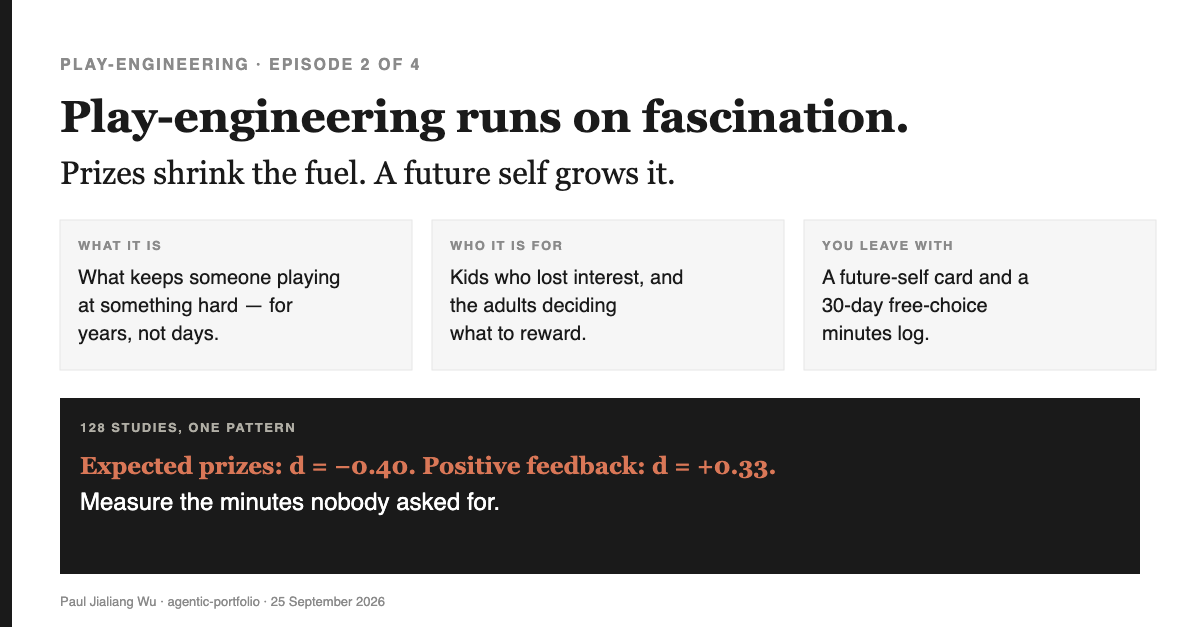
What this is. The second part of play-engineering: what keeps someone playing at something hard for years. The short answer is fascination — a picture of who you could become, plus a concrete plan — and the long answer includes the evidence that prizes for doing it can make you want to do it less.
Why it matters. Across 128 studies, expected rewards for doing an activity reduced how much people chose to do it on their own (effects down to d = −0.40), while positive feedback raised it (d = +0.33, though less for children than for college students) (Deci, Koestner & Ryan, 1999). A parent who pays for good grades may be pushing on the wrong pedal — and so may a company paying for "engagement", though the studies were mostly of children and students, not workplaces.
What you can do after. Write a one-card "future self" with a strategy, track the minutes you choose to spend on the skill when nobody asks — for 30 days — and, if you're the adult, swap promised prizes for specific feedback. Post your minutes in the comments.
Play-Engineering — the series spine
- Play finds the mechanism — what play-engineering is episode 1
- The fuel — fascination, not scores this episode
- Sci-fi to prototype — story, mechanism, toy, test, second case episode 3
- The restoration playbook — visions into 30-day projects episode 4
How to read the numbers: g and d measure how big a difference is — about 0.2 is small, 0.5 medium, 0.8 large. "SD" (standard deviation) is the same kind of unit.
The one question this episode answersWhat keeps a 12-year-old playing at something hard for years?
This piece does not answer how play turns into skill — that is episode 1, play finds the mechanism — or how to build what you are fascinated by, which is episode 3, or how to point it at a restored world, which is episode 4.
What this episode of play-engineering covers, and who it's for
Episode 1 said play-engineering is simple: play finds a mechanism, engineering names it and tests it on a second case. But none of that happens unless you keep coming back — for months, sometimes years. This episode is about the fuel. It's for students who have lost interest in something they used to love, for parents deciding what to reward, and for anyone who leads a team and wonders why incentives keep backfiring.
The sparring room from episode 1 carries on here, so let me extend it.
The picture: forms for the judges, or the fighter you want to become
In a martial arts club there are two ways to show up. You can practise forms so the judges give you a belt. Or you can train because you've seen the fighter you want to become — for me, as a college kid, it was Bruce Lee in films — and every session is a step toward him. Both people are in the same room doing the same drills. Only one of them stays after class to spar.
| In the club | In play-engineering |
|---|---|
| A belt promised for showing up | An expected, tangible reward — it shrinks free-choice motivation (d = −0.40) |
| A coach saying "your hips turned first — that's why it landed" | Positive feedback that tells you something true — it grows motivation (d = +0.33, weaker for children) |
| The fighter you want to become | A possible self — a vivid picture of who you could be |
| Your weekly training plan | A strategy attached to that picture |
| Getting kicked in round one and expecting it | Difficulty treated as normal, not as proof you can't |
| Staying after class to spar because you want to | Free-choice time — the thing to measure |
| The dream fight that gets cancelled | A future self that disappears — and the fuel goes with it |
My rocket, and my crash
When I was twelve and thirteen, in middle school in China, I was near the very bottom of my class — failing almost everything. My mother, who is wise, said I was playing too much and not listening, and if I worked harder I'd catch up. So I did what everyone around me did: I forced myself. I still remember the dim classroom and the rows of heads bent over homework. By the end of the semester I'd climbed to about 16th–20th out of 50. Decent. And I hated it.
Then my father bought my older sister a book about the junior college class — kids of twelve to fifteen who had taught themselves and gone straight to a famous university of science and technology. My sister didn't read it. I did. And something switched on. If they can do it, I thought, why not me?
I found every textbook I could — maths, physics, chemistry — and taught myself. In less than one semester I went from the bottom of the class to one of the top three students in a grade of about 360. By the end of middle school I had taught myself all of high-school maths, physics and chemistry. Nobody was paying me. Nobody had to make me.
And then the crash, which is the most important part. At fifteen I jumped ahead to sit the national university exam early, and missed the junior-college entry. Soon I was too old for that door at all. The picture that had pulled me — the self I was becoming — was gone. I was still top of my class in three subjects, but by my final year I felt, looking back, a little depressed. I went to a good university, not the one I had dreamed of. (If a lost dream ever leaves you feeling low for weeks, tell an adult you trust. It helps more than you'd think.)
Twice in the same body, the same brain, the same school: once pushed by effort, once pulled by a future self. The pull was far faster — until the thing pulling me disappeared.
What the research says about fuel
Prizes can shrink the thing they're meant to grow. In one of the best-known studies, preschoolers who already liked drawing with markers were promised a "good player" award for drawing — and later chose to draw less than children who got no award or an unexpected one (Lepper, Greene & Nisbett, 1973, described). A meta-analysis of 128 studies found the pattern holds: rewards you expect for doing, finishing or performing a task reduced free-choice motivation, while positive feedback that tells you something true about your performance increased it (Deci et al., 1999). The argument isn't settled forever — some researchers found the effect weaker — but the design lesson is safe: don't promise prizes for an activity you want someone to love; give them information.
A future self works — if it comes with a plan. In a school intervention, 141 low-income eighth graders built vivid "possible selves", linked each one to concrete strategies, and practised treating difficulty as normal. Their grades, test scores and initiative improved compared with 123 classmates, and the effect was still there two years later (Oyserman, Bybee & Terry, 2006). The authors are clear that a dream on its own is not enough; what worked was the dream plus the plan.
Read my story through that lens and it stops being a mystery. The junior-college book gave me a possible self. The textbooks gave me a strategy. The rocket was the two together. The crash was the possible self being taken away — and no strategy can run without something to steer toward.
The second fuel: maths as a story
After college I wanted to study abroad, and my English was bad — I failed my first two tries at the graduate exam. I went back and lived for a while with a college friend who was a brilliant mathematician. Over beers, he told me something that changed how I read everything. In my memory of it, he said that reading mathematics was like reading a storybook: the theorems are characters, and he was having a conversation with them about the universe.
I started reading maths that way — as a conversation with someone wise — and the subject I had drifted away from became beautiful again. It's worth being honest about the evidence here: teaching maths as storytelling is a well-developed idea among educators, but I found no controlled study measuring its effect. So it goes in this episode as a lived mechanism, not a proven one — and as a mission option, so you can measure it yourself.
Five whys: why did a failing twelve-year-old reach the top of his grade in one semester?
- Why did my rank jump? Because I studied for hours that nobody required. Evidence: my own account; one person, told as a story.
- Why did I study without being made to? Because I had a vivid picture of who I could become — the junior-college kids. Evidence: possible selves predict effort when they feel real and reachable (Oyserman et al., 2006).
- Why didn't the earlier "work harder" push do the same? Because effort for a score is the belt-for-showing-up kind of motivation, and expected rewards shrink free choice. Evidence: d = −0.40 across 128 studies (Deci et al., 1999).
- Why did the picture turn into progress instead of daydreaming? Because it came with a strategy — every textbook, in order. Evidence: the intervention that paired selves with strategies improved grades for 141 students.
- Why did it collapse later? Because the future self became impossible, and a strategy with nothing to
steer toward stops. The root: the fuel is a possible self plus a strategy; scores are the exhaust — and rewarding the exhaust
drains the fuel. Evidence: effects mediated by change in possible selves, still present at two years
(
evidence.ymlrowoyserman_treatment).
🔥 Your 30-day mission: the future-self card
For anyone aged 10 and up, plus one adult. You need an index card and a way to time yourself. 30 days.
- Day 1 — write the card. Front: "In five years, I'm someone who…" (be vivid: what can you build, fix, play, solve?). Back: one strategy for each week, starting with this one ("this Saturday I…"), and one sentence: "When it gets hard, that means…"
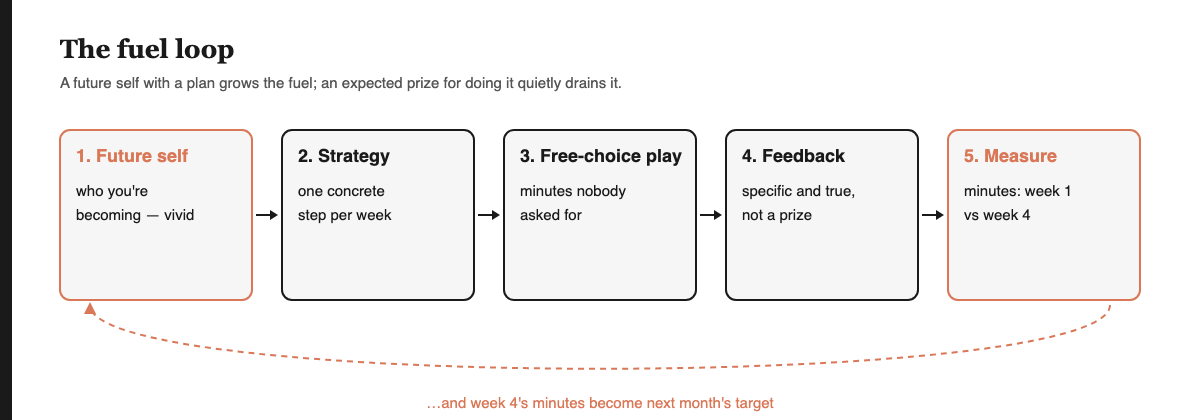
- Days 1–30 — measure the fuel, not the score. Each day, write down the minutes you spent on the skill that nobody asked you to spend. Homework doesn't count. Choosing to keep going does.
- For the adult: promise no prizes for doing it. Instead, once a week, tell them one specific true thing about their progress ("you solved that one by drawing it first").
- Optional twist: for one week, read one maths or science page as a story — who are the characters, what is the conflict — and see if your minutes change.
What to measure: free-choice minutes in week 1 vs week 4. Contribute: post both numbers and your future-self sentence in the comments.
Under 13? Ask a parent to post for you. No names — just age ranges (10–12, 13–15, 50+).
Operate — the thing that runs
In one sentence: every number on this page is checked by a robot before the page goes live. In more detail: the mission is the operating unit: a card, a daily number, a weekly piece of feedback. On this site, every research
figure on the page is pulled from content/series/play-engineering/evidence.yml and re-checked by
scripts/check-play-engineering.mjs on every build; the reader results are counted by
scripts/play-missions.mjs from the comments.
Feedback — the right number, and its blind spot
Free-choice minutes are the measurement the motivation research itself uses: not what you say you feel, but what you do when nobody's watching. If week 4 is higher than week 1, the fuel grew. The blind spot: minutes can rise for reasons that have nothing to do with the card — a holiday, a new friend in the same hobby, a rainy month. One person's numbers are a story; many people's numbers, in the comments, start to separate the card from the weather.
Feedforward — decided before the results
- If most readers' minutes fall, the card is too vague — the next version adds the ingredient most often skipped: the "when it gets hard" sentence, practised out loud.
- If the maths-as-story twist raises minutes for most who try it, it becomes its own mission in a follow-up, because that effect is unmeasured in the research and readers would be measuring it first.
- If an adult reports that prizes helped, that's welcome data — some studies found the effect weak — and it goes into this page's next update, not into a footnote.
Where this episode sits in the series
| Conception | Core concept | Governing principle | Main contributors | |
|---|---|---|---|---|
| Play (episode 1) | Froebel's first kindergarten (1837) → Papert's Mindstorms (1980) → Resnick's Lifelong Kindergarten | learning by making things you care about | guided play beats instruction; free play alone doesn't | Froebel · Papert · Resnick · Hirsh-Pasek & Golinkoff · Skene et al. |
| Fuel (episode 2) | Deci & Ryan's self-determination theory (1985) | fascination and a vivid future self | expected rewards shrink the fuel; a strategy makes a future self stick | Deci · Ryan · Lepper · Oyserman |
| Artifacts (episode 3) | Wells, Verne and the pulps → Goddard, Lake, Sikorsky | a story names a machine before anyone can build it | an artifact becomes engineering when its mechanism is tested on a second case | Goddard · Lake · XPRIZE · Lynch et al. (robots that play) |
| Restoration (episode 4) | Genesis 2:15 — to cultivate and keep | the vision is a mandate on earth, not only a promise about later | one proven mechanism, run locally, measured before and after | Rinaudo (FMNR) · Megatons to Megawatts · Tu Youyou · Experience Corps |
Same story, five exits
| If you are… | The decision this changes | One action |
|---|---|---|
| A student (10–15) | What to do when you've lost interest | Find a person who does what you want to do, then write one strategy to become like them |
| A parent or teacher | What to reward | Stop paying for grades; give one specific, true comment a week |
| An engineer | Your own learning | Track the hours you choose, not the courses you finish |
| A founder or team lead | Incentives | Reward outcomes rarely and unexpectedly; give frequent informational feedback |
| An investor | "Engagement" metrics in learning products | Ask for free-choice return rates, not streaks bought with badges |
Build it in 30 minutes
- Input: one skill and one person who is trying to learn it.
- Output: a future-self card and a 30-day line of free-choice minutes.
- Invariant: no promised, tangible reward for doing the activity.
- Stop rule: if minutes fall three weeks running, rewrite the card with the person — the picture isn't theirs yet.
- Minimal record:
date, free_choice_minutes, feedback_given. - Deliberately missing: a comparison week with a promised prize. Don't run it on a child you love; the research already has.
5S self-score, with evidence
| S | Self-score | Evidence |
|---|---|---|
| Simple | 4/5 | Two pedals — a future self with a plan grows the fuel, expected prizes drain it — drawn in the fuel loop. |
| Solid | 4/5 | Meta-analysis of 128 studies and a school intervention (Oyserman et al.); maths-as-story labelled unmeasured. |
| Sharp | 4/5 | The rocket and the crash explained by one mechanism — see the five whys. |
| SMART | 4/5 | A 30-day card with a daily free-choice number, counted across readers by scripts/play-missions.mjs. |
| Super-fun | 4/5 | A book bought for someone else, and a mathematician who read theorems like novels — root in five steps. |
References
- Deci, Koestner & Ryan (1999), Psychological Bulletin 125(6), 627–668 — rewards and intrinsic motivation (meta-analysis).
- Oyserman, Bybee & Terry (2006), JPSP 91(1), 188–204 — possible selves and school outcomes.
- Lepper, Greene & Nisbett (1973), Journal of Personality and Social Psychology 28(1) — described, not quoted.
- Zazkis & Liljedahl (2009), Teaching Mathematics as Storytelling — a practice book; no controlled outcome data found.
Related
content/series/play-engineering/evidence.yml.