AI-NATIVE SERIES · PLAY-ENGINEERING, EPISODE 3 OF 4
Play-Engineering a Sci-Fi Artifact: From Story to a Prototype a 12-Year-Old Can Test in 30 Days
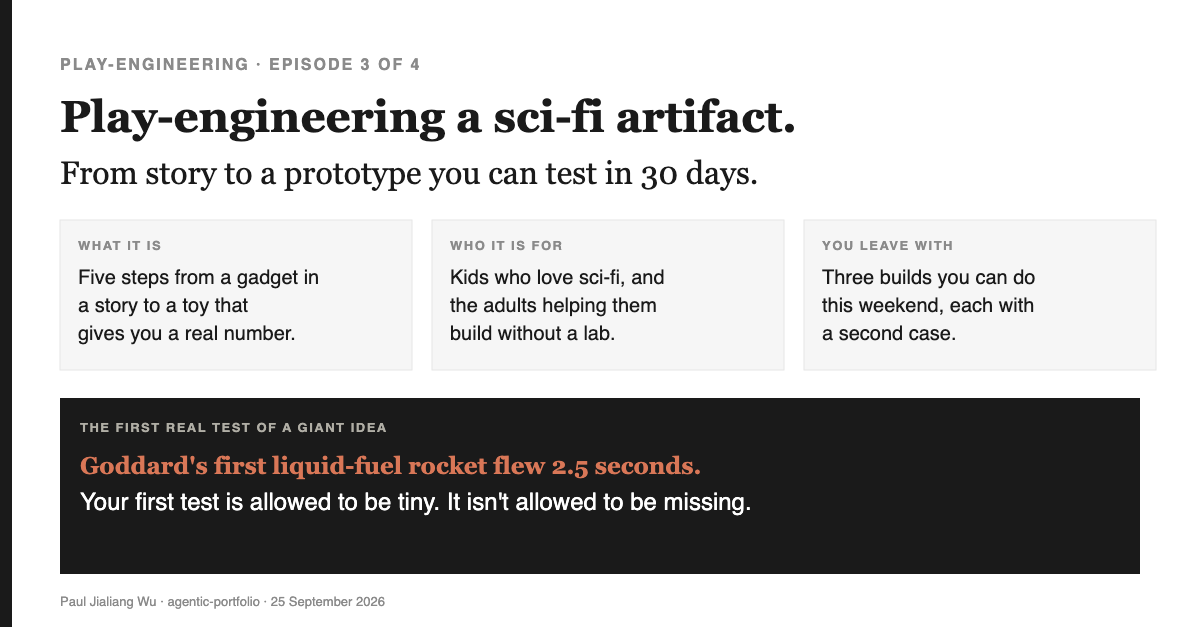
What this is. A five-step way to turn a gadget from science fiction — a tricorder, a universal translator, a rocket to Mars — into something a 12-year-old can build and test this month. It is play-engineering applied to the future: play with the story, find the mechanism under it, and test a toy version on two cases.
Why it matters. Science fiction really has launched engineers: Robert Goddard, at 17, imagined a machine that could rise toward Mars, and 27 years later his first liquid-fuel rocket flew for 2.5 seconds. But some of the most famous "sci-fi inspired it" stories are myths the inventors themselves corrected or never claimed. Knowing the difference is what separates a fan from an engineer.
What you can do after. Choose one of three builds you can do this weekend — a paper-cup tricorder, a water rocket (with an adult and a launcher kit), or a live-translation test — measure one number, test it on a second case, and post both numbers.
Play-Engineering — the series spine
- Play finds the mechanism — what play-engineering is episode 1
- The fuel — fascination, not scores episode 2
- Sci-fi to prototype — story, mechanism, toy, test, second case this episode
- The restoration playbook — visions into 30-day projects episode 4
How to read the numbers: g and d measure how big a difference is — about 0.2 is small, 0.5 medium, 0.8 large. "SD" (standard deviation) is the same kind of unit.
The one question this episode answersHow does a kid turn a sci-fi artifact into something they can build and test in 30 days?
This piece does not answer how play becomes skill — that is episode 1 — or what keeps you going, which is episode 2, or how to aim at a restored world, which is episode 4.
What this play-engineering episode covers, and who it's for
This episode is for kids who love science fiction and want to build something real, and for the adults who want to help them do it without a lab. It covers where sci-fi has genuinely inspired inventions (and where it hasn't), the five steps that turn a story into a prototype, and three builds you can do at a kitchen table. It connects the two earlier episodes: fascination (episode 2) is what a good story gives you; the mechanism-and-second-case method (episode 1) is what turns it into engineering.
The picture: learning a move from a kung-fu film
As a college student I learned martial arts partly by watching Bruce Lee films. A film move is like a sci-fi gadget: thrilling, impossible-looking, and made for a camera. Some moves are real. Some only work with a stunt double. The only way to know is to take the move apart and try it.
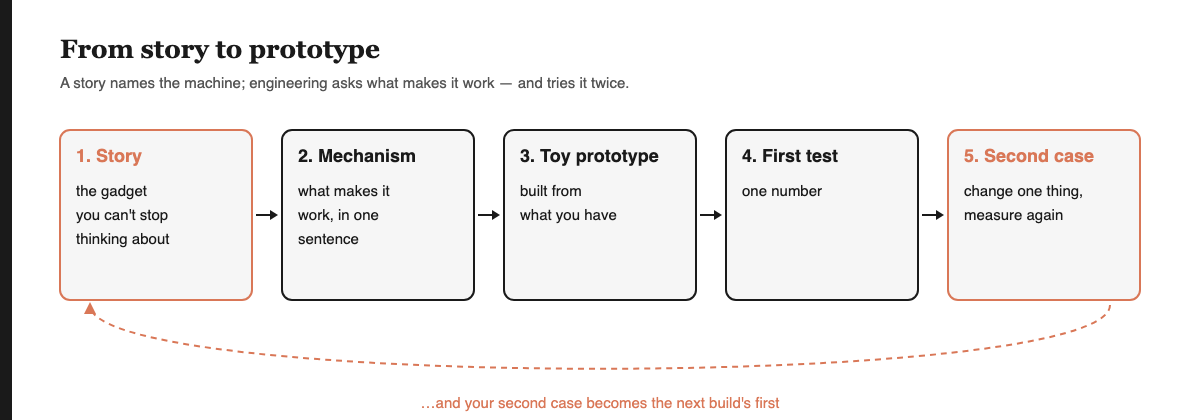
| Learning a film move | Play-engineering a sci-fi artifact |
|---|---|
| A move you saw in a film | The artifact in the story — tricorder, translator, rocket |
| "What actually makes that move work?" | Naming the mechanism — the physics or information under the gadget |
| Trying it slowly on a pad | A toy prototype made from what you have |
| Trying it in sparring | The first real test, with one number |
| Trying it on a different partner | The second case — does it still work somewhere else? |
| Moves that only work with a stunt double | Myths: inventions the story didn't actually cause |
Four real cases, and two myths to check
Goddard's cherry tree. In 1898, a teenager in Massachusetts read a newspaper serial about Martians invading Boston — a knock-off of H. G. Wells's The War of the Worlds, not the novel itself (American Heritage). On 19 October 1899, aged 17, he climbed a cherry tree to trim it and imagined a machine that could rise toward Mars. He wrote later that he came down "a different boy". He marked that date as his "Anniversary Day" for years (Clark University). Twenty-seven years later, on 16 March 1926, his first liquid-fuel rocket flew — for 2.5 seconds, 41 feet up, landing 184 feet away in a cabbage patch (NASA). Two and a half seconds. The first real test of the biggest idea of the century was shorter than a sneeze. That's what a first test looks like.
The tricorder. Star Trek's handheld medical scanner inspired a real competition: the Qualcomm Tricorder XPRIZE. Teams had to build a consumer device that could diagnose 13 health conditions and track five vital signs. A family team led by two brothers — an emergency doctor and an engineer — won in April 2017 (XPRIZE). The story named the dream; the prize forced a number on it.
The universal translator. Science fiction has imagined instant translation for decades. In June 2026, Google described live speech translation that detects 70+ languages and stays a few seconds behind the speaker (Google). Google's page doesn't mention Star Trek — the link from the story is ours, not theirs. Keep that habit: say which link you're making.
A boy, a library book, and a windmill. In Malawi, at 14, William Kamkwamba built a windmill that made electricity from spare parts and scrap, following rough plans in a library book called Using Energy (TED). The plans were rough, so he changed them to fit the parts he had. That changing is the engineering. And at 16, Boyan Slat went diving, saw more plastic than fish, and turned it into a school science project that became The Ocean Cleanup (The Ocean Cleanup).
Myth to check 1. You'll often read that Star Trek's communicator inspired the mobile phone. Martin Cooper, who made the first handheld mobile call in 1973, went along with that story once on camera — and has spent years taking it back. In his own words: "It wasn't Star Trek, it was Dick Tracy." (Good Times, 2021). The comic-strip detective's wrist radio was the real spark.
Myth to check 2. Leo Szilard conceived the nuclear chain reaction in London in 1933, and it's often said he got it from an H. G. Wells novel. He had read the novel — but according to the American Nuclear Society, he did not count the story as part of his inspiration (ANS). The lesson for a young engineer: the story an inventor tells and the story told about them are different kinds of evidence.
And the cautionary case: no second case. A 15-year-old once won a major science fair for a cancer-test idea and became famous — but, as of 2014, the results had not been published in a peer-reviewed journal, and experts had questioned them (Scholarly Kitchen). Winning a fair is a first test on one case. It isn't the second.
Why robots should pick projects the way you should
AI researchers have a rule for curious robots that works for curious kids too. Pierre-Yves Oudeyer's robots were rewarded for learning progress: they were pushed toward situations where they were getting better fastest — situations neither too predictable nor too unpredictable (Oudeyer, Kaplan & Hafner, 2007, described). A project that's too easy teaches nothing; one that's impossible teaches nothing either. Goddard's 2.5-second flight was exactly at that edge. When you choose your build below, choose the one where you honestly don't know if it will work.
Five whys: why do most sci-fi-inspired kid projects stop at "cool"?
- Why do they stop? Because the project copies how the gadget looks — a prop — not what makes it work. Evidence: the step from story to mechanism in every real case above; Kamkwamba changed rough plans to fit real parts (TED).
- Why copy the look? Because the mechanism is never named, so there's nothing to test. Evidence: the XPRIZE turned "a tricorder" into 13 conditions to diagnose — a named, testable target.
- Why does naming matter so much? Because only a named mechanism can be tried on a second case, and transfer happens through shared mechanisms. Evidence: far transfer without one measures about 0.03 SD (Sala & Gobet), from episode 1.
- Why isn't one good test enough? Because one case can be luck, or the wrong reason. Evidence: the science-fair case with no replication (Scholarly Kitchen).
- So what turns a story into engineering? The root: an artifact becomes engineering when its mechanism is named and tested on a second case — and the first test is allowed to be tiny. Evidence: 2.5 seconds in 1926, after 27 years (NASA).
🚀 Your 30-day mission: story to prototype
For anyone aged 10 and up, with an adult for safety. Pick one track. 30 days.
- Tricorder track. Mechanism: sound travels through a tube. Build a stethoscope from two paper cups and a length of tubing. Measure: heartbeats in 30 seconds at rest, then after 20 jumping jacks; check against a watch or phone. Second case: a different person.
- Rocket track. Mechanism: push water out one way, the bottle goes the other (Newton's third law). With an adult, outdoors: use a water-rocket launcher kit or your school's launcher and a fizzy-drink plastic bottle only (never glass, never a dented bottle). Pump no higher than the kit's rated pressure, wear eye protection, stand at least 5 metres back, never lean over it, never aim it at people. Measure: seconds in the air (Goddard's first flight: 2.5). Second case: change only one thing — the amount of water — and measure again.
- Translator track. Mechanism: speech → text → translated text → speech. Use a free live-translation app with a speaker of another language. Measure: out of 10 everyday sentences, how many they say came out right. Second case: a different language.
What to measure: your one number on the first case and on the second. Contribute: post the track, both numbers, and one sentence naming the mechanism in the comments.
Under 13? Ask a parent to post for you. No names — just age ranges (10–12, 13–15, 50+).
Operate — the thing that runs
In one sentence: every number on this page is checked by a robot before the page goes live. In more detail: every case number on this page is a row in content/series/play-engineering/evidence.yml with its source;
the gate scripts/check-play-engineering.mjs fails the build if the page and the file disagree, and the
quoted line from Martin Cooper is marked data-verbatim so no translation of this page can reword it.
Feedback — what a good result looks like, and what it hides
A good result is two numbers that agree roughly: the stethoscope counts close to the watch on two people; the rocket flies again after one change and you can say why the time moved. What the result hides: your equipment. A tube that leaks sound or a bottle with a weak seal can make a good mechanism look bad. That's why the second case changes only one thing — so a difference points at the thing you changed.
Feedforward — decided before the results
- If readers' second-case numbers mostly disagree with their first, the mission gets a third step — "repeat the first case once" — because the problem is noise, not the method.
- If a reader's build works surprisingly well, it becomes the worked case at the top of this page in the next update, with their permission.
- If no one picks the translator track, it's replaced with one that needs no app.
Where this episode sits in the series
| Conception | Core concept | Governing principle | Main contributors | |
|---|---|---|---|---|
| Play (episode 1) | Froebel's first kindergarten (1837) → Papert's Mindstorms (1980) → Resnick's Lifelong Kindergarten | learning by making things you care about | guided play beats instruction; free play alone doesn't | Froebel · Papert · Resnick · Hirsh-Pasek & Golinkoff · Skene et al. |
| Fuel (episode 2) | Deci & Ryan's self-determination theory (1985) | fascination and a vivid future self | expected rewards shrink the fuel; a strategy makes a future self stick | Deci · Ryan · Lepper · Oyserman |
| Artifacts (episode 3) | Wells, Verne and the pulps → Goddard, Lake, Sikorsky | a story names a machine before anyone can build it | an artifact becomes engineering when its mechanism is tested on a second case | Goddard · Lake · XPRIZE · Lynch et al. (robots that play) |
| Restoration (episode 4) | Genesis 2:15 — to cultivate and keep | the vision is a mandate on earth, not only a promise about later | one proven mechanism, run locally, measured before and after | Rinaudo (FMNR) · Megatons to Megawatts · Tu Youyou · Experience Corps |
Same story, five exits
| If you are… | The decision this changes | One action |
|---|---|---|
| A student (10–15) | Your next project | Pick the gadget, then write the mechanism in one sentence before you build anything |
| A parent or teacher | Science-fair coaching | Ask for a second case, not a prettier poster |
| An engineer | Roadmaps inspired by demos | Name the mechanism under the demo and test it on a case the demo didn't show |
| A founder | A moonshot pitch | Show your 2.5-second flight: the smallest real test, with its number |
| An investor | "Inspired by sci-fi" pitches | Ask what the second case was; a single demo is a stunt |
Build it in 30 minutes
- Input: one artifact from a story.
- Output: a one-sentence mechanism, a toy prototype, and two numbers.
- Invariant: the second case changes exactly one thing.
- Stop rule: if you can't write the mechanism in one sentence, you're still at step 1 — read or watch more.
- Minimal record:
artifact, mechanism, case_1_number, change, case_2_number. - Deliberately missing: safety engineering for anything bigger than a bottle. Ask an adult — Goddard's own diary says the lower half of his first rocket's nozzle burned off (American Heritage).
5S self-score, with evidence
| S | Self-score | Evidence |
|---|---|---|
| Simple | 4/5 | One picture — learning a film move — mapped in its table and drawn as five steps. |
| Solid | 4/5 | Case numbers from first-party sources (NASA, XPRIZE); two myths corrected with the inventors' own positions. |
| Sharp | 4/5 | The difference between a fan and an engineer is a named mechanism and a second case — see the five whys. |
| SMART | 4/5 | Three 30-day tracks, each with one number and a one-change second case, counted by scripts/play-missions.mjs. |
| Super-fun | 4/5 | The century's biggest idea, first tested for less time than a sneeze — Goddard, above. |
References
- Clark University — Goddard's Anniversary Day; NASA (2026) — the first liquid-fuel flight.
- XPRIZE (2017) — the Tricorder XPRIZE result.
- Google (2026) — live speech translation.
- TED speaker bio; The Ocean Cleanup.
- Martin Cooper interview: Good Times, 2021.
- Leo Szilard and the chain reaction: American Nuclear Society.
- Oudeyer, Kaplan & Hafner (2007), "Intrinsic Motivation Systems for Autonomous Mental Development", IEEE Transactions on Evolutionary Computation — described.
Related
content/series/play-engineering/evidence.yml; builds involving pressure or water need an adult.