AI-NATIVE SERIES · PLAY-ENGINEERING, EPISODE 4 OF 4
Play-Engineering Heaven on Earth: Turning Visions of Restoration into Playbooks You Can Measure
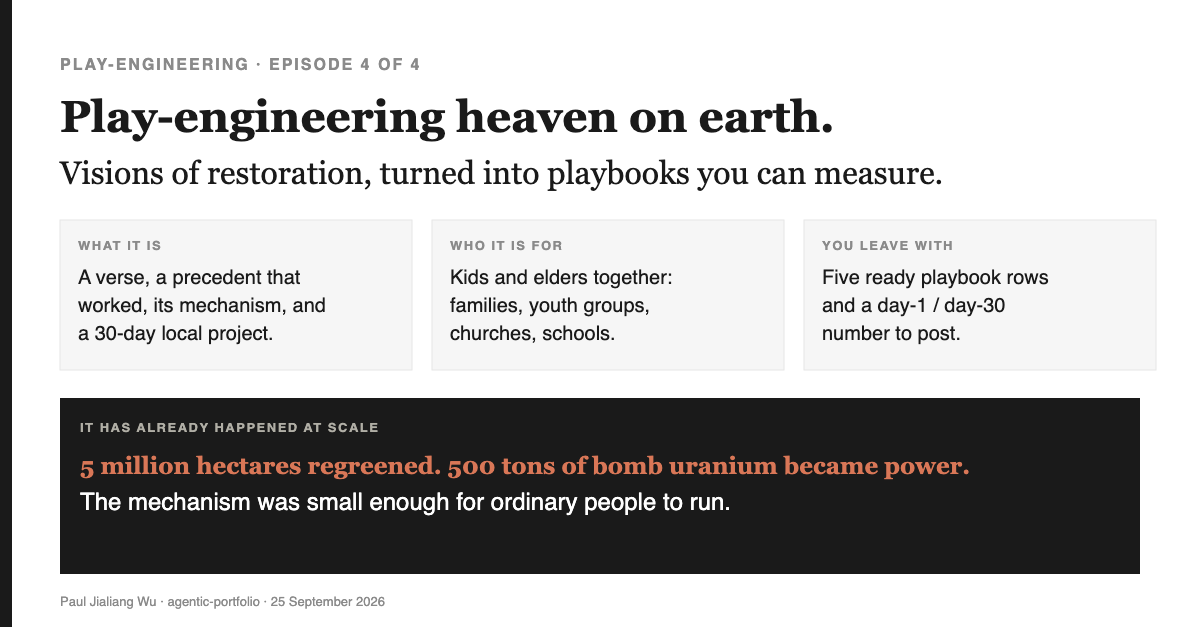
What this is. A way to turn the Bible's pictures of a restored world — deserts that bloom, weapons turned into tools, leaves that heal the nations — into a project a team of kids and elders can run in 30 days and measure. Each vision is matched to a real project that already worked at scale, the mechanism that made it work, and a small local version of it.
Why it matters. These visions are easy to admire and hard to act on, so they often stay on the wall. But some of them have already happened at scale: farmers in Niger regrew 5 million hectares of land, and 500 tons of weapons uranium became electricity for American homes. The mechanism in each case was small enough for ordinary people to run.
What you can do after. Form a team of at least one young person and one elder, choose one row of the playbook below, measure a number on day 1 and day 30, and post both.
Play-Engineering — the series spine
- Play finds the mechanism — what play-engineering is episode 1
- The fuel — fascination, not scores episode 2
- Sci-fi to prototype — story, mechanism, toy, test, second case episode 3
- The restoration playbook — visions into 30-day projects this episode
The one question this episode answersHow does a team of kids and elders turn a vision of restoration into a plan they can run and measure?
This piece does not answer how play becomes skill — that is episode 1 — what keeps you going, which is episode 2, or how to prototype a gadget, which is episode 3.
What this play-engineering episode covers, and who it's for
This is the last episode of the play-engineering series. The first three were about how to learn (play, then name the mechanism), what keeps you going (a future self with a plan), and how to build what a story imagines (a toy prototype and a second case). This one points all of it at the biggest story I know: the Bible's picture of a world set right.
It's written from my own faith, and for readers who share it or are curious about it — families, youth groups, churches, schools. If you don't share it, the method still works on any vision you care about; you'll just be choosing different verses. Every quotation is from the World English Bible, a public-domain translation, checked word for word against the published text. (If you're reading a translated edition of this page, the verses there are a translation of that translation, not an official Bible version in your language.)
The picture: the dojo's creed, and the master who trains the young
Every good martial arts school has a creed on the wall — why it exists, what it's for. A creed that stays on the wall does nothing. It matters when an old master and a young student step onto the mat together and turn it into one technique, practised until it works.
| In the dojo | In a restoration playbook |
|---|---|
| The creed on the wall | The vision — one verse |
| A technique already proven in real fights | A precedent — a real project that worked at scale |
| Why the technique works | Its mechanism, in one sentence |
| Your first class on the mat | A small local project you can run in 30 days |
| The master who dreams and the student who sees | A team of elders and the young (Joel 2:28) |
| The belt test with a real partner | A before-and-after number |
Why a restored world is full of play
Here is the verse that made me realise this series belonged together. The prophet Zechariah, describing Jerusalem restored, doesn't talk about buildings or armies. He talks about children:
"The streets of the city will be full of boys and girls playing in its streets.”"
— Zechariah 8:5 (WEB, World English Bible) — the lone quotation mark is the WEB's own; the speech continues beyond this verse
The picture of heaven on earth includes kids playing in the street. Play isn't a break from the vision; it's part of it. And the prayer Jesus taught puts the vision here, not only later:
"Let your Kingdom come. Let your will be done, as in heaven, so on earth."
— Matthew 6:10 (WEB, World English Bible)
Some people read the Bible's prophecies mainly as a timetable for the end of the world. I read them also as a job description for now — which is how the first job was given, in a garden:
"Yahweh God took the man, and put him into the garden of Eden to cultivate and keep it."
— Genesis 2:15 (WEB, World English Bible)
To cultivate and keep. That's engineering and stewardship in four words. The question is how to do it at a size a family can manage.
The playbook: five visions, five precedents, five 30-day projects
For each vision below there is a real project that already worked, a mechanism small enough to copy, and a local version a team can run in a month. The numbers in the second column are from the sources linked beside them.
| Vision | Precedent that worked | Mechanism | Your 30-day project | Your number |
|---|---|---|---|---|
| Isaiah 35:1 the desert will rejoice and blossom | Farmer Managed Natural Regeneration (FMNR), Niger — Tony Rinaudo (there from 1981) and farmers 5 million hectares and over 200 million trees, by regrowing living stumps (World Vision, Right Livelihood) | Choose the strongest stems on a living stump, prune them halfway up, mark the tree, protect it | With a landowner's permission, gloves, and an adult who can spot poison ivy or poison oak, find, mark and protect 10 volunteer seedlings or stump shoots | How many are alive and taller on day 30 |
| Isaiah 2:4 swords into plowshares | Megatons to Megawatts, United States and Russia, completed December 2013 500 metric tons of weapons uranium turned into reactor fuel — up to 10 percent of US electricity (Centrus) | Take something built to destroy and change its form so it serves | With an adult, and only with each owner's OK, collect broken toys and electronics to repair or recycle. Never open anything that plugs into the wall; never touch swollen or damaged batteries; take batteries and e-waste to a proper drop-off | Items diverted from the bin, counted |
| Revelation 22:2 leaves for the healing of the nations | Artemisinin — Tu Youyou, Nobel Prize 2015 more than 100 000 lives a year in Africa alone (Nobel Assembly), from sweet wormwood and a handbook written around 317–420 AD (Nobel Prize) | Read old knowledge carefully, then change one step of the method (she switched from boiling to an ether-based solvent that works at a lower temperature) | With a grandparent, list three home remedies from their childhood and look each one up on MedlinePlus or the NHS website. Checking is not trying: don't give any remedy to anyone | Remedies checked: supported, unsupported, or unknown |
| Joel 2:28 old men will dream dreams, young men will see visions | Experience Corps — tutors over 55 in grades 1–3, 23 schools over 60 percent more progress in key reading skills in one school year (Washington University in St. Louis) | An elder and a child, a fixed time, the same book, week after week | An elder and the young person read aloud together to a child in grades 1–3, three times a week | Words read correctly in one minute, day 1 vs day 30 |
| Habakkuk 2:14 the earth filled with knowledge, as the waters cover the sea | Khan Academy — free lessons for anyone 104.9 million yearly active learners — and, honestly, 1.7 million who became proficient in 60+ skills (Khan Academy) | Teach one skill clearly enough that someone else can do it | Make a 3-minute video or poster teaching one thing you know well | How many viewers can do it afterwards, tested by you |
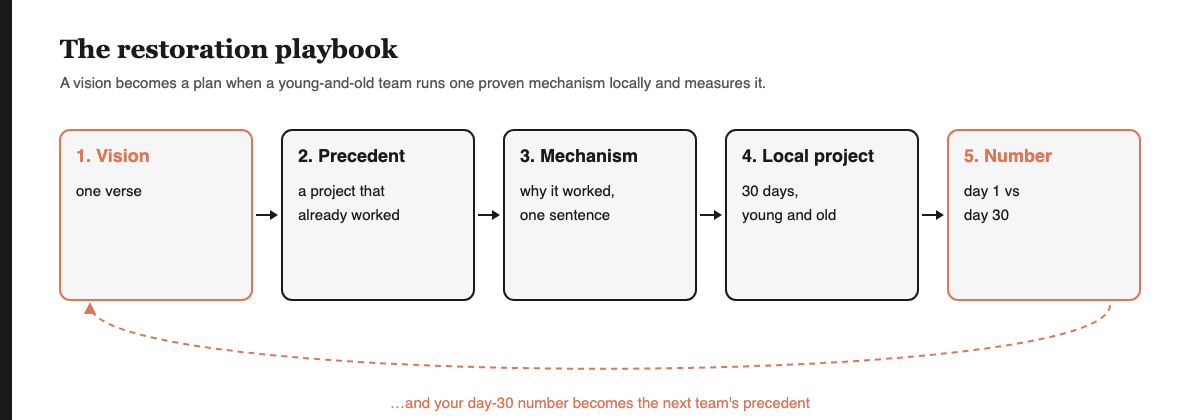
Three of these deserve a closer look, because the mechanism is surprising.
The desert that rejoiced.
"The wilderness and the dry land will be glad. The desert will rejoice and blossom like a rose."
— Isaiah 35:1 (WEB, World English Bible)
In Niger, where he worked from 1981, an Australian agronomist named Tony Rinaudo noticed that the "bare" land was full of living tree stumps that sprouted every year and were cut back. The mechanism wasn't planting — it was protecting what was already alive: choose the strongest stems, prune them, mark the tree so neighbours leave it. Farmers spread the practice to 5 million hectares, with over 200 million trees regrown (Right Livelihood Award, 2018). The desert rejoiced because people stopped cutting what God had left in the ground.
Swords into plowshares — literally.
"He will judge between the nations, and will decide concerning many peoples; and they shall beat their swords into plowshares, and their spears into pruning hooks. Nation shall not lift up sword against nation, neither shall they learn war any more."
— Isaiah 2:4 (WEB, World English Bible)
For twenty years, the United States bought uranium from dismantled Russian nuclear weapons, diluted it, and burned it as fuel in American power plants: 500 metric tons, enough for 20,000 warheads, supplying up to 10 percent of US electricity (Centrus Energy). There's a reasonable chance that at some point in those years, if you lived in the US, a lamp in your town was lit by a former bomb.
Old dreams and young visions.
"“It will happen afterward, that I will pour out my Spirit on all flesh; and your sons and your daughters will prophesy. Your old men will dream dreams. Your young men will see visions."
— Joel 2:28 (WEB, World English Bible) — the lone quotation mark is the WEB's own; the speech continues beyond this verse
The best evidence I found for young-and-old teams is modest and real: children in grades one to three tutored by adults over 55 made over 60 percent more progress in key reading skills in a school year, in a study of more than 800 children at 23 schools (Washington University in St. Louis). I looked for studies of elders and teenagers inventing together and found almost nothing measured. That's not a reason to stop — it's a gap your team could be the first to fill.
And one honest note on the knowledge row. Habakkuk pictures the earth filled with knowledge "as the waters cover the sea". Free online lessons now reach 104.9 million learners a year — but 1.7 million became proficient in 60+ skills. Reach is not the same as knowing. That's why the knowledge project below measures whether someone can do the thing afterwards.
Five whys: why do visions of a restored world so rarely become projects?
- Why do they stay on the wall? Because they're read as a spectacle to wait for, not a job to start. Evidence: the prayer itself asks for it "on earth" — Matthew 6:10 (WEB), quoted above.
- Why don't people start? Because the vision is too big to measure — "the desert will blossom" has no day-30 number. Evidence: every precedent in the playbook reduced its vision to a countable unit: hectares, tons, lives, words per minute.
- How did the precedents make it measurable? By finding a mechanism small enough for ordinary people to run — prune the stems, dilute the uranium, change one step of the recipe. Evidence: 5 million hectares from pruning (World Vision).
- Why does it need both the young and the old? Because elders carry the proven mechanisms and the patience; the young carry energy and new eyes — and elder-tutored children measurably learned faster. Evidence: over 60 percent more reading progress (Experience Corps).
- So what turns a vision into a playbook? The root: a vision becomes a plan when a young-and-old team
picks one mechanism that has already worked somewhere, runs a small local version, and measures before and after.
Evidence: the five precedents in
content/series/play-engineering/evidence.yml, each with its source.
🌱 Your 30-day mission: one verse, one mechanism, one number
For a team of at least one person aged 10–15 and one person over 50. 30 days.
- Day 1 — choose. Read the playbook together. Pick one row. Each person says why, in one sentence.
- Day 1 — measure before. Write down the starting number (seedlings alive, items diverted, words read per minute…).
- Days 2–29 — run it. On the schedule your row gives, together. The elder brings patience and what they know; the young person brings a new idea to try once.
- Day 30 — measure after. Same method as day 1.
Safety first: if you're not family, meet in a public place, or follow your church's or school's child-safety policy.
What to measure: your number on day 1 and day 30. Contribute: post the row you chose, both numbers, and your team's age ranges (not names) in the comments. If enough teams do, this becomes the first measured record of young-and-old restoration projects that I know of.
Under 13? Ask a parent to post for you. No names — just age ranges (10–12, 13–15, 50+).
Operate — the thing that runs
In one sentence: every number and every verse on this page is checked by a robot before the page goes live. In more detail: the playbook table is generated from scripts/build-play-engineering.py, and every number in it comes from
content/series/play-engineering/evidence.yml. Every verse is rendered from scripture.yml, which
was fetched from the World English Bible and is checked byte for byte by scripts/check-play-engineering.mjs —
a trimmed or reworded verse fails the site's build.
Feedback — what the number tells you, and what it can't
The before-and-after number tells you whether your small version of the mechanism worked in your place. It can't tell you whether your project is the reason: seedlings survive in a wet month, reading improves in any month with attention. That's fine. The precedents above were tested at scale by others; your job is to see if the mechanism runs where you live. And one thing no number here measures: what happens between a twelve-year-old and a seventy-year-old who spend a month building something together. Write that down too.
Feedforward — decided before the results
- If teams report the reading row most, its evidence is strongest — it becomes the recommended first project.
- If a team finds a local mechanism that isn't in the table, it's added as a sixth row, with their permission and their numbers.
- If fewer than three teams report within 30 days, the mission is too heavy for one month: it shrinks to one weekend and one number.
Where this episode sits in the series
| Conception | Core concept | Governing principle | Main contributors | |
|---|---|---|---|---|
| Play (episode 1) | Froebel's first kindergarten (1837) → Papert's Mindstorms (1980) → Resnick's Lifelong Kindergarten | learning by making things you care about | guided play beats instruction; free play alone doesn't | Froebel · Papert · Resnick · Hirsh-Pasek & Golinkoff · Skene et al. |
| Fuel (episode 2) | Deci & Ryan's self-determination theory (1985) | fascination and a vivid future self | expected rewards shrink the fuel; a strategy makes a future self stick | Deci · Ryan · Lepper · Oyserman |
| Artifacts (episode 3) | Wells, Verne and the pulps → Goddard, Lake, Sikorsky | a story names a machine before anyone can build it | an artifact becomes engineering when its mechanism is tested on a second case | Goddard · Lake · XPRIZE · Lynch et al. (robots that play) |
| Restoration (episode 4) | Genesis 2:15 — to cultivate and keep | the vision is a mandate on earth, not only a promise about later | one proven mechanism, run locally, measured before and after | Rinaudo (FMNR) · Megatons to Megawatts · Tu Youyou · Experience Corps |
Same story, five exits
| If you are… | The decision this changes | One action |
|---|---|---|
| A student (10–15) | What to do with a big dream | Find someone who already made it work somewhere, and copy the mechanism small |
| A parent, grandparent or teacher | How to spend a month with a young person | Pick one playbook row together and measure day 1 and day 30 |
| A church or youth leader | Service projects | Replace one "event" with a measured 30-day project run by a mixed-age team |
| A founder | Impact claims | State your mechanism in one sentence and your before-and-after number |
| An investor or donor | What to fund | Fund mechanisms ordinary people can run — pruning, not planting — and ask for the count |
Build it in 30 minutes
- Input: one vision you care about (a verse, or any picture of a better world).
- Output: a one-row playbook: precedent, mechanism, local project, number.
- Invariant: the precedent must have worked somewhere real, with a source.
- Stop rule: if you can't find a precedent, your first project is to find one — ask the oldest person you know.
- Minimal record:
vision, precedent, source, mechanism, local_project, day1, day30, team_ages. - Deliberately missing: a comparison team. Two teams, same row, different towns, and you have real evidence.
5S self-score, with evidence
| S | Self-score | Evidence |
|---|---|---|
| Simple | 4/5 | One picture — the dojo's creed made into one technique — and one table, drawn as the playbook. |
| Solid | 4/5 | Every precedent number from a first-party source (Centrus, Nobel Assembly); every verse checked byte-for-byte against scripture.yml. |
| Sharp | 4/5 | The mechanism in the desert was protecting what was already alive — see the five whys. |
| SMART | 4/5 | Five 30-day projects, each with a day-1 and day-30 number, counted by scripts/play-missions.mjs. |
| Super-fun | 4/5 | A lamp lit by a former bomb (500 tons of bomb uranium), and children playing in the restored city's streets — Zechariah 8:5. |
References
- Scripture: World English Bible (public domain), via bible-api.com.
- World Vision Australia; Right Livelihood Award 2018; Right Livelihood Award.
- Centrus Energy — Megatons to Megawatts.
- Nobel Assembly (2015) — Nobel Prize in Physiology or Medicine 2015.
- Experience Corps evaluation (Washington University in St. Louis, 2009) — Experience Corps evaluation.
- Khan Academy annual report SY24-25.
Related
content/series/play-engineering/evidence.yml.