AI-NATIVE SERIES · SHEPHERD'S ACADEMY OF WAR, PART 5 OF 5
A Scorecard for a Family Academy: One Car-Ride Drill, Four Numbers, Six Tripwires
1-minute takeaway
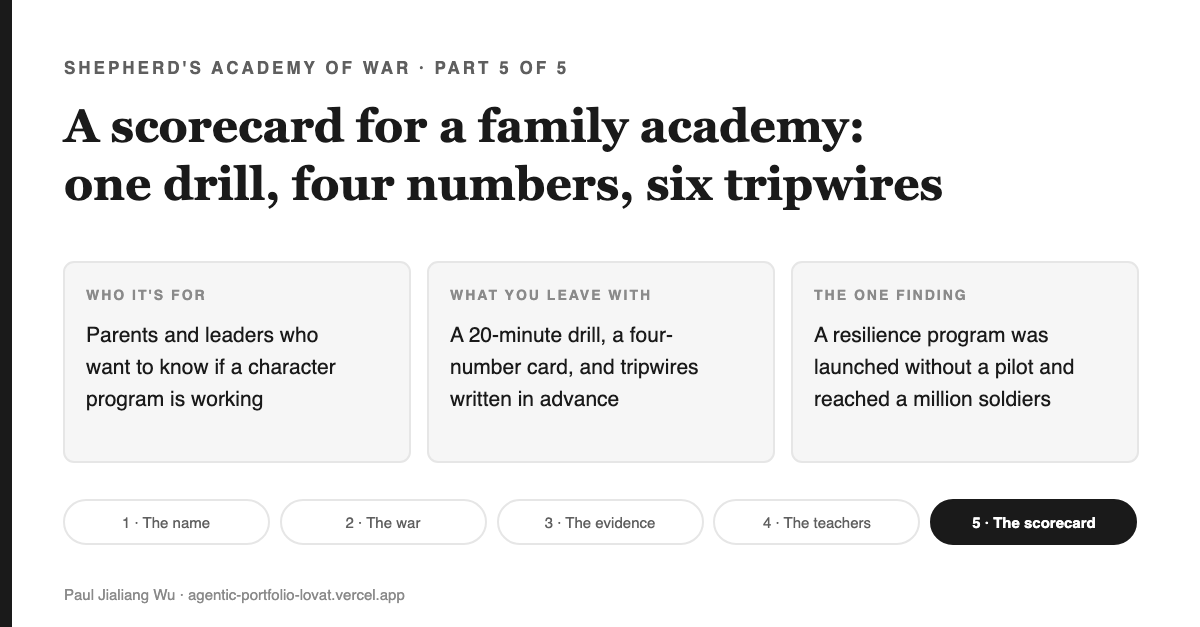
What this is. Part 5 of five. A scorecard for Shepherd's Academy of War: one drill as designed, four numbers to count, and six tripwires that would make us change course. Nothing has been measured yet, and the page says so.
Why it matters. The U.S. Army launched resilience training without a pilot test, at a reported 125 million dollars, and it reached more than a million soldiers before any independent review. If an army can skip the test, a dad in a car certainly can.
What you can do after reading. Run the twenty-minute drill for 30 days, count four numbers on an index card, and write your own tripwires before you look at the results. Check our numbers on 11 January 2027.
Shepherd's Academy of War — the series spine
▶ See it running: open the live demo public · no sign-in
- The name — learn the attack, live as a protector episode 1
- The war — five arenas, and a last battle with one fighter episode 2
- The evidence — courage training that works, and what backfires episode 3
- The teachers — guest instructors give content, not contact episode 4
- The scorecard — one drill, four numbers, six tripwires this episode
How will we know whether Shepherd's Academy of War is working, and what would make us change it or stop?
This piece does not answer: What the name means — that is part 1. What the last battle asks of a child — that is part 2. The evidence for each practice — that is part 3. Who may teach and how — that is part 4.
How to read the labels: EVIDENCE is sourced, DESIGN is how SAW is built, OPEN is not yet tested, and LENS is my own conviction.
A note before we start: these are my own views, not my employer's. I'm a Christian father, not a clinician or a researcher, and nothing here is medical advice. Verses are quoted from the World English Bible (WEB), which is public domain, as bible-api.com returns them; a translated edition of this article translates the WEB.
What this part covers: a scorecard for a three-week-old academy, and who it is for
This part is for parents and leaders who run anything meant to build character and want to know whether it works. It gives one drill, four numbers to count, and six conditions, written in advance, that would make us change course.
Four parts of this series made claims. This one says how I will find out whether they were true.
Shepherd's Academy of War is three weeks old. It has two students, my sons, who are 11 and 7. It has no confirmed instructor and no building, and nothing has been measured yet. So this scorecard is empty today, on purpose and in public. An empty scorecard with dates on it is more honest than a full brochure.
I suspect, about my own project, that enthusiasm is being counted as evidence.
What does run today is the field lab this grows out of, at daniel-and-david.vercel.app. Its free Builder Loop app takes a family through five short build-show-learn cycles and keeps every note on your own device. Its measure, which I am borrowing, is what a child can show they did without being pushed (theory of change). The SAW drill below is not in the app. It is an index card and a car.
The picture: a scoreboard that can show a loss
No extended analogy. One test: can this number go down, and would I show you if it did?
| A brochure number | A scorecard number |
|---|---|
| "Kids love it" | Minutes a child chooses to spend on it when nobody asks |
| "We teach courage" | Fears the child chose and attempted this month |
| "We build character" | Rescues logged by the child, with what each one cost |
| "Rooted in conviction" | Times the child said a polite, firm no, or offered a better rule |
| "Trusted by families" | Tripwires written before the results, and whether any fired |
Why measure a family project at all
EVIDENCE Because larger and better-funded people than me skipped it. The U.S. Army gave resilience training to its soldiers under a program called Comprehensive Soldier Fitness. Critics writing in the field's own journal described it as a 125-million-dollar initiative launched without pilot testing (Eidelson, Pilisuk & Soldz, 2011). Two years later, reviewers noted it had reached more than a million soldiers and had still not been independently and objectively reviewed (Steenkamp, Nash & Litz, 2013).
LENS If an army with a research budget can roll out character training to a million people before testing it, a father in a car is certain to. I am the least objective evaluator this academy will ever have. I named it, and I love the students. So the test has to be written before I look at the results.
The drill
Here is the drill as I have designed it. We have not yet run it as written. It takes twenty minutes and fits a drive a family is making anyway, which is how the oldest instruction on the subject says to do it:
These words, which I command you today, shall be on your heart; and you shall teach them diligently to your children, and shall talk of them when you sit in your house, and when you walk by the way, and when you lie down, and when you rise up.
— Deuteronomy 6:6-7 (WEB, World English Bible)
"When you walk by the way." We drive by the way. Close enough.
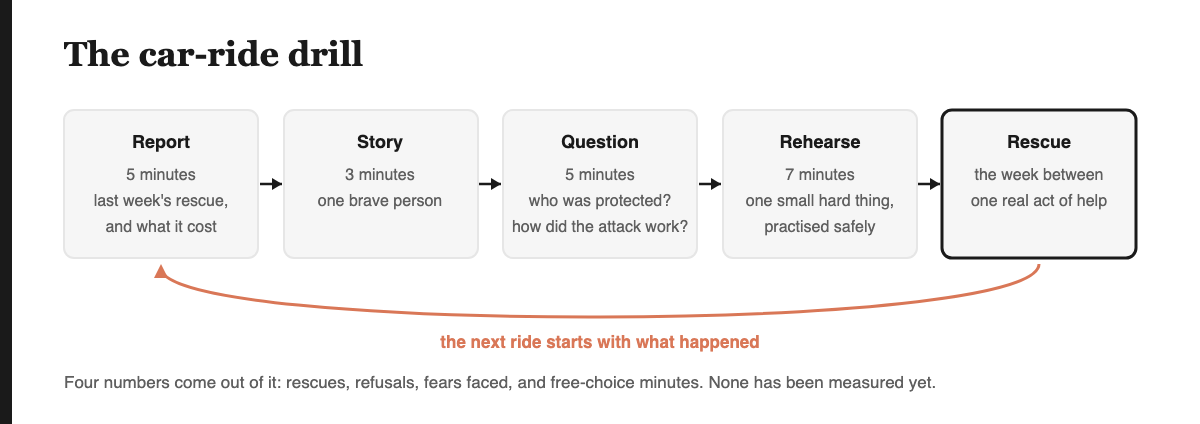
DESIGN The drill has five moves.
- Report (5 minutes). What happened with last week's rescue? What did it cost? This comes first because it is the only part that matters.
- Story (3 minutes). One brave person, told short. A verse, a relative, someone in the news.
- Question (5 minutes). Who was protected? What did it cost? And one from part 1: how would the attack have worked? You cannot guard against what you do not understand.
- Rehearse (7 minutes). One small hard thing, practised safely. Said out loud, acted out, or planned for when we arrive.
- Rescue (the week between). One real act of help, chosen by the child.
DESIGN The arena rotates, one a week, through the five from part 2. This is a plan. We have not yet run a full rotation.
| Week | Arena | Story | The attack we take apart | Rehearse | A rescue that fits |
|---|---|---|---|---|---|
| 1 | Body | David and the lion (1 Samuel 17) | How a grab and a push work | Break a wrist grab; fall safely on grass, parent beside | Carry something heavy for someone |
| 2 | Money | Daniel says no to the king's table (Daniel 1:8) | How a "free" offer hooks you | Find the catch in one advert | Give away something you earned |
| 3 | Information | "Wise as serpents" (Matthew 10:16) | How a fake message is built | The adult writes one on paper; the child lists its tells | Check one claim before it gets shared |
| 4 | Public life | Daniel and the ten-day test (Daniel 1) | How pressure to go along is applied | Five whys on one rule, then a better rule offered to the person who guards it | Do one job well that nobody asked for |
| 5 | Spirit | The kit bag (Ephesians 6) | How fear talks to you | Name it, breathe slowly, one verse | Encourage one person who is low |
Every row keeps the laws from part 1, and each is sized for the child: a seven-year-old watches and names; an eleven-year-old does. The attack is studied so it can be stopped. A fake message is written by the adult, on paper, and never sent. No row has a person as the enemy.
Four numbers
DESIGN One index card per child per month, four tallies.
- Rescues. Acts of help the child chose, each with what it cost.
- Refusals and rebuilds. Times the child decided beforehand not to do something, and didn't, or questioned a rule the right way and offered a better one. The Daniel count.
- Fears faced. Rungs attempted on the Brave Ladder from part 3, chosen by the child.
- Free-choice minutes. Time the child spends on any of this when nobody asked. The play series explains why this is the one I trust most: it is what a child does when no one is watching.
And one number for me: how many of the four tallies I filled in for them. The target is zero.
OPEN Today all four read zero, because counting starts with this article. On 11 January 2027 I will publish what the cards say, including if they say nothing happened. Sample size: two. And the experimenter hands out the snacks, which is one more reason there are no prizes.
One more rule, because of the word "war"
A program that uses the word war owes the public one rule in writing.
DESIGN Illness is never a spiritual verdict. See a doctor, and pray. Both. An illness of body or mind is never described as a spiritual failure, or as anything other than an illness. The academy teaches children to stand against fear and lies. It does not diagnose anyone.
EVIDENCE Two of the largest church bodies have it in writing. In 2013 the Southern Baptist Convention resolved: "we support the wise use of medical intervention for mental health concerns when appropriate" (SBC, 2013). The Catholic Catechism, in the very paragraph about its rite against evil, says: "Illness, especially psychological illness, is a very different matter; treating this is the concern of medical science." (Catechism 1673).
EVIDENCE The common failure is silence. In a 2014 survey, 66% of Protestant senior pastors said they seldom speak to their congregation about mental illness (Lifeway Research, 2014). LENS Silence leaves children to fill the gap with their own explanations. So any program like this one should say it plainly, in words a seven-year-old can hold: being sick is not being bad, doctors are a gift, and we pray too.
Five whys: why do character programs so rarely find out whether they work?
- Why don't they find out? Because they count what is easy: attendance, smiles, testimonials. Evidence: my own brochure column above; I wrote every line of it first.
- Why count the easy things? Because the program was launched before anyone decided what failing would look like. Evidence: a 125-million-dollar program with no pilot (Eidelson et al., 2011).
- Why launch before deciding? Because the people launching it already believe. Evidence: more than a million soldiers trained before an independent review (Steenkamp et al., 2013).
- Why does belief block measurement? Because a believer reads every result as support. A good week proves it works; a bad week proves they need more of it. Evidence: one father, told as a story.
- Why does anything break that loop? Because a condition written before the result cannot be reinterpreted after it. Evidence: the MYRIAD trial in part 3 ran at scale, found no average benefit and signs of harm for high-risk students, and said so (MYRIAD, 2022). The root: you only learn whether a program for children works if you write down, before you look, what would make you change it or stop.
🔥 Your 30-day mission: the drill and the card
For one child aged 5 and up, plus one adult, and a journey you already make each week. 30 days.
- Before day 1, the adult writes three tripwires on the back of the card: three things that, if they happen, mean you change course or stop. Sign and date it.
- Week by week, run the drill: report, story, question, rehearse, rescue. Start with any arena. Twenty minutes. Five weeks if you want every arena.
- The child keeps the card: four tallies, in their own handwriting. Rescues, refusals, fears faced, free-choice minutes.
- No prizes. One specific true sentence a week.
- Day 30: read the tripwires before you read the tallies.
What to measure: the four tallies, and whether a tripwire fired. Contribute: post your four numbers, and yes or no on the tripwires, in the comments.
Under 13? Ask a parent to post for you. No names, only an age range (5–7, 8–12, 13–15).
Operate: the thing that runs
In one sentence: the date on which I owe you numbers is written into this page, and the page is checked. DESIGN The re-check date, 11 January 2027, sits in this article's TRUE section, and `scripts/check-saw.mjs` fails the build if any part of the series lacks a dated re-check. The same script refuses the series if it stops stating its honest status, or claims an instructor it does not have. The drill itself is a card. I would like it to run in the field lab's app one day; that is a build, and this series comes before any build.
Feedback: the numbers, and what they cannot see
DESIGN Four tallies a month per child, read against last month's. Free-choice minutes is the lead signal. If it is zero, the others are probably me.
OPEN What the card cannot see is most of what matters. It cannot see who a child is at fourteen. It cannot see what they do when they are alone, which is the whole point of the Daniel house. It cannot separate the drill from an ordinary good month. And with two children there is no comparison at all. Readers' cards in the comments are the only way this becomes more than a family story, and even then it will be a collection of stories. I will describe it that way.
Feedforward: six tripwires, decided now
DESIGN What I commit to before the results exist.
- A person in the enemy slot. If either child names a person or a group as the enemy and I trace it to our language, the war vocabulary stops that week.
- Fear. Dread before the drill, bad dreams, or anxious repeated praying: the frightening content stops that day, and I ask a paediatrician and a pastor for help.
- No fuel. Free-choice minutes at zero for three weeks running means this is my project and not theirs. I hand them the design and wait.
- An injury. Anything beyond a scrape, or any contact to the head: the body arena pauses until someone qualified has looked at what we were doing.
- A missed date. If I cannot show the cards on 11 January 2027, I say so here. A missing result is a result.
- A verdict. If illness ever gets spiritual-blame language in this academy, or the drill is ever used in place of medical care, it stops and the correction is made in the open.
Where this part sits in the series
| Conception | Core concept | Governing principle | Main contributors | |
|---|---|---|---|---|
| The name (part 1) | Psalm 144:1 → Plato's guardians (c. 375 BC) → the Boys' Brigade (1883) → William James (1910) | the shepherd-warrior: able to attack, committed to protect | no person is ever the enemy; every fight ends in a rescue | Plato · the Boys' Brigade · Baden-Powell · William James · C. S. Lewis · Sue Rahr |
| The war (part 2) | Revelation (c. AD 95) → Tertullian (c. 200) → the Catechism (1992) → Bauckham (1993) | the long war has every arena; the last battle has one fighter | never tell a child the outcome of history depends on their strength | John of Patmos · Tertullian · G. E. Ladd · Richard Bauckham · J. R. Michaels |
| The evidence (part 3) | Campbell's boot-camp review (2005) → the practice corrections (2014) → MYRIAD (2022) → risky play (2024) | courage is chosen risk plus self-control, practised small | remove hazards, keep risks; fierce and gentle together | Macnamara · Güllich · Canadian Paediatric Society · the MYRIAD trial team · American Academy of Pediatrics |
| The teachers (part 4) | Scouting's two-adult rule (1988) → the Safe Sport Act (2017) → SafeSport's athlete survey (2024) | content, not contact | no adult is ever alone with a child, and a credential is not a safeguard | U.S. Center for SafeSport · Travis Manion Foundation · Trail Life USA · Bond & DePaulo |
| The scorecard (this part) | Deuteronomy 6:7 → the Army's untested rollout → MYRIAD (2022) | a drill small enough to run, a count that can go down | write the tripwire before you see the result; medicine and prayer together | Eidelson, Pilisuk & Soldz · Steenkamp, Nash & Litz · Southern Baptist Convention (2013) · Lifeway Research |
Same story, five exits
| If you are… | The decision this changes | One action |
|---|---|---|
| A student (10–15) | Who keeps score on you | Keep your own card; decide what counts as a rescue |
| A parent | How you judge any program your child is in | Ask what number would make them change it |
| A coach or youth leader | Your end-of-season report | Add one number that could go down, and publish it |
| An engineer or founder | Shipping a people program | Write the stop condition in the launch document |
| A pastor or elder | How your church speaks about illness | Say "see a doctor, and we will pray" from the front, this month |
Build it in 30 minutes
- Input: one weekly journey, one child, one index card, one pen.
- Output: three signed tripwires on the back; four empty tallies on the front.
- Invariant: the child keeps the card. No prizes. No person as the enemy. Illness is never a spiritual verdict.
- Stop rule: any tripwire. Read them before the tallies.
- Minimal record: `month, rescues, refusals, fears_faced, free_choice_minutes, tripwire_fired`.
- Deliberately missing: ranks, a leaderboard, and a comparison between siblings.
TRUE
- Transferable. Any program meant to change people (onboarding, a leadership course, a small group) can use the same card: one behaviour that is chosen freely, counted by the person, with stop conditions signed in advance.
- Recursive. This article is wrong if the four numbers cannot tell a good month from a bad one, or if a tripwire fires. Re-check on 2027-01-11, here, with the cards.
- Understandable. In one sentence: the plan is one short drill a week, the kids count four things on a card, and we wrote down in advance what would make us stop. The move it asks of you is to prototype: run the small version before you believe in the big one.
- Experience it. Open the Builder Loop app at daniel-and-david.vercel.app to see the build-show-learn cycle this borrows, then write three tripwires on a card. What would prove me wrong: January's cards.
- Built. What runs: the field lab's app, and the dated check on this page. The drill is a design on a card, in an academy three weeks old.
- Taught. Have your child explain the four tallies to another adult and decide, themselves, whether something counted as a rescue. If they overrule you, good.
5S self-score, with evidence
| S | Self-score | Evidence |
|---|---|---|
| Simple | 4/5 | One test for any number: can it go down, and would I show you? One card, four tallies. |
| Solid | 3/5 | The Army figures and both church statements are quoted from pages re-opened on 2026-10-11. The drill and the four numbers are a design with no data behind them yet, and the page says so four times. |
| Sharp | 4/5 | The root names the mechanism: a condition written before the result cannot be reinterpreted after it. |
| SMART | 5/5 | A 20-minute drill, four tallies, six tripwires, and one date: 2027-01-11. |
| Super-fun | 3/5 | "We drive by the way. Close enough." And an experimenter who hands out the snacks. |
Sources
- Eidelson, Pilisuk & Soldz (2011), critique of Comprehensive Soldier Fitness, American Psychologist: https://pubmed.ncbi.nlm.nih.gov/21967209/
- Steenkamp, Nash & Litz (2013), review of Comprehensive Soldier Fitness: https://pubmed.ncbi.nlm.nih.gov/23597815/
- Southern Baptist Convention (2013), resolution "On Mental Health Concerns and the Heart of God": https://www.sbc.net/resource-library/resolutions/on-mental-health-concerns-and-the-heart-of-god/
- Catechism of the Catholic Church, paragraph 1673: https://www.vatican.va/archive/ENG0015/__P58.HTM
- Lifeway Research (2014), pastors and mental illness: https://research.lifeway.com/2014/09/22/mental-illness-remains-taboo-topic-for-many-pastors/
- MYRIAD trial (2022): https://pmc.ncbi.nlm.nih.gov/articles/PMC9340034
- Daniel & David field lab, theory of change and North Star measure: https://github.com/wjlgatech/daniel-and-david/blob/main/docs/vision/theory-of-change.md
- World English Bible via bible-api.com (Deuteronomy 6:6–7): https://bible-api.com/
- The research dossier behind this series: https://github.com/wjlgatech/daniel-and-david/blob/main/docs/research/shepherd-warrior-formation.md