AI-NATIVE SERIES · SHEPHERD'S ACADEMY OF WAR, PART 3 OF 5
Courage Training for Children: What the Evidence Supports and What Backfires
1-minute takeaway
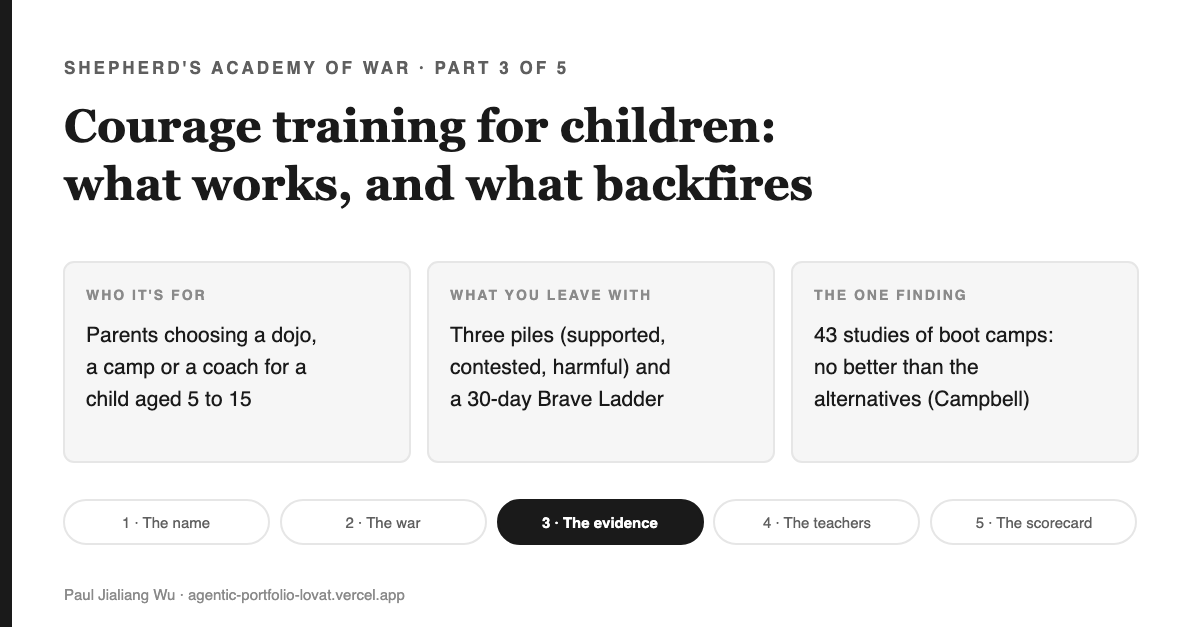
What this is. Part 3 of five. I sort what I wanted to teach my sons about courage into three piles by the evidence: supported, contested, and harmful. Some of my favorite ideas landed in the wrong pile.
Why it matters. A review of 43 studies found boot camps did no better than the alternatives. A trial with 8,376 students found school mindfulness lessons made no average difference, with signs of harm for children who were already struggling. A well-meant toughness program can hurt the child you most want to help.
What you can do after reading. Run the 30-day Brave Ladder: the child picks the rungs, you remove hazards and keep risks, and you count to fifteen before stepping in (never near water or traffic). Use the five rules to check any class, camp or coach.
Shepherd's Academy of War — the series spine
▶ See it running: open the live demo public · no sign-in
- The name — learn the attack, live as a protector episode 1
- The war — five arenas, and a last battle with one fighter episode 2
- The evidence — courage training that works, and what backfires this episode
- The teachers — guest instructors give content, not contact episode 4
- The scorecard — one drill, four numbers, six tripwires episode 5
What does the evidence say actually builds courage and self-control in a seven-year-old and an eleven-year-old?
This piece does not answer: Why we call it an academy of war — that is part 1. What the Bible's last battle asks of a child — that is part 2. Who is allowed to teach, and under what rule — that is part 4. The weekly drill and the scorecard — that is part 5.
How to read the labels: EVIDENCE is sourced, DESIGN is how SAW is built, OPEN is not yet tested, and LENS is my own conviction.
A note before we start: these are my own views, not my employer's, and I am a father reading studies, not a clinician. Nothing here is medical advice. Where a study is small, old, or only shows a correlation, I say so. Verses are quoted from the World English Bible (WEB), which is public domain, as bible-api.com returns them; a translated edition of this article translates the WEB.
What this part covers: courage training for children, and who it is for
This part is for parents choosing a dojo, a camp or a coach for a child between 5 and 15, and for anyone who has bought a "resilience program" on the strength of its trailer. It sorts courage training into three piles by the evidence: supported, contested, and harmful.
I started Shepherd's Academy of War with a shopping list. I wanted my sons, 11 and 7, to have the mental toughness of a Navy SEAL, the discipline of a fighter, and the practice habits of an Olympian. Before teaching any of it I checked each item against the research, the way I'd check a supplier. Part 1 named five arenas of training: body, money, information, public life and spirit. This part is mostly about the first, because that is where the injury data is.
The academy is three weeks old and nothing has been measured yet. The field lab it grows out of is live at daniel-and-david.vercel.app: the free Builder Loop app there walks a family through small real projects on your own device, and the same rule runs through it that runs through this article. Try the small thing, then look at what actually happened.
The picture: a move is not proven until it meets resistance
Back to the sparring room from the play series.
Every club has the student who looks superb in drills. The partner stands still, the move lands, everyone nods. Then comes the first round against someone who does not cooperate, and half of the beautiful moves vanish. Nobody is surprised. A move that has only met a willing partner is a demonstration.
A study with a comparison group is the resisting partner.
| In the club | In courage training |
|---|---|
| A move shown on a partner who stands still | A testimonial, a trailer, a famous quote |
| The same move against a resisting partner | A study with a comparison group |
| A move that works on many partners | A review of many studies |
| The coach who says "that one doesn't work, drop it" | A null result. Rare, and worth more than applause |
| Tapping out | A stop rule decided before you start |
| Learning to fall first | Remove the hazards before you add the risk |
| The bow | Self-control: the thing the training is for |
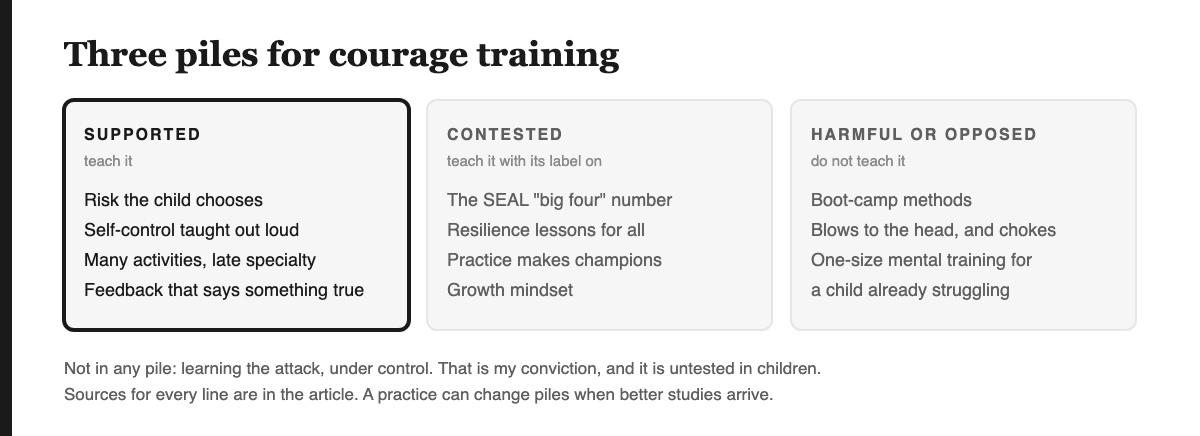
Three piles
Supported: teach it
Risk the child chooses. EVIDENCE In 2024 the Canadian Paediatric Society published a position statement in favour of risky play, which it defines as "thrilling and exciting forms of free play that involve uncertainty of outcome and a possibility of physical injury" (CPS, 2024). It draws one line I find useful. A risk is something the child can see and judge: how high to climb. A hazard is something the child cannot see: the rotten branch. The adult's job is to remove hazards and leave risks, and to wait 15 to 30 seconds before stepping in. OPEN The broader claim that less independence has caused more childhood anxiety rests on correlations; its own authors say so.
Self-control, taught out loud. EVIDENCE A 2025 study of 847 adolescent martial artists found more training went with less aggression, and self-control accounted for 68.25% of that link. It found no difference between traditional Chinese styles and the others (BMC Psychology, 2025). It is a snapshot, so it cannot prove cause. The best causal evidence I found is modest: a randomised trial of capoeira in preschools improved one thing, the ability to hold back an impulse, by 0.13 of a standard deviation, which is small (Oxford Economic Papers, 2023). LENS So the benefit seems to ride on the bow.
Many activities, and a late specialty. EVIDENCE A review of 6,096 athletes, 772 of them among the world's best, found that the adults who reached the very top had played more sports as children, started their main sport later, and improved more slowly at first than those who peaked at national level (Güllich et al., 2021). A 2025 paper in Science went further across sport, music, chess and science: the standout children and the adult champions are mostly different people (Güllich et al., 2025). My seven-year-old does not need a specialty. He needs a wide base and time.
Feedback that says something true. The play series covered this: promised prizes shrink the wish to keep going, and specific true feedback grows it. It is why this academy has no belts.
My conviction, not yet tested
Learning the attack, under control. LENS I believe a defender has to be trained as an attacker: you cannot stop a throw you have never learned, and you cannot secure a system you have never tried to break. EVIDENCE Professional security works this way. A red team is, in the U.S. standards body's words, "a group of people authorized and organized to emulate a potential adversary's attack" (NIST), and Carnegie Mellon University runs a free cybersecurity learning platform, long known as picoCTF, where students learn defence on targets built for the purpose (picoCTF). OPEN I found no controlled study showing that children who learn attacking techniques defend better. So this does not belong in the pile above, and I have not put it there. DESIGN What the evidence does limit is the form. For children: throws, holds and escapes against a resisting partner; arguing the other side of their own idea; breaking things only where breaking is the assignment and an adult is present.
Contested: teach it with its label on
The SEAL "big four". Goal-setting, mental rehearsal, self-talk and slow breathing. EVIDENCE These are ordinary sport-psychology skills and safe for children. The famous claim attached to them, that they raised the pass rate of SEAL training from 25 to 33 percent, I traced to a 2009 blog post retelling a television documentary (Psychology Today, 2009). I found no Navy document and no study behind the number. It is the kind of number I would have repeated. We will teach the breathing and leave the number out.
Resilience lessons for everyone. EVIDENCE A 2025 analysis of 71 studies and 63,041 young people found that universal school programs for anxiety and depression produce very small average effects (meta-analysis, 2025). They may be worth doing, but they will not transform a child.
Practice makes champions. EVIDENCE It helps, less than the legend says. Across the studies pooled, deliberate practice explained 26% of the difference in games, 18% in sports, and under 1% in professions (Macnamara et al., 2014).
Growth mindset. OPEN Two large reviews of the same mindset studies disagree: one finds the average effect weak, the other finds real help for struggling students (Hechinger Report). I would not call it settled science.
Harmful or opposed: do not teach it
Boot-camp methods. EVIDENCE A Campbell review of 43 studies concluded that correctional boot camps have "neither a greater nor a lesser effect on recidivism" than the alternatives (Campbell Collaboration, 2005). In those studies, shouting and drill did not reduce reoffending. The military-style program with good trial results, the National Guard's ChalleNGe, is for teenagers who have left school, runs for seventeen months with mentoring, and improved schooling and earnings but not behaviour (MDRC, 2011). It is not evidence for a seven-year-old.
Blows to the head, and chokes. EVIDENCE The American Academy of Pediatrics' report on martial arts names blows to the head and choking or submission movements as the high-risk parts (AAP, 2016). Canada's paediatricians oppose boxing for children outright (CPS, 2011). And a 2025 University of Florida study of emergency-room data found children were 54% of martial-arts concussion cases, with nearly 86% happening in ordinary practice, not competition (WJXT report, 2025). So the danger is in an ordinary Tuesday class.
One-size mental training for a child who is already struggling. EVIDENCE The MYRIAD trial gave mindfulness lessons to 8,376 students aged 11 to 13 in 84 schools. On average it made no difference. For students already at high risk, the results pointed the wrong way. The authors' conclusion: "Universal SBMT is not recommended in this format in early adolescence" (MYRIAD, 2022). (SBMT is school-based mindfulness training.) LENS This is the finding I weigh most. A program can be kind, popular and well-funded and still hurt the child you built it for.
What that leaves: five rules
DESIGN I will use these to judge any class, camp or coach, including me.
- The child picks the rung. Courage is practised on risks the child chooses. An adult who chooses the fear for the child is practising obedience.
- Remove hazards, keep risks. And count to fifteen before you step in. Never near water or traffic.
- Learn the attack (my conviction); no blows to the head, no chokes. A child should learn how a throw, a hold and an escape work from both sides, against a partner who resists. Falls come first and contact comes late.
- Teach the bow out loud. Say what self-control is, when it was used today, and what it cost. The benefit rides on the talking.
- Wide base, slow start, no ranking of children. The early star and the adult champion are usually different people.
An old sentence says the same thing in fewer words:
One who is slow to anger is better than the mighty; one who rules his spirit, than he who takes a city.
— Proverbs 16:32 (WEB, World English Bible)
EVIDENCE One children's program puts restraint first. Its first rule of engagement is "Avoid the fight at all costs" (Gracie Bullyproof). I would ask any grappling program how it handles chokes and submissions before enrolling a young child.
Five whys: why did I want special-forces toughness for a seven-year-old?
- Why did I want it? Because the toughest people I could picture were soldiers and fighters, and I wanted my sons to be hard to break. Evidence: my own shopping list; one father, told as a story.
- Why was that picture so available? Because toughness is sold with trailers and one-line numbers, and they are easy to remember. Evidence: the 25-to-33-percent claim, which I traced to a blog about a documentary (Psychology Today, 2009).
- Why doubt the hard version? Because hardness applied from outside teaches endurance of the adult, not command of oneself. Evidence: 43 studies of boot camps for offenders, no effect on reoffending. That is the nearest test I found, and it is not a test on young children (Campbell, 2005).
- Why can a gentle version hurt too? Because one program for every child ignores the child who is already carrying too much. Evidence: MYRIAD's high-risk students did worse (2022).
- Why does anything work, then? Because the active ingredient is small and unglamorous: a risk the child chose, a trusted adult near enough to help and far enough not to, and self-control named out loud afterwards. Evidence: the CPS risky-play statement and the self-control finding above. The root: courage does not get poured into a child from a tougher adult. It grows when a child keeps choosing slightly hard things in a place safe enough to fail.
🔥 Your 30-day mission: the Brave Ladder
For one child aged 5 and up, plus one adult. You need paper and a marker. 30 days.
- Day 1: the child draws a ladder with five rungs and writes one slightly scary thing on each, easiest at the bottom. Their list, not yours. (Ordering their own food. The high bar at the playground. Saying sorry first. Asking a new kid to play.)
- The adult's only job on day 1: walk the list for hazards, the things the child cannot see, and remove them. Leave the risks.
- Days 2–30: one attempt a week or more. The adult counts to fifteen, silently, before helping. The count never applies near water or traffic, or at a height you would not let them jump down from. There you stay within arm's reach.
- After each attempt, the bow: one sentence from the child. "What did you have to hold back, or push through?"
- No prizes. One specific true sentence from the adult.
What to measure: rungs attempted, and how many times the adult stepped in before fifteen. The second number is the adult's score. Contribute: post both in the comments.
Under 13? Ask a parent to post for you. No names, only an age range (5–7, 8–12, 13–15).
Operate: the thing that runs
In one sentence: every number in this article points to a page I re-opened before publishing, and the page will not build if a quotation is no longer there. DESIGN The five quoted sentences sit in `content/series/saw/quotes.yml` with their source pages, and `python3 scripts/build-saw.py --verify-quotes` fetches each page and looks for the words. Before publishing I re-opened every page cited in this series by script. The facts that did not reproduce were reworded or removed. At home the thing that runs is a paper ladder.
Feedback: the number, and its blind spot
DESIGN Rungs attempted is the child's number. Early step-ins is the adult's. If the second one falls over four weeks, the adult is learning, and in my house that is the harder half.
OPEN The blind spots: a ladder only shows the fears a child is willing to write down. The biggest ones rarely make the list. And a climbed rung is not the same as a calmer child. If a child's worries are heavy or getting heavier, a ladder is the wrong tool and a paediatrician is the right call.
Feedforward: decided before the results
DESIGN Decided now:
- If a child stops adding rungs or starts dreading the ladder, I picked it for them somewhere. Hand the marker back and wait a month.
- If my step-in count has not fallen by week 4, the problem is my fear, and the next ladder is mine.
- If a better study moves an item between piles, the article changes, with the date. The first one I am watching is a 2026 review comparing martial-arts styles that I could not open.
- If a child is struggling with anxiety or low mood, we do not run a program on them. We ask for help.
Where this part sits in the series
| Conception | Core concept | Governing principle | Main contributors | |
|---|---|---|---|---|
| The name (part 1) | Psalm 144:1 → Plato's guardians (c. 375 BC) → the Boys' Brigade (1883) → William James (1910) | the shepherd-warrior: able to attack, committed to protect | no person is ever the enemy; every fight ends in a rescue | Plato · the Boys' Brigade · Baden-Powell · William James · C. S. Lewis · Sue Rahr |
| The war (part 2) | Revelation (c. AD 95) → Tertullian (c. 200) → the Catechism (1992) → Bauckham (1993) | the long war has every arena; the last battle has one fighter | never tell a child the outcome of history depends on their strength | John of Patmos · Tertullian · G. E. Ladd · Richard Bauckham · J. R. Michaels |
| The evidence (this part) | Campbell's boot-camp review (2005) → the practice corrections (2014) → MYRIAD (2022) → risky play (2024) | courage is chosen risk plus self-control, practised small | remove hazards, keep risks; fierce and gentle together | Macnamara · Güllich · Canadian Paediatric Society · the MYRIAD trial team · American Academy of Pediatrics |
| The teachers (part 4) | Scouting's two-adult rule (1988) → the Safe Sport Act (2017) → SafeSport's athlete survey (2024) | content, not contact | no adult is ever alone with a child, and a credential is not a safeguard | U.S. Center for SafeSport · Travis Manion Foundation · Trail Life USA · Bond & DePaulo |
| The scorecard (part 5) | Deuteronomy 6:7 → the Army's untested rollout → MYRIAD (2022) | a drill small enough to run, a count that can go down | write the tripwire before you see the result; medicine and prayer together | Eidelson, Pilisuk & Soldz · Steenkamp, Nash & Litz · Southern Baptist Convention (2013) · Lifeway Research |
Same story, five exits
| If you are… | The decision this changes | One action |
|---|---|---|
| A student (10–15) | What "tough" means | Draw your own ladder; put one thing on it nobody knows scares you |
| A parent | Which class or camp to pick | Ask: head contact? chokes? who picks the challenge? |
| A coach | How you run a Tuesday class | End every session by naming one act of self-control you saw |
| A school or church leader | Buying a resilience program | Ask for the comparison-group result, and what happens to struggling kids |
| An engineer or founder | How you train defenders, and what you quote | Red-team one plan with permission; trace one favourite statistic to its source |
Build it in 30 minutes
- Input: one child, paper, a marker, an adult willing to count to fifteen.
- Output: a five-rung ladder in the child's handwriting and a hazard walk by the adult.
- Invariant: the child chooses; no head contact; no prizes.
- Stop rule: dread, or any sign of real distress, ends the ladder.
- Minimal record: `date, rung, attempted, adult_stepped_in_early`.
- Deliberately missing: any comparison between children.
TRUE
- Transferable. The three-pile sort works on any training you are about to buy: a leadership course, a productivity system, a diet. Ask for the resisting-partner evidence.
- Recursive. This article is wrong wherever a pile is wrong. Re-check on 2027-01-11: re-open every link, and move anything a newer review has moved.
- Understandable. In one sentence: kids get brave by choosing small scary things themselves, with an adult close by who does not jump in too fast. The move it asks of you is to redirect: look at what happened in the study, away from the trailer.
- Experience it. Open the CPS statement and read its definitions of risk and hazard, then walk your own garden or playground with them. What would prove me wrong: a controlled study where adult-chosen, drill-style toughness beats child-chosen challenge.
- Built. What runs: the fact check on this page, and the field lab at daniel-and-david.vercel.app. The ladder is paper.
- Taught. Have a child explain risk and hazard to a younger child using one tree. If the younger one can point to a hazard, it landed.
5S self-score, with evidence
| S | Self-score | Evidence |
|---|---|---|
| Simple | 4/5 | One picture: a move is not proven until it meets a resisting partner. Three piles. |
| Solid | 4/5 | Eighteen findings, each linked to a page re-opened on 2026-10-11; correlational and small results labelled as such; my own untested conviction has its own heading; one review I could not open is named as unread. |
| Sharp | 4/5 | The MYRIAD authors quoted in their own words; the root names the mechanism: chosen risk, a near adult, self-control said aloud. |
| SMART | 4/5 | A 30-day ladder with two numbers, one of them the adult's. |
| Super-fun | 3/5 | The famous SEAL number turned out to be a television documentary. |
Sources
- Canadian Paediatric Society (2024), position statement on outdoor risky play: https://cps.ca/en/documents/position/outdoor-risky-play
- BMC Psychology (2025), martial arts, self-control and aggression in 847 adolescents: https://pmc.ncbi.nlm.nih.gov/articles/PMC11980128
- Oxford Economic Papers (2023), capoeira trial in preschools: https://ideas.repec.org/a/oup/oxecpp/v75y2023i2p490-506..html
- Güllich, Macnamara & Hambrick (2021), meta-analysis of 6,096 athletes: https://pubmed.ncbi.nlm.nih.gov/34260336/
- Güllich, Barth, Hambrick & Macnamara (2025), Science: https://pubmed.ncbi.nlm.nih.gov/41411418/
- Macnamara, Hambrick & Oswald (2014), deliberate practice meta-analysis: https://pubmed.ncbi.nlm.nih.gov/24986855/
- Psychology Today blog (2009), the SEAL pass-rate claim: https://www.psychologytoday.com/us/blog/communication-central/200911/how-the-navy-seals-increased-passing-rates
- Meta-analysis of universal school mental-health programs (2025): https://pmc.ncbi.nlm.nih.gov/articles/PMC12171270/
- Hechinger Report on the growth-mindset debate: https://hechingerreport.org/proof-points-does-growth-mindset-matter-the-debate-heats-up
- Campbell Collaboration (2005), effects of correctional boot camps: https://www.campbellcollaboration.org/review/effects-of-correctional-boot-camps-on-offending/
- MDRC (2011), National Guard Youth ChalleNGe evaluation: https://www.mdrc.org/work/publications/staying-course
- American Academy of Pediatrics (2016), youth participation and injury risk in martial arts: https://pubmed.ncbi.nlm.nih.gov/27940732/
- Canadian Paediatric Society (2011), boxing statement: https://cps.ca/en/media/Boxing-not-for-children-and-teens
- WJXT (2025), report of the University of Florida concussion study: https://gmg-wjxt-prod.cdn.arcpublishing.com/health/2025/07/18/interest-in-martial-arts-is-increasing-so-are-concussions-uf-study-finds
- MYRIAD trial (2022): https://pmc.ncbi.nlm.nih.gov/articles/PMC9340034
- Gracie University, Gracie Bullyproof: https://www.gracieuniversity.com/GracieKids
- NIST Computer Security Resource Center, glossary entry "red team": https://csrc.nist.gov/glossary/term/red_team
- picoCTF / CyLab Security Academy, Carnegie Mellon University: https://picoctf.org/
- The research dossier behind this series: https://github.com/wjlgatech/daniel-and-david/blob/main/docs/research/shepherd-warrior-formation.md