AI-NATIVE SERIES · SHEPHERD'S ACADEMY OF WAR, PART 2 OF 5
Revelation 19 Has One Fighter, and the Long War Has Five Arenas: What a Child Trains For
1-minute takeaway
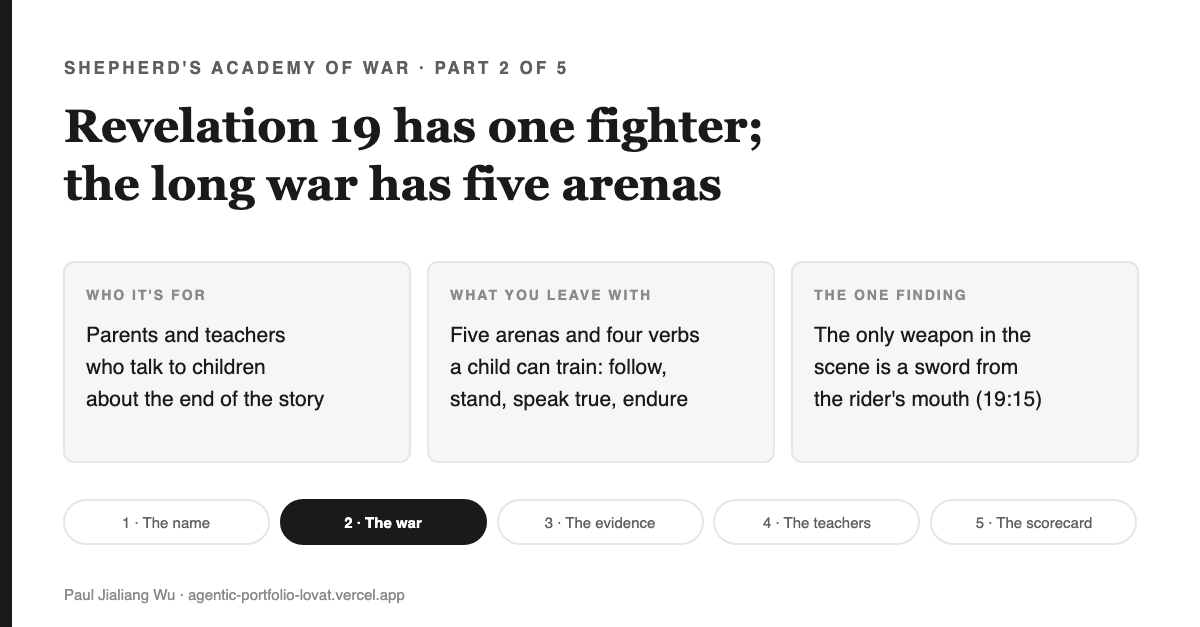
What this is. Part 2 of five. I test my own mission statement against Revelation 19 and 20, verse by verse, and against Catholic, Orthodox and Protestant readers. The last battle has one fighter. The long war before it runs through five arenas (body, money, information, public life, spirit), and that is where a child trains for real.
Why it matters. Telling a child that history depends on their strength is a misreading and a heavy load. Children who already worry may be the ones most at risk from fear-heavy religious teaching. If you teach children about the end of the story, the calendar is disputed. Who wins is not, though whether believers fight alongside him is, and I show one side.
What you can do after reading. Read a few verses with a child, find who holds the sword, and run the 30-day four-verb log across the five arenas. Replace one "win" sentence in your own house rules with "stand".
Shepherd's Academy of War — the series spine
▶ See it running: open the live demo public · no sign-in
- The name — learn the attack, live as a protector episode 1
- The war — five arenas, and a last battle with one fighter this episode
- The evidence — courage training that works, and what backfires episode 3
- The teachers — guest instructors give content, not contact episode 4
- The scorecard — one drill, four numbers, six tripwires episode 5
Where is the war fought, who wins the last battle in Revelation 19 and 20, and what does that leave a child to train for?
This piece does not answer: Why the academy keeps the word "war" at all — that is part 1. What the evidence says builds courage in a seven-year-old — that is part 3. How guest instructors can teach safely — that is part 4. How we measure whether the training works — that is part 5.
How to read the labels: EVIDENCE is sourced, DESIGN is how SAW is built, OPEN is not yet tested, and LENS is my own conviction.
A note before we start: these are my own views, not my employer's. I'm a Christian reading my own scriptures here, as a father and not as a scholar. If you read from another faith or none, the useful part may be the method: check your mission statement against its source before you hand it to a child. Every verse is quoted from the World English Bible (WEB), which is public domain, exactly as bible-api.com returns it. A translated edition of this article translates the WEB; it is not a published Bible in that language.
What this part covers: Revelation 19, the last battle, and who this is for
This part is for parents and teachers who talk to children about how the story ends, and for anyone who has written a mission statement faster than they read its source. It tests one sentence against the text of Revelation 19 and 20, verse by verse, and against readers from three Christian traditions.
The sentence is mine. When I started Shepherd's Academy of War with my sons, I wrote its aim as: to raise the next generation of warriors who can win the last battle in Revelation 19 and 20. Our household question, for any confident claim, is "How do we know?" So I asked it of my own sentence.
Here is what I found, and what I still hold: the long war has every arena, and the last battle has one fighter. The academy is three weeks old, so this is a cheap moment to check.
The field lab SAW grows out of is live at daniel-and-david.vercel.app, where you can open the free Builder Loop app and run a four-week family project on your own device. That is real and running. The four-verb log in this article is an index card, and nothing has been measured yet.
The picture: check who is holding the sword
No extended analogy this time. The method is one move, and a child can do it: point at the verse and ask who is doing the action.
It is the same move as checking who actually scored in a match you only heard about. You stop repeating the story and look at the tape.
| What I assumed | What the text gives |
|---|---|
| An army fights | One rider fights |
| Many swords | One sword, and it comes out of his mouth |
| The army's job is to win | The army's only verb is "followed" |
| Armor is for attack | Every piece but one is for standing your ground |
| Children train for victory | Children train to follow, stand, speak true and endure |
| The war is only in the heart | The long war has five arenas: body, money, information, public life, spirit |
What the text says, verse by verse
The scene opens with a rider.
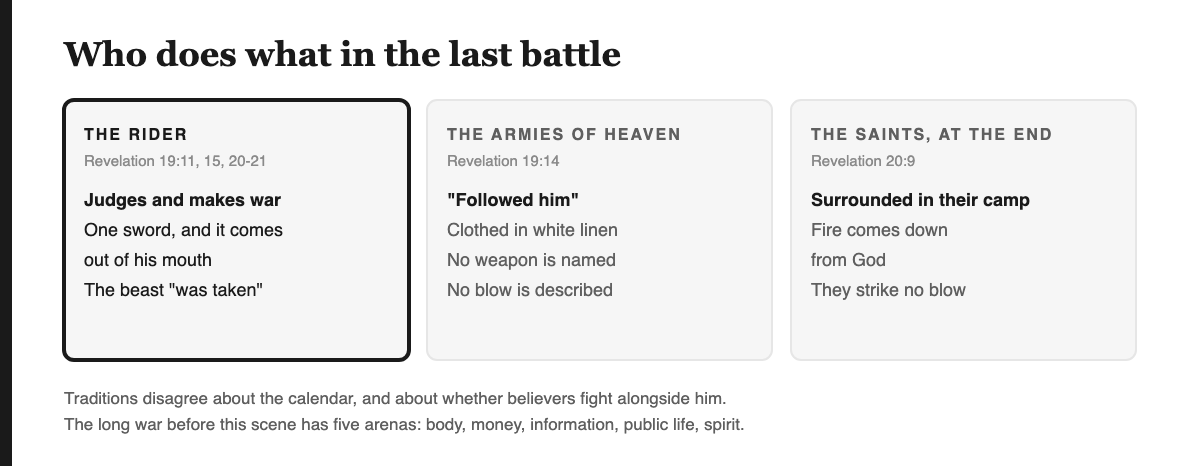
I saw the heaven opened, and behold, a white horse, and he who sat on it is called Faithful and True. In righteousness he judges and makes war.
— Revelation 19:11 (WEB, World English Bible)
He makes war. That part I had right. Now the army.
The armies which are in heaven followed him on white horses, clothed in white, pure, fine linen. Out of his mouth proceeds a sharp, double-edged sword, that with it he should strike the nations. He will rule them with an iron rod. He treads the wine press of the fierceness of the wrath of God, the Almighty.
— Revelation 19:14-15 (WEB, World English Bible)
EVIDENCE Read it the way you would read a box score. The armies have one verb: they followed. (Commentators differ on whether these armies are angels, believers or both. I take the verb either way: the ones with him follow.) They are described by their clothes, and six verses earlier the text explains the clothes: "the fine linen is the righteous acts of the saints" (Revelation 19:8, WEB). No weapon is named for them. The only sword in the scene belongs to the rider, and it is in his mouth. A sword in the mouth is a word. The verse is severe: the rider strikes the nations, and the judging is his.
When the enemy gathers to fight "him who sat on the horse, and … his army" (19:19), no fight is narrated. The beast is taken. The verses that follow are grim and I do not read them to a seven-year-old, but they are consistent: one sword, one person using it.
Then the very last battle, a chapter later:
They went up over the width of the earth, and surrounded the camp of the saints, and the beloved city. Fire came down out of heaven from God and devoured them.
— Revelation 20:9 (WEB, World English Bible)
EVIDENCE In the final scene the saints are the ones surrounded. They are in a camp. Fire comes from God. They do not strike a blow.
So where does the book say believers win anything? One place says how:
They overcame him because of the Lamb’s blood, and because of the word of their testimony. They didn’t love their life, even to death.
— Revelation 12:11 (WEB, World English Bible)
They overcome by what someone else did, by telling the truth about it, and by not clinging to their own safety. The virtue the book names for them is endurance (Revelation 13:10).
My sentence said my sons would win the last battle. In these two chapters the text gives that job to someone else, and gives the people with him a different one.
What readers across traditions say
I am a father with a browser, so I checked whether I was reading it oddly. I quote the first source directly. The next two I read through a digest and a review, so I describe them and link what I read.
EVIDENCE The Catholic Catechism says the kingdom will be fulfilled "not by a historic triumph of the Church through a progressive ascendancy, but only by God's victory over the final unleashing of evil" (Catechism 677).
EVIDENCE George Ladd, a Protestant scholar who expected a literal future battle, is cited on this passage as saying the only weapon in it is the word of Christ (commentary digest citing Ladd).
EVIDENCE A journal review of Richard Bauckham's study of Revelation summarises his reading: the Messiah conquers as a warrior, but "his victory is gained by non-military means", his own death, and believers take part by witness and suffering (Andrews University Seminary Studies, 1995). The words quoted are the reviewer's.
EVIDENCE An Orthodox priest's summary of his church's teaching reads the thousand years of chapter 20 as the indefinite time between Christ's first and second comings, ended by Christ (Whiteford). An evangelical commentary agrees that the victory comes through the sword of his mouth and no battle is described (IVP New Testament Commentary).
OPEN These readers disagree about plenty. They disagree about the calendar: whether the thousand years are literal and future, or a picture of the present age, or a long era of the gospel spreading. They disagree about whose blood is on the rider's robe. There are also Christian teachers who picture believers as an end-time army, and other verses a reader could bring: "The Lamb will overcome them … and those who are with him" (Revelation 17:14), and the promise of authority over the nations to the one who overcomes (2:26–27). This article does not survey that teaching. What I can say is narrower: in the readers I could open, from three traditions, nobody has the believers winning chapters 19 and 20 by fighting. Whether believers fight alongside him at all is disputed, and I have shown one side.
What that leaves a child to train for
Take the armor passage every Sunday-school child knows.
Stand therefore, having the utility belt of truth buckled around your waist, and having put on the breastplate of righteousness, and having fitted your feet with the preparation of the Good News of peace; above all, taking up the shield of faith, with which you will be able to quench all the fiery darts of the evil one. And take the helmet of salvation, and the sword of the Spirit, which is the word of God;
— Ephesians 6:14-17 (WEB, World English Bible)
Yes, the World English Bible says utility belt. I did not expect the apostle Paul and Batman to share equipment, and I intend to get a full week of car rides out of it.
EVIDENCE Look at the list as a parent would look at a kit bag. Belt, breastplate, shoes, shield, helmet: five things for not getting knocked over. One sword, and it is a word. The command that opens the list is "stand", and the verse before says the goal is "having done all, to stand" (Ephesians 6:13, WEB).
DESIGN So the academy trains four verbs, and each one is something a seven-year-old can do this week.
- Follow. Do the right thing when someone you trust goes first. (Revelation 19:14)
- Stand. Stay put when it would be easier to leave: next to the kid being laughed at, or in your own "no". (Ephesians 6:13)
- Speak true. Say what happened, including the part that makes you look bad. (Revelation 12:11)
- Endure. Finish the hard thing after it stops being fun. (Revelation 13:10)
None of the four needs an enemy who is a person. That was law one in part 1, and here it turns out to be the text's own shape.
LENS None of this makes the training soft. Part 1 argued that a defender has to learn the attack, and I hold that. The Bible's own picture is a soldier who can take hardship (2 Timothy 2:3), and David's hands were trained for real. The point is narrower than "don't train". Train hard, in every arena, and know which battle is yours. The last one already has its fighter.
LENS It also changes the weight on the child. "You must win" puts the end of the world on small shoulders. "Stand, and you are not alone" is a load a child can carry. Jesus said as much to the one friend who did reach for a weapon:
Then Jesus said to him, “Put your sword back into its place, for all those who take the sword will die by the sword.
— Matthew 26:52 (WEB, World English Bible)
The long war before it: five arenas
Here is where I differ from a view I often meet. LENS Many believers I know hear "not against flesh and blood" and conclude the war is invisible and inward only. I don't read it that way. That verse says who the enemy is not. It does not say the arena is only in the heart. I believe the Omega War, the long conflict that ends in the scene above, is spiritual and physical, financial and geopolitical, fought in networks and in minds, at every scale from one decision in one child to nations and centuries. Fought, for us, by serving, standing and refusing. Never by taking charge, and never against a person.
LENS The same book that gives the last battle one fighter spends chapters on the arenas before it. The verses are quoted exactly; the reading of them as arenas is mine.
He causes all, the small and the great, the rich and the poor, and the free and the slave, to be given marks on their right hands, or on their foreheads; and that no one would be able to buy or to sell, unless he has that mark, the name of the beast or the number of his name.
— Revelation 13:16-17 (WEB, World English Bible)
I read that as a payment system used as a weapon. Chapter 18 describes the fall of a trading empire through its cargo list, which runs from gold to grain and ends with "people’s bodies and souls" (Revelation 18:13, WEB). The false prophet's whole job is deception (19:20). And the believers' instruction in the middle of it is to leave: "Come out of her, my people, that you have no participation in her sins" (Revelation 18:4, WEB).
The older stories are just as concrete. Daniel served at the top of a foreign government and was "distinguished above the presidents and the satraps, because an excellent spirit was in him" (Daniel 6:3, WEB). The verse goes on: the king "thought to set him over the whole realm". That was the king's idea. Daniel did not seek it. And when Nehemiah's wall-builders were threatened:
Those who built the wall, and those who bore burdens loaded themselves; everyone with one of his hands did the work, and with the other held his weapon. Among the builders, everyone wore his sword at his side, and so built. He who sounded the trumpet was by me.
— Nehemiah 4:17-18 (WEB, World English Bible)
A tool in one hand and a means of defence in the other. They were building, and they were ready. The threat in that story was people, and the builders stood ready to defend their families. Scripture does not pretend defence is never physical. Law one governs how a child is taught to see: someone who threatens you may have to be stopped, and is still never a kind of person to hate.
LENS The strongest verse against my reading deserves its place here:
For though we walk in the flesh, we don’t wage war according to the flesh; for the weapons of our warfare are not of the flesh, but mighty before God to the throwing down of strongholds,
— 2 Corinthians 10:3-4 (WEB, World English Bible)
I take it at full strength. The weapons are not the world's weapons: no coercion, no deceit, no hatred. But the same sentence says "we walk in the flesh". The arenas are the ordinary ones, bodies and budgets and offices, and the difference is in how a believer acts inside them. A reader may fairly conclude that Paul means more inward than I do.
DESIGN So the academy trains in five arenas, and each has a text behind it.
| Arena | In the text | What a child trains | The four verbs there |
|---|---|---|---|
| Body | Nehemiah 4:17; David and the lion | Strength, endurance, protecting someone smaller | Stand between; endure |
| Money | Revelation 13:17; 18:11–13 | Earning honestly, giving, not being for sale | Follow the honest path; speak true about a price |
| Information | The false prophet, 19:20; Matthew 10:16 | Checking claims, guarding accounts, never spreading a lie | Speak true; stand against a crowd that is wrong |
| Public life | Daniel 1, 3 and 6 | Excellent work where you are; a polite, firm no | Stand; endure |
| Spirit | Ephesians 6; Revelation 12:11 | Prayer, scripture, a clean conscience | All four |
LENS Both are true. The long war has every arena, and in every one of them a child trains for real, including learning how the attack works, as part 1 argued. The last battle has one fighter. A believer who trains hard in five arenas and knows whose victory it is carries a load a person can bear. In all five, the first law stays where it was: an arena can be physical, and a person is still never the enemy. And it is not a claim that Christians should take charge of these arenas. The posture is Daniel's: serve, stand and refuse.
OPEN "Omega War" is our family's name for this, not a term from the text or from the scholars I read. The claim that the war reaches every arena is my conviction; I have shown the verses I rest it on, and a reader may weigh them differently.
Five whys: why did a careful father write "win the last battle"?
- Why did I write it? Because "win" is the verb of every world I work in: sport, startups, engineering. Evidence: my own sentence; one person, told as a story.
- Why does one verb matter? Because children take adults literally, and a child who is told the outcome depends on them may believe it. Evidence: a 2025 clinical review of scrupulosity in children describes fearing sin where there is none, driven by intolerance of uncertainty (Children, 2025). I found no controlled study of end-times teaching and child anxiety, so this is a caution, not a measured effect.
- Why is that easy to miss? Because the passage is known by its reputation, "the battle", more than by its verbs. Evidence: the armies' only verb is "followed" (Revelation 19:14).
- Why is the reputation different from the text? Because the soldier picture drifted. It began as a picture of inner struggle and was later taken literally for armed knights and crusades. Evidence: the history of the "soldier of Christ" idea (Miles Christianus); around AD 200 Tertullian was still asking whether a Christian could make "an occupation of the sword" at all (De Corona 11).
- Why does the drift matter for children? Because the young get swept up first. In 1212 crowds of the young and the poor set off for Jerusalem behind boy preachers; historians dispute the details, and none of the accounts ends well (Children's Crusade). The root: when adults misname who wins, children inherit a job that was never theirs. Name the winner correctly and the child's job shrinks to something a child can do.
🔥 Your 30-day mission: the four-verb log
For one child aged 7 and up, plus one adult. You need a Bible or bible-api.com, and an index card. 30 days.
- Day 1: find the sword. For a child under 10, read Revelation 19:11 and 19:14 only, and tell them in your own words that the rider's sword is his word. From 10 up, add verse 15. Ask: who has the sword? Where is it? What does the army do? The rest of the chapter can wait some years.
- Day 2: pack the kit bag. Read Ephesians 6:14–17. Sort the six items into "for standing" and "for striking". Count each pile.
- Days 3–30: log the four verbs, and the arena. One line a day: which verb you did (follow, stand, speak true, endure), in which arena (body, money, information, public life, spirit), and what happened.
- For the adult: log your own. This article is my entry one, under "speak true".
What to measure: which verb and which arena show up least by week 4. Those are the ones to practise. Contribute: post your least-used verb in the comments.
Under 13? Ask a parent to post for you. No names, only an age range (7–9, 10–12, 13–15).
Operate: the thing that runs
In one sentence: every block-quoted verse on this page is checked against its source by a script before the page can go live. DESIGN The verses live in `content/series/saw/scripture.yml`, stored exactly as bible-api.com returned them. `scripts/check-saw.mjs` compares each quoted verse to that file and fails the build on a changed word or an unmarked trim. `python3 scripts/build-saw.py --verify-scripture` fetches every verse again and reports any drift. Every quotation from a commentator is listed in `quotes.yml` with the page it was read on. If I trim a verse toward my argument, the build goes red.
Feedback: the number, and its blind spot
DESIGN The number is the count of each verb in the log, and above all the one that shows up least. There is also a one-question check: before day 1 and after day 30, ask the child "who wins at the end?" and write down the answer in their words.
OPEN The blind spot is large and I'd rather say it. A log counts behaviour. It cannot see faith, and it should not try. A child can stand next to a lonely classmate for reasons that have nothing to do with Revelation, and that is fine. The log tells me whether the four verbs are being practised, not why.
Feedforward: decided before the results
DESIGN Decided now:
- If a child shows fear, bad dreams, or repeated anxious praying after any of this, the Revelation reading stops that day and stays stopped. We keep the four verbs, which need no frightening pictures, and I ask a paediatrician and a pastor. The scrupulosity review says a clergy conversation can help tell ordinary practice from a compulsion.
- If a reader shows me, from anywhere in the book, a verse where believers win the final battle by fighting, this article gets corrected at the top, with their name if they want it. The two I would start with are 17:14 and 2:26–27.
- If my sons answer "we do" when I ask "who wins?" on day 30, the teaching failed, and the fault is mine.
Where this part sits in the series
| Conception | Core concept | Governing principle | Main contributors | |
|---|---|---|---|---|
| The name (part 1) | Psalm 144:1 → Plato's guardians (c. 375 BC) → the Boys' Brigade (1883) → William James (1910) | the shepherd-warrior: able to attack, committed to protect | no person is ever the enemy; every fight ends in a rescue | Plato · the Boys' Brigade · Baden-Powell · William James · C. S. Lewis · Sue Rahr |
| The war (this part) | Revelation (c. AD 95) → Tertullian (c. 200) → the Catechism (1992) → Bauckham (1993) | the long war has every arena; the last battle has one fighter | never tell a child the outcome of history depends on their strength | John of Patmos · Tertullian · G. E. Ladd · Richard Bauckham · J. R. Michaels |
| The evidence (part 3) | Campbell's boot-camp review (2005) → the practice corrections (2014) → MYRIAD (2022) → risky play (2024) | courage is chosen risk plus self-control, practised small | remove hazards, keep risks; fierce and gentle together | Macnamara · Güllich · Canadian Paediatric Society · the MYRIAD trial team · American Academy of Pediatrics |
| The teachers (part 4) | Scouting's two-adult rule (1988) → the Safe Sport Act (2017) → SafeSport's athlete survey (2024) | content, not contact | no adult is ever alone with a child, and a credential is not a safeguard | U.S. Center for SafeSport · Travis Manion Foundation · Trail Life USA · Bond & DePaulo |
| The scorecard (part 5) | Deuteronomy 6:7 → the Army's untested rollout → MYRIAD (2022) | a drill small enough to run, a count that can go down | write the tripwire before you see the result; medicine and prayer together | Eidelson, Pilisuk & Soldz · Steenkamp, Nash & Litz · Southern Baptist Convention (2013) · Lifeway Research |
Same story, five exits
| If you are… | The decision this changes | One action |
|---|---|---|
| A student (10–15) | What you think you are responsible for | Write down one thing that is your job and one that isn't |
| A parent | How you talk about the end of the story | Replace one "we must win" with "we stand, and we are not alone" |
| A teacher or pastor | Spiritual-warfare lessons for children | Teach the kit bag: five for standing, one word |
| An engineer or founder | Your mission statement | Check it against its source text before you print it |
| A leader | What you ask of the young | Ask for endurance and honesty, and carry the outcome yourself |
Build it in 30 minutes
- Input: two passages (Revelation 19:11 and 19:14, with verse 15 from age 10; Ephesians 6:13–17), one child, one card.
- Output: the child's own answer to "who has the sword?", and a four-verb log.
- Invariant: no person is the enemy; no frightening imagery for young children.
- Stop rule: any sign of fear or compulsive worry stops the reading.
- Minimal record: `date, verb, arena, what_happened`.
- Deliberately missing: a timeline of the end times. The traditions disagree, and a child does not need one to stand.
TRUE
- Transferable. Any mission statement borrowed from a source (a founder's letter, a constitution, a scripture) can be checked the same way: find the verb, and see who the source gives it to.
- Recursive. This article is wrong if the book has believers winning the final battle by fighting, or if the four verbs frighten children. Re-check on 2027-01-11 against the reader replies and my sons' day-30 answers.
- Understandable. In one sentence: the long war is everywhere and we train for it for real, but in the last battle Jesus does the fighting, and our job is to follow, stand, tell the truth and keep going. The move it asks of you is to let go: put down a job that was never yours.
- Experience it. Read Revelation 19:14–15 right now at bible-api.com and find the army's verb. What would prove me wrong: a verse.
- Built. What runs: the verse check on this page, and the field lab at daniel-and-david.vercel.app. The four-verb log is a card.
- Taught. Ask a child to sort the armor into two piles and explain the piles to you. If they can, they have it.
5S self-score, with evidence
| S | Self-score | Evidence |
|---|---|---|
| Simple | 4/5 | One move a child can do: point at the verse and ask who is doing the action. |
| Solid | 3/5 | Nine verses checked against the WEB by script. The five-arena claim is labelled as my conviction. Two commentators are read through a digest and a review, and I say so each time. Two history rows rest on Wikipedia. |
| Sharp | 4/5 | The Catechism and Bauckham's reviewer quoted with sources; the strongest verse against my reading is quoted in full; the root names the mechanism: misname the winner and the child inherits the job. |
| SMART | 4/5 | A 30-day log, a before-and-after question, and three tripwires with a date. |
| Super-fun | 4/5 | The utility belt. It is in the translation; I only pointed. |
Sources
- World English Bible via bible-api.com (Revelation 12:11, 13:16–17, 17:14, 18:4, 19:8, 19:11, 19:14–15, 20:9; Nehemiah 4:17–18; Daniel 6:3; 2 Corinthians 10:3–4; Ephesians 6:13–17; Matthew 26:52): https://bible-api.com/
- Catechism of the Catholic Church, paragraphs 675–677: https://www.vatican.va/archive/ENG0015/__P1V.HTM
- Commentary digest quoting G. E. Ladd on Revelation 19: https://www.toughquestionsanswered.org/2017/09/27/commentary-on-revelation-19-battle-of-armageddon/
- Review of R. Bauckham, The Climax of Prophecy, Andrews University Seminary Studies (1995): https://www.andrews.edu/library/car/cardigital/Periodicals/AUSS/1995-2/1995-2-12.pdf
- J. R. Michaels, IVP New Testament Commentary on Revelation 19:11–16: https://www.biblegateway.com/resources/ivp-nt/Mounted-General
- Fr. John Whiteford on the Orthodox reading of the millennium: https://orthochristian.com/86556.html
- Tertullian, De Corona, chapter 11: https://www.newadvent.org/fathers/0304.htm
- Wikipedia: Miles Christianus; Children's Crusade (history only): https://en.wikipedia.org/wiki/Miles_Christianus
- Review of pediatric scrupulosity, Children (2025): https://pmc.ncbi.nlm.nih.gov/articles/PMC12025576/
- The research dossier behind this series: https://github.com/wjlgatech/daniel-and-david/blob/main/docs/research/shepherd-warrior-formation.md