AI-NATIVE SERIES · SHEPHERD'S ACADEMY OF WAR, PART 1 OF 5
An Academy of War for Children: Learn the Attack, Live as a Protector
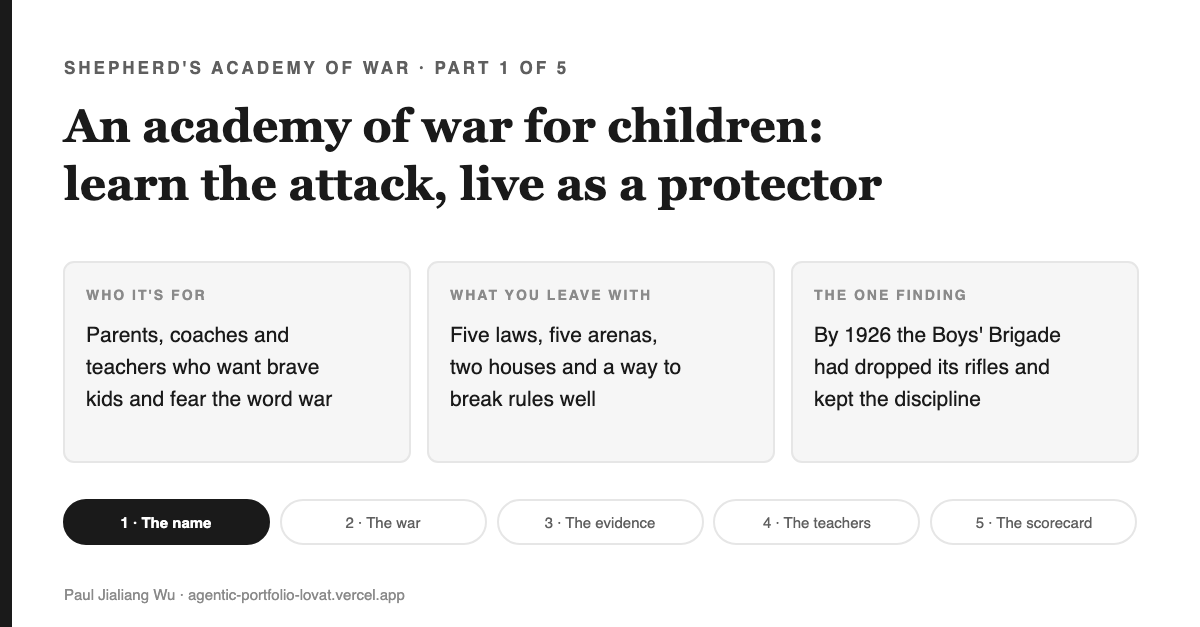
1-minute takeaway
What this is. Part 1 of five on Shepherd's Academy of War (SAW), a family academy I started with my two sons, 11 and 7. It explains the three words in the name. An Academy of War for children teaches real skill, including how an attack works, and fixes in writing where that skill may be aimed: no person is ever the enemy.
Why it matters. Words reach strangers without their intent. In June 2026 a church's children's program about spiritual warfare went viral for its soldier costumes and air rifles. Police found no crime, and the church still became a national story. If you lead children under a strong name, you owe the public a definition before they supply their own.
What you can do after reading. Take home the five laws, the five arenas and the two houses (David rescues; Daniel refuses and rebuilds the rule). Run the 30-day rescue log with one child, try the five-step way to question a rule, and hold us to the three tripwires on the name.
Shepherd's Academy of War — the series spine
▶ See it running: open the live demo public · no sign-in
- The name — learn the attack, live as a protector this episode
- The war — five arenas, and a last battle with one fighter episode 2
- The evidence — courage training that works, and what backfires episode 3
- The teachers — guest instructors give content, not contact episode 4
- The scorecard — one drill, four numbers, six tripwires episode 5
What is Shepherd's Academy of War, and why keep the word "war" in a school for children?
This piece does not answer: Which arenas the war is fought in, who wins the last battle, and what that leaves a child to train for — that is part 2. Which kinds of courage training have evidence behind them, and which backfire — that is part 3. How an elite adult can teach a child without ever being alone with one — that is part 4. How we will know whether any of this works, and what would make us stop — that is part 5.
How to read the labels: EVIDENCE is sourced, DESIGN is how SAW is built, OPEN is not yet tested, and LENS is my own conviction.
A note before we start: these are my own views, not my employer's. I'm a Christian and this series says so plainly. If you read from another faith or none, the practices here also stand on research you can check, and I've labelled which claims are evidence and which are conviction. Every verse is quoted from the World English Bible (WEB), which is public domain, exactly as bible-api.com returns it. A translated edition of this article translates the WEB; it is not a published Bible in that language.
What this part covers: an Academy of War for children, and who it is for
Three weeks ago, on car rides with my two sons, I started something we call Shepherd's Academy of War. Daniel is 11. David is 7. Enrollment: two. Faculty: one dad. Campus: the back seat.
This series is what I am writing before I build anything. Part 1 is about the name, because the name is the first thing a stranger meets and the word "war" next to the word "children" should make any sensible adult slow down. It made me slow down, three weeks late. This part is for parents, coaches and teachers who want brave kids and are uneasy about warrior talk, and for anyone curious whether the word can be used honestly at all.
SAW grows out of an earlier project. In June I wrote about raising my sons as builders, and last month about learning through play. The field lab those came from is live at daniel-and-david.vercel.app: you can open the free Builder Loop app and three small family apps there today, and they run on your own device. That part is real. What you will not find there yet is anything called SAW. The academy is three weeks old, no instructor is confirmed, and nothing has been measured.
The picture: the sparring room has a door
The play series used one picture, a martial arts club, and I'll keep it. In that series the question was what happens inside the room. This one is about the door.
A good club teaches a white belt two things before any technique. How to fall without getting hurt. And when not to fight. Only then does it teach anything that could hurt someone, and it keeps teaching the first two forever. A bad club skips straight to the hitting. From the street you cannot tell them apart. Both have a sign that says "martial arts".
| In the club | In Shepherd's Academy of War |
|---|---|
| The sign over the door | The name. It says "war", and it owes the street an explanation |
| Learning to fall first | A child learns to take a hard thing safely before attempting a bigger one |
| "When not to fight" | The first law: no person is ever the enemy |
| The technique, attack included | Real skill. You cannot block a move you have never learned to throw |
| The bow before and after | Fierce and gentle practised together, every time |
| The rules of the mat | Where the skill may be aimed, fixed in writing before the first lesson |
| Walking a smaller kid home | The rescue. It is the first thing we count |
LENS A name is the sign over the door. If the sign says "war", the first sentence under it has to say what kind.
Learn the attack, live as a protector
LENS To be a successful defender you need to be trained as an excellent attacker. To be good at cyber security you have to be able to hack. A goalkeeper who has never taken a penalty is guessing.
EVIDENCE Security work is built on this. The U.S. standards body defines a red team as "a group of people authorized and organized to emulate a potential adversary's attack" so that the defenders learn what works (NIST glossary). Note the first adjective: authorized. Intelligence analysts are trained the same way, with drills named Devil's Advocacy and Red Team Analysis, to attack their own conclusions before an opponent does (U.S. Government tradecraft primer, 2009).
Jesus put both halves in one sentence when he sent his students out:
“Behold, I send you out as sheep among wolves. Therefore be wise as serpents, and harmless as doves.
— Matthew 10:16 (WEB, World English Bible)
Know how the serpent thinks. Stay harmless anyway. C. S. Lewis, writing in 1940 with bombers overhead, argued that the knight is no halfway point between ferocity and meekness. He is both, at full strength ("The Necessity of Chivalry", as quoted at Mere Inkling). Both dials go all the way up. A harmless child who is kind has made no choice. A capable one who is kind has.
DESIGN What changes with age is the form of the attack, and what never changes is where it may be aimed. For a seven-year-old and an eleven-year-old, it means technique under control, red-team thinking against their own ideas, and learning how an attack on a system works only inside sandboxes built for teaching, with an adult. Part 3 gives the evidence for those limits.
One war, five arenas
A second conviction, and I know it is not the common one among Christians. LENS The common view I meet among Christians is that spiritual warfare is invisible and inward only. I believe the war the Bible describes, which our family calls the Omega War after the one who says "I am the Alpha and the Omega" (Revelation 22:13, WEB), is fought in every arena at once: spiritual and physical, financial and geopolitical, in networks and in minds, and at every scale from one choice in one child to nations and centuries. Fought, for us, by serving, standing and refusing. Never by taking charge, and never against a person.
LENS Four passages put the conflict in markets, governments and a building site. Revelation's beast controls who may "buy or to sell" (13:17). Its fallen city is described by a cargo list that ends with "people’s bodies and souls" (18:13, WEB). Daniel's whole story happens inside a foreign government. And when Nehemiah's builders were threatened, each one "with one of his hands did the work, and with the other held his weapon" (Nehemiah 4:17, WEB).
DESIGN So the academy trains in five arenas, and part 2 maps each one to the text.
| Arena | What a child trains | The attack they learn to understand |
|---|---|---|
| Body | Strength, endurance, safe falling, protecting someone smaller | How a grab, a push and a fall actually work |
| Money | Earning honestly, giving, not being for sale | How a con, a debt trap and a bribe work |
| Information | Checking claims, guarding accounts, telling the truth | How a lie, a phish and a deepfake are built |
| Public life | Serving excellently where you are, refusing what is wrong | How pressure to bow is applied |
| Spirit | Prayer, scripture, a clean conscience | How fear, pride and despair get in |
The first law holds in all five. An arena can be physical. A person is still never the enemy.
LENS One thing this is not. It is not a claim that Christians should take charge of these arenas. The posture is Daniel's: serve, stand and refuse. He served a foreign government with distinction and never tried to take it over.
Three words, read slowly
Shepherd. The name starts here on purpose. The shepherd I have in mind is the one my younger son shares a name with.
He also chose David his servant, and took him from the sheepfolds; … So he was their shepherd according to the integrity of his heart, and guided them by the skillfulness of his hands.
— Psalm 78:70-72 (WEB, World English Bible)
Two measures: integrity of heart, skill of hands. LENS That is the whole curriculum, and the order matters.
Academy. A place where you practise something until you can do it without the teacher. Ours meets in a car, so the standard is modest.
War. This is the word that needs defending. It comes from a line David wrote:
Blessed be Yahweh, my rock, who teaches my hands to war, and my fingers to battle:
— Psalm 144:1 (WEB, World English Bible)
And it is fenced, immediately, by a line Paul wrote a thousand years later:
For our wrestling is not against flesh and blood, but against the principalities, against the powers, against the world’s rulers of the darkness of this age, and against the spiritual forces of wickedness in the heavenly places.
— Ephesians 6:12 (WEB, World English Bible)
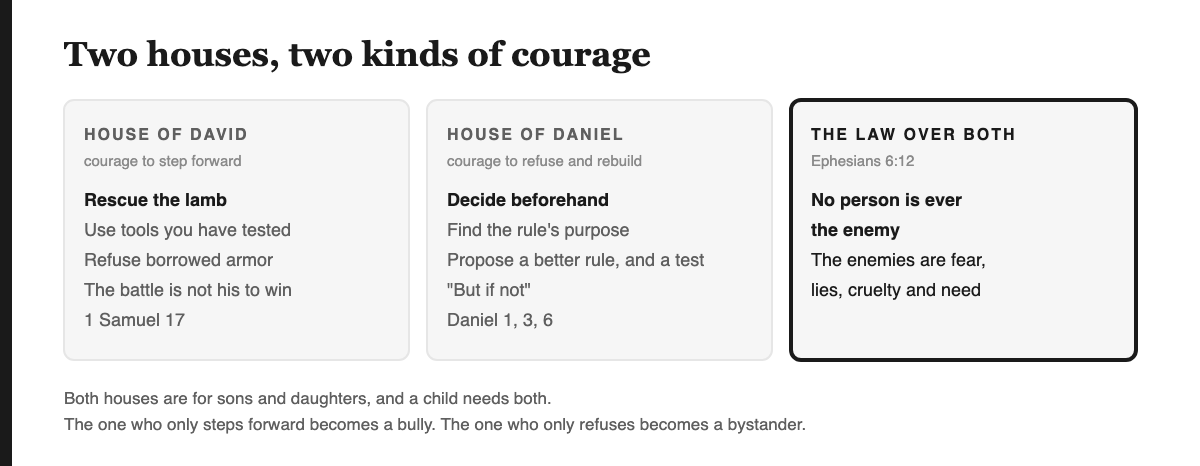
Not against flesh and blood. DESIGN In this academy that sentence is a rule a child can repeat: people are never the enemy. The enemies have names like fear, lies, cruelty and need. No person, no family, no group, no nation and no party ever goes in that slot. (Scripture has passages where nations are judged, and part 2 quotes one. The judging there is God's. It is never handed to a child, or to me.)
What the word costs in 2026
First, what the word costs.
EVIDENCE In September 2026 the Public Religion Research Institute published a survey of 22,111 American adults on Christian nationalism. Support for political violence ran from 17% among those who reject it to 28% among its firmest adherents (PRRI, 2026). In a Pew survey reported in May, 59% of U.S. adults had heard of the term (Detroit Catholic, 2026). A Christian father who puts "war" in the name of a children's program will be read through that lens by default. I am not that, and saying so is my job, not the reader's.
EVIDENCE In June 2026 a church in Lexington, Kentucky ran a vacation Bible school skit about spiritual warfare, with adults in soldier costumes and air rifles and children chanting along. The pastor said it was a 32-year tradition. The video went viral. Police said no crime was involved and pointed complaints to the state's child-welfare cabinet (WKYT, 2026). LENS They meant Ephesians 6. The clip showed rifles and chanting children, and nothing of what they meant.
EVIDENCE A whole profession has walked this road. In 2015 Sue Rahr and Stephen Rice wrote that American policing had drifted toward a mindset of "warriors at war with the people we are sworn to protect and serve", and argued for the word "guardian" instead (Rahr & Rice, 2015).
And the acronym is SAW. A horror franchise with that name confirmed its eleventh film on 24 September (Toy People News, 2026). I named a children's academy after it by accident, and checked three weeks later.
Why we are keeping it, for now
EVIDENCE In 1910 the philosopher William James, a committed pacifist, argued that peace would not last unless it found a way to grow the virtues war grows: courage, hardiness, giving up private comfort for something larger. "Martial virtues must be the enduring cement", he wrote, and he proposed sending the young against hardship instead of against people: mines, fishing fleets in December, road-building (James, 1910). He called it the moral equivalent of war.
EVIDENCE Three youth movements that lasted moved the same way. The Boys' Brigade began in Glasgow in 1883 with drill and dummy rifles, and in 1926 dropped the rifles and kept the discipline (Boys' Brigade). Scouting began as a rewrite of an army manual, tested on 22 boys in 1907, and worked once it was reframed around explorers and a promise (Scouting for Boys). Outward Bound opened in 1941 to help young seamen survive, and trained them through expeditions and rescue (Outward Bound).
EVIDENCE The newest mainstream version arrives on 20 November 2026: Apple's film of Way of the Warrior Kid, about a Navy SEAL uncle and his nephew. Apple's own summary says "Instead of teaching his nephew how to fight, Jake shows Marc what real courage is" (Apple, 2026). That is not quite my line, since I think the nephew should learn technique too. It does show where a large studio expects the public to stand.
LENS So here is my bet. A softer name would be safer, and it would also let me dodge the question. Children already know there is something to fight. They meet fear, lies and cruelty in the first week of school. I would rather name the fight and aim it than pretend it isn't there. OPEN Whether a stranger reads the name the way I mean it is untested. The tripwires below say what would make me drop it.
The five laws
DESIGN These come from the research in this series. Each later part earns one or two of them.
- People are never the enemy. Paul names spiritual powers (Ephesians 6:12). For a child we name what those powers do: fear, lies, cruelty and need.
- Every fight ends in a rescue. Skill is for something. If nothing was protected, fed, fixed or freed, it did not count.
- Fierce and gentle, both to the nth. Real capability, attack included, under rules written first. Plato warned that guardians must be "dangerous to their enemies, and gentle to their friends", or they turn on their own (Republic, Book II).
- Tested tools only. No borrowed armor, no ranks, no burden heavier than the child.
- The last battle is not ours to win. The long war is ours to serve in, in every arena. The final one has its own fighter, and we never tell a child that history depends on their strength. Part 2 is about this one, and about testing my own first sentence against the text.
Law 4 also answers a question the play series raised. Promised prizes shrink the wish to keep going, so there are no belts and no badges here. A rescue is its own record.
The two houses
My sons share their names with two people in the Bible, and the two are opposites. I want them to resemble both.
David steps forward. Before the famous fight, his job was sheep:
David said to Saul, “Your servant was keeping his father’s sheep; and when a lion or a bear came, and took a lamb out of the flock, I went out after him, and struck him, and rescued it out of his mouth. When he arose against me, I caught him by his beard, and struck him, and killed him.
— 1 Samuel 17:34-35 (WEB, World English Bible)
His fighting record is a list of rescues, and they were real fights. He could get the lamb back because he had learned to stop a lion. When the king offers him royal armor he hands it back: “I can’t go with these; for I have not tested them.” (1 Samuel 17:39, WEB).
Daniel refuses, and then rebuilds. Taken as a teenager into a foreign empire, he never raises a hand. He decides beforehand, asks politely, proposes something better, does excellent work, and keeps praying with the window open after it is made illegal.
If it happens, our God whom we serve is able to deliver us from the burning fiery furnace; and he will deliver us out of your hand, O king. But if not, let it be known to you, O king, that we will not serve your gods or worship the golden image which you have set up.”
— Daniel 3:17-18 (WEB, World English Bible)
"But if not" is courage that does not depend on being rescued. Those words belong to Daniel's three friends, and the house is named for all four.
LENS A child needs both houses. The one who only steps forward becomes a bully. The one who only refuses becomes a bystander. EVIDENCE An honest note: David is not a gentle figure. The verse above ends with a dead lion, and later he does bring down Goliath. I will not sand that off for my sons. The skill was real, and it was learned in years of unseen practice guarding sheep. The lamb is what it was for.
Groundbreakers: break the rule to keep its purpose
There is one more thing the House of Daniel teaches, and it is the one people least expect from an academy with laws. LENS I train my sons to be groundbreakers and future makers, and that means training them to break rules. Carefully, and for a reason.
Look at what Daniel actually does in chapter 1. The rule is the king's menu. He does not simply refuse it, and he does not sneak around it. He goes to the official whose job is to enforce it, works out what the rule is for, which is healthy trainees, and proposes an experiment that serves that purpose better:
“Test your servants, I beg you, ten days; and let them give us vegetables to eat, and water to drink. Then let our faces be examined before you, and the face of the youths who eat of the king’s dainties; and as you see, deal with your servants.”
— Daniel 1:12-13 (WEB, World English Bible)
The official agrees, runs the test for ten days, and changes the rule on the evidence. Nobody was humiliated and nobody was defied. The rule's guardian became the co-author of a better rule.
DESIGN That is the method I mean to teach, in five steps.
- Find the assumption. What did the people who made this rule take for granted?
- Find the purpose. What was it designed to protect or produce? Jesus put the whole idea in one line: "The Sabbath was made for man, not man for the Sabbath" (Mark 2:27, WEB).
- Find the shift. What has changed since, so that the rule now falls short of its own purpose, or even works against it?
- Ask five whys with the people who guard the rule. With them, and never about them behind their backs. They usually know the purpose better than you do.
- Propose the new rule, and a test. Ten days, a small trial, a measure both sides accept. If the test fails, the old rule stands and you have learned why it was there.
EVIDENCE The first half of this is an old discipline. G. K. Chesterton's parable of the fence, from 1929, says a reformer may only remove a fence across a road once he can explain why it was put there (Chesterton, *The Thing*, as described on Wikipedia). LENS The second half is what I add for my sons: once you can explain it, and the reason has expired, you owe the world a better fence.
Breaking a rule this way builds something, because the conversation with its guardians converges on the purpose you both care about. And it applies to this academy's own laws. A child who can show me, with five whys, that one of them now defeats its purpose has done exactly what the academy is for.
Five whys: why would a program for brave children keep the word it is most afraid of?
- Why keep "war"? Because the children already face things worth fighting, and an unnamed fight gets aimed by someone else. Evidence: James's argument that peace needs a moral equivalent of war (1910).
- Why is naming it risky? Because a warrior word with no stated enemy picks up whatever enemy is nearby. Evidence: policing's drift toward "warriors at war with the people we are sworn to protect and serve" (Rahr & Rice, 2015).
- Why does the enemy slot fill unless someone fills it first? Because fear is easier to teach than restraint, and a group feels closest when it has someone to be against. Evidence: 28% support for political violence among Christian nationalism's adherents, against 17% among those who reject it (PRRI, 2026).
- Why did some movements escape that? Because they wrote the restraint into the structure, and removed the props that contradicted it. Evidence: the Boys' Brigade dropped its dummy rifles in 1926 and kept the discipline (Boys' Brigade).
- Why isn't a good intention enough? Because intent does not travel with a name or a clip. Evidence: Lexington, where a 32-year tradition became a national story about children and rifles (WKYT, 2026). The root: a fighting word is safe for children only when the enemy, the weapon and the winner are fixed in writing before the first lesson. Otherwise the word does the choosing.
🔥 Your 30-day mission: the rescue log
For one child aged 5 and up, plus one adult. You need an index card on the fridge. 30 days.
- Day 1: say the first law out loud together. "People are never the enemy." Then ask the child to name three real enemies. (Expect broccoli. Accept one joke, then ask again.) If they name a person, ask what that person did, and write down the deed: the meanness, not the kid.
- Days 1–30: log rescues. One line each: what was protected, fed, fixed or freed, and what it cost you. Carrying groceries counts. Sitting with the kid nobody sits with counts double.
- Once a week: a Daniel moment. One thing the child decided beforehand not to do, and didn't. Or one rule they questioned the right way: found its purpose, asked the person who guards it, and offered a better one.
- For the adult: no prizes. Once a week, say one specific true thing ("you noticed she was alone before I did").
What to measure: rescues in week 1 and in week 4. Contribute: post both numbers in the comments.
Under 13? Ask a parent to post for you. No names, only an age range (5–7, 8–12, 13–15).
Operate: the thing that runs
In one sentence: this page cannot ship if it breaks its own laws. DESIGN The article you are reading is generated from a source file, and a script, `scripts/check-saw.mjs`, reads that source before every build. It fails the build if any part claims an instructor we do not have, uses violent language about people, describes a person's illness as a spiritual verdict, drops the honest status, or prints a Bible verse that does not match the World English Bible.
Feedback: the number, and what it cannot see
DESIGN The number is rescues per week, logged by the child. If week 4 is higher than week 1, something grew. OPEN Its blind spots are real. A child can log rescues to please a parent, which is the prize problem coming in by the back door. A rescue log says nothing about what a child does when no adult is near. And one family is a story, not a result. Reader numbers in the comments are the first thing that could turn it into more.
Feedforward: three tripwires for the name
DESIGN Decided now, before any results:
- If a child in this academy ever names a person or a group as the enemy and I trace it to our own language, the word "war" comes off the door that week.
- If, by 11 January 2027, more than half of the first twenty strangers who see the name describe it as militant when asked what they think it is, the public name changes and the family keeps its nickname.
- If I catch myself defending the name more than running the drill, the name was vanity. Same outcome.
Where this part sits in the series
| Conception | Core concept | Governing principle | Main contributors | |
|---|---|---|---|---|
| The name (this part) | Psalm 144:1 → Plato's guardians (c. 375 BC) → the Boys' Brigade (1883) → William James (1910) | the shepherd-warrior: able to attack, committed to protect | no person is ever the enemy; every fight ends in a rescue | Plato · the Boys' Brigade · Baden-Powell · William James · C. S. Lewis · Sue Rahr |
| The war (part 2) | Revelation (c. AD 95) → Tertullian (c. 200) → the Catechism (1992) → Bauckham (1993) | the long war has every arena; the last battle has one fighter | never tell a child the outcome of history depends on their strength | John of Patmos · Tertullian · G. E. Ladd · Richard Bauckham · J. R. Michaels |
| The evidence (part 3) | Campbell's boot-camp review (2005) → the practice corrections (2014) → MYRIAD (2022) → risky play (2024) | courage is chosen risk plus self-control, practised small | remove hazards, keep risks; fierce and gentle together | Macnamara · Güllich · Canadian Paediatric Society · the MYRIAD trial team · American Academy of Pediatrics |
| The teachers (part 4) | Scouting's two-adult rule (1988) → the Safe Sport Act (2017) → SafeSport's athlete survey (2024) | content, not contact | no adult is ever alone with a child, and a credential is not a safeguard | U.S. Center for SafeSport · Travis Manion Foundation · Trail Life USA · Bond & DePaulo |
| The scorecard (part 5) | Deuteronomy 6:7 → the Army's untested rollout → MYRIAD (2022) | a drill small enough to run, a count that can go down | write the tripwire before you see the result; medicine and prayer together | Eidelson, Pilisuk & Soldz · Steenkamp, Nash & Litz · Southern Baptist Convention (2013) · Lifeway Research |
Same story, five exits
| If you are… | The decision this changes | One action |
|---|---|---|
| A student (10–15) | What counts as brave | Log one rescue that cost you something, and question one rule by finding its purpose first |
| A parent | Whether to teach a child to fight at all | Teach the skill, and fix the aim in writing first: "people are never the enemy" |
| A coach or teacher | Your team's name, chant and props | Ask what a stranger would think from a 10-second clip |
| An engineer or founder | How you train defenders | Red-team your own plan, with authorization, before anyone else does |
| A pastor or youth leader | Spiritual-warfare teaching for children | Remove the props; keep the restraint; say who the enemy is not |
Build it in 30 minutes
- Input: one child, one adult, one index card.
- Output: a first law said aloud, and a 30-day line of rescues.
- Invariant: no person is ever written in the enemy slot. No prizes.
- Stop rule: if logging becomes performing for the adult, stop counting for two weeks and just notice.
- Minimal record: `date, what_was_protected, what_it_cost`.
- Deliberately missing: ranks, uniforms, and any instructor other than a parent. Part 4 explains why that comes later and slowly.
TRUE
- Transferable. Any team with a strong name (a sales "war room", a "tiger team", a school "house") can run the same check: name the enemy, the weapon and the winner in writing.
- Recursive. This article is wrong if the name is read as militant by most strangers. Re-check on 2027-01-11 against the second tripwire, and say so here either way.
- Understandable. In one sentence: we teach kids real skill, even how an attack works, so they can protect people, and nobody is ever the enemy. The move it asks of you is to suspend: hold your first reaction to the word for one page.
- Experience it. Open the field lab at daniel-and-david.vercel.app and run the rescue log on a card tonight. What would prove me wrong: twenty strangers and a majority who hear a militia.
- Built. What runs today is the field lab, the index card, and the gate on this page. SAW as an institution does not exist yet.
- Taught. Teach the two houses to someone under 12 and ask which house they need more practice in. Their answer is the lesson.
5S self-score, with evidence
| S | Self-score | Evidence |
|---|---|---|
| Simple | 4/5 | One picture, the club's door, and one rule a seven-year-old can say: people are never the enemy. One line for the rest: learn the attack, live as a protector. |
| Solid | 4/5 | Every figure links to a page I re-fetched on 2026-10-11; five quotations checked word for word; Lewis is paraphrased from a secondary page; verses checked against the WEB. Wikipedia is used for three history dates. |
| Sharp | 4/5 | Rahr, James, Plato and the NIST definition quoted with sources; the root names the mechanism: fix the enemy, the weapon and the winner in writing first. |
| SMART | 4/5 | A 30-day log with one number and three dated tripwires. |
| Super-fun | 3/5 | The acronym, which nobody planned, and broccoli as an enemy of the people. |
Sources
- Public Religion Research Institute (2026), survey release on Christian nationalism, 22,111 adults: https://prri.org/press-release/survey-new-report-analyzes-the-two-thirds-of-americans-who-resist-christian-nationalism/
- Detroit Catholic (2026), report of the Pew Research Center survey: https://www.detroitcatholic.com/news/more-americans-aware-of-christian-nationalism-but-negative-view-of-it-prevails
- WKYT (2026-06-30), Lexington vacation Bible school video: https://www.wkyt.com/2026/06/30/lexington-church-faces-backlash-after-vacation-bible-school-video-goes-viral/
- Rahr, S. & Rice, S. (2015), From Warriors to Guardians, Harvard Kennedy School / National Institute of Justice: https://www.ojp.gov/pdffiles1/nij/248654.pdf
- James, W. (1910), "The Moral Equivalent of War": https://constitution.org/wj/meow.htm
- Plato, Republic, Book II, Jowett translation (Project Gutenberg): https://www.gutenberg.org/cache/epub/1497/pg1497.txt
- NIST Computer Security Resource Center, glossary entry "red team": https://csrc.nist.gov/glossary/term/red_team
- U.S. Government (2009), A Tradecraft Primer: Structured Analytic Techniques for Improving Intelligence Analysis: https://www.cia.gov/resources/csi/static/Tradecraft-Primer-apr09.pdf
- C. S. Lewis, "The Necessity of Chivalry" (1940), as quoted at Mere Inkling: https://mereinkling.net/2016/09/13/the-urgent-need-for-chivalry/
- Apple (2026), press release for Way of the Warrior Kid: https://www.apple.com/tv-pr/news/2026/02/apple-original-films-way-of-the-warrior-kid-starring-chris-pratt-linda-cardellini-and-jude-hill-to-premiere-globally-november-20/
- Wikipedia: Boys' Brigade, Scouting for Boys, Outward Bound (history dates only): https://en.wikipedia.org/wiki/Boys%27_Brigade
- Toy People News (2026), Saw XI confirmed: https://www.toy-people.com/en/?p=114774
- Wikipedia: G. K. Chesterton (the fence parable, from The Thing, 1929): https://en.wikipedia.org/wiki/G._K._Chesterton
- World English Bible via bible-api.com (Psalm 78:70–72; Psalm 144:1; Ephesians 6:12; Matthew 10:16; 1 Samuel 17:34–35; Daniel 1:12–13; Daniel 3:17–18): https://bible-api.com/
- The research dossier behind this series: https://github.com/wjlgatech/daniel-and-david/blob/main/docs/research/shepherd-warrior-formation.md