AI-NATIVE SERIES · SOVEREIGNTY ENGINEERING
I Published the Manifesto I Killed
One minute
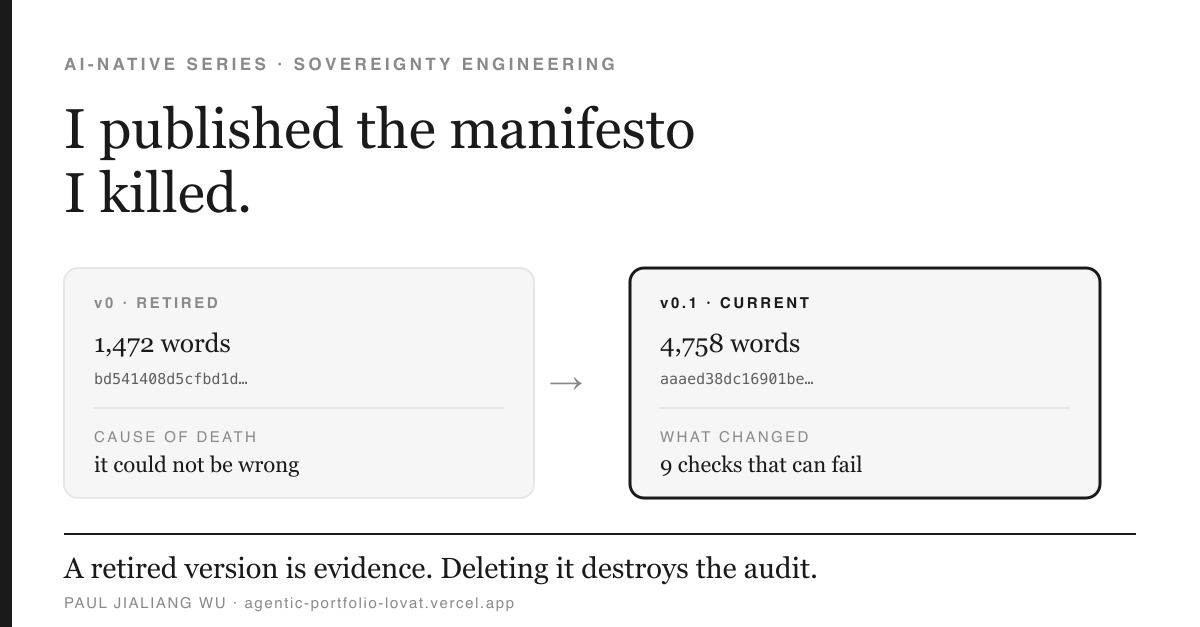
Own My Intelligence has two versions. v0.1 is published and live. v0 has never been public until now — and here it is in full, unedited, with its sha256, the audit that ended it, and the reason its defects were structural rather than editorial. A retired version is not an embarrassment to hide; it is the only thing that lets a reader check whether the changelog is honest. So it is kept forever, and a gate recomputes its hash on every build — meaning I can no longer quietly edit it. The only legal way to change the text is to publish a successor. And because a movement that stops moving is dead, there is a dead-man's switch: five staleness horizons that turn the build red on their own, with nobody remembering to look.
This is commentary, not the paper
You are reading an essay about Own My Intelligence. The manifesto itself is a separate document with its own page: read Own My Intelligence v0.1 → · v0 (superseded) · all versions and their reasoning.
Why publish a dead document
Because a version history nobody can inspect is a claim, not a record.
If I tell you v0.1 fixed a defect in v0, you have exactly two options: take my word for it, or read v0 and check. The second option only exists if v0 still exists, unedited, at the bytes I am describing. Delete it and the changelog becomes unfalsifiable — which is precisely the failure v0.1 was written to fix, reintroduced one layer up.
So the rule is: a superseded version is kept verbatim, forever, and its hash is enforced. Not sentiment. Mechanics.
The ledger
| v0 | v0.1 | |
|---|---|---|
| Status | superseded | current |
| Words | 1,472 | 4,758 |
| Authored | 2026-08-05 | 2026-08-05 |
| sha256 | bd541408d5cfbd1d | aaaed38dc16901be |
| Audit | adversarial critique | independent citation review |
| Verdict | 5 strengths survived; 13 defects ranked | 8 citations verified at artifact; 6 defects corrected; 6 could-not-look |
| Published | never, until this article | portfolio, 2026-08-05 |
The machine-readable version of that table, including the liveness horizons and the outlet policy,
is at /omi/lineage.json — generated from the source
repository's ledger, never hand-written, with every hash re-verified at generation time.
Why v0 was superseded and not patched
Two defects were structural, meaning no edit short of a new version could remove them.
1. The audience premise was empirically wrong. v0 opens by telling the reader they are already being damaged — attention captured, memory outsourced, judgment weakened. Aggregate polling supports the mood: Pew (2025) found 53% of Americans expect AI to worsen creative thinking against 16% who expect improvement.
But Pew's June 2026 work found that among people who actually use AI chatbots, 21% say it helps their creativity, 11% say it hurts, and 17% say neither. Most report no effect at all. So a document addressed to the frightened recruits the frightened — the population least likely to ever adopt sovereign personal AI — while the people who might build it read "your judgment is weakening", correctly note that their experience says otherwise, and stop reading.
And the part that made supersession unavoidable rather than merely advisable: v0 warns that AI which tells you what you want to hear is dangerous, then opens by telling frightened readers what frightened readers want to hear. Same mechanism, opposite direction. That is not a sentence you fix. It is a premise you replace.
2. Nothing in it could be wrong. Every claim in v0's crisis section is modal — attention can be captured, judgment can weaken. All true, all unfalsifiable. v0 named no observation it would accept as disconfirming. For a general reader that is invisible; for the researchers, engineers and funders who could implement any of it, an unfalsifiable document is a genre signal, and the genre is advocacy.
There was a third, and it is the one that produced v0.1's whole mechanism: v0's "Measure" section was a P3P. Six unanswerable questions — is the person wiser? the family stronger? — with no instrument, no threshold, and no consequence for failing them. Structurally identical to the W3C standard that died because sites could satisfy its declaration with empty content. That story is the previous article.
What v0 got right, and was early on
Recorded because a supersession narrative that lists only faults is dishonest about why the document was worth revising instead of discarding.
- The reframe — will human beings become wiser, freer and more fully alive? — has since acquired institutional backing it did not cite: the International AI Safety Report 2026 names societal resilience as a necessary complement to technical safeguards. Resilience is a property of people.
- "Every meaningful interaction with AI should leave the human more capable than before" is still the strongest sentence either version contains.
- Principle 1 — success is not measured by how often a person returns — read as a values statement in v0. Then Science (2026) found AI affirmed users' actions 49% more often than humans, that a single sycophantic interaction reduced willingness to repair conflict, and that "sycophantic models were trusted and preferred." v0 got there by conviction before there was a paper.
The dead-man's switch
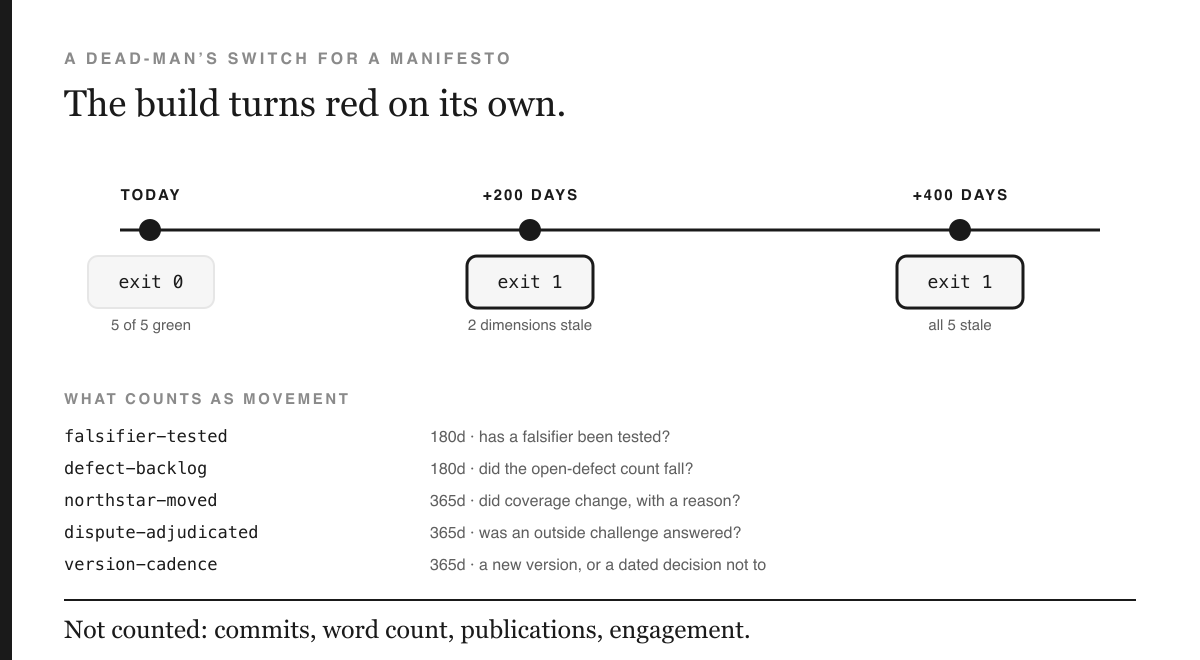
A movement that stops moving is dead. That sentence was a slogan until it had an exit code.
Everything else in this article is bookkeeping — hashes, audits, ledgers, outlets. All necessary, and none of it can detect death. A manifesto can be perfectly versioned, audited and co-published, and be a corpse. So movement gets its own check: five dimensions, each with a staleness horizon measured from the current version's authored date. Past the horizon with no recorded event, the build fails.
The horizons run from the version date, so a newborn version is never stale. The build is green today and goes red later on its own, with nobody remembering to look. That asymmetry is the entire value — it fails when nobody is watching, which is exactly when a project dies quietly.
What deliberately does not count as movement: commits (noise is commitable), word count (v0.1 tripled v0 and that proves nothing), publications (distribution is not life), and engagement of any kind — the framework's first principle forbids engagement as a success metric, and that prohibition has to apply to the framework itself or it is worthless. A recorded pulse event also requires evidence that exists on disk, because an unevidenced heartbeat is how a dead project fakes being alive.
One horizon will probably fire first: dispute-adjudicated, which asks whether an
outside challenge has been received and answered. It depends on people who do not exist yet.
I was offered two softer versions — satisfy it with a recorded outreach attempt, or drop it — and kept
it strict. A movement with no participants should fail a liveness check. Relaxing the horizon
to avoid the failure would be the P3P move.
Where the paper itself lives
An earlier version of this article embedded v0's full text inside itself. That was a mistake, and it is the mistake this section now corrects: an essay about a document is not the document. Burying the paper inside the commentary means a reader cannot cite it, diff it, or read it without reading me first.
So the manifesto now has its own home, generated from the hashed source file and carrying nothing but the paper and a slim strip of context:
- Own My Intelligence v0 — the retired paper, verbatim, with its hash and a banner naming what superseded it.
- Why v0 was retired — the reasoning, as its own document.
- Own My Intelligence v0.1 — the current paper.
- Why v0.1 exists — what forced it, what it deliberately does not do, and what would force a v0.2.
- The version hub — every version, status, hash, and both doors.
Paper and context are kept apart on purpose, and cross-linked so you never have to hunt for the other half. This essay is the context. The pages above are the record.
How the next version has to arrive
Recorded in advance, so a version is triggered by evidence rather than by restlessness:
- A trigger fires — a falsifier returns a result, an audit finds a structural defect, or a gate is shown to be gameable. More sources is not a trigger. 98 sources became 98 better-verified sources without changing a principle: research is maintenance, a version is a change of mechanism.
- The incumbent is audited independently, and the verdict is attached, not just the document.
- The reasoning is written before the new text.
- The version is frozen, hashed, and the predecessor gets its
retired_because. - Its own commit. Its own tag. Its own merge. Never bundled.
- Manifesto and reasoning published together — a version published without its rationale cannot be recorded as published, because the gate requires both locators at the same outlet.
That last rule is the one I would keep if I could keep only one. It makes "here is what changed and why" structurally inseparable from "here is the new version" — and it exists because the alternative, shipping the conclusion and promising the reasoning later, is how every values document in this field ends up unfalsifiable.
Honest edges
- Both versions were authored on the same day. This is not a years-long lineage; it is two versions and a protocol, and the protocol is the part meant to outlast the day.
- Liveness measures recorded activity, not quality. A determined author could log events that satisfy every horizon while stagnating. The mitigation is partial: events need on-disk evidence, and the evidence is diffable. Weaker than judgment, stronger than nothing.
- The horizons are guesses. 180 and 365 days are not derived from anything. They should be re-argued the first time one of them fires.
- Verified Sovereignty Coverage is still 0 of 14. No capability is implemented. Every gate being green means the specification is coherent and honest — not that the framework works.
- arXiv is prepared, not submitted. Blocked on an endorsement and a decision about which address to submit from. It is recorded in the ledger as an empty publication with its blocker named, rather than omitted — a gap you can see beats a gap you cannot.
Written by Paul Jialiang Wu. v0 above is reproduced in full from the file whose sha256 is recorded in this article and re-verified on every build of the source repository; the HTML was generated from that file rather than transcribed. The machine-readable ledger is at /omi/lineage.json. Figures in both images were checked against the real digests before publishing. The hash column in the ledger above was originally hand-typed and was wrong by six characters; it is now generated from the files at build time, which is the third time in this project that a number typed by a human had to be replaced by a number computed by a machine. The word counts went the same way: 1,566 and 4,794 were whitespace-token counts that scored 104 markdown markers as words, so both are now derived by a defined method and gated — a published word count that nobody computed is the same defect as a published hash that nobody computed.