AI-NATIVE SERIES · WEARABLE AI · THE WEARABLE LADDER, EPISODE 1 OF 3
Head-Worn Computers Died 23 Times — 19 of Them Died of Money, Not the Computer
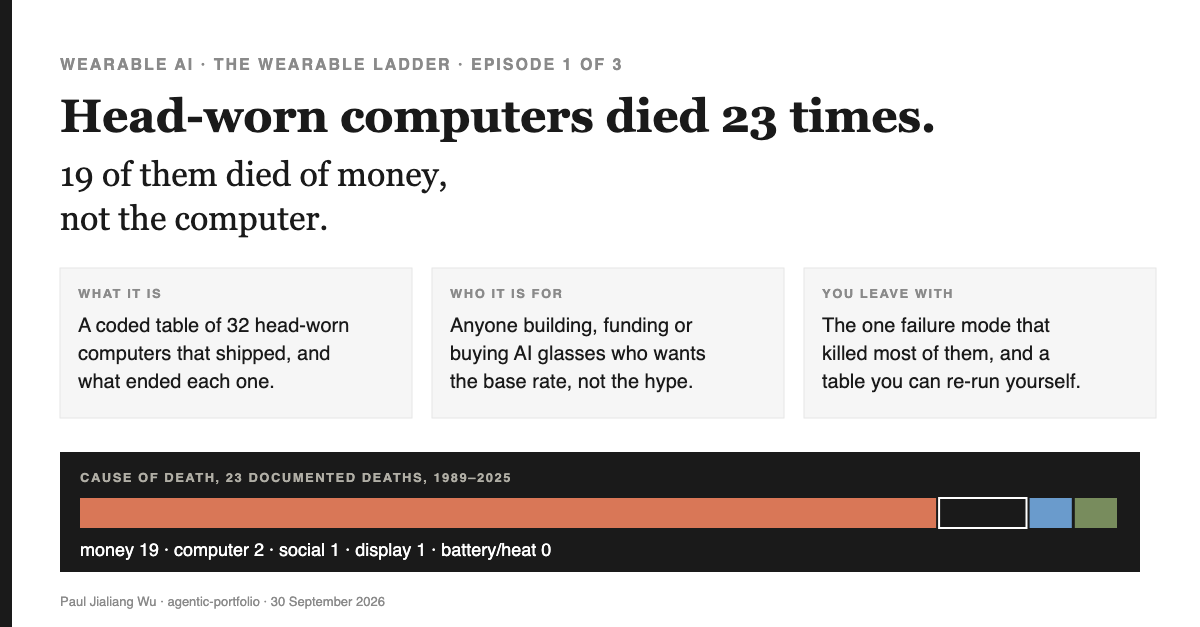
What this is. A table of every head-worn computer I could document that was sold to real buyers — smart glasses, visors and headsets that went on sale between 1989 and 2024 — with the thing that ended each one coded into one of five causes and a source on every row. 32 shipped; 23 died a documented death.
Why it matters. The story everyone tells is that smart glasses failed because the technology wasn't ready, or because people hated being filmed. The data says neither. 19 of the 23 died of money — too expensive for the buyers who actually existed, or the maker ran out of cash or patience. If you are building, funding or buying AI glasses in 2026, that is the failure mode to price in, and it is not the one on the keynote slide.
What you can do after. Name the real base rate in one sentence, check any new glasses launch against the one question that killed its predecessors, and re-run or extend the table yourself — it is committed as data, and a script recomputes every number on this page from it.
The Wearable Ladder — the series spine
- The death table — why head-worn computers failed this episode
- Eighteen laptop tasks, judged by the documentation episode 2
- The prediction ledger — five conditions, eight dated predictions episode 3
The one question this episode answersWhat actually killed the head-worn computers that shipped before 2023?
This piece does not answer what today's glasses can actually do — that is episode 2, the documented surface and the pre-registered road-trip audit — or what has to become true before glasses replace a desk, which is episode 3, the prediction ledger.
What this history of head-worn computers covers, and who it's for
This is episode 1 of The Wearable Ladder, a three-part series on AI glasses: the past, the present, and a dated set of predictions about the future. This episode is the past. It covers every head-worn computer I could find that was actually sold — not demoed, not prototyped — from the Private Eye in 1989 to the Quest Pro, which left Meta's store in January 2025. Glasses and headsets are both in, because the question is about putting a computer on your face, and a table that dropped the headsets would hide half the evidence. Where the split matters I report the glasses on their own.
It is for three kinds of reader. Engineers deciding whether to build on glasses now. Founders and investors deciding whether this is the time it works. And anyone who bought a pair this year and is wondering whether the thing on their face is the next Google Glass. Every number here is recomputed by a script from a committed file, so if you disagree with a coding, you can change one line and watch the headline move.
One picture will carry all three episodes, so let me introduce it as a tool before using it.
One picture for the whole series: a fighter's career
A fighter's career rarely ends on a knockout. That is the thing people outside the sport get wrong. Most fighters retire because the purse stopped covering the camp: eight weeks of coaches, sparring partners, physio and food cost more than the fights paid, and one day the numbers say stop. A few retire because they got beaten. A few get booed out of the building. Almost none retire because they were too tired — cardio is the thing everyone worries about and it is rarely what ends a career.
The map from that to a computer you wear is exact, and every piece of it is load-bearing below:
| In the fighter's career | For a head-worn computer |
|---|---|
| Can you actually throw the punches? | Can the device do the job — the computer, the software, the AI (cause code compute) |
| The cost of the training camp | The bill of materials: the display, the optics, the chips, the battery |
| The purse | What the buyers who actually exist will pay, times how many of them there are |
| The promotion that books you | The channel that sells you: an electronics store, a developer programme, or an eyewear shop |
| Retiring because the purse stopped covering the camp | Death by money — too expensive for its market, or the maker quit (price_market) |
| Losing on a knockout | Death by the computer (compute) |
| Booed out of the arena | Death by social backlash — privacy, stigma, bans (social) |
| Can't see the punches coming | Death by the display — eye strain, a poor picture, a narrow view (display_optics) |
| Gassing out in the third round | Death by battery or heat (thermal_power) |
| Cutting weight to fight in a division with paying cards | Removing the expensive part to hit a price people already pay for glasses |
The death table
The method, in full, so you can check it. For each product I recorded the maker, the year it shipped, the launch price, the launch battery claim, how it ended, and the source for each fact. A product counts as a death only if it shipped to buyers and ended in a documented failure: a discontinuation, a shutdown, a write-down, or a successor that replaced a flop. A normal generational hand-off is not a death — Epson's Moverio line and Vuzix's successors are in the table and are not counted. Two rows never shipped at all, Sutherland's 1968 display and Intel's Vaunt, and they are excluded from every count. The table has 34 rows; 32 shipped; 23 died a documented death.
Each death gets exactly one primary cause from five: money, the computer, social backlash, the
display, or battery and heat. Where the record shows a strong second cause, it goes in a separate
secondary_cause column and is never counted in the headline. The coder's reasoning for every
row is written into the file, in a field called coding_rationale, so a disagreement is an
argument about one sentence rather than about a vibe.
The result. Of 23 documented deaths: 19 money · 2 the computer · 1 social backlash · 1 the display · 0 battery or heat.
The glasses alone, without the headsets: 13 deaths, 11 of them money, 1 the computer, 1 social backlash.
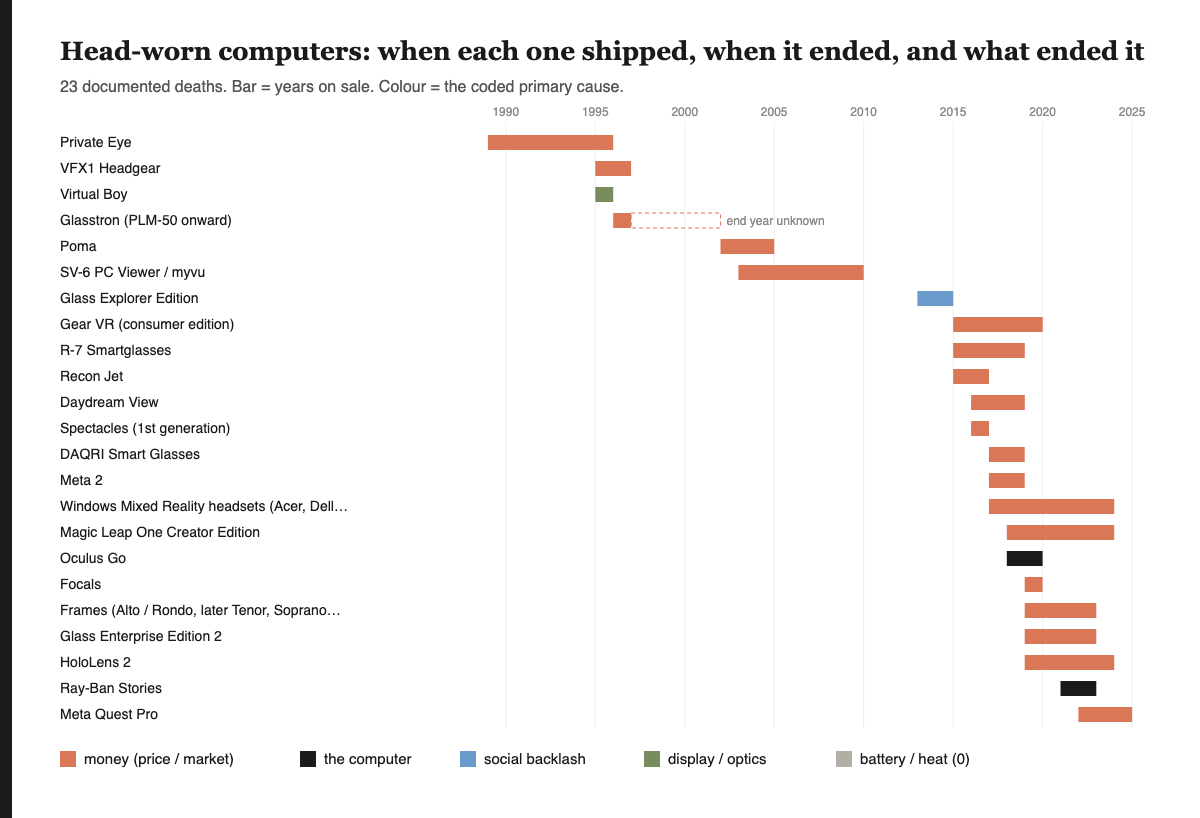
Two things in that result deserve a second look, because they cut against what almost everyone believes.
Battery and heat killed nobody. 0 primary causes. Every review of every one of these devices complained about the battery — Recon Jet's lasted about two and a half hours against a four-hour target in one reviewer's test — and the complaint shows up as a secondary cause 2 times. But it never ended a product on its own. It is the fighter everyone says has no cardio, who somehow never loses a fight on cardio.
Social backlash killed exactly one. Google Glass Explorer Edition, which is also the one everybody remembers, which is why it feels like the rule. The "Glasshole" story is true about Glass. It is not true about the category.
The full table of 23 deaths (price marked * where the figure was not confirmed on a fetched page)
| Product | Form | On sale | Launch price | What ended it | |
|---|---|---|---|---|---|
| Private Eye | glasses | 1989–1996 | $795 | money | source |
| VFX1 Headgear | headset | 1995–1997 | $695 | money | source |
| Virtual Boy | headset | 1995–1996 | $179.95 | display / optics | source |
| Glasstron (PLM-50 onward) | glasses | 1996–? | $900 | money | source |
| Poma | glasses | 2002–2005 | $1,499* | money | source |
| SV-6 PC Viewer / myvu | glasses | 2003–2010 | $1,995* | money | source |
| Glass Explorer Edition | glasses | 2013–2015 | $1,500 | social backlash | source |
| Gear VR (consumer edition) | headset | 2015–2020 | $99.99 | money | source |
| R-7 Smartglasses | glasses | 2015–2019 | — | money | source |
| Recon Jet | glasses | 2015–2017 | $699 | money | source |
| Daydream View | headset | 2016–2019 | $79 | money | source |
| Spectacles (1st generation) | glasses | 2016–2017 | $129.99 | money | source |
| DAQRI Smart Glasses | glasses | 2017–2019 | $5,000 | money | source |
| Meta 2 | headset | 2017–2019 | $1,500 | money | source |
| Windows Mixed Reality headsets (Acer, Dell, HP, Lenovo, Samsung Odyssey) | headset | 2017–2024 | $349 | money | source |
| Magic Leap One Creator Edition | headset | 2018–2024 | $2,295 | money | source |
| Oculus Go | headset | 2018–2020 | $199 | the computer | source |
| Focals | glasses | 2019–2020 | $999* | money | source |
| Frames (Alto / Rondo, later Tenor, Soprano, Tempo) | glasses | 2019–2023 | $199 | money | source |
| Glass Enterprise Edition 2 | glasses | 2019–2023 | $999* | money | source |
| HoloLens 2 | headset | 2019–2024 | $3,500 | money | source |
| Ray-Ban Stories | glasses | 2021–2023 | $299 | the computer | source |
| Meta Quest Pro | headset | 2022–2025 | $1,499.99 | money | source |
Three deaths, told properly
Magic Leap One (2018): booked a stadium, sold a school gym. It launched at $2,295. Its chief executive had hoped to sell at least a million units in the first year; it sold about 6,000 in six months. That is off by a factor of roughly 167. The company cut half its staff and pivoted to enterprise customers in 2020. The narrow field of view is blamed everywhere, but no source I could fetch ties the sales to it, so it sits in the secondary column. The primary cause is the purse.
Snap Spectacles (2016): the cheap one also died of money. At $129.99 it was the least expensive product in the table, which is the useful counterexample: money is not only "too expensive". Snap took a charge of roughly $40 million on unsold inventory and unused parts in 2017, after misjudging demand. And notice what it had already done: no display, a toy's price. It had cut weight and still couldn't sell the fight. Cutting weight gets you into the division; it doesn't sell the tickets.
Ray-Ban Stories (2021): the only glasses death coded to the computer, and what fixed it. Meta and EssilorLuxottica's first pair sold about 300,000 units, with only about 27,000 monthly active users according to a leaked internal document reported by the Wall Street Journal. The return rate was reported at 13%, from users with "issues with connectivity, battery life, importing captured media and more." The coder weighed that list as mostly a software problem, with battery second, which makes it one of only 2 deaths coded to the computer, and the only one among the glasses. And its successor is the most interesting row in the whole table.
What changed in 2023: the fighter cut weight
Ray-Ban Meta shipped in 2023 and is the first pair of smart glasses to sell like a product rather than a demo: EssilorLuxottica reported selling 7 million Ray-Ban and Oakley smart glasses in 2025, more than triple the year before.
Look at what it did not do. It did not add a display — the single most expensive and most fragile part on the bill, the thing Glass, Focals, Magic Leap and HoloLens all carried. It kept a camera, speakers, microphones, and a much better assistant, which fixed the one row where the computer was the cause. And it came in a Ray-Ban frame, sold through the world's largest eyewear company, at a sunglasses price.
In the fighter's terms: it cut weight to fight in the division where the cards pay, and it signed with the promotion that already owns the arenas. The purse finally covered the camp. Be careful with the lesson, though: removing the display was necessary, not sufficient. Spectacles, Bose Frames and Ray-Ban Stories had no display and still died. The one that lived also took the eyewear channel — it cut weight and signed with the promotion that owns the arenas.
Five whys: from "it died" to the root
- Why did head-worn computers keep dying? Because the maker stopped
selling or supporting them. All 23 ended in a discontinuation, a shutdown, a write-down or a
replacement; none was a recall or a ban.
Evidence: the
ending_incidentcolumn ofcontent/series/wearable-ladder/deaths.yml. - Why did makers stop? Because sales were a fraction of plan — Magic Leap sold 6,000 against a hoped-for million; Snap wrote down about $40 million of Spectacles. Evidence: the Magic Leap sales report and Snap's write-down, both linked in "Three deaths, told properly" above.
- Why were sales so low? For most of them, because the price was set by the
parts, not by what the buyers who existed would pay: $1,500 for Glass, $2,295 for Magic Leap, $3,500 for
HoloLens 2, $5,000 for DAQRI. Not for all: four of the money deaths were cheap — Gear VR, Daydream View,
Spectacles and Bose Frames, all $199 or less — and died of demand, not of their bill of materials.
Evidence: the
price_usdcolumn, where the tag says FETCHED. - Why were the parts so expensive? Because each device carried a display
and optics — the most expensive and least mature part of the bill — to do a job most buyers did not have
every day.
Evidence: every counted death except Spectacles, Bose Frames and Ray-Ban Stories put a
display in front of the eyes (Gear VR and Daydream borrowed the phone's) — and the
cheap display-less ones died anyway, which is why the root below is about who the product was for;
formandending_incidentin the data. - Why did they carry the display anyway? Because the product was designed as a computer you wear rather than glasses that happen to compute: it was priced like a computer and sold to people who wanted glasses. That is the root. The one pair that flipped it — no display, an eyewear maker's frame and channel — is the one that sold millions. Evidence: seven million Ray-Ban and Oakley Meta glasses sold in 2025, linked in "What changed in 2023" above.
Operate — the table runs
This is not a list in an article; it is a file the build reads. The operating loop:
content/series/wearable-ladder/deaths.yml     # one row per product, one primary cause each
node scripts/check-wearable-ladder.mjs --metrics   # recompute every number on this page
node scripts/check-wearable-ladder.mjs             # fail if any printed number disagrees
python3 scripts/build-wearable-ladder.py           # rebuild the page, the cover and the timeline
To add a device — the next one to die, or one I missed — add a row with a source, pick one of the
five causes, and write one sentence of coding_rationale. The headline, the cover and the
timeline all regenerate. If you change a coding and forget to rebuild, the build goes red: every
number on this page is marked with the metric it came from, and npm test compares them.
Feedback — what the measurement says, and what it cannot see
The gate goes red when a printed number drifts from the data, when a row has no source, or when a page claims a count the file doesn't support. It is honest about arithmetic. It is blind to four things, and you should weigh the result with them in mind:
- Money is partly a catch-all. Makers rarely say why they stop. When the record only says "discontinued", the death lands in money by default. The secondary column is where the specific weakness shows up, and it names the display 3 times and battery or heat 2 times.
- Price is downstream of parts. A display costs money. So "not the computer" is true of the immediate cause, and a determined reader can argue that expensive hardware is a technology problem one step back. I think that argument is right, and it is why the root in the five whys is the design choice, not the chip.
- One coder. The five-way coding was done once, by one researcher, with the reasons written down. It has not been independently re-coded. That is the cheapest improvement to this table, and the file is shaped to take it.
- Survivors are invisible. A device that never launched, or a start-up that died before shipping, is not in the table. The table is about products that reached buyers.
Feedforward — the tripwires I'm committing to now
A history is only useful if it predicts. So these are written before the outcomes, and the series gate checks their dates:
- If Ray-Ban Meta-class glasses die, the table says it will be money, not the computer.
Specifically: if EssilorLuxottica reports that yearly unit sales of Meta glasses fell, the first
explanation to test is price and channel, not capability. This is tracked as prediction
P7-essilux-20M-yearin episode 3's ledger. - A display pair that is priced like a computer will repeat the pattern. Meta's Ray-Ban Display costs $799 and carries the expensive part back onto the face. If it is discontinued without a cheaper successor — checked on 2027-09-30 against Meta's store page — it is another row in this table, coded money, and I will add it.
- If a death is ever coded to battery or heat, the cardio assumption in episode 3 gets re-read. Episode 3 treats all-day power as a condition to meet, not a cause of death. One thermal death would promote it.
Where this episode sits in the series
| Conception | Core concept | Governing principle | Main contributors | |
|---|---|---|---|---|
| Past (episode 1) | 1968, Sutherland's head-mounted display | a computer you wear, so it follows your gaze | the devices died of economics, not of the computer | Sutherland · Reflection Technology · Google X · North · Snap · Magic Leap |
| Present (episode 2) | 2023 → 2026, camera-and-speaker AI glasses | the glasses are input and output; the thinking happens elsewhere | the phone is the relay, the cloud is the processor | Meta · EssilorLuxottica · Qualcomm |
| Future (episode 3) | the wristband that reads your muscles, plus agents | your intent becomes the input device | what you can say to the machine per second is the new bottleneck | Meta Reality Labs (sEMG) · Google / Samsung (Android XR) · Apple (reported) |
Same story, five exits
| If you are… | The decision this changes | One action |
|---|---|---|
| A student | What to believe when a keynote says "the technology is finally ready" | Ask what the device costs to make, and who already buys something like it at that price |
| An engineer | Whether to build on glasses now | Build for the pair people already wear daily — the audio-and-camera kind — not the one with the display |
| A founder | Your pricing and your channel | Price against the glasses your buyer already owns, and find the store that already sells them |
| An executive | Whether to equip a team | Pilot on the cheap pair; treat a display pair as a bet that the price will fall |
| An investor | What risk you are actually underwriting | Model unit economics and distribution first; capability risk killed 2 of 23 |
Build it in 30 minutes
- Input: a list of products in any category you care about (e-readers, smart speakers, robot vacuums), each with a source.
- Output: a count of deaths by cause, and one sentence you can defend.
- Invariant: exactly one primary cause per death, from a closed list you write before you start coding rows; every row has a source and a written rationale.
- Stop rule: stop adding rows when a new one no longer changes the ranking of causes.
- Minimal schema:
name, year_shipped, year_ended, price_usd, cause_of_death, secondary_cause, counted_as_death, coding_rationale, sources. - CI threshold: any number you print must be recomputed from the file by a script, and the build fails on disagreement.
- Deliberately missing: a second, independent coder. Add one before you bet money on the result.
5S self-score, with evidence
| S | Self-score | Evidence |
|---|---|---|
| Simple | 4/5 | One model (a fighter's career ends on the purse, not the knockout) mapped 1:1 in the table above; one headline number (19 of 23). |
| Solid | 4/5 | Every row carries a source; unconfirmed prices are starred; the counts are recomputed by scripts/check-wearable-ladder.mjs. Not 5: single coder, no independent re-code. |
| Sharp | 4/5 | The finding contradicts the spec it was written from: the plan predicted social or thermal deaths; the data says money. See Feedback and docs/plans/2026-09-19-glasses-season-spec.md. |
| SMART | 4/5 | Three dated tripwires, one of them tracked in the ledger as P7-essilux-20M-year in content/series/wearable-ladder/predictions.yml. |
| Surprise | 4/5 | Battery and heat — the complaint in every review — are the primary cause of 0 deaths; social backlash of 1. |
References
- The coded table and every per-row source:
content/series/wearable-ladder/deaths.ymlin this site's repository. - Magic Leap sales: Engadget, 6 December 2019.
- Snap Spectacles write-down: Spectacles (product), citing Snap's Q3 2017 filing.
- Ray-Ban Stories usage: UploadVR, reporting the Wall Street Journal.
- Ray-Ban Meta 2025 sales: UploadVR.
- Oculus Go's end, in Facebook's words: UploadVR.
- Google Glass Explorer Edition: Google Glass.
- North Focals shutdown: Voicebot.ai.
Related
content/series/wearable-ladder/deaths.yml by
scripts/check-wearable-ladder.mjs; change a row and the page disagrees with itself until it is rebuilt.