AI-NATIVE SERIES · WEARABLE AI · THE WEARABLE LADDER, EPISODE 3 OF 3
AI Glasses Replace the Desk Only When Five Things Come True — Here Are the Dates
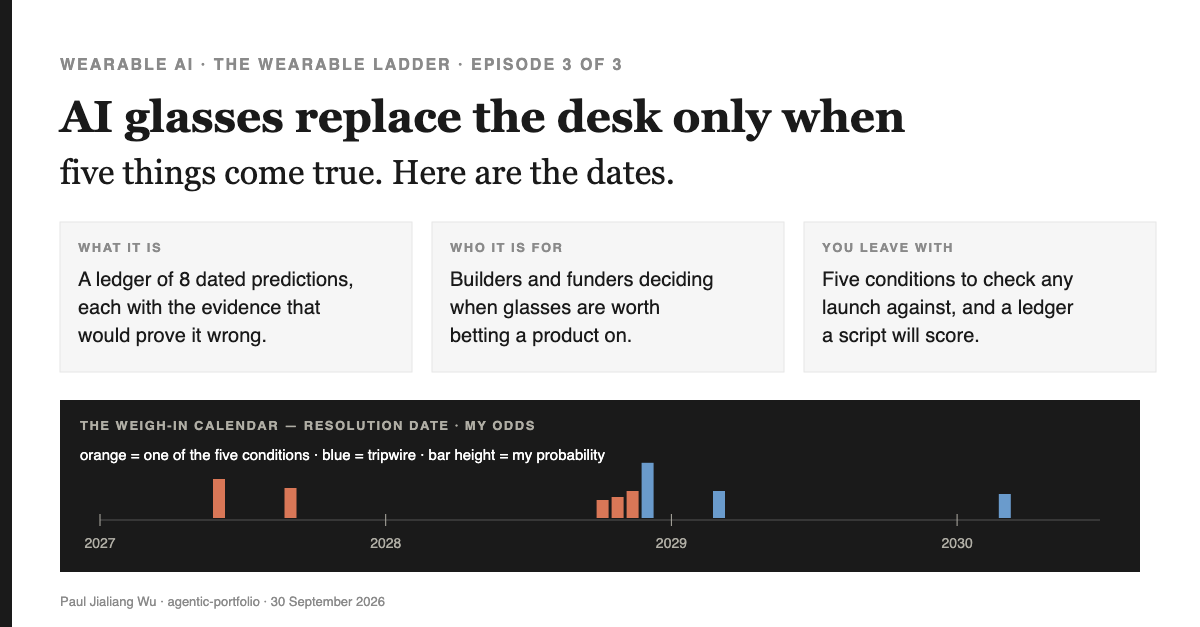
What this is. A ledger of 8 predictions about AI glasses, each with a resolution date between 2027 and 2030, the public evidence that would prove it wrong, and my probability today. Five of them are the conditions that must all come true before glasses can replace a desk; three are tripwires that say whether anyone will buy or allow them.
Why it matters. Every glasses keynote says the desk is going away. None of them says when, or what would prove it wrong, so none of them can be wrong. A prediction without a date is a horoscope with a spreadsheet. This one can lose — and the repository that hosts it fails its own build if I stop scoring it.
What you can do after. Check any glasses launch against five conditions in a minute; know which condition is the real bottleneck for your own work; and copy the ledger pattern — claim, date, falsifier, odds, and a script that refuses to forget — for any bet your team is making.
The Wearable Ladder — the series spine
- The death table — why head-worn computers failed episode 1
- Eighteen laptop tasks, judged by the documentation episode 2
- The prediction ledger — five conditions, eight dated predictions this episode
The one question this episode answersWhat has to become true, and by when, before glasses can replace a desk?
This piece does not answer why earlier head-worn computers failed — that is episode 1, the death table — or what today's glasses can do on a real day, which is episode 2, the documented surface and the pre-registered road-trip audit.
What this AI glasses prediction ledger covers, and who it's for
This is the last episode of The Wearable Ladder. Episode 1 coded every head-worn computer that shipped and failed, and found that 19 of 23 died of money. Episode 2 judged 18 of my laptop tasks against what the glasses are documented to do, and pre-registered the road-trip audit that will check it. This episode looks forward, and does it in the only form that can be graded: a list of specific claims about AI glasses, each with a date, a falsifier, and a number.
It is for anyone who has to decide when — when to build a product for glasses, when to fund one, when to buy a team a pair and expect real work from it. It was written two days after Meta Connect 2026, and every baseline number carries its source and a tag: FETCHED means the number was read on that page; UNVERIFIED means it was seen only in a snippet, a secondary report or a rumour.
The series has one picture, and this episode uses the part of it that looks forward.
The picture: a fight camp with weigh-ins
A fighter who says "I'll be in shape eventually" is not in a fight camp. A camp is a calendar of weigh-ins: on a given morning you step on a scale, the number is the number, and nobody argues with the scale. You make weight or you don't. Before a fighter can turn professional, five things have to be true at once — and a fighter who is great at four of them still doesn't get the fight. So the picture carries two maps at once: each weigh-in is one prediction, and each of the fighter's five skills is one condition.
| In the fight camp | In this ledger |
|---|---|
| A weigh-in | One prediction |
| The target weight | The claim — one sentence, with a threshold |
| The morning of the weigh-in | resolution_date |
| The scale | falsifier — the public source that settles it |
| The coach's honest odds | my_probability, scored later with a Brier score |
| Cardio for all five rounds | Condition 1 — power: all day on the face |
| Hand speed | Condition 2 — input: writing, not just commanding |
| Seeing the punch coming | Condition 3 — a display worth working on |
| A promotion that lets anyone fight | Condition 4 — anyone can publish an app |
| The corner between rounds | Condition 5 — the laptop becomes the server |
| Ticket sales and the athletic commission | The tripwires — the market, and the law |
The thesis: the laptop becomes the server
Here is the claim the whole ledger hangs on. Glasses will not replace a desk by becoming a laptop on your face. The face is the wrong place for a laptop — episode 1's table is a graveyard of devices that tried to put the expensive part up there. Glasses replace a desk when the laptop stops being where you sit and becomes where the work runs, and the glasses become the corner's voice in your ear: you say what you want, an agent with the laptop's full power does it, and you hear what happened.
Connect 2026 put both halves of that on stage in the same week, without joining them. Meta's new agent,
Muse, has a Mac app with computer use, and Muse is "coming soon" to the glasses, woken by saying its name
(Meta). Separately, the
developer toolkit for the glasses reached version 1.0 and added voice invocation — but it only
launches an app; it cannot pass the request along
(changelog). The corner
exists and the fighter exists. Nobody has yet let the corner talk to the fighter mid-round. That gap is
prediction P5.
Five conditions, and where each stands today
1. Power — all day on the face. Meta Ray-Ban Display, the display pair, weighs 69 g
(Meta) and runs up to 6 hours of mixed use per charge (Meta help).
A workday plus a commute is 10 hours or more — my assumption, not a measurement. Episode 1 found that battery and heat were the primary cause of
0 deaths, so this is not a killer — it is a ceiling on how much of the day the
glasses can hold. Prediction P1 asks for 12 hours at 70 g, with a camera and colour display, by the end of 2028.
2. Input — writing, not just commanding. Voice is a jab: fast, and good for setting up
the round, but you cannot write a design doc by talking to a room. Meta's wristband paper in Nature
measured handwriting with the muscle-reading band at a median of 20.9 words per minute in closed-loop use
(Nature, 2025) — a useful speed for a
reply, and below the 36 words per minute the same paper cites for a phone keyboard. Prediction P2 asks for a median of 40 words per minute,
published or shipped, by the end of 2028.
3. Display — a screen worth working on. Today's display pair shows a small, sharp
picture in one eye — a monocular display at 42 pixels per degree (Meta).
Enough for a message and a map; not enough for a spreadsheet. Prediction P4 asks for
see-through colour in both eyes, with a camera and no cable, from a major maker at $999 or less by the
end of 2028. Meta's new VR Glasses do not count: they are $1,299.99, they cover your eyes, and they run from a battery pack.
4. Openness — anyone can ship an app. This is the condition people forget, and the
one with the most concrete slip on record. At Connect 2025, Meta targeted open publishing for 2026
(Meta).
At Connect 2026 the toolkit reached 1.0, but every new capability is marked experimental, and apps using
those capabilities "cannot be published yet" (changelog);
two curated places to find apps are "coming soon" with no date
(Meta developer blog); and the iOS
guide still says publishing to the App Store "is not currently supported"
(Meta). A fighter who says he'll make weight
"this year", then quietly deletes the year, is telling you something. Prediction P3 gives it
until 30 June 2027.
5. The laptop becomes the server. The corner has to be able to act. Prediction
P5 resolves true only if a request spoken or written on the glasses makes the maker's own agent
operate your Mac or PC to finish a multi-step task, generally available, by 30 September 2027.
The ledger
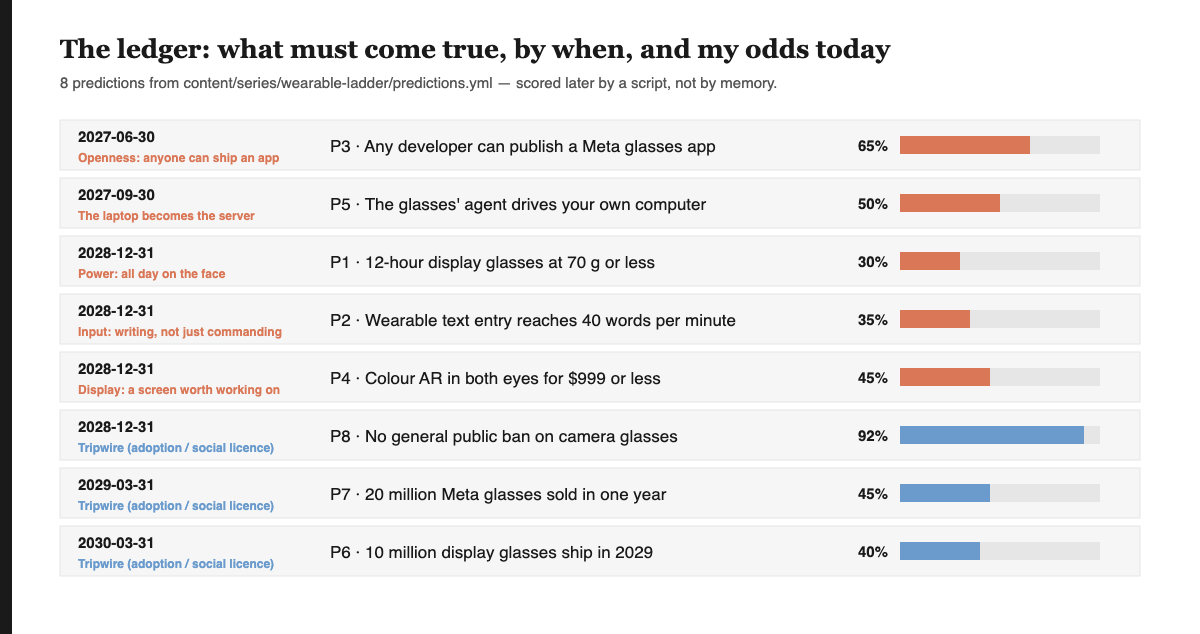
| Prediction | Claim | Resolves | What settles it | My odds |
|---|---|---|---|---|
P3-open-publishing-metaOpenness: anyone can ship an app | By 2027-06-30 any registered developer (not only Meta-selected partners) can publish an integration built on the Meta Wearables Device Access Toolkit — or an app on a Meta glasses store — to the general public in the US. | 2027-06-30 | TRUE if Meta's developer docs/FAQ (wearables.developer.meta.com) or an official Meta developer blog states general-availability publishing is open to all developers by the date. FALSE if the FAQ still says publishing is unavailable / partner-only on the resolution date. | 65% |
P5-glasses-agent-drives-your-computerThe laptop becomes the server | By 2027-09-30 Meta, Google or Apple ships to the general public (US) a documented feature where a request spoken or written on their glasses makes the first-party agent operate the user's own desktop/laptop computer (computer use on Mac or PC) to complete a multi-step task. | 2027-09-30 | TRUE if an official help-center page, product blog, or release notes describe issuing the task from the glasses and the agent acting in apps on the user's own Mac/PC (not only cloud/web connectors), generally available (not waitlist-only) in the US. FALSE otherwise. | 50% |
P1-power-12h-displayPower: all day on the face | By 2028-12-31 Meta, Google (any Android XR partner incl. Samsung), or Apple ships a camera-equipped, full-colour display glasses whose manufacturer-stated battery life is >= 12 hours of "mixed use" on the glasses alone (charging case excluded) at <= 70 g. | 2028-12-31 | TRUE if an official product/spec page from Meta, Google, Samsung or Apple lists all four: camera, colour display, >=12 h mixed-use (glasses only), <=70 g, for a product on sale in the US by the date. FALSE otherwise. Monochrome, camera-less, or case-inclusive hours do not count. | 30% |
P2-input-40wpmInput: writing, not just commanding | By 2028-12-31 a peer-reviewed paper or a shipped product spec reports a non-invasive wearable text-entry method usable with glasses (sEMG wristband or equivalent, no physical keyboard or touchscreen) reaching a median >= 40 words per minute in closed-loop use. | 2028-12-31 | TRUE if a paper in a peer-reviewed venue (Nature/Science family, CHI, UIST, NeurIPS, IEEE TBME etc.) or an official Meta/Google/Apple spec page states a median closed-loop rate >= 40 WPM across participants for such a method. Best-single-user, open-loop/offline decoding, or invasive BCIs do not count. | 35% |
P4-binocular-under-999Display: a screen worth working on | By 2028-12-31 Meta, Google/Samsung (Android XR), or Apple sells in the US a see-through glasses product with a full-colour display in BOTH eyes, a camera, and no cable to a phone/puck, at a US list price <= $999 (including any required wristband). | 2028-12-31 | TRUE if an official store page from one of those vendors shows such a product purchasable at <= $999. FALSE otherwise. Tethered viewers (XREAL-style), monochrome HUDs, passthrough VR glasses, and prototypes/dev kits do not count. | 45% |
P8-no-general-public-banTripwire (adoption / social licence) | By 2028-12-31 no US state and no EU member state enacts a general ban on WEARING camera-equipped smart glasses in public places. (Venue rules — courts, schools, businesses — and bans on covert or non-consensual recording do NOT count.) | 2028-12-31 | FALSE if statute text (state legislature site / EUR-Lex / national gazette) prohibits wearing or operating camera glasses in public generally. TRUE otherwise. | 92% |
P7-essilux-20M-yearTripwire (adoption / social licence) | EssilorLuxottica reports selling >= 20 million Meta smart glasses (all brands, all tiers) in a single calendar year for some year up to and including FY2028. | 2029-03-31 | TRUE if EssilorLuxottica's annual results / investor call (or tier-1 reporting of it) states >= 20M units for one calendar year <= 2028. FALSE if FY2028 results are out and no year reached 20M. | 45% |
P6-display-glasses-10MTripwire (adoption / social licence) | IDC reports worldwide shipments of optical see-through (OST) display glasses >= 10 million units for calendar year 2029. | 2030-03-31 | TRUE if an IDC press release/blog (or IDC figure quoted by a tier-1 outlet) gives >= 10.0M OST / display-glasses units for 2029. FALSE if IDC's 2029 figure is below 10M. If IDC changes the category definition, use its closest 'display glasses' line and note the change. | 40% |
The baseline evidence for every prediction, with its tag and source
| Prediction | Where it stands on 2026-09-30 |
|---|---|
P3-open-publishing-meta | Toolkit announced at Connect 2025 (Sept 2025) as a developer preview: 'only select partners will be able to publish their integrations to the general public'; Meta targets 'publishing to general availability in 2026' FETCHED — source As of Connect 2026 (late Sept 2026) the toolkit FAQ still says 'publishing is currently not available during the Developer Preview phase'; HTML/JS web apps for Ray-Ban Display reach 6 countries FETCHED — source Connect 2026 (2026-09-24): toolkit 1.0 released; features labeled experimental 'can be built and tested against, though apps using them cannot be published yet' FETCHED — source Two CURATED discovery surfaces 'coming soon' (on Ray-Ban Display, and a curated list in the Meta AI app) — no submission date FETCHED — source iOS guide: 'Publishing to the App Store is not currently supported, but we plan to do so in the future' FETCHED — source |
P5-glasses-agent-drives-your-computer | Meta Connect 2026 (2026-09-23): Muse agent has a Mac app 'with computer use' that can control any app with permission; Muse 'coming soon to AI glasses' with hands-free access by saying its name — no date, and the glasses→Mac link is not stated FETCHED — source Muse on glasses: workouts, meals, shopping, booking appointments; 'across your phone, computer, and the web' FETCHED — source Research prototype: VisionClaw, always-on AI agents through smart glasses (arXiv 2604.03486) UNVERIFIED — source |
P1-power-12h-display | Meta Ray-Ban Display: 69 g, $799 with the Neural Band, monocular full-colour display at 42 px/deg FETCHED — source Meta Ray-Ban Display: up to 6 hours of mixed-use battery per charge, up to 24 hours more from the case (Meta's help page; the launch post said 30 h total) FETCHED — source Even Realities G2 (counter-example, excluded by the claim): 36 g, ~2 days, binocular GREEN monochrome, no camera, no speakers, $599 UNVERIFIED — source |
P2-input-40wpm | Meta Reality Labs, Nature (published 2025-07-23): sEMG handwriting 20.9 WPM closed-loop median; personalization improves handwriting decoding by a further 16%; 0.88 gesture detections/s; 0.66 target acquisitions/s FETCHED — source Neural handwriting shipped on Ray-Ban Display: early access from CES 2026 (Jan), later rolled out broadly (WhatsApp, Messenger, Instagram, native messaging) UNVERIFIED — source |
P4-binocular-under-999 | Ray-Ban Display is monocular (right lens) at $799 incl. Neural Band FETCHED — source Meta VR Glasses announced at Connect 2026: $1,299.99, ~100 g, binocular micro-OLED, separate battery puck, ships spring 2027 (not see-through AR; excluded) FETCHED — source Reported roadmap: 'Hypernova 2' binocular HUD glasses and 'Artemis' consumer AR glasses around 2027, Artemis rumored $1,200-1,500 UNVERIFIED — source Google I/O 2026: display glasses with Samsung/Gentle Monster/Warby Parker come after the fall-2026 audio glasses; no date or price FETCHED — source |
P8-no-general-public-ban | New York Unified Court System bars smart glasses from all state courthouses effective 2026-07-20 (memo dated 2026-07-01) — a venue rule, not a statute UNVERIFIED — source California SB 1130 (introduced 2026-02-17): crime to secretly record with a wearable at a place of business; bans disabling the recording indicator; reported passed both houses, last action 2026-09-09 (governor action pending) UNVERIFIED — source |
P7-essilux-20M-year | EssilorLuxottica: more than 7 million Meta smart glasses sold in 2025 (more than tripled vs 2024); ~2M sold Oct 2023-Feb 2025 FETCHED — source Capacity plan: 10M units/yr by end of 2026; Bloomberg reported talks of 20-30M FETCHED — source |
P6-display-glasses-10M | IDC (2026-06-15): display-less glasses 2.7M units in all of 2024; ~2.25M in Q1 2026 alone; forecast 13.6M display-less and 3M OST display glasses in 2026; 27.3M display-less and 12.2M OST by 2030 FETCHED — source IDC (2026-09-16): Q2 2026 smart-glasses shipments +35.3% YoY; display glasses 14.3% of Q2 2026 shipments; Meta 68.7% share FETCHED — source |
Read the odds as a set. The two I am most confident in are the least interesting: that open publishing
arrives within six months of Meta's own deadline (P3, 65%) and that nobody bans wearing camera
glasses in public outright (P8, 92%). The ones that decide whether glasses replace a desk —
all-day power, fast writing, a real display — are each below even odds by the end of 2028. Three of my five
conditions are under 50%: by my own odds, this fighter is still an amateur. Multiply them and
the honest answer to "when will glasses replace my desk" is: not in this ledger's window, unless the corner
does most of the fighting. Which is the thesis — with one honest caveat: even if the laptop does the work, you still have to tell
it what you want, which is why input (P2) stays on the list when the display and the battery
matter less.
Five whys: why can't glasses replace a desk in 2026?
- Why can't you do a desk's work through glasses today? Because the work cannot get in or out fast enough: no third-party app can yet be published to the public, and the wristband's closed-loop handwriting runs at a median of 20.9 words per minute. Evidence: Meta's iOS integration guide; Nature, 2025.
- Why is the pipe so narrow? Because desk work is mostly producing and reading dense text, and the glasses offer a small display in one eye and a wristband that writes below the 36 words per minute the same paper cites for a phone keyboard. Evidence: Meta Ray-Ban Display (monocular, 42 pixels per degree).
- Why not just put a bigger screen and a keyboard on them? Because the face
limits weight and power — 69 g and up to 6 hours today — and episode 1 shows what happens to devices that put
the expensive part on the face: 19 of 23 died of money.
Evidence:
content/series/wearable-ladder/deaths.yml. - So where can the work go instead? To a computer that isn't on your face. Meta already ships an agent that operates a Mac, and has announced it for the glasses. Evidence: Connect 2026.
- Why hasn't that happened? Because the glasses can only send the laptop an
intent if an agent is allowed to receive it, and the platform does not yet let one: voice
invocation launches an app without the request, and the connectors to Meta AI are early access. The
root: the desk disappears when the glasses carry intents to an agent with the laptop's power — so the
bottleneck is the developer surface and the agent's reliability, not the lens.
Evidence: toolkit 1.0 changelog;
docs/plans/2026-09-25-glasses-connect-2026-delta.md, rows 6–7.
Operate — the ledger runs
The ledger is a file, content/series/wearable-ladder/predictions.yml, and the table above is
generated from it. Scoring a prediction is one edit — add an outcome with its evidence:
  - id: P3-open-publishing-meta
    ...
    outcome: {result: false, evidence: https://developers.meta.com/wearables/faq/, scored: 2027-07-01}
Then node scripts/check-wearable-ladder.mjs --metrics reports how many are resolved and, as
soon as one is, a Brier score — the mean of (my probability − what happened)², where 0 is perfect
foresight and 0.25 is what you get by saying 50% about everything. The claims, dates and probabilities
are never edited after publication. You can add an outcome; you cannot move the goalposts.
Feedback — how it goes red, and what it cannot see
Thirty days after a prediction's resolution date, if it has no outcome, the site's build
fails: npm test runs the series gate, and the gate names the unscored prediction.
That is the whole trick. The repository refuses to deploy anything until I have looked at the scale — and
the scale doesn't care that I wrote the odds. It
cannot see three things:
- Which predictions I chose. Eight is a selection. A ledger can be perfectly calibrated on easy claims and silent on the one that mattered. The five conditions were fixed first, and each prediction names the condition it tests, so a gap is visible — but the choice was mine.
- Whether my odds are good before 2027. Nothing resolves until mid-2027. Until then the Brier score is empty, and I have said so rather than printing a zero.
- Definition drift. Analyst categories change.
P6depends on IDC's "optical see-through" line; if IDC redefines it, the prediction's text says to use the closest line and note the change.
Feedforward — what I will do when each weigh-in comes in
The point of committing now is to decide the response before the result can bias it:
- If
P3resolves false (no open publishing by mid-2027): stop planning a glasses app for the Meta store. Build for Meta's web apps and assistant connectors, or for another maker's glasses — distribution is the purse, and episode 1 says the purse decides. - If
P5resolves true (the maker's agent drives your laptop from the glasses): run the episode 2 audit with the same pre-registered task list, again, and compare. That is the test of the thesis. - If
P2resolves false (no 40-words-per-minute input by 2029): assume writing stays at the desk and design glasses work around approving, routing and listening — the jab, not the knockout. - If
P8resolves false (a general public ban somewhere): re-open episode 1's social row. It was one death in 23; a ban would make social backlash a live cause again.
Where this episode sits in the series
| Conception | Core concept | Governing principle | Main contributors | |
|---|---|---|---|---|
| Past (episode 1) | 1968, Sutherland's head-mounted display | a computer you wear, so it follows your gaze | the devices died of economics, not of the computer | Sutherland · Reflection Technology · Google X · North · Snap · Magic Leap |
| Present (episode 2) | 2023 → 2026, camera-and-speaker AI glasses | the glasses are input and output; the thinking happens elsewhere | the phone is the relay, the cloud is the processor | Meta · EssilorLuxottica · Qualcomm |
| Future (episode 3) | the wristband that reads your muscles, plus agents | your intent becomes the input device | what you can say to the machine per second is the new bottleneck | Meta Reality Labs (sEMG) · Google / Samsung (Android XR) · Apple (reported) |
Same story, five exits
| If you are… | The decision this changes | One action |
|---|---|---|
| A student | How to read a tech prediction | Ask for the date and the falsifier; if there are neither, it is a horoscope |
| An engineer | What to build now | Build the agent the glasses will talk to, not the glasses app — it works today on the phone and the laptop |
| A founder | When to bet a product on glasses | Tie the bet to P3 and P5 resolving true; until then glasses are a channel, not a platform |
| An executive | Whether glasses replace laptops for your team | Not before 2028 on this ledger's odds; pilot glasses for capture and messaging, keep the desks |
| An investor | What to underwrite | Underwrite distribution and the agent layer; the display is the part history punishes |
Build it in 30 minutes
- Input: a decision your team is making that depends on the future ("we'll need X by next year").
- Output: three to eight rows, each a claim with a threshold, a date, a public falsifier, and a probability.
- Invariant: claims, dates and odds are frozen when written; only outcomes are added.
- Stop rule: stop when every assumption your decision rests on has a row.
- Minimal schema:
id, claim, resolution_date, falsifier, current_evidence[{value, source, tag}], my_probability, outcome?. - CI threshold: the build fails when a row is 30 days past its date with no outcome.
- Deliberately missing: a second forecaster. Two people's odds on the same rows, scored side by side, is the upgrade.
5S self-score, with evidence
| S | Self-score | Evidence |
|---|---|---|
| Simple | 4/5 | One picture (weigh-ins: a date and a scale), mapped 1:1 in the table above; one thesis (the laptop becomes the server). See the five whys. |
| Solid | 4/5 | Every baseline carries a source and a FETCHED/UNVERIFIED tag in content/series/wearable-ladder/predictions.yml; Connect 2026 changes logged in docs/plans/2026-09-25-glasses-connect-2026-delta.md. Not 5: single forecaster. |
| Sharp | 4/5 | The root is the developer surface, not the lens — backed by the toolkit 1.0 changelog (voice invocation launches only). |
| SMART | 5/5 | 8 predictions, each with a date between 2027 and 2030; the build fails on an unscored one (scripts/check-wearable-ladder.mjs). |
| Surprise | 3/5 | A 2026 publishing target became "coming soon" with no date — see the Connect recap. Honest score: the humour is thinner than the evidence. |
References
- The ledger and every baseline source:
content/series/wearable-ladder/predictions.yml. - Meta Connect 2026 announcements: Meta.
- Toolkit 1.0 changelog: facebook/meta-wearables-dat-ios.
- Toolkit publishing status: Meta developer blog, Connect recap; iOS integration guide.
- The original 2026 publishing target: Meta developer blog.
- The neuromotor wristband paper: Nature, 2025 (PMC full text).
- Meta Ray-Ban Display specifications: Meta.
- Market baselines: IDC; UploadVR on EssilorLuxottica.
Related
content/series/wearable-ladder/predictions.yml, and the
site's build fails if any prediction goes unscored 30 days after its date.