AI-NATIVE SERIES · WEARABLE AI · THE WEARABLE LADDER, EPISODE 2 OF 3
AI Glasses, by the Documentation: 11 of My 18 Laptop Tasks Should Work Hands-Free
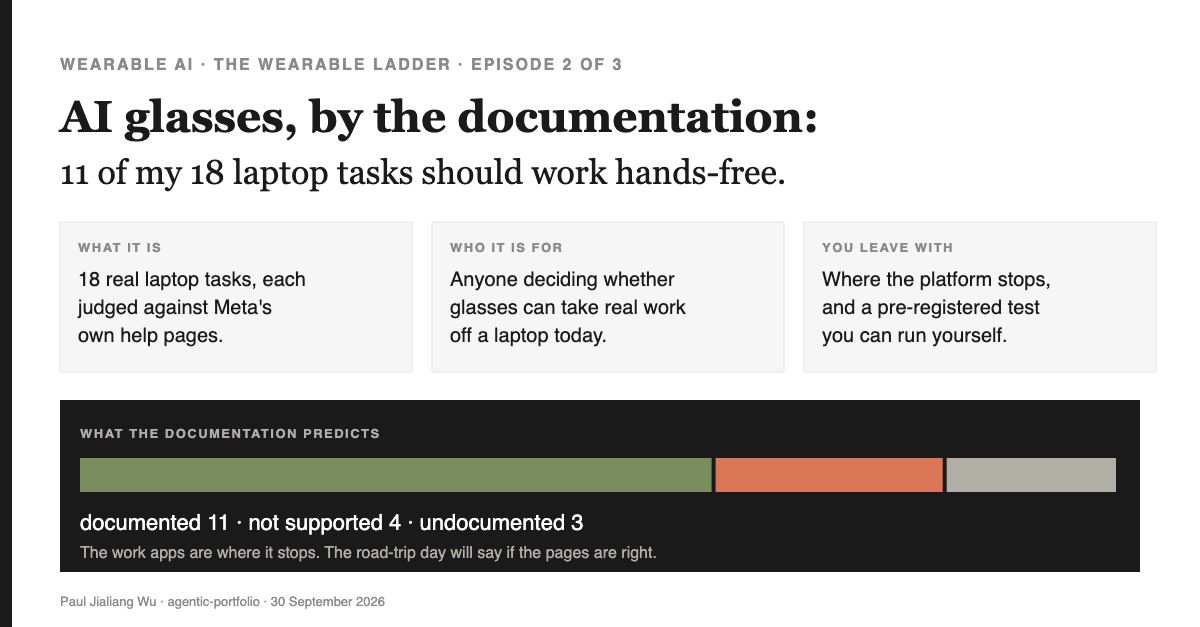
What this is. I wrote down 18 things I normally open a laptop for — reading a cofounder's message, checking the calendar, asking a coding agent to do something — and checked each one against what Meta's own documentation says Ray-Ban Meta glasses can do. 11 are documented as possible hands-free, 4 are documented as not supported, and 3 the documentation doesn't mention.
Why it matters. The line between "yes" and "no" isn't random. Messages, calls and the calendar are on the yes side; the apps where my actual work happens — WeChat, Feishu, GitHub, a coding agent — are on the no side. The glasses can handle your life's admin today. Your work, not yet, and the reason is the platform, not the hardware.
What you can do after. Sort your own laptop tasks the same way in ten minutes, before you buy a pair or build for one. And since documentation is a claim, not a measurement, the same 18 tasks are pre-registered for a road-trip day that will test it — the results will be added to this page, dated.
The Wearable Ladder — the series spine
- The death table — why head-worn computers failed episode 1
- Eighteen laptop tasks, judged by the documentation this episode
- The prediction ledger — five conditions, eight dated predictions episode 3
The one question this episode answersWhich of my laptop tasks can AI glasses actually do hands-free today, and where do they break?
This piece does not answer why earlier head-worn computers died — that is episode 1, the death table — or what must become true before glasses replace a desk, which is episode 3, the prediction ledger.
What this AI glasses episode covers, and who it's for
This is episode 2 of The Wearable Ladder. Episode 1 looked back at 23 head-worn computers that failed; episode 3 looks forward with dated predictions. This one is the present tense. The plan was to answer it with a road-trip day — every task tried hands-free, every attempt logged. That day hasn't happened yet, and I won't invent it. So this edition answers from the other honest source: the documentation, task by task, with a link for every verdict. The day will then test whether the documentation is right.
It's for engineers deciding what to build for glasses, founders deciding whether a pair belongs in the kit, and anyone who bought a pair and wonders what it can actually do.
The picture: a sparring round, under the ruleset
You cannot bring a barbell into a sparring round. Whatever you do in the round, you do with what's already on you — and under the ruleset, not the highlight reel. The glasses are the only computer already on you mid-climb or mid-drive; the documentation is the ruleset.
| In the round | With the glasses |
|---|---|
| What's on you when the bell rings | The only input and output present in every posture: microphones, speakers, a camera |
| The jab | A short voice request — fast, low bandwidth; it sets up work rather than finishing it |
| The ruleset, not the highlight reel | What Meta documents the glasses can do, not what a demo showed |
| Moves the ruleset bans | Tasks the documentation says are not supported |
| The corner between rounds | The phone and the cloud, where the work actually runs |
| The fight that tests your plan | The road-trip day, logged live, that tests the documentation |
The ruleset: what the documentation says
Before judging any task, the ground rules. The glasses are a curated bridge, not a mirror of your phone.
| Capability | What the documentation says | |
|---|---|---|
| Hear a message read aloud | WhatsApp, Messenger, Instagram, and your phone's own messages — a closed list | source |
| Reply by voice | Yes for the same list; the glasses read your reply back and you say yes, no or cancel | source |
| Telegram, Slack, Signal, WeChat, Feishu | Telegram, Slack and Signal are never named on any Meta page; WeChat and Feishu are not on the closed list — not supported | source |
| Voice notes | Up to 60 seconds; recording stops after 3 seconds of silence | source |
| Calendar | Google Calendar and Outlook: ask and create events by voice (English, US) | source |
| Read aloud only; no official page documents replying | source | |
| Reminders | Set and search by voice; needs the phone; English in US, Canada, Australia | source |
| Offline | Photos, video, battery level and audio from the phone; the assistant needs a connection | source |
| Third-party apps | Toolkit 1.0 shipped 24 September 2026; its new features cannot be published yet | source |
Meta Connect 2026 (23–24 September) changed the developer side: the toolkit for building glasses apps reached version 1.0, with a battery reading and a way to launch your app by voice. But every one of those new features is marked experimental, and apps that use them "cannot be published yet" (toolkit changelog). Voice launch opens an app; it can't pass it your request.
My 18 laptop tasks, judged by the documentation
11 documented · 4 not supported · 3 undocumented, out of 18 tasks, registered on 25 September from a list of what I actually do; the documentation was read on 19 and 25 September.
The "not supported" column is every work tool on the list. The "documented" column is messages, calls, calendar, reminders, photos and questions.
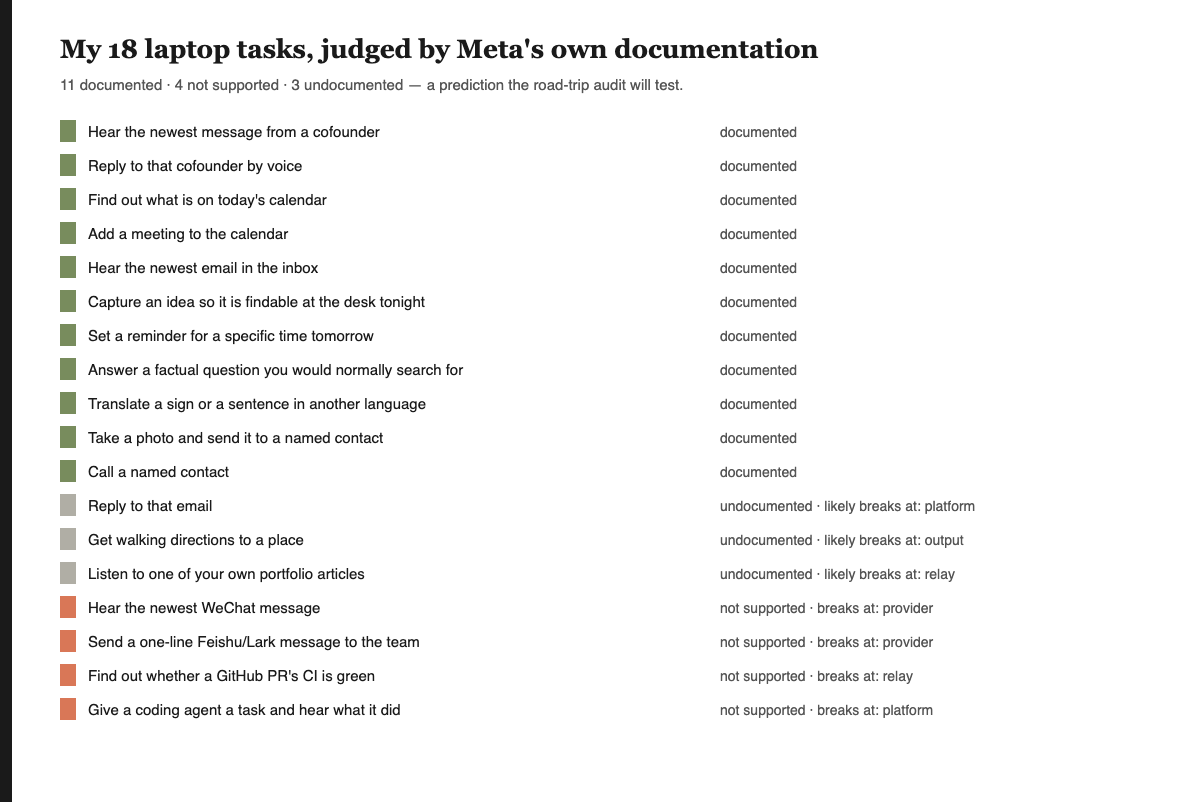
| Task | Documentation says | Breaks at | Detail | |
|---|---|---|---|---|
| Hear the newest message from a cofounder | ✅ documented | — | Announce + automatic readout for WhatsApp, Messenger, Instagram and phone messages | source |
| Reply to that cofounder by voice | ✅ documented | — | 'Hey Meta, reply' — the reply is read back and you confirm; WhatsApp/Messenger/Instagram | source |
| Hear the newest WeChat message | ❌ not supported | provider | WeChat is not a listed provider; the list is closed (Messenger, WhatsApp, Instagram, phone) | source |
| Send a one-line Feishu/Lark message to the team | ❌ not supported | provider | Feishu/Lark is not a listed provider | source |
| Find out what is on today's calendar | ✅ documented | — | Google Calendar and Outlook: 'what does my day look like' (English, US) | source |
| Add a meeting to the calendar | ✅ documented | — | Create events by voice (English, US) | source |
| Hear the newest email in the inbox | ✅ documented | — | 'Hey Meta, read my emails aloud' — read-out only (release notes v25, 2026-05-14; US/CA) | source |
| Reply to that email | ❔ undocumented | platform | No official page documents composing or replying to email | source |
| Capture an idea so it is findable at the desk tonight | ✅ documented | — | 'Remember this…' writes to Reminders, searchable by voice (English, US/CA/AU) | source |
| Set a reminder for a specific time tomorrow | ✅ documented | — | 'Set a reminder for…' — needs the phone for push notifications | source |
| Answer a factual question you would normally search for | ✅ documented | — | Meta AI answers — but only with a connection; offline the assistant is unavailable | source |
| Translate a sign or a sentence in another language | ✅ documented | — | Live translation of speech (6 languages offline, 14 more online); reading a sign through Live AI is not separately documented | source |
| Take a photo and send it to a named contact | ✅ documented | — | 'Send a picture to [contact] on WhatsApp/Messenger/Instagram/my phone' — no preview before sending | source |
| Find out whether a GitHub PR's CI is green | ❌ not supported | relay | No GitHub integration on the glasses today; Meta's Muse agent (GitHub among 1,500+ connectors) is 'coming soon to AI glasses', no date | source |
| Give a coding agent a task and hear what it did | ❌ not supported | platform | Voice invocation only launches an app (experimental, unpublishable); Meta AI Connectors are early-access sign-up only | source |
| Get walking directions to a place | ❔ undocumented | output | Walking, cycling and transit navigation are documented for Meta Ray-Ban Display (US/CA); not documented for Ray-Ban Meta Gen 2 | source |
| Listen to one of your own portfolio articles | ❔ undocumented | relay | The documentation is silent on reading a web page aloud; the phone would likely have to do it | source |
| Call a named contact | ✅ documented | — | 'Hey Meta, call [name] on WhatsApp' and phone calls | source |
Two caveats the table carries in its details column. Many "yes" answers are English-only and US-first — calendar and email readout are documented for English in the US. And several need a connection: offline, the assistant isn't there at all. A "yes" in the table is a yes for an English speaker in the US with signal.
What the pattern says
Look at where the "no"s land: provider (WeChat and Feishu aren't on the closed list of message apps),
relay (no way to reach GitHub without the phone doing it), platform (no general hook
for an agent). None of them is the battery, the camera, or the microphones. The hardware can hear me and talk back; the
platform decides who it's allowed to talk to. That is episode 1's lesson in the present tense — the devices that failed
weren't limited by their computers either — and it is exactly the condition episode 3 tracks as prediction
P3: whether any developer can publish a glasses app by mid-2027. The guest list is starting to open: Meta's
Muse agent, which already connects to GitHub among 1,500+ services, is "coming soon" to the glasses, and Meta AI Connectors
let a service offer actions to the assistant — both announced at Connect 2026, both without a date or general availability
(Meta: Muse,
Connectors). That's P3 in motion.
Five whys: why can't the glasses do my work tasks?
- Why can't they? Because 4 of my 18 tasks — WeChat, Feishu, GitHub, a
coding agent — are documented as not supported, and the documentation is silent on the rest of my work stack. Evidence: the table above, generated from
content/series/wearable-ladder/audit-tasks.yml. - Why are those apps missing? Because the glasses only connect to providers Meta lists — Messenger, WhatsApp, Instagram and your phone's messages — and the list is closed. Evidence: Meta help: message providers.
- Why can't those apps add themselves? Because third-party apps for the glasses can't yet be published to the public, and publishing to the App Store "is not currently supported". Evidence: Meta's iOS integration guide.
- Why not, when the toolkit just reached 1.0? Because every new capability in 1.0 is marked experimental, and apps using it "cannot be published yet". Evidence: toolkit 1.0 changelog.
- So what's the real bottleneck? The root: for work, the glasses are limited by who the platform lets in, not by what the hardware can do. The same device that reads a WhatsApp message aloud can't read a WeChat one. Evidence: tasks 1 and 3 in the table — same device, same action, different app, opposite verdict.
Operate — the test that runs next
Documentation is a claim. The test is already built and live: the 18 tasks are pre-registered in
content/series/wearable-ladder/audit-tasks.yml, each with what "done" means, and an owner-only phone page on this
site (/glasses-audit) logs each attempt the moment it happens — pass, or fail plus which of eight layers broke.
node scripts/glasses-audit.mjs pull brings the log into the repo, and this page is rebuilt with the measured
result next to the documented one.
What each failure layer would mean — written on 2026-09-25, before any attempt
- wake (the assistant didn't start, or stopped listening): The front door is the bottleneck. Nothing a developer builds fixes a wake word that doesn't fire; this is Meta's firmware and microphones, and the fix is theirs.
- hearing (it started, but misheard the request): Speech recognition outdoors is the bottleneck — names, product words, wind. It says the input condition in episode 3 (writing, not just commanding) matters sooner than the display.
- provider (the app I needed isn't a supported provider): The closed provider list is the bottleneck: the glasses talk to WhatsApp, Messenger, Instagram and the phone, and the work happens elsewhere. The fix is a relay — which is episode 3's thesis (the laptop becomes the server) arriving early.
- network (no or weak signal): Connectivity is the bottleneck. Meta AI needs the network; a road trip doesn't always have one. It argues for on-device models before better ones.
- power (battery, battery saver, or heat): Power is the bottleneck — which would contradict episode 1, where battery and heat were the primary cause of zero deaths. Episode 1's tripwire says to re-read the cardio assumption if this happens, and I will.
- output (it answered, but the answer was unusable by ear): The output channel is the bottleneck: audio is too narrow for the answer. It is the argument for a display — the expensive part episode 1 warns about.
- platform (a documented platform limit — a 60-second voice note, a 3-minute video, no API): Policy, not engineering, is the bottleneck. The limits are written down; they are choices, and choices can change at the next Connect.
- relay (it needed the phone or the laptop after all): The glasses were not hands-free for this work; they were a remote control for the phone. This is condition 5 in episode 3 — the corner can't yet act for you mid-round.
Feedback — what the documentation can't see
- Whether it's true. A help page can be stale, optimistic, or region-specific. Meta's own pages contradict each other in places (battery life with the case is 24 hours on one page, 30 on another).
- How it feels. "Supported" can still mean three tries in the wind. Only the day's timings will show that.
- Your tasks. Mine are a founder's; a nurse's or a student's list would sort differently. Make your own.
Feedforward — predictions for the day, written now
- At least 9 of the 11 documented tasks will pass on the first attempt. If fewer do, the documentation is optimistic, and that becomes the headline of the update.
- All 4 "not supported" tasks will fail, and the most common failure layer will be
providerorrelay. If a "no" task passes, the documentation is behind the product — also a finding. - The measured update will be published by 2026-10-31 — or this line will say why not.
- If prediction
P5in episode 3 resolves true (the glasses' agent drives your own computer), the whole list is run again.
Where this episode sits in the series
| Conception | Core concept | Governing principle | Main contributors | |
|---|---|---|---|---|
| Past (episode 1) | 1968, Sutherland's head-mounted display | a computer you wear, so it follows your gaze | the devices died of economics, not of the computer | Sutherland · Reflection Technology · Google X · North · Snap · Magic Leap |
| Present (episode 2) | 2023 → 2026, camera-and-speaker AI glasses | the glasses are input and output; the thinking happens elsewhere | the phone is the relay, the cloud is the processor | Meta · EssilorLuxottica · Qualcomm |
| Future (episode 3) | the wristband that reads your muscles, plus agents | your intent becomes the input device | what you can say to the machine per second is the new bottleneck | Meta Reality Labs (sEMG) · Google / Samsung (Android XR) · Apple (reported) |
Same story, five exits
| If you are… | The decision this changes | One action |
|---|---|---|
| A student | Whether glasses help with schoolwork | List your tasks; if they live in apps Meta doesn't list, the answer today is no |
| An engineer | What to build | Build where the "no"s are — the relay from glasses to the work apps — as soon as publishing opens |
| A founder | Whether to buy the team a pair | Yes for capture, messages and calendar; no for the work stack, yet |
| An executive | Glasses in the workforce | Pilot where your team's comms already run on a listed provider |
| An investor | The glasses opportunity | Underwrite the platform opening (P3), not the hardware spec sheet |
Build it in 30 minutes
- Input: ten to twenty things you open a laptop for, written before you look anything up.
- Output: each one marked documented / not supported / undocumented, with a link.
- Invariant: the list is written first; no swapping tasks after you see the answers.
- Stop rule: if the documentation is silent, mark it undocumented — don't guess.
- Minimal record:
task, done_when, documented.verdict, documented.layer, documented.source. - Deliberately missing: the measurement. That's the day — and the second half of this page.
5S self-score, with evidence
| S | Self-score | Evidence |
|---|---|---|
| Simple | 4/5 | One picture — the ruleset, not the highlight reel — and one number: 11 of 18. |
| Solid | 4/5 | Every verdict links to Meta's own page in content/series/wearable-ladder/audit-tasks.yml. Not 5: documentation is not measurement, and this edition says so. |
| Sharp | 4/5 | The same device reads a WhatsApp message and can't read a WeChat one — see the five whys. |
| SMART | 4/5 | Three written predictions for the day, scored when scripts/glasses-audit.mjs pull runs. |
| Surprise | 3/5 | The hardware isn't the limit; the guest list is — see the provider list. |
Related
content/series/wearable-ladder/audit-tasks.yml; the road-trip
results will be added beside them, dated.