AI-NATIVE SERIES · FUTURE MAKERS STRATEGIC COLLAB, PART 1 OF 4
Not Another Tech Talk: What Makes Future Makers Strategic Collab (FM-SC) Different
1-minute takeaway
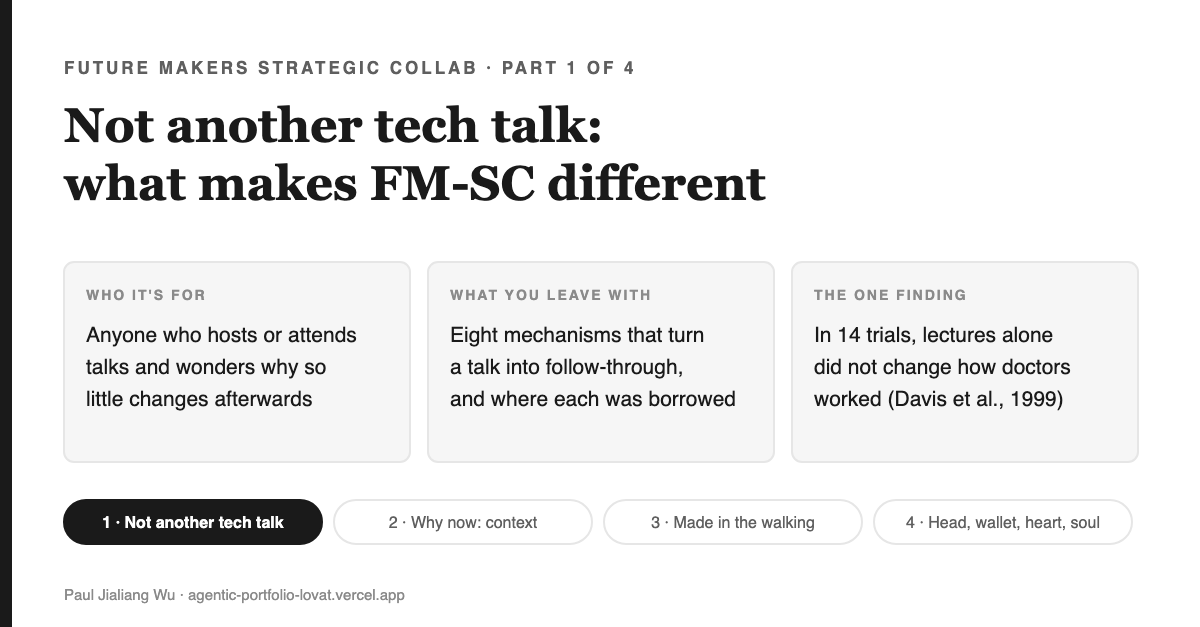
What this is. The first of four articles on Future Makers Strategic Collab (FM-SC), a tech talk series that invites frontier AI companies and is built so that something is different afterwards. It compares FM-SC with academic and industry conferences and lists the eight things it does differently.
Why it matters. In a review of 14 randomized trials with doctors, lectures alone did not change how they worked, and there was some evidence that interactive sessions did. If you host or attend talks, much of the hour may be leaving no trace, and the fix is in how the talk is run, not who gives it.
What you can do after reading. Take the eight mechanisms to your next talk, meetup or offsite, and run the one-line test at the end: name one thing you will do differently, with a date. If you can't, the article shows which mechanism was missing.
Future Makers Strategic Collab — the series spine
▶ See it running: open the live demo public · no sign-in
- Not another tech talk — what makes FM-SC different this episode
- Why now — when AI is cheap, context compounds episode 2
- The match — made in the walking, not the talk episode 3
- Head, wallet, heart, soul — two witnesses per practice episode 4
How to read the labels: EVIDENCE is sourced, DESIGN is how FM-SC is built, OPEN is not yet tested, and LENS is my own conviction.
What this series covers: a tech talk built to change what people do
This is a four-part series about Future Makers Strategic Collab (FM-SC), a tech talk series we run at the Accenture Advanced AI Center with invited frontier companies. It's for engineers, founders, researchers and leaders who host or attend talks and wonder why so little changes afterwards. Part 1 compares FM-SC with academic and industry formats: what each is built to do, and the eight things FM-SC does differently.
Make a bet first
Which of these best predicts that a professional session actually changes what people do at work afterwards?
- A. A famous speaker.
- B. A big audience.
- C. Interaction: the audience works on the problem with the speaker, rather than only listening.
- D. A recording people can rewatch.
Pick one. The answer comes from a review of randomized trials, and we'll get to it.
Where this started
In September 2022, after the Southern Data Science Conference, I wrote two posts. One was a playful "unofficial survey" of the event, which ended on a line I still believe: "all models are wrong, but some are useful, some time." (Wu, 2022a). The other argued that a conference should move from a single snapshot to ongoing interactions: speakers posing real problems, learners forming teams with mentors, and relationships that last longer than the event (Wu, 2022b).
Four years later, at the Accenture Advanced AI Center, we built a first working version of that idea. We call it Future Makers Strategic Collab (FM-SC). The invited speakers are Future Makers. On October 2, 2026, the first were Felix Meng and Austin Cai of XTrace, who build shared memory for people and AI agents.
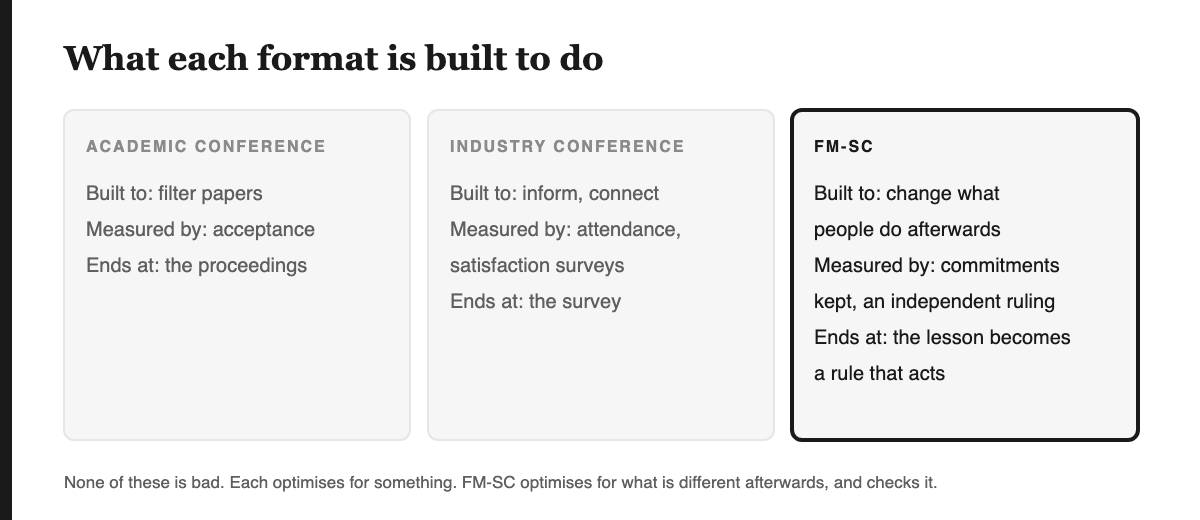
What most talks and conferences are built to do
It's worth being fair about this. Every format optimizes for something, and most optimize for the right thing for them.
Academic conferences exist to decide which papers get accepted. EVIDENCE That process is noisier than many people assume. When NeurIPS had 882 papers reviewed by two independent committees in 2021, the committees disagreed on 23% of them (NeurIPS consistency experiment). By my arithmetic on the published counts, roughly half of the papers one committee accepted, the other rejected. That isn't a scandal. It's what happens when experts judge alone, under time pressure, without a shared bar.
Industry conferences exist to inform and to connect. LENS In my experience they are judged mostly by attendance and the post-event survey: did people come, and did they like it?
Talks of almost every kind end at the applause. Applause is the one metric every talk collects live, for free, from the whole audience, and it measures how the last sentence landed. EVIDENCE The answer to the bet is C. A review of 14 randomized trials in continuing medical education found that "didactic sessions do not appear to be effective in changing physician performance", and some evidence, from fewer studies, that interactive sessions did (Davis et al., JAMA 1999). Those were doctors, not engineers, so treat it as a strong hint rather than a law.
None of this makes conferences bad. It means they were built to inform, to filter, or to connect, and changing what people do was never the job.
Eight things FM-SC does differently
FM-SC is built around one question: after this talk, will something be different, and how would we know? Each of the eight answers below is something a typical talk doesn't do.
- The question comes before the invitation. DESIGN Before anyone is invited, we write what we're trying to find out, and the observation that would prove us wrong. EVIDENCE Science has a version of this, the Registered Report, in which the method is reviewed before the data exist. In one comparison, 96% of standard psychology papers reported positive results, against 44% of Registered Reports (Scheel, Schijen & Lakens, 2021). Writing the test first keeps us honest about what we learned.
- Seats are chosen by alignment, not seniority. Each invited person's work connects to what the speaker builds.
- Everyone brings a question. Each person logs a real question, challenge or request before the day, and the Q&A runs from that queue.
- We meet before the talk, and we test live. Pre-meetings with the speaker's engineers and leaders, plus a short live test that the speaker sees in advance so it's fair.
- The last ten minutes are commitments. Each one has one owner and a date, read aloud.
- Someone who didn't invite the speaker rules on the result. Confirmed, refuted, or still open, within five working days. DESIGN The person who wanted the talk to go well is never the one who decides whether it did.
- The speaker gets something real, then we ask for the next three. Measured feedback first; then an introduction to a frontier lab, a builder and a researcher. EVIDENCE Some, not all, accelerators sped startups up, and fieldwork on the ones that helped suggests a key driver was "broad, intensive, and paced consultation": repeated contact rather than one demo (Hallen, Cohen & Bingham, Organization Science 2020).
- Lessons become rules that act before the next mistake. What we learn is written into rules our own system checks before the next step, not into a recording nobody rewatches.
What we borrowed, honestly
None of these eight is new on its own, and I'd rather say so than claim otherwise.
- Write the test first: Registered Reports, above.
- Argue the idea, in the open: at Xerox PARC, Bob Taylor held informal meetings in a "beanbag" room where staff presented new ideas and got frank, sometimes brutal, feedback from colleagues (Computer History Museum).
- Small, invited, working rooms: Dagstuhl seminars, invitation-only, lasting three or five days (Schloss Dagstuhl).
- Buy the product, not the shares: BMW Startup Garage's venture-client model. EVIDENCE BMW reports pilots with 280-plus startups and 38-plus that became established suppliers; dividing those two lower bounds gives roughly 13.6%, by my arithmetic (BMW Startup Garage).
DESIGN What FM-SC adds is the combination: one loop, run for every talk, and checked by software so promises can't quietly drop. The loop has nine steps: register the question, convene the right room, prepare, engage, capture what was said, follow through on commitments, rule on what we learned, reciprocate (thank the speaker first, then ask for introductions), and compound (turn the lessons into rules).
See it running: the FM-SC web app
DESIGN The software that checks the loop is an agentic web app: you ask it a question and it answers from the record. A public copy is open to anyone at strategic-collab.vercel.app, with no sign-in. It opens on one question: What do you want to know? Ask it How are we doing? or Who are the Future Makers? and every answer comes back in the same shape: one headline, one number, one next step, and what the answer is based on. The nine steps, the lessons that became rules, and who is allowed to see what each have their own page behind the menu.
Two things to know before you click. The talk record on the home page is the real one, at the level we may show in public. The walkthrough pages behind the menu run on made-up people and events, and a strip at the top of the page says so. The names, notes and rulings from the real room stay on our own machine and are never put online.
The honest scorecard
FM-SC has run one talk. Here's where it stands, by its own rules.
- The question was written two days before the talk, and timestamped. That is our first miss: mechanism 1 says before the invitation. So the first rule the system learned from the first talk was about its own organisers.
- Nothing from the talk has been tested yet. When something is, the speaker sees the test first.
- EVIDENCE By my count, the talk drew three-plus deep-dive discussions before the event and fifteen-plus questions during and after it.
- The first loop is not closed yet. By our own rule it can't count, because we didn't record the preparation before the day. We turned that miss into a rule that now warns ahead of every session.
How this could fail
- It becomes paperwork. If the nine steps feel like forms rather than help, people will route around them. We'd see preparation and follow-up fall off.
- Nobody owns the ruling. An independent ruling needs an independent person with time. Without one, the loop stops at step seven, the ruling.
- We confuse rigor with hostility. A fair test can feel like an ambush. That's why speakers see the test in advance, and why failures are reported as promptly as passes.
- OPEN It doesn't compound. If talk number ten isn't run better than talk number one, all of this is overhead.
Your move this week
Think of the last talk you attended. Write down one thing you're doing differently because of it, with a date. If you can't, ask yourself which of the eight was missing.
Then spend five minutes in the FM-SC web app. Open The nine steps and find the step your last talk skipped.
Next
Part 2 asks why this matters more now. AI models are getting cheaper and more alike every year. When everyone can rent the same intelligence, what's left to compete on?
Sources
- Wu, P. J. (2022a). How come this Southern Data Science Conference ranking #1. LinkedIn. https://www.linkedin.com/pulse/how-data-science-conference-becomes-ranking-1-paul-jialiang-wu-phd/
- Wu, P. J. (2022b). Here comes the 12X-Future Southern Data Science Conferences. LinkedIn. https://www.linkedin.com/pulse/here-coms-12x-future-southern-data-science-conference-wu-phd/
- NeurIPS (2021). The NeurIPS 2021 consistency experiment. https://blog.neurips.cc/2021/12/08/the-neurips-2021-consistency-experiment/
- Davis, D. et al. (1999). Impact of formal continuing medical education. JAMA, 282(9). https://jamanetwork.com/journals/jama/fullarticle/191423
- Scheel, A. M., Schijen, M. & Lakens, D. (2021). An excess of positive results. Advances in Methods and Practices in Psychological Science. https://forrt.org/curated_resources/an-excess-of-positive-results-comparing/
- Hallen, B. L., Cohen, S. L. & Bingham, C. B. (2020). Do accelerators work? If so, how? Organization Science, 31(2). https://doi.org/10.1287/orsc.2019.1304
- Computer History Museum, Xerox PARC. https://www.computerhistory.org/revolution/input-output/14/348
- Schloss Dagstuhl, Dagstuhl Seminars. https://www.dagstuhl.de/en/seminars/dagstuhl-seminars
- BMW Startup Garage. https://bmwstartupgarage.com/