AI-NATIVE SERIES · FUTURE MAKERS STRATEGIC COLLAB, PART 3 OF 4
Strategic Collaboration Is Made in the Walking, Not the Talk
1-minute takeaway
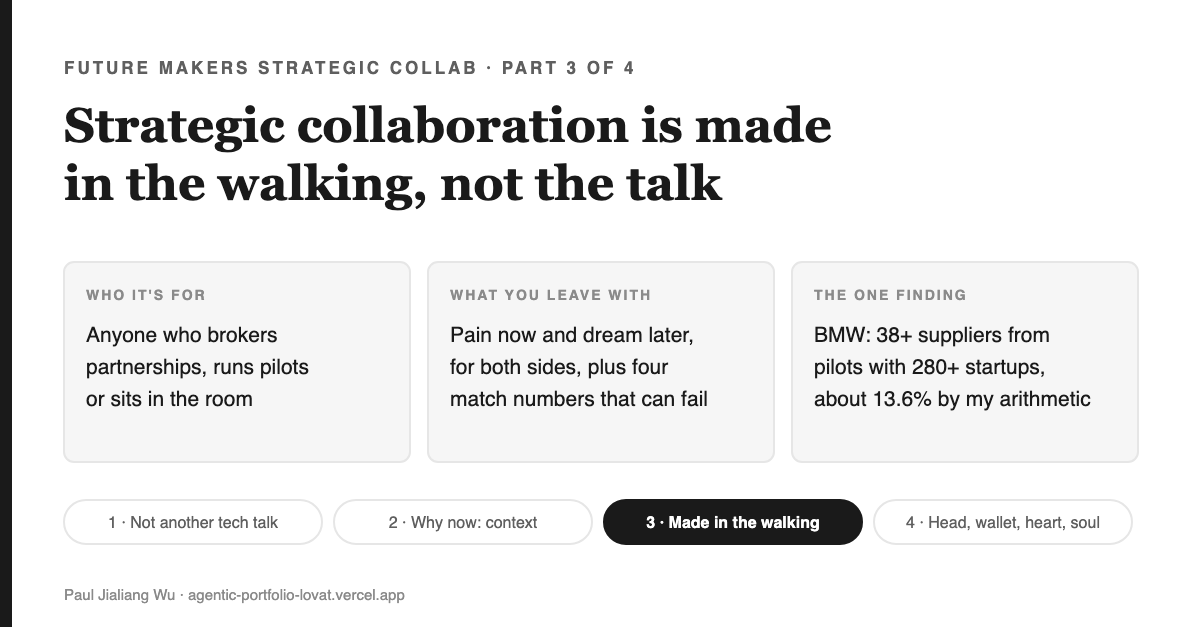
What this is. Part 3 of the FM-SC series, about matching a frontier company with the people who could use its work. Each side has a pain now and a dream for later, and the claim is that you only learn both over many walks and talks, never in one meeting.
Why it matters. Most partnerships are judged on one great meeting or demo. BMW's venture-client unit reports 38-plus established suppliers from pilots with 280-plus startups, about 13.6% by my arithmetic, after weeks of contact and a bounded test, even though over half its alumni win paid follow-up work.
What you can do after reading. Before your next outside meeting, write down their pain now and their dream in a year, and bring one question about the gap. Afterwards, write down one commitment with a name and a date. Count your walks.
Future Makers Strategic Collab — the series spine
▶ See it running: open the live demo public · no sign-in
- Not another tech talk — what makes FM-SC different episode 1
- Why now — when AI is cheap, context compounds episode 2
- The match — made in the walking, not the talk this episode
- Head, wallet, heart, soul — two witnesses per practice episode 4
How to read the labels: EVIDENCE is sourced, DESIGN is how FM-SC is built, OPEN is not yet tested, and LENS is my own conviction.
What this episode covers: how a strategic collaboration match is understood
Part 3 is about matching: how a frontier company (the provider) and the people who could use its work (the demanders) come to understand each other well enough to collaborate. It's for anyone who brokers partnerships, runs pilots or sits in the room. The claim: a strategic collaboration is understood over many walks and talks, not in one meeting.
Make a bet first
Before you read on, decide which of these predicts whether a speaker and a room will still be working together three months after a talk:
- A. How famous the speaker is.
- B. How many people attended.
- C. How many people arrived carrying a specific question they needed answered.
- D. How good the slides were.
Hold your answer. We'll come back to it.
Two sides, two kinds of pain, two kinds of dream
Every FM-SC talk has two sides. In plain words: the company giving the talk, which I'll call the provider, and the people in the room who could use its work, the demanders. A conference treats the first as content and the second as an audience. FM-SC treats both as people with a job to get done.
That phrase is borrowed on purpose. Clayton Christensen's jobs to be done argues that people don't buy products; they "hire" them to make progress in a particular circumstance (Christensen et al., HBR 2016). DESIGN FM-SC asks the same question of both sides, twice. What hurts now? And what would a dream-come-true look like in a year?
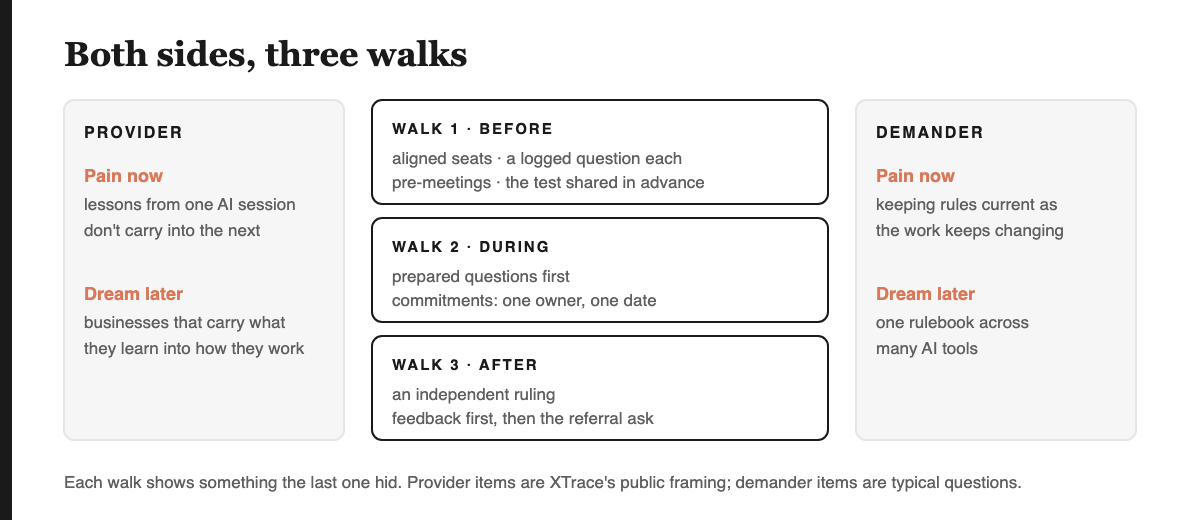
For our first Future Makers, Felix Meng and Austin Cai of XTrace, the provider side was easy to state from their own public words. Their pain, as they frame it publicly: what a business learns in one AI session rarely carries into the next, so a correction made today doesn't guide tomorrow's work. Their dream, in Austin's public post after the talk: "businesses that carry what they learn into how they work". XTrace's own site puts the same thesis as "shared intelligence for people and AI agents" (xtrace.ai).
The demander side is quieter, and more specific. People who might use a shared memory for AI tend to ask practical questions: how does a rule stay current when the work keeps changing, how do you stop a bad lesson from spreading, and does one rulebook work across several AI tools at once? Those are typical questions, not quotes from our room. DESIGN In practice we keep the room's questions as quote-backed notes until a person confirms them, so the demander side we act on is what people asked, not what we guessed.
Why one conversation is not enough
Here is the uncomfortable fact about matching people: a single meeting tells you what someone says, not what they need. Ask anyone who has bought software after one great demo.
EVIDENCE Engineers' communication falls off sharply with physical distance. Thomas Allen's MIT studies of R&D labs found the chance of regular technical communication drops steeply within the first few tens of metres (Allen, Managing the Flow of Technology, 1977; summarised as the Allen curve). Proximity is built by walking, again and again, not by one visit. EVIDENCE BMW Startup Garage, which calls itself the world's first venture-client unit, reports pilots with 280-plus startups, 38-plus that became established BMW suppliers, and over half of its alumni winning paid follow-up projects; from first touchpoint to final evaluation takes 4 to 8 weeks (BMW Startup Garage). Dividing the two lower bounds gives roughly 13.6% becoming suppliers, by my arithmetic. Even a practised matchmaker needs repeated contact and a bounded test before a match is real.
So FM-SC is built as walks and talks, not a talk.
- Before the talk. Each seat is chosen by alignment with what the provider actually builds. Each person logs one real question, challenge or request before they arrive. We hold pre-meetings with the provider's engineers and leaders. We also send them, in advance, the live test we'll run, so the test is fair rather than an ambush.
- During the talk. The question goes on screen first. The prepared questions are taken in order, before open mic. The last ten minutes are commitments, each read aloud with one owner and a date.
- After the talk. Someone who did not invite the speaker rules on what we learned. The speaker gets measured feedback first, and only then the ask for three people we should meet next.
DESIGN Each of those moments is a chance to learn something the last one hid. That is what "compounding closed loop" means here, in plain words: every walk changes how the next one is run.
What "a good match" means, in numbers you can check
"Great match" is a feeling. FM-SC writes it down as things that can fail.
- Preparation coverage: the share of invited people who arrived with a logged question. The bar is 80%.
- Follow-up speed: days from the talk to the first commitment with an owner and a date. The bar is two.
- Follow-through: commitments finished on time and checked by someone other than the owner. EVIDENCE A team-retrospective vendor reports that action items with both an owner and a due date finished about 90% of the time, versus about 67% for actions with neither (TeamRetro, vendor-reported). We treat that as a direction, not a target.
- The referral chain: whether the speaker introduces us to the next lab, builder or person, and whether that introduction becomes a talk.
DESIGN Nobody keeps these numbers by hand. The FM-SC web app works them out from what was recorded, on a page called Getting better, and marks a number UNMEASURED when there is too little to count. The app is public, with no sign-in. Its walkthrough runs on a made-up talk, so you can watch how the scoring behaves without seeing anyone's real work.
DESIGN My answer to the bet at the top is C, and I should be clear that it's a design bet, not a measured result: no study I know of tracks three-month collaboration after a talk. It's the only one of the four our design measures. EVIDENCE The nearest research is from training: whether people liked a session tells you little about what they learned, while whether they found it useful predicts on-the-job transfer better (Alliger et al., 1997). A room that arrives with questions is a room that came to use something. Fame, crowds and slides are what the one great demo had. And notice the price tags: a famous speaker costs a fee, a crowd costs a venue, good slides cost a weekend. A question costs a guest five minutes. The cheapest of the four is the one we chose to measure.
The honest scorecard
FM-SC has run one talk. Here is what that first walk taught us about our own matching.
EVIDENCE The provider side was understood well, from their public material and the session itself. EVIDENCE On the demander side, my own count is three-plus deep-dive discussions before the event and fifteen-plus questions during and after. But we did not record the preparation in our own system before the day. By our own rule, the first loop cannot count as closed, because preparation logged after the fact proves nothing about arriving prepared. DESIGN So we turned that miss into a rule: the system now warns before any session that has no recorded preparation.
The biggest blind spot on the first walk was ours: we built a system to log the room's preparation, then didn't use it before the day. That's the point of walking more than once. The first walk shows you where you were guessing.
How this could fail
Three ways, stated now so you can hold us to them:
- Matching becomes networking. If seats go to whoever is available rather than whoever is aligned, the talk becomes a lunch with slides. We'd see preparation coverage fall below the bar.
- The loop stalls at the human step. Software can surface a deadline. It can't make anyone rule on a result or send a thank-you. If rulings arrive late or never, the loop is a pipeline.
- The referral chain never forms. OPEN If speakers don't introduce us onward, FM-SC stays an outbound invitation list. Whether it becomes an inbound network is still an open question after one talk.
Your move this week
Pick one meeting you have with someone outside your team. Before it, write down two things: what hurts for them now, and what a dream outcome looks like for them in a year. Bring one specific question about the gap between the two. Afterwards, write the one commitment either of you made, with a name and a date. That's one walk.
Next
In part 4, the question I get asked most: why does a program about AI talks lean on Proverbs and on management science at the same time? It's because the hardest problems in FM-SC turn out to be about people.
Sources
- Christensen, C., Hall, T., Dillon, K. & Duncan, D. (2016). Know Your Customers' "Jobs to Be Done." Harvard Business Review. https://hbr.org/2016/09/know-your-customers-jobs-to-be-done
- Allen, T. J. (1977). Managing the Flow of Technology. MIT Press. Summary of the Allen curve: https://en.wikipedia.org/wiki/Allen_curve
- BMW Startup Garage, program figures. https://bmwstartupgarage.com/
- TeamRetro, Follow-Through Index (vendor-reported). https://www.teamretro.com/guides/follow-through-index/
- Alliger, G. M., Tannenbaum, S. I., Bennett, W., Traver, H. & Shotland, A. (1997). A meta-analysis of the relations among training criteria. Personnel Psychology, 50, 341–358. https://onlinelibrary.wiley.com/doi/abs/10.1111/j.1744-6570.1997.tb00911.x
- XTrace, company site. https://xtrace.ai/
- Austin Cai, public LinkedIn post after the October 2, 2026 talk. Quoted as posted (testimony); LinkedIn is login-walled.
- Wu, P. J. (2022). Here comes the 12X-Future Southern Data Science Conferences. LinkedIn. https://www.linkedin.com/pulse/here-coms-12x-future-southern-data-science-conference-wu-phd/