AI-NATIVE SERIES · FUTURE MAKERS STRATEGIC COLLAB, PART 2 OF 4
Why Now: When AI Access Is Cheap, What Compounds Is Context
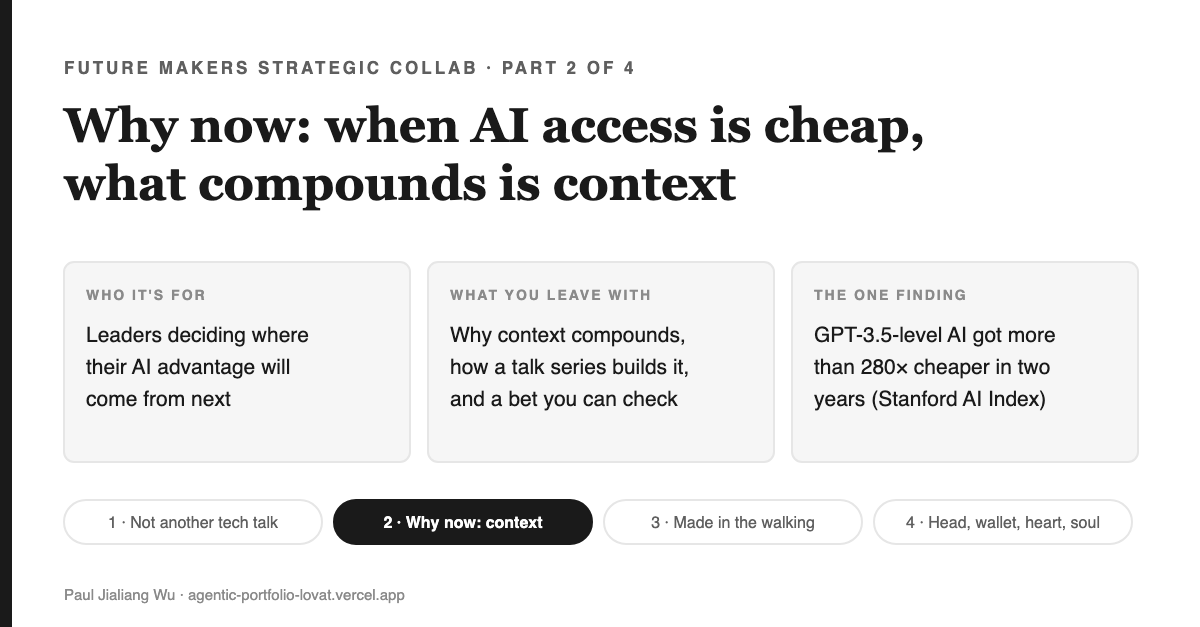
1-minute takeaway
What this is. Part 2 of the FM-SC series. It argues that once AI models are cheap and alike, a business's advantage moves to its context: the decisions, standards and lessons it builds by doing the work. A talk series that keeps what it learns is one way to build that context.
Why it matters. Stanford's AI Index measured a more-than-280-fold cost drop for GPT-3.5-level performance in two years, and organisational adoption at 88% in the 2026 AI Index. If your team's lessons live in people's heads, that is the part of your edge you can lose in one resignation.
What you can do after reading. List three decisions your team made this quarter that nobody outside it could reconstruct, and find where each one lives. Then hold FM-SC to its three public tests for October 2027.
Future Makers Strategic Collab — the series spine
▶ See it running: open the live demo public · no sign-in
- Not another tech talk — what makes FM-SC different episode 1
- Why now — when AI is cheap, context compounds this episode
- The match — made in the walking, not the talk episode 3
- Head, wallet, heart, soul — two witnesses per practice episode 4
How to read the labels: EVIDENCE is sourced, DESIGN is how FM-SC is built, OPEN is not yet tested, and LENS is my own conviction.
What this episode covers: why context is the edge once AI is cheap
Part 2 asks why a tech talk format matters more after AI than before it. It's for leaders deciding where their AI advantage will come from, and for builders whose team's lessons live in people's heads. The short version: models are getting cheaper and more alike, so what a business learns, and keeps, becomes its context, and its edge.
Make a bet first
Between November 2022 and October 2024, by how much did the cost of getting GPT-3.5-level performance from an AI model fall?
- A. About 2×.
- B. About 20×.
- C. More than 200×.
Choose before you scroll.
The answer, and why it changes the question
EVIDENCE C. Stanford's AI Index reports the cost of that level of performance fell more than 280-fold in those two years, while the share of organizations using AI rose from 55% to 78% (Stanford HAI, AI Index 2025). EVIDENCE Independent analysts at Epoch AI measured prices for constant capability falling between 9× and 900× per year, depending on the task, with the caveat that the fastest drops are recent and may not persist (Epoch AI). EVIDENCE In the 2026 AI Index, organizational adoption stood at 88%, and the performance gap between the top US and Chinese models had effectively closed, with the leader ahead by just 2.7% (Stanford HAI, AI Index 2026).
When the same intelligence is cheap, widely used, and roughly level across providers, the model itself stops being the advantage. Saying "we use AI" is heading the way of saying "we use electricity": true, and not a reason to pick you. So the question every business has to answer shifts from which AI should we buy? to what do we have that the AI can't get anywhere else?
What the Future Makers said
Our first Future Makers, Felix Meng and Austin Cai of XTrace, answered that question in their talk. After the event, Austin summed up the three points that resonated most in the room, in his own words on LinkedIn:
- "Access to top AI models are commoditized, now a business’s advantage comes from the context it own: the decisions, standards and lessons built through doing the work."
- "Governance is the difference between a dirt road and a highway."
- "Every AI session should leave the business better equipped for the next."
OPEN The first point is a thesis, and it's one that many investors and vendors share (Insight Partners, for example). That doesn't make it wrong. It does mean it should be tested, not repeated. I work at a consultancy, which has its own reasons to like the idea, so weigh my agreement accordingly.
Why a talk series belongs in this story
Here's the connection most people miss. If the advantage moves to context, meaning the decisions, standards and lessons a business builds by doing the work, then the way a business learns from outsiders becomes part of its advantage.
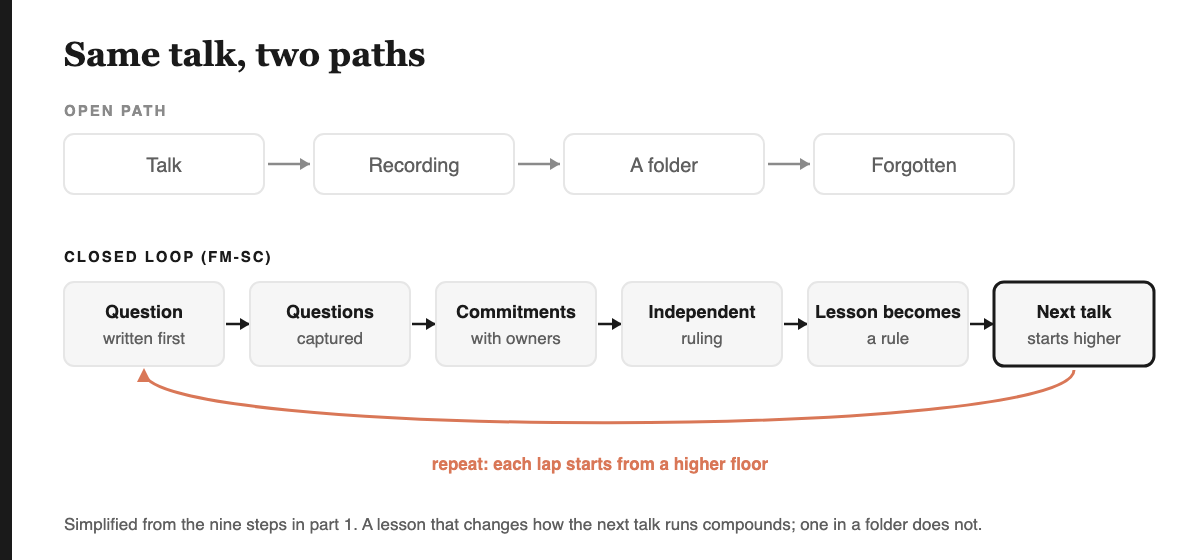
A typical talk is an expensive way to learn and a cheap way to forget. Someone brilliant shares a frontier idea; a room nods; the recording goes into a folder, where it joins every other recording in the folder. Whatever context was created walks out the door with the speaker.
I first wrote about this in 2022, before the current wave of AI. After the Southern Data Science Conference, I argued that a conference should move from a single snapshot to ongoing interactions, and from people laboring through content to people creating together (Wu, 2022). At the time, that was a nice-to-have. Back then, a team's edge could still come from having better tools than its competitors. When everyone has the same tools, the snapshot is worth even less, and the ongoing interaction is where the value is.
DESIGN Compounding is a plain idea. A lesson that changes how the next talk is run makes that talk a little better, and its lessons start from a higher floor. A lesson that sits in a folder changes nothing, however good it was. So the test of a talk series is not how good any one talk was. It is whether talk ten is visibly better run than talk one.
DESIGN FM-SC treats every talk as a way to build context that stays:
- The question we bring is written down before the talk, so what we learn can be checked.
- What the room asks is captured, confirmed by a person, and kept.
- Commitments have owners and dates, so learning turns into action.
- A ruling by someone independent records what we actually found out.
- And the lessons become rules our own system applies before the next step.
That last point is where FM-SC and our first speakers' thesis met. XTrace's public framing is that a correction made today should guide tomorrow's work, not sit in a note. We took that seriously enough to apply it to ourselves the same week. EVIDENCE Our own lessons from the first talk are now six rules that our system checks before acting. Some only advise, some warn, and one stops a step outright until its condition is met. Notes we would have filed in that folder now argue back, starting with the one from part 1 about the organisers who forgot to record our own preparation. It warns us first.
DESIGN You can read those rules yourself. They are a page called Lessons in the FM-SC web app, which is public and needs no sign-in. Each rule says whether it advises, warns or stops a step. The people and events in the app's walkthrough are made up; the rules, and the way they run ahead of each action, are the ones we use.
Is it "revolutionary"?
It's tempting to call FM-SC revolutionary in the post-AI era. I won't, yet. That word is earned by results over time, and FM-SC has run one talk.
What I will argue is narrower and, I think, more useful. DESIGN When intelligence is a commodity, a business's real advantage is how fast it learns and how well it keeps what it learns. A talk series is one of the oldest ways organizations learn from the outside. Running it as a closed loop, with a question, an independent ruling and lessons that act, turns it from an event into an engine. Whether that engine compounds is an empirical question. So here is how we'll know.
My bet, in public
My bet: by October 2027, FM-SC will have done three things. If it hasn't, it's just another talk series, and I'll say so here.
- At least one talk has closed all nine steps of the loop (listed in part 1), with every step recorded at the time it happened.
- At least one Future Maker's introduction has led to another Future Maker's talk.
- At least one fair test has reached a verdict, pass or fail, and the speaker has received it in writing.
OPEN None of the three has happened yet.
How this could fail
- The thesis is wrong. If the decisive advantage stays with whoever has the best model, context matters less than we think. The AI Index trend makes that unlikely in the near term, but trends turn.
- We hoard instead of compound. Keeping lessons inside one program doesn't compound anything. They have to reach the people doing the work.
- Rules go stale. A lesson that was true in October can be wrong by March. Every rule in our system has a review date for that reason. If we stop reviewing, the rules become the kind of stale memory the first talk warned about.
Your move this week
List three decisions your team made this quarter that nobody outside it could reconstruct: why you chose one approach over another. Ask where each of them lives today. If the answer is "in someone's head," that's the context you're one resignation away from losing.
Next
Part 3 is about the match itself: how understanding both sides of a collaboration, their pain now and their dream for later, takes many walks and talks, not one.
Sources
- Stanford HAI (2025). AI Index Report 2025. https://hai.stanford.edu/ai-index/2025-ai-index-report
- Stanford HAI (2026). AI Index Report 2026. https://hai.stanford.edu/ai-index/2026-ai-index-report
- Epoch AI (2025). LLM inference price trends. https://epoch.ai/data-insights/llm-inference-price-trends
- Insight Partners. Building a moat in the age of AI (investor perspective). https://insightpartners.com/ideas/building-a-moat-in-the-age-of-ai
- Austin Cai, public LinkedIn post after the October 2, 2026 talk. Quoted as posted (testimony, not research); LinkedIn is login-walled, so a reader can't fetch it without an account.
- XTrace, company site. https://xtrace.ai/