AI-NATIVE SERIES · FUTURE MAKERS STRATEGIC COLLAB, PART 4 OF 4
Head, Wallet, Heart, Soul: Biblical Principles and Management Science in FM-SC
1-minute takeaway
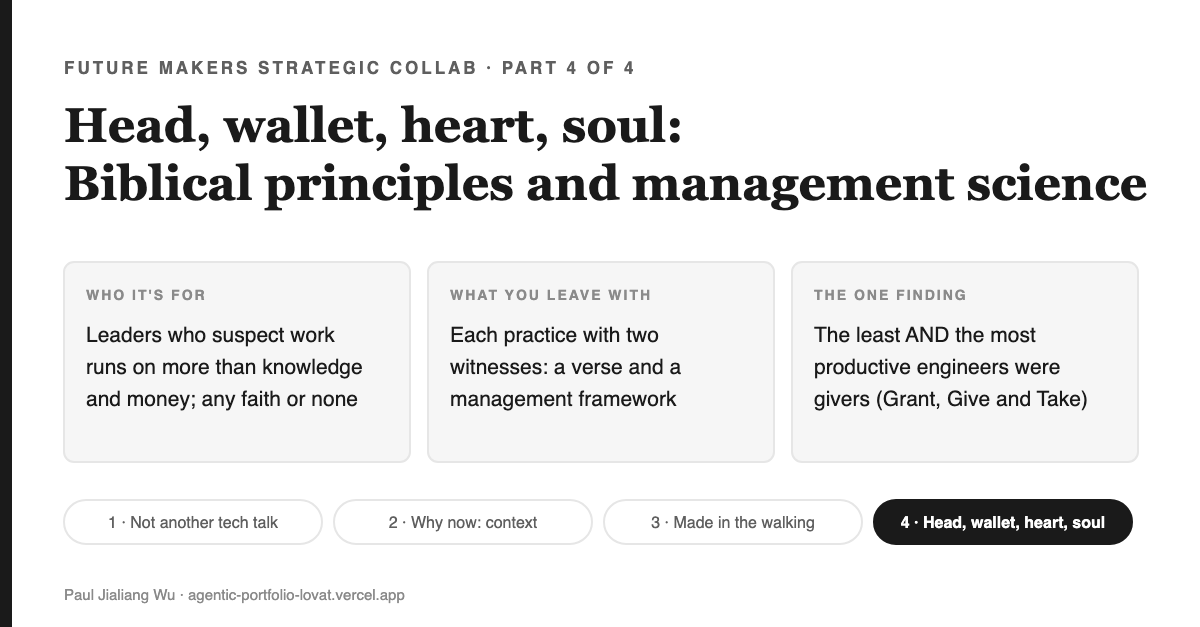
What this is. Part 4 of the FM-SC series. It reads each practice through two witnesses, a Biblical principle and a management framework, across four levels: head (what we learn), wallet (what we build and buy), heart (how people feel working together) and soul (why we do it).
Why it matters. Gallup found only 20% of employees worldwide engaged in 2025. Gallup doesn't say why; my reading is that work which reaches only the head leaves most of a person outside. Every practice here also stands on management research, so it works whatever your faith.
What you can do after reading. Pick one working relationship. Write one thing you can give that helps their goal, and one thing you need from them, with a date. Give first, then ask.
Future Makers Strategic Collab — the series spine
▶ See it running: open the live demo public · no sign-in
- Not another tech talk — what makes FM-SC different episode 1
- Why now — when AI is cheap, context compounds episode 2
- The match — made in the walking, not the talk episode 3
- Head, wallet, heart, soul — two witnesses per practice this episode
How to read the labels: EVIDENCE is sourced, DESIGN is how FM-SC is built, OPEN is not yet tested, and LENS is my own conviction.
What this episode covers: Biblical principles and management science, side by side
Part 4 is about people, not technology. It reads each FM-SC practice through two witnesses: a Biblical principle and a management framework. It's for leaders who suspect collaboration runs on more than knowledge and money, and for readers of any faith or none who want the practices without the theology.
Make a bet first
In a well-known study of engineers, who ended up at the bottom for productivity: the people who gave more help than they received, or the people who took more than they gave? And who ended up at the top?
Pick an answer for each. We'll come back to it.
Why a talk program needs more than the head
Most talks and conferences change one thing: what people know. Some change a second: what deals get done. FM-SC was designed around four, and our first talk showed why: what broke was mostly not about knowledge.
EVIDENCE Most employees are not engaged. Gallup's 2026 report found only 20% of employees worldwide were engaged in 2025, at an estimated cost of about $10 trillion in lost productivity (Gallup, State of the Global Workplace). LENS Gallup doesn't say why; my reading is that work which reaches only the head leaves most of a person outside the room.
LENS I've come to believe that durable collaboration needs all four: head (what we learn), wallet (what we build and buy), heart (how people feel about working together), and soul (why we do it at all, and who we become doing it).
What follows reads each FM-SC practice through two witnesses, one old and one modern. The two-witness idea is itself old:
… At the mouth of two witnesses, or at the mouth of three witnesses, shall a matter be established.
— Deuteronomy 19:15 (WEB, World English Bible)
I'm borrowing the pattern, not the courtroom.
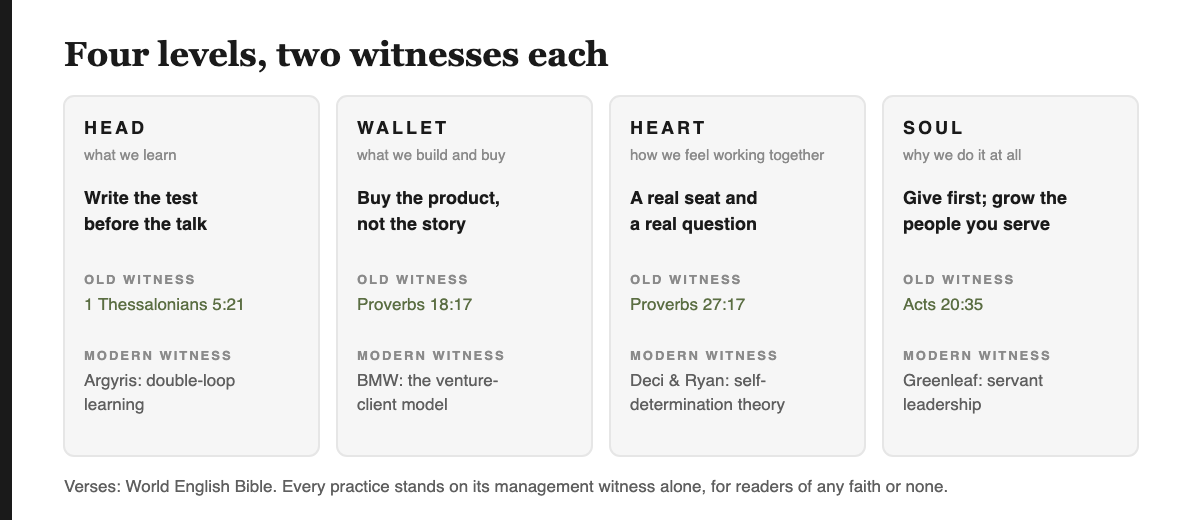
Head: write the test before the talk
The practice. Before any invitation goes out, we write what we're trying to find out and what would prove us wrong.
The old witness. LENS Two verses, one about testing and one about planning:
Test all things, and hold firmly that which is good.
— 1 Thessalonians 5:21 (WEB, World English Bible)
For which of you, desiring to build a tower, doesn’t first sit down and count the cost, to see if he has enough to complete it?
— Luke 14:28 (WEB, World English Bible)
The apostle's line was about discernment, not laboratory method, so I read it as a habit rather than a proof.
The modern witness. EVIDENCE Chris Argyris called learning that never questions its own assumptions single-loop, like a thermostat that holds 68° without ever asking whether 68° is right (Argyris, HBR 1977). Writing the falsifier first is a way of forcing the second loop.
Head: make the lesson stop the next mistake
The practice. When FM-SC learns something, it becomes a rule that runs before the next action. It can guide, warn, or stop a step outright. DESIGN You can watch this one work: the rules are the Lessons page of the FM-SC web app, open to anyone with no sign-in. Its walkthrough runs on made-up people and events.
The modern witness. EVIDENCE Toyota's jidoka designs equipment "to stop automatically and to detect and call attention to problems immediately whenever they occur", and any worker can pull the andon cord to halt the line until it's fixed (Toyota, Jidoka). A lesson that can't stop anything is a note.
The old witness. LENS Watching closely comes first. Then you change what you do.
Know well the state of your flocks, and pay attention to your herds:
— Proverbs 27:23 (WEB, World English Bible)
Wallet: buy the product, not the story
The practice. An idea from a talk earns a fair test with the pass marks fixed in advance. Only a pass earns a pilot.
The modern witness. EVIDENCE BMW's venture-client model, run through BMW Startup Garage, became a client of startups rather than an investor in them. It calls itself the world's first venture client unit, and pilots a startup's product in real BMW applications (BMW Startup Garage). In short: buy the product, not the shares.
The old witness. LENS The first account always sounds complete:
He who pleads his cause first seems right; until another comes and questions him.
— Proverbs 18:17 (WEB, World English Bible)
FM-SC has a rule: the person who will rule on a talk is never the person who invited the speaker. I read that rule through this verse, but it comes from audit practice (maker is not checker) and stands without it.
Wallet: referrals, soberly
The practice. After the speaker has been thanked with something useful, we ask them to introduce us to three people: a frontier lab, a builder, and a researcher.
The modern witness. EVIDENCE A study of a bank's referral program found referred customers were worth at least 16% more. But the margin advantage eroded over time; only better retention lasted (Schmitt, Skiera & Van den Bulte, Journal of Marketing 2011). Referral chains help. They are not magic.
The old witness. LENS A chain of teaching, in one verse:
The things which you have heard from me among many witnesses, commit the same to faithful men, who will be able to teach others also.
— 2 Timothy 2:2 (WEB, World English Bible)
Four generations in one sentence: a teacher, a student, faithful people, and others. That is the closest picture I know of "making my ceilings your foundations." Its context is passing on faith; I'm borrowing the pattern.
Heart: belonging, competence, a real seat
The practice. People are invited because their work aligns with what the speaker builds, not by seniority. Everyone arrives with one question, challenge or request. Each commitment has one owner, by name.
The modern witness. EVIDENCE Self-determination theory finds that motivation and well-being rest on three needs: competence, autonomy and relatedness (Deci & Ryan, 2000). DESIGN A real question meets competence. A seat by alignment meets relatedness. A commitment you own meets autonomy.
EVIDENCE Amy Edmondson defined psychological safety as "a shared belief held by members of a team that the team is safe for interpersonal risk taking", and found it predicted how much teams learned (Edmondson, 1999, as summarised by Psych Safety). FM-SC needs it, because we publish what failed, including our own misses.
The old witness. LENS Sharpening only happens when both sides bring something hard.
Iron sharpens iron; so a man sharpens his friend’s countenance.
— Proverbs 27:17 (WEB, World English Bible)
Soul: give first, and grow the people you serve
The practice. Every speaker gets measured feedback before any ask. Any award goes only to a contribution we can point to, and never depends on a purchase.
The old witness. LENS Two verses about whose interests come first:
… remember the words of the Lord Jesus, that he himself said, ‘It is more blessed to give than to receive.’
— Acts 20:35 (WEB, World English Bible)
each of you not just looking to his own things, but each of you also to the things of others.
— Philippians 2:4 (WEB, World English Bible)
There's a verse I deliberately don't use here: Luke 6:38, the promise that what you give comes back to you in good measure. In context it's about mercy, not a referral tactic, and FM-SC is not give-to-get.
The modern witness. EVIDENCE Robert Greenleaf's test for servant leadership: "Do those served grow as persons? Do they, while being served, become healthier, wiser, freer, more autonomous, more likely themselves to become servants?" (Greenleaf Center). DESIGN That is the test FM-SC sets for itself with every speaker and every builder in the room.
The answer to the bet
EVIDENCE Both. In Adam Grant's research, the least productive engineers gave more than they received. So did the most productive. The bottom and the top of the ranking were held by the same kind of person, which is the most annoying possible answer to a bet, and the most useful. The difference was that successful givers were "otherish": generous, but also protecting their own goals (Wharton, on Give and Take). That's why FM-SC gives first and still writes down what it needs, with dates.
The honest scorecard
FM-SC has run one talk. On the head, it produced a ruling question, a fair test with pass marks fixed before it runs, and six lessons now built into the rules. On the wallet, nothing is bought, and nothing will be until a test passes. On the heart, by my count three-plus deep-dive conversations happened before the event and fifteen-plus questions during and after it. OPEN Soul is the slowest of the four, and the hardest to measure honestly. We'll know more after the next few speakers, and whether they choose to pass the baton. The head has already taught us a lesson, and it was about us: the organisers who preach writing the question first wrote our own two days before the talk, after the invitation.
How this could fail
- Faith as marketing. If verses become decoration for a sales pitch, they insult both the faith and the reader. Each principle here has to stand on its practice, and on its management witness, alone.
- Giving that burns out. EVIDENCE Grant's selfless givers sit at the bottom. If the organizers give endlessly and never ask, the program ends with them.
- Proof-texting. Pulling a verse out of its setting to win an argument. I've tried to name each verse's real context. Correct me where I've failed.
- Excluding people. If a colleague of another faith, or none, felt this program wasn't for them, it would have failed at the heart level whatever else it achieved.
Your move this week
Choose one working relationship. Write down one thing you can give that person this week that helps their goal, measured if you can, and one thing you need from them, with a date. Give the first before you ask the second.
Next
That's the end of this series. If you know a frontier lab, builder or researcher whose ceiling could be someone else's foundation, I'd like to hear about them.
Sources
- Gallup, State of the Global Workplace (2026 report on 2025 data). https://www.gallup.com/workplace/349484/state-of-the-global-workplace.aspx
- Argyris, C. (1977). Double loop learning in organizations. Harvard Business Review (summary). https://leeds-faculty.colorado.edu/larsenk/learnorg/argyr1.html
- Toyota, Jidoka and Andon. https://mag.toyota.co.uk/jidoka-toyota-production-system/ · https://mag.toyota.co.uk/andon-toyota-production-system/
- BMW Startup Garage, the venture-client model. https://bmwstartupgarage.com/
- Schmitt, P., Skiera, B. & Van den Bulte, C. (2011). Referral programs and customer value. Journal of Marketing, 75(1). https://faculty.wharton.upenn.edu/wp-content/uploads/2012/04/Schmitt-Skiera-vandenBulte-2011-Referral-Programs-Customer-Value.pdf
- Deci, E. L. & Ryan, R. M. (2000). The "what" and "why" of goal pursuits. Psychological Inquiry, 11(4). https://www.selfdeterminationtheory.org/SDT/documents/2000_DeciRyan_PIWhatWhy.pdf
- Edmondson, A. (1999). Psychological safety and learning behavior in work teams. Administrative Science Quarterly, 44(2). https://doi.org/10.2307/2666999 (summary used: https://explore.psychsafety.com/n/edmondson-1999.md)
- Greenleaf, R. K. (1970). The Servant as Leader. https://greenleaf.org/what-is-servant-leadership/
- Grant, A. (2013). Give and Take (via Wharton). https://knowledge.wharton.upenn.edu/?p=13185
- Scripture: World English Bible (WEB, public domain), fetched from bible-api.com and quoted exactly. https://bible-api.com/