AI-Native Series · Trust Engineering
Test Everything. Hold On to the Good. Now We Have the Tools.
1-minute takeaway — what you'll walk away with
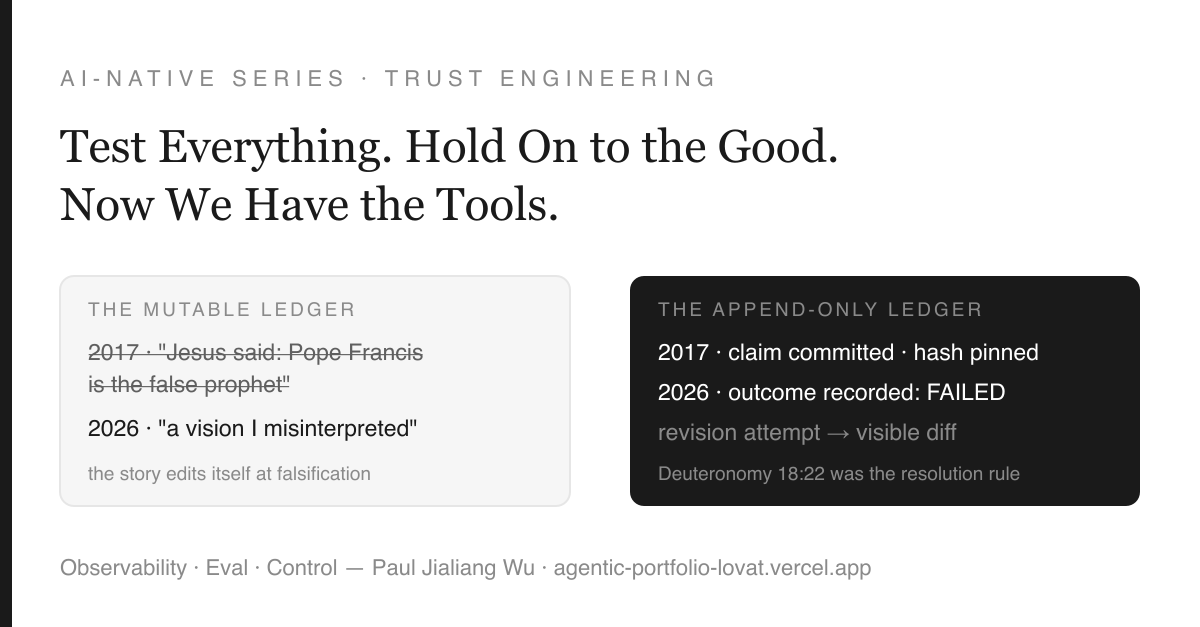
In 2017 a well-known charismatic minister said Jesus told him, "very simply and very clearly," that Pope Francis was the false prophet of Revelation. In 2026, after the prophecy failed, the claim became "a vision" he had "misinterpreted." That is not a spiritual problem first — it is a mutable ledger problem, and engineering already knows the fix. This essay takes a documented ministry-integrity collapse, shows that Scripture specified the test suite three millennia ago, and lays out the OEC stack — Observability, Eval, Control — that AI-native trust engineering would wire around any system whose words move people's lives and money.
A case study in charisma outrunning accountability, and the trust stack that closes the gap. ~9 min.
In July 2026, Pastor Joe Sweet and the board of Shekinah Worship Center published a formal public statement about the minister Sundar Selvaraj, whom they note they had platformed "for over 20 years" [4]. Its central finding is unflinching — and, unusually for this genre, it leads with its evidence inventory: "It has been thoroughly documented in video recordings, transcriptions of those videos, text messages, numerous emails, testimonies of numerous victims and witnesses and a conference phone call with Sundar Selvaraj on February 25, 2026, that Sundar has demonstrated a pattern of lying and has engaged in giving false “prophetic” words to manipulate and intentionally mislead people, causing harm to individuals and families." The statement calls the warning "our duty to God and to people," concerning a ministry that "has, in fact, proven to be harmful, especially to the unwary" [4].
I'm not writing this to pile on one man; the allegations are the testimony of those who came forward, and I've listed what is verified and what is testimony at the end. I'm writing because the pattern in those transcripts is one I recognize professionally. I spend my days building accountability systems for AI agents — machines whose words can move people's decisions and money. And the uncomfortable observation is this: the average production chatbot now operates under stricter prophetic standards than some prophets. Its claims are logged immutably. Its outputs are evaluated against declared criteria. Its failures have consequences wired to them. The pulpit deserves at least what we demand of a language model.
The diff that tells the whole story
The clearest exhibit is a nine-year quote diff, preserved in the second transcript by the minister Stephen Powell. In 2017: "Jesus appeared to me... and then very simply and very clearly he said 'the present Pope Francis is the prophesied false prophet.'" In the 2026 apology, after Pope Francis died without the prophecy coming to pass: "I had a vision... I mistakenly presumed and misinterpreted it to mean that the reigning pope at the time, Pope Francis, was the one." Powell's critique lands where an engineer's would: "He is changing the story... when you say that Jesus appeared to you and told you with his words... there's no room for interpretation."
In my field this maneuver has a name: rewriting the commit after the build failed. A direct quotation became a vision; a named subject became an assumption the audience supposedly made. The claim mutated exactly at the moment accountability arrived — which is only possible because the claim lived in a mutable medium: memory, sermons, re-uploaded videos. Nothing pinned the 2017 words to 2017.
The mental model: charisma scales faster than accountability — ledgers scale accountability. A gifted speaker can reach a million people by Sunday; the community's ability to test what he said grows much slower. Every integrity collapse in the transcripts — and in crypto, in wellness empires, in AI-hype startups — lives in that gap. You close it the way engineering closes it: make the claims observable (recorded, immutable, public), make the evaluation explicit (declared criteria, scored by others), and make the consequences wired (platforms and money respond to the scorecard, not the charisma).
The case pattern — six failure modes, one root
The transcripts document six recurring mechanisms. Condensed, and attributed — these are the accounts of those who came forward:
- Prophecy as coercion. A young woman allegedly pressured into a rushed marriage — reportedly useful for a U.S. visa — by prophetic words, including a wedding-day claim: "I see now an angel that's assigned to make sure this marriage will never fall apart." Per the transcript, the same minister had privately said the marriage was "not the will of the Lord."
- Costume vs. ledger. The public persona of a "sadu" — an ascetic renouncer — alongside, per the transcripts, multiple homes across four countries and luxury vehicles. The brand and the balance sheet tell different stories, and only one of them is audited.
- Semantic retreat. The Pope Francis diff above — visitation downgraded to vision, quotation to assumption, at exactly the moment of falsification.
- Isolation. Sermons, quoted in the transcripts, praising members who "have left your fathers, your mothers... because God has called you." Isolation removes the very people most likely to run the test the community won't.
- Worship laundering. The reported teaching that Jesus permitted him to "receive the worship on behalf of Jesus." Whatever else that is, it is a claim engineered to be untestable — questioning it becomes questioning Jesus.
- Accountability arriving decades late. The de-platforming came after 20 years — and only because one insider treated evidence as binding. The control loop existed; its latency was a generation.
One root under all six: unfalsifiable inputs, unaudited state, unenforced outputs. Any system with that architecture — church, DAO (a blockchain-governed collective with no human gatekeeper), startup, or agent swarm — produces this failure class eventually. The robes are incidental.
How the truth actually surfaced — and what it cost
The discovery chain, as the third transcript recounts it, is a case study in accountability running on manual labor. In January 2026, former members of Steven Francis's church — some of them former members of Sweet's own congregation — contacted Sweet's office "in desperation," reporting lies, manipulation, and financial dishonesty. They had first gone to the system's own accountability layer — the church's elders, and Selvaraj himself — and, per their account, were ignored. The inner loop was closed; the truth had to route around it.
So in February 2026, Sweet and his wife traveled to Shelby, North Carolina, and rebuilt the observability layer by hand: days of interviews with ten people who describe themselves as victims, written statements from ten more, audio and video recordings of messages the witnesses describe as deceptive, financial documents and canceled checks described in the transcript as evidence of money laundering — and the wedding transcript in which Selvaraj prophetically blessed the very marriage he had — per the transcript — privately called "not the will of the Lord." Weeks of travel and testimony-gathering to assemble what an append-only ledger would have held all along. The evidence always existed. The access cost a pastorate's worth of trust and a cross-country trip.
Two earlier moments in the transcript deserve their own frame. In 2019, Steven Francis asked Sweet to sponsor his U.S. religious-worker visa; the forms that arrived claimed Steven would be a 20-hour-per-week employee of Sweet's church, preach there four times a year, and sit on its board — none of it true, per Sweet. Sweet refused to sign. That signature was a write boundary — the same mechanism my strategy engine uses when it refuses to record a decision it cannot verify: bad claims never get to exist if the gate holds. And in 2023, in Jerusalem, when Sweet explained the refusal, Selvaraj's reported reply was the quiet center of the whole affair: "No, my brother did that. I know him and I know what he is like." If the reported reply is accurate, the knowledge preceded the concealment by years. Observability was never the bottleneck for the insiders — enforcement was.
Scripture shipped the test suite first
Here is what should embarrass no Christian: none of the fixes require new theology. The oldest layer of the canon already specifies falsifiability as the test for prophetic claims: "If what a prophet proclaims in the name of the Lord does not take place or come true, that is a message the Lord has not spoken. That prophet has spoken presumptuously, so do not be alarmed" (Deuteronomy 18:22). That is a resolution criterion — outcome-based, binary, no appeals to sincerity.
The New Testament adds peer review: "Two or three prophets should speak, and the others should weigh carefully what is said" (1 Corinthians 14:29) — evaluation by a panel, not self-attestation. It adds an explicit instruction to test: "do not believe every spirit, but test the spirits to see whether they are from God, because many false prophets have gone out into the world" (1 John 4:1). It defines the metric: "By their fruit you will recognize them" (Matthew 7:16) — outcomes, not vibes. It ships a glory-seeking detector: "Whoever speaks on their own does so to gain personal glory" (John 7:18). It predicts the exploit class: "In their greed these teachers will exploit you with fabricated stories" (2 Peter 2:3). And it hard-codes the one non-negotiable: "I am the Lord... I will not yield my glory to another" (Isaiah 42:8) — no worship-receiving-by-proxy, ever. It even names the posture this essay takes for its title: "but test them all; hold on to what is good" (1 Thessalonians 5:21) — testing is not the opposite of honoring prophecy; it is how prophecy is honored.
The spec is complete. What's missing is the runtime — the church-scale machinery that actually executes these tests faster than every twenty years.
The human attempt, honored honestly
The charismatic world has tried. The Prophetic Standards Statement (2021), signed by dozens of leaders after a wave of failed public prophecies, says plainly: "we can only believe the prophetic word if it is not contrary to Scripture, it is not factually in error, and our own spirits bear witness with it." It names the structural problem — "anyone claiming to be a prophet can release a word to the general public without any accountability or even responsibility" — and it mandates the fix for public failure: "If the word was delivered publicly, then a public apology (and/or explanation/clarification) should be presented" [1]. On the financial side, the ECFA's Seven Standards of Responsible Stewardship have run a working accreditation-and-revocation loop for ministries' finances since 1979 [2].
Both are real progress, and both share a limitation: they are voluntary policies executed on mutable infrastructure. A signatory can quietly go silent; a statement binds only the conscientious — the people least likely to need it. Policy without observability is a sermon about logging.
The OEC stack: what AI-native engineering adds
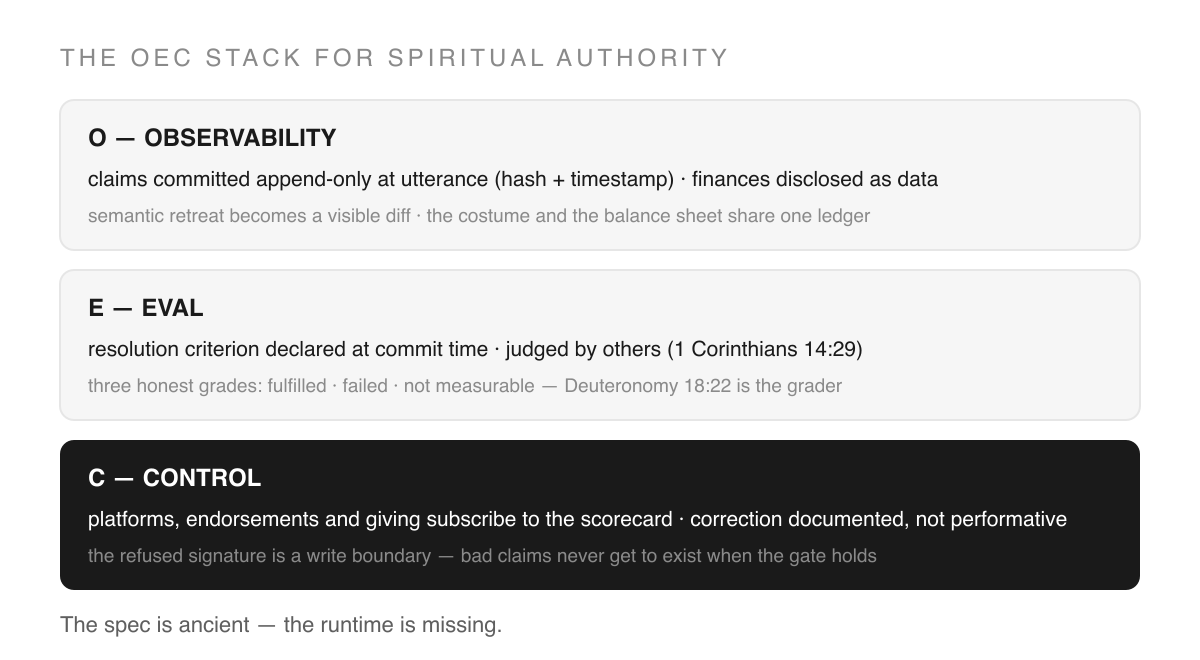
In agentic system design we use a simple governing loop — OEC: Observability, Eval, Control. You cannot trust what you cannot observe; you cannot improve what you cannot evaluate; you cannot govern what you cannot correct. Applied here:
1 · Observability — claims become commits
A public prophetic word should be recorded the way engineering records anything it may need to audit: append-only, timestamped, content-addressed. This is the one place the web3 toolbox earns its keep — not tokens, but the humble commitment device: hash the claim at utterance, anchor it in a public log (a transparency log in the mold of Certificate Transparency [3], or a smart-contract registry — the mechanism matters less than the immutability). Then "Jesus said Pope Francis" in 2017 stays diffable against "a vision I misinterpreted" in 2026, and semantic retreat becomes a visible edit war instead of a memory dispute. The same layer covers the costume problem: ECFA-style financial disclosure, but as machine-readable data rather than a PDF a donor never finds.
2 · Eval — declared criteria, judged by others
Every logged claim carries its resolution criterion at commit time: what would count as fulfilled, by when, judged by whom. Deuteronomy 18:22 is the grader; 1 Corinthians 14:29 names the panel — others weigh, never the speaker. Three honest grades, exactly as in my own eval discipline: fulfilled, failed, and — crucially — not measurable, for words too vague to test. A prophecy that can never be false can never be counted true; it goes in the ledger as unmeasurable, not as a win. Over time each public ministry accrues what every AI agent I ship accrues: a track record computed from the ledger, not from the highlight reel. (This is the discipline behind my private eval-anything framework: every claim a testable assertion; no evidence, no pass — the same rule this portfolio applies to résumés and to its own report cards.)
3 · Control — consequences wired to the scorecard
Pastor Sweet's de-platforming was the control action — correct, courageous, and decades latent, because it depended on one insider's conscience, a refused signature in 2019, and a self-funded investigation in 2026. In an OEC design, control is wired, not heroic: platforms, conference invitations, endorsements and giving flows subscribe to the scorecard. A failed public word triggers the Prophetic Standards Statement's own remedy — public correction — as a standing expectation, not a hostage negotiation. And repentance, the church's oldest control loop, gets the dignity of documentation: a recorded correction, a change in behavior the ledger can see. In machine-learning terms this is the fine-tuning step — error signal in, adjusted behavior out — and its absence is precisely what the July 2026 statement describes: evidence presented, no correction returned.
I run this loop on myself, involuntarily. Earlier this week my own accountability engine graded a turn of my work 0.57 against the 1.0 I claimed, because my evidence was weaker than my confidence — and the number is published where my readers can check it. It stung precisely as much as it should. Systems that force the quiet number out loud are the only ones whose loud numbers mean anything — that's as true of a portfolio as of a pulpit.
The thought experiment: replay the documented case through the stack
My rule for any proposed system: test it against the incident that motivated it — honestly, including the cells where it fails. The Shekinah statement is unusually testable because it publishes its own evidence. Five replays:
- The wedding contradiction — caught instantly, no prophecy timeline needed. Per the statement's transcript excerpts, Selvaraj privately warned his brother that "this marriage is not the will of the Lord" and to "wait for another 6 months until mother also comes into agreement" — then declared at the wedding, "I see now an angel that's assigned to make sure this marriage will never fall apart... No one can break this wedding, marriage, apart" [4]. On a claim ledger, those are two commits by the same author about the same subject with opposite content. Consistency evals resolve immediately — you don't wait decades for an angel to fail; the diff fires the day of the second commit, before the vows if the family can read the log.
- The 2019 visa forms — the write boundary worked, at n=1. The statement records that "Steven had put fraudulent statements on his visa application back in 2019" and that Sweet refused to sign [4]. The stack's job is to make that refusal the default rather than the exception: attestations that require a co-signature become machine-checkable claims (a "20-hour-per-week employee" either appears on payroll data or doesn't). Honest limit: a gate only guards its own door — per the statement, the application simply proceeded elsewhere. Gates work as a network or barely at all.
- The 20-year platform — endorsement as a living object. "We platformed Sundar for over 20 years" [4] is the latency the Control layer exists to compress: an endorsement that re-verifies against the ledger annually — like ECFA accreditation, which expires and must be renewed — instead of a one-time blessing that outlives its evidence by decades.
- The erased dissent — observability includes objections. Per the statement, the wedding "was arranged and rushed" "without the mother's consent," with the engagement following about a week after the groom's documented driving violation [4]. A dissent record — a family objection logged beside the prophetic claim that overrode it — is exactly the kind of low-tech observability that changes outcomes: the community sees a contested word as contested. Honest limit: isolation tactics attack the log's readership; a ledger no one around you reads is a diary.
- The timing tell — latency becomes a metric. The statement observes that Selvaraj's public apology arrived "conveniently, AFTER" he learned a statement about him was coming [4]. On a timestamped ledger, latency-to-correction is computable: the Pope prophecy was falsifiable at the Pope's death, and — per the statement's timeline — the correction arrived only under exposure threat, a gap the Eval layer would publish as a number, not an insinuation.
And the honest failure cells: the stack cannot see unrecorded pastoral conversations; it cannot stop spiritual intimidation from suppressing reports before they reach any log; and its adoption problem is real — the leaders who most need a ledger will not volunteer for one. Which is why the control lever is not the prophet but the platforms: conferences, networks, and broadcasters requiring ledger participation as a condition of the stage, exactly as ECFA membership already works for finances.
Update, same day: this thought experiment is no longer only prose — the stack shipped as working code, with these five replays as its named test suite, in the open-source seminary platform kingdom-come. The receipts are in part 2.
What this does not do
Honesty about limits: a ledger cannot regenerate a heart, and no gate ever built has stopped a determined fraud from finding the unmeasured surface. This stack does something narrower and still decisive: it raises the cost of fraud and collapses the cost of discernment. Today, testing a minister requires twenty years of insider access and the courage of a Joe Sweet. With claims-as-commits and scores-in-public, it requires a link. The Spirit is not caged by this — testing is commanded (1 John 4:1); the ledger just makes obedience cheap. The genuinely humble minister loses nothing except plausible deniability, which is the one asset a true prophet never needed.
Patterns / Anti-patterns
- Pattern — commit at utterance. Public claim → immutable record with a resolution criterion. If it can't carry one, file it as unmeasurable.
- Pattern — others weigh. Evaluation panels per 1 Corinthians 14:29 — never the speaker grading his own homework.
- Pattern — consequences by subscription. Platforms and funders read the scorecard automatically; de-platforming shouldn't require a whistleblower's twenty-year friendship.
- Anti-pattern — sincerity as evidence. Projected humility is an output, not an audit. The transcripts show it deployed as damage control.
- Anti-pattern — unfalsifiable authority. "Receive worship on my behalf" and the transcripts' reported claims of daily "open heavens" visitations are claims engineered to make testing feel like blasphemy. Isaiah 42:8 closes that door.
- Anti-pattern — isolation as consecration. Any call that systematically severs family severs the reviewers. Divine calls integrate and heal; extraction serves the extractor.
The mechanism, named: charisma scales faster than accountability, and every integrity collapse lives in that gap; ledgers, declared evals, and wired consequences are how you scale accountability at the same rate as reach.
The first principle, one sentence: a word claimed from God is a commit, not a draft — record it, let others test it against its own stated criterion, and let the consequences bind, because Deuteronomy 18:22 was never a suggestion.
Provenance — what's verified and what's testimony
The case material comes in two classes. Quotations attributed to the Shekinah Worship Center statement — the evidence-inventory sentence, "pattern of lying," "duty to God and to people," "harmful, especially to the unwary," the 20-year platforming, the wedding-transcript excerpts, the 2019 visa-application characterization, the consent and timing details, and the apology-timing observation — were verified verbatim against the live public statement at shekinahworship.com (published July 10, 2026; updated July 26, 2026). The remaining material — the 2017 and 2026 prophecy quotations, Stephen Powell's critique, and parts of the discovery narrative — is quoted from three transcript digests supplied to me and remains the testimony of those who came forward, as rendered there. In both classes the claims are one side's account: attributed throughout, presented as allegation where they allege, and the accused's response beyond the quoted apology is not represented here. No wrongdoing is asserted in my own voice. The Prophetic Standards Statement and ECFA quotations were verified verbatim against their live sites; all Scripture quotations are from the NIV, verified against BibleGateway; Certificate Transparency is cited descriptively. The 0.57 grade is my own, reproducible from this repo's committed report cards.
References
- Prophetic Standards Statement (2021). "We can only believe the prophetic word if it is not contrary to Scripture, it is not factually in error, and our own spirits bear witness with it." propheticstandards.com
- Evangelical Council for Financial Accountability. Seven Standards of Responsible Stewardship. ecfa.org/Content/Standards
- Laurie, B., Langley, A., & Kasper, E. (2013). Certificate Transparency, RFC 6962 — the append-only public-log design this essay borrows. datatracker.ietf.org/doc/html/rfc6962
- Shekinah Worship Center (2026, July 10; updated July 26). Statement Regarding Sadhu Sundar Selvaraj. All quotations verified verbatim against the live page. shekinahworship.com/statement-regarding-sadhu-sundar-selvaraj
- Scripture quotations: The Holy Bible, New International Version (NIV) — Deuteronomy 18:22; Isaiah 42:8; Matthew 7:16; John 7:18; 1 Corinthians 14:29; 1 Thessalonians 5:21; 2 Peter 2:3; 1 John 4:1. Verified against biblegateway.com
Related
Written from the Shekinah Worship Center's public statement (quotes verified verbatim), three supplied transcript digests (attributed as testimony), and the verified texts of the Prophetic Standards Statement, ECFA, and Scripture (NIV), and a working week spent building the same accountability loops for machines. — Paul Jialiang Wu · agentic-portfolio-lovat.vercel.app