AI-Native Series · Strategy OS
We Built a Machine That Argues With Us. Its Best Feature Is the Word "No."
1-minute takeaway — what you'll walk away with
Ten days, nine milestones, a strategy engine whose defining feature is refusal: it rejects goal-shaped diagnoses, unowned milestones, and alarms nobody answers — and when it came time to close its own final milestone, it refused us, because only a human may decide. One principle to keep: reliability comes from what a system refuses to accept, not from what it promises to produce.
Two weeks ago I wrote about making strategy documents pass CI. Twenty planning artifacts, a gate script, an honest scoreboard. A reader could fairly ask: fine, the paperwork compiles — where's the engine?
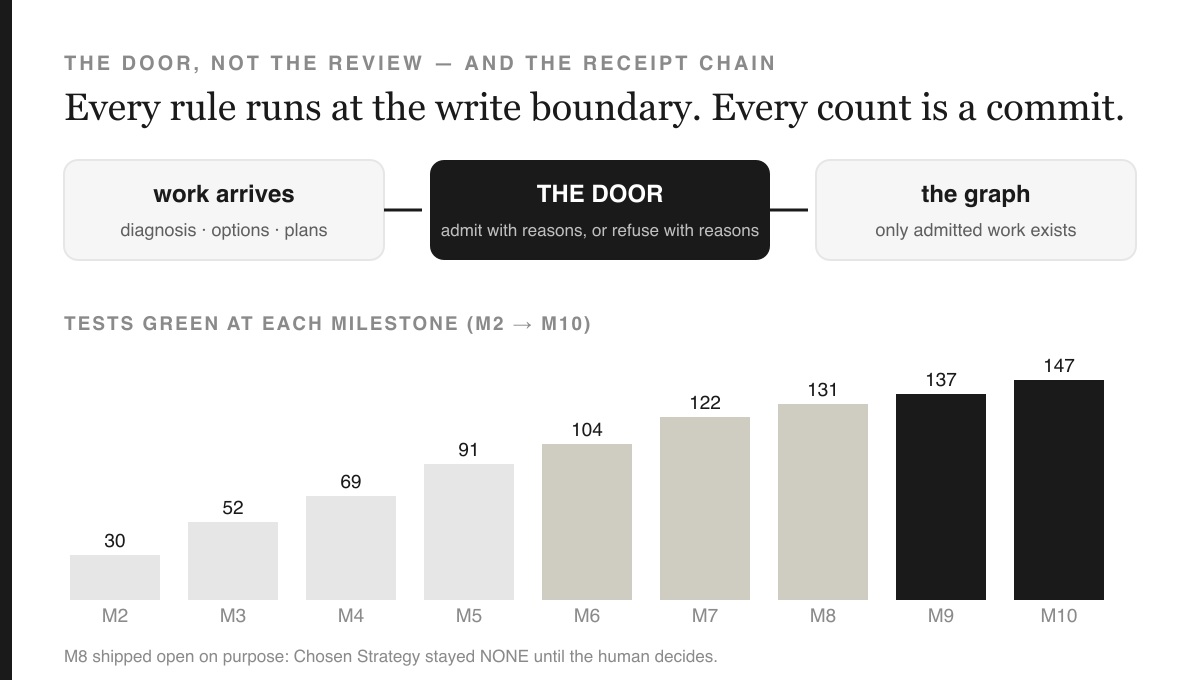
This is the engine. Ten days, milestones M2 through M10, a strategy operating system that takes an evidence base and walks it through diagnosis → options → decision → architecture → execution → adaptation (the intake enforces Rumelt's diagnosis-first kernel [4]), with a test suite that grew from 30 to 147 along the way (the full chain, by milestone: 30 → 52 → 69 → 91 → 104 → 122 → 131 → 137 → 147 — each number is a commit you can diff).
And the thing I want to tell you about is not what it produces. It's what it refuses.
The refusal catalog (all real error messages)
Every module admits work the way a bouncer admits guests: at the door, with reasons. These are verbatim strings from the codebase:
- State a diagnosis that starts with "build," "grow," or "launch" and it throws: that is a goal, not a diagnosis. Goals wearing diagnosis costumes get carded.
- Submit two strategy options that are the same bet in different adjectives: rejected — "genuinely different means different bets, not different adjectives."
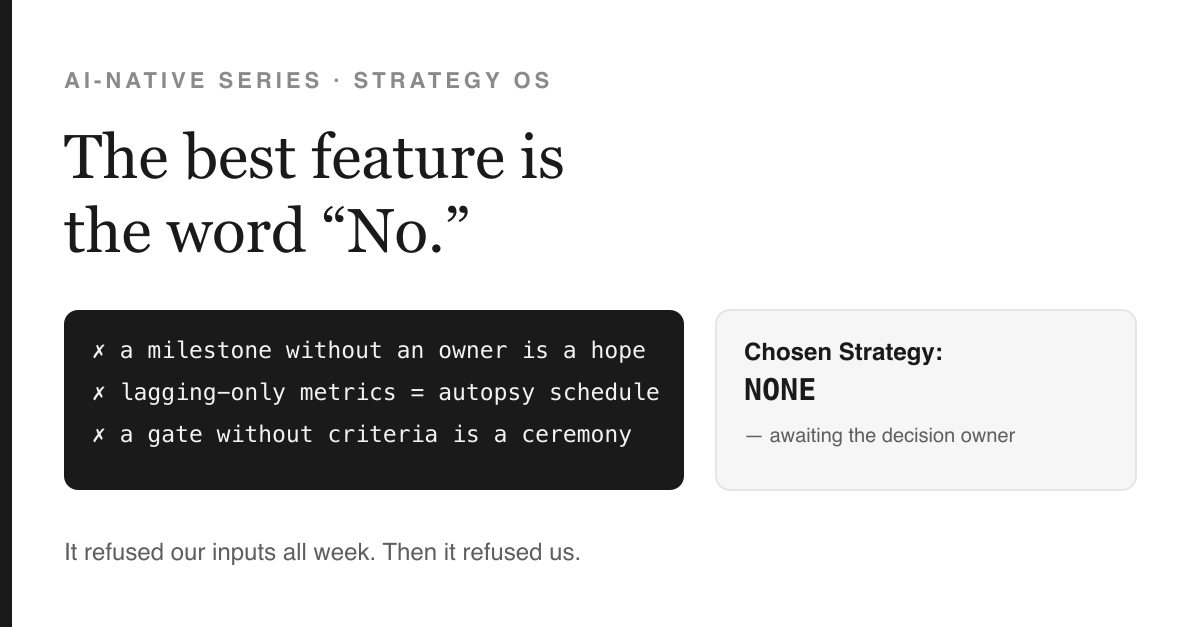
- A milestone with no named human owner: "a milestone without a human owner is a hope."
- A measurement plan with only lagging metrics: "lagging-only measurement is an autopsy schedule."
- A decision gate with no criteria: "a gate without criteria is a ceremony."
- A tripwire with no named response: "an alarm nobody owns."
- A predicted competitor move with no stated incentive: "a vibe, not game theory."
The knowledge layer refuses too. Strategy frameworks live as data cards, each carrying an honest evidence rating — and our research found the ratings roughly inverted against fame (the most famous tools often carry the weakest evidence; the field even published a paper literally titled "SWOT Analysis: It's Time for a Product Recall" [3]). So the loader enforces a rule: a weak-evidence framework physically cannot hold the "verdict" role. It may brainstorm. It may never judge. Famous ≠ valid, as a type error.
The mechanism (name it once)
Write-boundary enforcement: every integrity rule runs at the moment of writing, not in a review afterward. A "fact" without supporting evidence isn't flagged for cleanup — it cannot enter the graph at all. Reviews catch what already happened; doors decide what gets to exist. That's the whole trick, and it's why each of the ten quality detectors is tested in both directions: seeded with a known-bad it must catch, and run on a clean fixture it must stay silent on. A smoke alarm that never fires is broken; one that always fires is furniture.
Then it refused us
Milestone 8 was the graduation exercise: run a real strategy question through the whole engine, end to end. Evidence in, diagnosis, three genuinely different options, scenario stress, a tradeoff ranking. The ranking was decisive — 8.2 versus 3.7 versus 3.4. Everyone could see the answer.
The machine would not write it down.
Its deepest rule — enforced in the same write-boundary way as everything else — is that agents cannot author decisions. A Decision node requires a human owner or it cannot be constructed. So the shipped report reads, in bold, Chosen Strategy: NONE — awaiting the decision owner, and two of its four quality rubrics honestly show FAIL with the named reason: no chosen strategy (human Decision) to align against. The milestone stayed open. The machine we built to say no said no to its own finish line, and the AI that built it declined to forge the signature.
My favorite detail is smaller. Our report-card tool grades every delivery, and when a milestone came back with a perfect score, it printed the grade as 1.00 (sandbagged?) — it is structurally incapable of seeing a perfect score without raising an eyebrow. We built a system so suspicious of good news that it heckles us, and after some reflection we decided this is the single most trustworthy thing about it.
Why refusal is the economics, not just the hygiene
McKinsey's July piece on agentic economics reports enterprise AI spend tripling in twelve months while token prices fell, and quotes David Tepper, CEO of Pay-i: "Tokens are not value; tokens are the bill." [1] His reasoning: consumption pricing means activity and value have fully decoupled — an agent can burn budget forever producing outputs nobody should accept. Independent measurement backs the shape of the problem: roughly 60% of an agentic task's cost is the checking, repairing, and reverifying after the first answer [2].
Follow that logic one step further than the cost dashboards do: if most of the cost is verification, the highest-leverage component you can build is a cheap, early, unbluffable "no." Every admission the door refuses is a downstream verification you never pay for. Refusal isn't the compliance layer of the system. It's the margin.
Patterns / Anti-patterns
Patterns: rules enforced at the write boundary; every detector proven to fire AND to stay silent; unmeasured checks reported as "not measured" and excluded from the composite (never counted as green); the human decision as a structural requirement, not a policy request.
Anti-patterns: gates that warn instead of reject (a warning is a rejection you've pre-forgiven); composite scores that quietly count what they never measured; frameworks chosen by fame; and the deadliest — an agent "helpfully" filling in the human's signature to close a ticket.
Steal this (the SMART core)
Pick one review process you run — code review, deck review, hiring loop. Within two weeks: (1) write down the three defects it should refuse at the door, as executable checks; (2) for each check, produce one seeded known-bad it must catch and one clean case it must pass — both, or the check doesn't count; (3) count refusals for a month. If the count is zero, your gate is furniture; if it never stays silent, it's noise. Either way, now you know — measurably.
The first principle, one sentence: reliability comes from what a system refuses to accept, not from what it promises to produce.
The mental model for a 15-year-old: this machine is a bouncer, not a butler. A butler brings you whatever you ask for and apologizes beautifully when it's wrong. A bouncer checks ID at the door — including, on one memorable night, yours.
The repo stays private for now. The final milestone stays honestly open, waiting on one human sentence. The machine and I are both fine with that; frankly, it insisted.
References
[1] Hämäläinen, L., Patel, M., Blumberg, S., Catlin, T., Lala, W. "Is that AI agent worth it? Agentic economics and the modern operating model." McKinsey Quarterly, July 2026. (Tepper quote verbatim from the article.)
[2] Salim, M. et al. "Tokenomics: Quantifying Where Tokens Are Used in Agentic Software Engineering." arXiv:2601.14470, January 2026. (Link verified 2026-08-02.)
[3] Hill, T., Westbrook, R. "SWOT Analysis: It's Time for a Product Recall." Long Range Planning 30(1), 1997. (Title quoted; the paper's field study found SWOT outputs typically unused downstream.)
[4] Rumelt, R. Good Strategy Bad Strategy. Crown Business, 2011. (The diagnosis → guiding policy → coherent action kernel our intake enforces; described, not quoted.)
AI-Native Series · Paul Jialiang Wu · love12xfuture · Every error message quoted is verbatim from the codebase; every test count maps to a commit; the one thing the machine wouldn't produce is the one thing it shouldn't.