AI-Native Series · Trust Engineering
The Essay Proposed a Prophecy Ledger. The Code Shipped Seventeen Minutes Later.
1-minute takeaway — what you'll walk away with
Essays that propose infrastructure usually end with "someone should build this." Seventeen minutes after the prophecy-ledger essay merged, the OEC integrity chain landed on the main branch of kingdom-come — a real, open-source seminary platform — as ~330 lines of code, 10 API routes, and a test suite whose test names ARE the essay's thought experiment: the wedding contradiction, the unfalsifiable word, the latency clock, the expiring endorsement. The lesson isn't speed; it's genre. A proposal with a passing test suite is a different kind of promise — and agentic engineering just made that the default kind.
Part 2 of the integrity-stack story: from argument to git push, same afternoon. ~7 min.
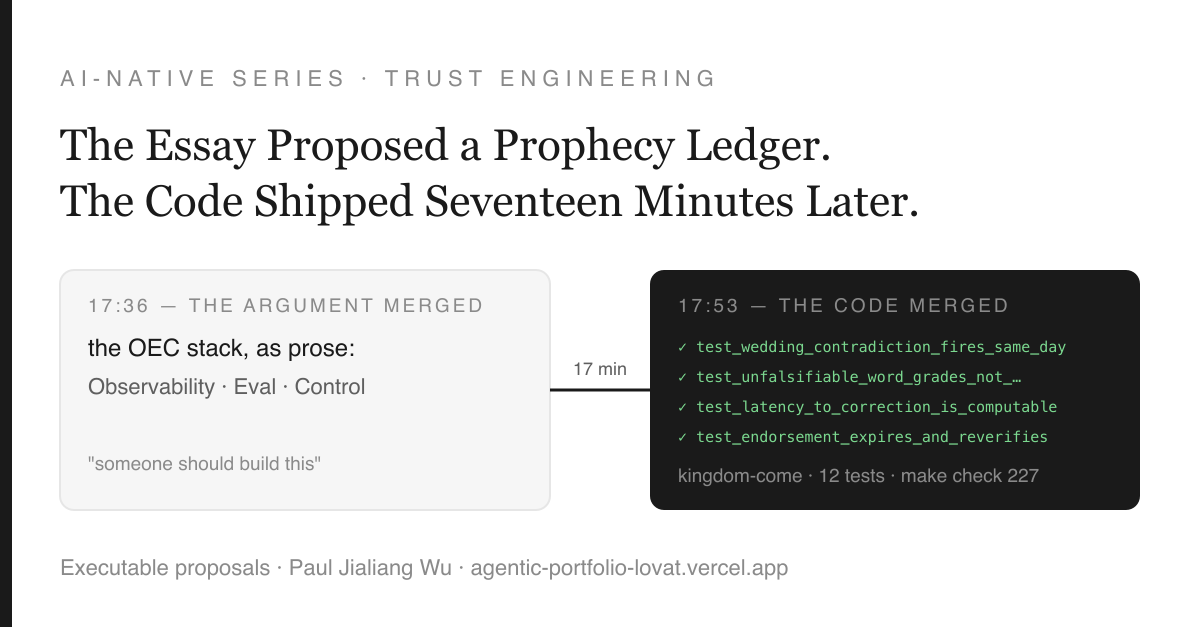
The previous essay made a proposal: treat public spiritual claims the way trustworthy systems treat any consequential output — Observability (claims as append-only, hash-chained commits), Eval (declared resolution criteria, three honest grades, contradiction and latency checks), Control (a platform gate whose consequences subscribe to the scorecard). It ended, as such essays do, with a stack diagram.
Essays like that have a failure mode, and I named it in the essay itself: "policy without observability is a sermon about logging." The same razor cuts the author: a proposal without an implementation is a sermon about gates. So here is part 2, which exists because the follow-up to this particular essay is not a discussion thread. It's a commit.
The mental model: executable proposals. In the old economics of building, an essay and an implementation were different projects — the essay cost a day, the code cost a quarter, so the world filled up with essays. Agentic engineering collapses that spread: the same afternoon that produced the argument produced ~330 lines, 10 API routes, and 12 tests on a real platform's main branch. When implementation is this cheap, "someone should build this" stops being a conclusion and starts being a confession.
The vessel: a platform that already weighed prophecy
The code didn't land in a toy repo. kingdom-come is an open-source seminary-formation platform (FastAPI, live demo, 200+ tests) that already had something remarkable: pastoral prayer and prophecy ledgers, where a prophetic word is weighed by 2-of-3 designated weighers — 1 Corinthians 14:29 as a literal state machine — then tracked to fulfillment with required testimony. The pastoral half of the essay's proposal existed before the essay did.
What it lacked was the integrity half: the pastoral ledger records what the community decided, but nothing guaranteed the record itself couldn't be quietly rewritten, nothing required a claim to be falsifiable, and no consequence was wired to the track record. Exactly the three gaps the 2026 case exposed. So the new module — backend/services/integrity.py — sits beside the pastoral ledger and closes them.
What the code enforces (not suggests)
- The past is append-only. Every event — claim, resolution, correction, dissent, endorsement — is a hash-chained commit. A revision is a new event; "it was only a vision" becomes a visible diff in the claim's history. Rewriting any past entry makes
verify_chainname the exact broken sequence number. - Unfalsifiable words can't win. A claim declares its resolution criterion and horizon at commit time. Try to grade an uncriterioned word "fulfilled" and the API refuses with a 422. The rule lives in the source's own docstring, where the next maintainer can't miss it: "a word that can never be false can never be counted true."
- Contradictions surface the same day. Same speaker, same subject, opposite stance, neither corrected — detected at the second commit, decades before any fulfillment horizon. The gate fails that day.
- Correction latency is a number. A failed public word carries a running uncorrected-days clock; a public correction stops it and reopens the gate. The timing tell from the case — an apology arriving only under exposure threat — becomes a published metric, not an insinuation.
- The gate names its reasons.
platform_gatefails only on measured evidence, and every failure is a sentence: "open contradiction(s) on: marriage:couple-a" · "failed public word uncorrected for 400 days (policy: 30)." Unmeasurable words never pass or fail it — they simply don't count. - Endorsements expire. An endorsement is a living object that re-verifies against the gate. It cannot outlive its evidence by twenty years, because it cannot outlive its own clock at all.
The test suite is the thought experiment
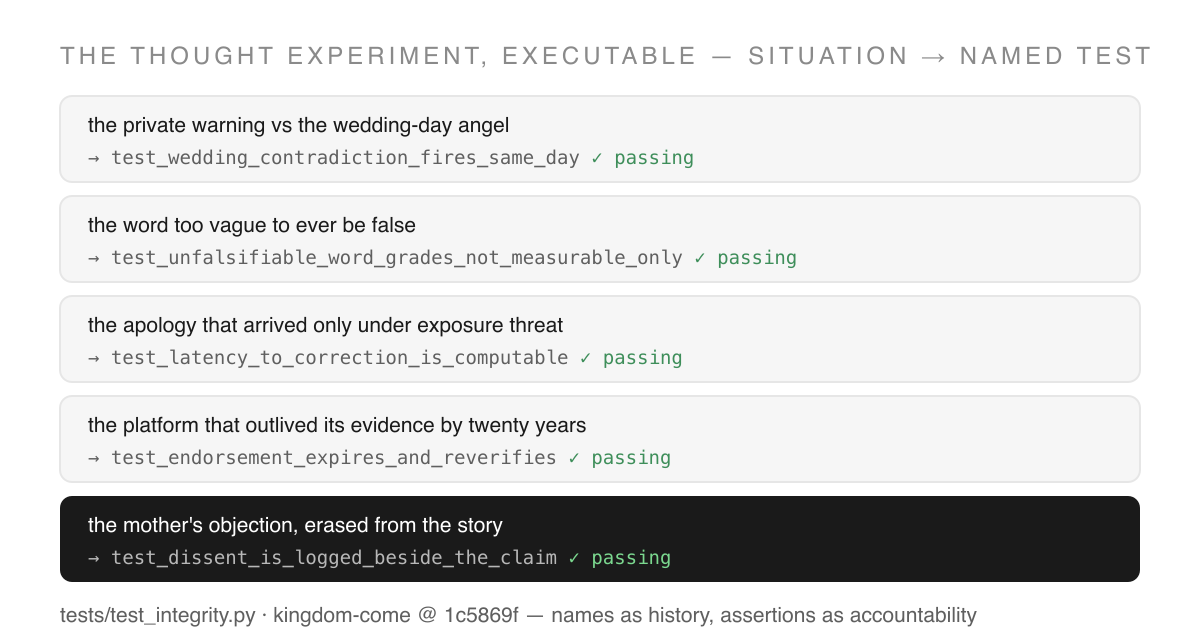
Part 1 ended with a thought experiment: replay the documented case through the stack, honestly. In part 2 the replay isn't prose — it's tests/test_integrity.py, and the names are the point. Verbatim from the suite, which anyone can read in the public repo [1]:
test_wedding_contradiction_fires_same_day— the private "not the will of the Lord" and the wedding-day angel, as two commits; the contradiction detector fires without waiting for an angel to fail.test_unfalsifiable_word_grades_not_measurable_only— "a season of breakthrough is coming" can be filed, never won.test_latency_to_correction_is_computable— a word falsified 400 days ago, uncorrected: the gate fails with the number in the reason; correct it publicly and the gate reopens.test_endorsement_expires_and_reverifies— the same endorsement that reports current today reports failing the day its speaker's record does, no new decision required.test_dissent_is_logged_beside_the_claim— the mother's objection, recorded next to the word that overrode her, visible in the claim's history forever.test_chain_tamper_is_detected_and_named— the semantic-retreat move, attempted against the ledger itself: the quiet rewrite of a past entry breaks the chain at seq 0, and a broken ledger fails the gate for everyone it covers.
Twelve tests in the module; the platform's full gate — make check — passed 227 on the commit that shipped it [1]. And one test deserves its own sentence, because it's the one the whole design answers to: test_gate_passes_a_clean_speaker. A faithful speaker with a measurable word, honestly resolved, sails through. The stack costs the honest minister nothing — which was always the tell that the cost was never the point.
What same-day shipping does — and doesn't — prove
Honesty about the seventeen minutes: the code was built in parallel with the essay's final review, by the same human-plus-agents workflow that wrote the essay — the number measures the gap between merges, not a supernatural typing speed. And a v1 on main is not a deployed institution: the chain is in-memory with persistence as a documented follow-up; contradiction detection is structural (declared subject and stance), not semantic — the module's docstring says so out loud rather than letting a reader assume NLP magic; and the adoption problem from part 1 is untouched by any amount of code, because the leaders who most need a ledger will not volunteer for one. Platforms remain the lever.
What it does prove is narrower and, I think, more useful: the excuse inventory shrank. "Someone should build this" now has a reply with a commit hash. When an essay's proposal can be running, tested, on a real platform's main branch before the essay's promotion kit is even clicked, the honest question for any standards document — the church's, or anyone's — stops being "is this a good idea?" and becomes "why is this still a PDF?"
Patterns / Anti-patterns
- Pattern — ship the gate with the proposal. If you argue for a standard, the artifact is the enforcement, not the argument.
- Pattern — name tests after the failure that motivated them.
test_wedding_contradiction_fires_same_dayteaches the next maintainer more history than a comment block ever will. - Pattern — make the honest grade the enforced grade. not_measurable as a 422, not a footnote.
- Anti-pattern — the eternal whitepaper. A standard that has been "forthcoming" longer than it would take to implement.
- Anti-pattern — demo-repo proofs. Code that only runs beside the essay that praises it. The integrity chain lives in a platform with users, tests, and a deploy — beside the pastoral ledger it completes.
- Anti-pattern — reading speed as virtue. Seventeen minutes is a property of the workflow, not a merit of the author. The merit, if any, is refusing to publish the sermon without the logging.
The mechanism, named: executable proposals — when agentic engineering collapses the cost gap between arguing and building, the implementation becomes the sincerity test for the argument.
The first principle, one sentence: if you propose a gate, ship the gate — an unshipped standard is a sermon about logging, and the congregation can now check the commit log.
Provenance — what's verified and what's claimed
All code and test names quoted here are verifiable against the public kingdom-come repository at commit 1c5869f [1], including the in-source rule "a word that can never be false can never be counted true." The 227-passing-tests figure is from my own make check run on that commit, recorded in the repo's report card (rc0001 in its docs/reportcards/collection.json). The seventeen-minute gap is between two merge timestamps in my own repositories' logs — kingdom-come's is public; the portfolio's is private, so treat that number as my report, checkable in spirit against the two artifacts' publication times. The 2026 case is covered, with full provenance discipline, in part 1.
References
- wjlgatech/kingdom-come (public repository) — backend/services/integrity.py · tests/test_integrity.py · commit
1c5869f, 2026-08-02. - Wu, P. J. (2026). Test Everything. Hold On to the Good. Now We Have the Tools. Part 1 — the case, the ancient spec, the OEC design. agentic-portfolio-lovat.vercel.app/articles/prophetic-integrity-stack.html
- Shekinah Worship Center (2026). Statement Regarding Sadhu Sundar Selvaraj — the documented case behind the test names; quotations verified in part 1. shekinahworship.com
- Scripture: The Holy Bible, New International Version (NIV) — 1 Corinthians 14:29 ("Two or three prophets should speak, and the others should weigh carefully what is said"), verified against biblegateway.com; implemented as kingdom-come's 2-of-3 weighing rule.
Related
Written the day the code shipped, from the public repository, the passing test suite, and part 1's verified case file. — Paul Jialiang Wu · agentic-portfolio-lovat.vercel.app