AI-Native Series · Faith
His Life Review Surfaced a Door, Not a Doctorate. Matthew 25 Called It First.
1-minute takeaway — what you'll walk away with
Near-death experiencers come back changed in a consistent direction — less afraid of death, less materialistic, more given to love and service — and the sort order of the life review (small kindnesses over credentials) is not new information. Scripture published it two thousand years ago: "whatever you did for one of the least of these." This essay reads the NDE research through a biblical lens and lands it in three places I actually live: my walk with God (number your days), my service of people (the King's criteria), and how my marriage fights (the sundown rule, reconciliation before worship, and prayers that unresolved conflict can hinder).
A companion to the Prof. Zhao Yue NDE essay — this time from inside the faith. ~8 min.
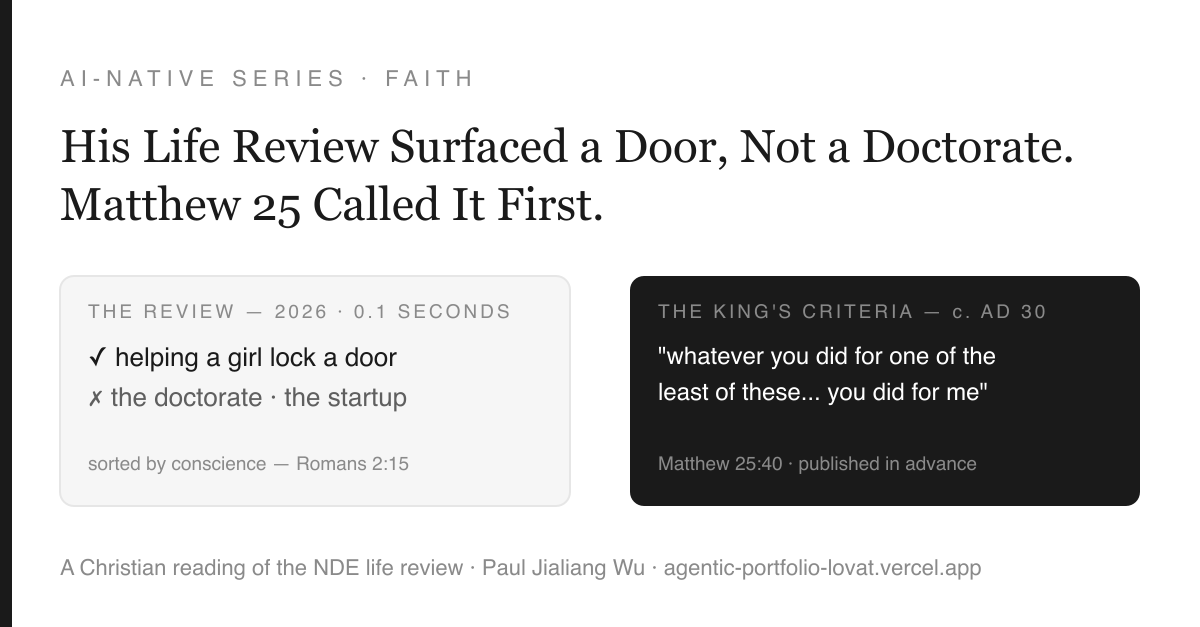
In the companion essay, I told the story straight: Prof. Zhao Yue's car skidded toward a cliff, and in the 0.1 seconds before impact he experienced a full life review. What surfaced was helping a girl lock a door. What never came up: the PhD, the startup, the professorship. He rebuilt his life around that sort order — conscience over credentials, altruism as the physics of value.
Reading his testimony as a Christian, I kept having the same reaction: none of this is breaking news. The professor needed a cliff. The psalmist just asked for math lessons — "Teach us to number our days, that we may gain a heart of wisdom" (Psalm 90:12). What Zhao discovered at terminal velocity, Scripture has been assigning as homework for three thousand years.
This essay does three things: takes the research on how and why NDEs change people seriously; reads it through the Bible rather than around it; and then gets practical in the three places I actually live — my walk with God, my service of people, and how conflict gets resolved in my marriage.
The research: people come back different, in a consistent direction
The striking thing about near-death experiences is not that they happen — it's what they do to people afterward. The University of Virginia's Division of Perceptual Studies, where Dr. Bruce Greyson "has studied over 1000 cases and documented the profound effects on individuals' attitudes, beliefs, values, and personalities" [1], has catalogued the pattern for five decades. A prospective study of cardiac-arrest survivors in The Lancet followed experiencers for years afterward, documenting the experiences arising under clinically dire conditions and tracking survivors longitudinally [2]. And the direction of change is remarkably consistent across the literature: diminished fear of death, loosened grip on status and possessions, and a reweighting of life toward love, service, and the people at hand.
Why it changes them is less settled. The neuroscience account says the slowed time and vivid replay are artifacts of memory encoding under threat — Eagleman's free-fall experiments found "time-slowing is a function of recollection, not perception" [3]. The experiencers themselves report something more like an audit: their life read back to them, weighted by conscience. As in the companion essay, I don't need to adjudicate the mechanism to take the pattern seriously. But as a Christian I notice something the secular literature treats as surprising and Scripture treats as expected: proximity to death clarifies values in a specific direction — toward love — and it does so across cultures. That is exactly what you'd predict if Ecclesiastes is right: "It is better to go to a house of mourning than to go to a house of feasting, for death is the destiny of everyone; the living should take this to heart" (Ecclesiastes 7:2). The house of mourning is a classroom. The NDE is that classroom with the door locked.
The mental model: the older ledger. Zhao's life review sorted small kindnesses above credentials, and it stunned him. But that sort order has been published for two thousand years: "Truly I tell you, whatever you did for one of the least of these brothers and sisters of mine, you did for me" (Matthew 25:40). The review isn't a new revelation. It's a preview — and the criteria were never secret.
Reading the NDE biblically — with both eyes open
Let me be careful here, because Christians should be. Near-death testimony is not canon — not part of the Bible, not carrying its authority. The apostle Paul himself had the most famous "caught up" experience in Scripture — "I know a man in Christ who fourteen years ago was caught up to the third heaven. Whether it was in the body or out of the body I do not know — God knows" (2 Corinthians 12:2) — and his handling of it is the model: he barely talks about it, builds no doctrine on it, and within a few verses is boasting about his weaknesses instead. The instruction for everything in this category is 1 Thessalonians 5:21: "test them all; hold on to what is good." So I test Zhao's testimony against Scripture — and what's remarkable is how much of it Scripture already said:
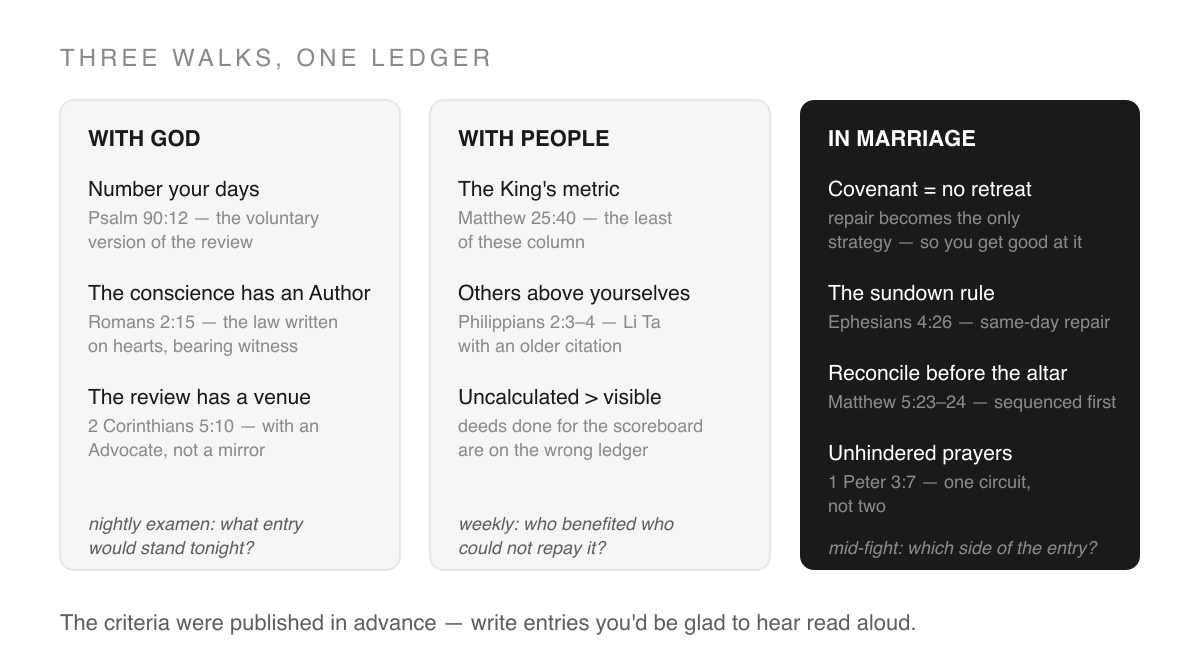
- The in-house auditor has an Author. Zhao calls it Liang Zhi, the innate conscience. Paul calls it "the requirements of the law are written on their hearts, their consciences also bearing witness, and their thoughts sometimes accusing them and at other times even defending them" (Romans 2:15). The audit Zhao met at the cliff is standard equipment — and it's not self-installed.
- The review has a scheduled venue. "For we must all appear before the judgment seat of Christ, so that each of us may receive what is due us for the things done while in the body, whether good or bad" (2 Corinthians 5:10). For the believer this is not an admissions exam — that verdict was settled at the cross, received by grace — but Scripture is plain that a faithful review of what we built is coming. Zhao's 0.1 seconds reads like a courtesy preview of a courtroom the Bible already put on the calendar.
- The sort order is the King's. Matthew 25 ranks the final review's line items — feeding, welcoming, clothing, visiting — and every one of them is a door-lock-sized act aimed at someone who couldn't repay it. Zhao's discovery that "small, uncalculated kindnesses" outrank credentials isn't Eastern wisdom borrowing from nowhere; it's common grace — God's kindness distributed even outside the church — echoing a published standard.
Where I part ways with the interview is equally important: the review's Judge, in Zhao's telling, is one's own higher self. Scripture agrees the conscience witnesses — and then says the court belongs to Christ. That difference isn't small. A self-judged ledger can only produce despair or self-congratulation; a Christ-judged ledger comes with an Advocate, and the grace to start writing better entries today without pretending the old ones away.
Walk 1: with God — number your days on purpose
The NDE is an involuntary crash course in Psalm 90:12. The voluntary version is a discipline the church has practiced for centuries: memento mori, numbering your days before they're numbered for you. Practically, I'm building Zhao's "death test" into my evening prayer as an examen — the old practice of prayerfully reviewing the day — with a biblical spine: Lord, if the ledger closed tonight, what entry from today would stand — and what needs repairing before it compounds? Two things change immediately. First, the small deeds stop feeling small: if Matthew 25 is the rubric, then the unglamorous kindnesses I'm tempted to skip are literally the line items. Second, ambition doesn't die — it gets re-pointed. The question stops being "what am I building?" and becomes "who is it for?" — which is just Philippians 2 with a to-do list: "in humility value others above yourselves, not looking to your own interests but each of you to the interests of the others" (Philippians 2:3–4).
Walk 2: with people — adopt the King's metric
Zhao's business thesis — Li Ta, altruism as the physics of value — lands for me as a secular restatement of a Christian claim: service is not the tax on success; it's the substance the review will weigh. So the metric I'm adopting is embarrassingly countable: at week's end, who is concretely better off because of something I did that they couldn't repay? Not reach, not impressions — the least-of-these column. The professor's replay suggests, and the King's words confirm, that this is the column the audit weighs heaviest. Everything else on my dashboard is, at best, instrumentation.
Walk 3: in marriage — how the ledger changes a fight
This is where the whole thing gets tested, because nobody's conscience ledger accumulates entries faster than at home. Four changes, each anchored to a text older than the interview:
- Covenant is the original no-retreat commitment. Zhao argues values only become real where retreat is impossible — his example is founding a company. Scripture built that structure into marriage on purpose: covenant, not contract. The point of no-exit isn't grimness; it's that repair becomes the only strategy, so you get good at repair. Every marriage fight is resolved differently by two people who know neither one is leaving the room for good.
- The sundown rule. "'In your anger do not sin': Do not let the sun go down while you are still angry, and do not give the devil a foothold" (Ephesians 4:26–27). This is Zhao's "correct unkindnesses immediately, so they never accumulate as baggage" — commanded, with a deadline, two millennia earlier. Unresolved conflict compounds like unrepaired code: the fix is cheapest the same day.
- Reconciliation outranks performance. "First go and be reconciled to them; then come and offer your gift" (Matthew 5:23–24). Jesus puts a broken relationship ahead of worship itself — the sort order again, applied to conflict: repairing with my wife is not the interruption of my spiritual life; it is my spiritual life, sequenced first.
- Unresolved conflict has a vertical cost. "Husbands... be considerate as you live with your wives, and treat them with respect... as heirs with you of the gracious gift of life, so that nothing will hinder your prayers" (1 Peter 3:7). Scripture wires the marriage and the walk with God into one circuit: I don't get to be cold at the kitchen table and warm at the altar. The 0.1-second version: in the middle of an argument, run the read-back test — this exchange is one entry in a ledger my wife and I are co-writing; which side do I want my next sentence on? It is very hard to win a fight and write a good entry with the same sentence.
Patterns / Anti-patterns
- Pattern — number your days voluntarily. A daily examen against the Matthew 25 rubric beats an involuntary review at a cliff.
- Pattern — repair before sundown. Same-day reconciliation, at home first. The fix compounds either way; choose which direction.
- Pattern — count the least-of-these column. Weekly: who benefited who couldn't repay it?
- Anti-pattern — building doctrine on experiences. Even the apostle with the best experience refused to. Test everything against Scripture; keep what is good.
- Anti-pattern — winning the argument, losing the entry. Any fight you win in a way you couldn't bear read back was a loss.
- Anti-pattern — service as reputation. Deeds done for the scoreboard are on the wrong ledger; the review reads the uncalculated column.
The mechanism, named: mortality as a means of grace. Contemplated rightly — a house of mourning, a numbered day, a preview like Zhao's — death stops being the enemy of meaning and becomes the lens that restores it, collapsing every secondary value and leaving love standing.
The first principle, one sentence: the final review's criteria were published in advance — "whatever you did for one of the least of these" — so a wise life, a faithful service, and a well-fought marriage are all the same discipline: write entries today that you'd be glad to hear read aloud by the King.
Provenance — what's verified and what's testimony
Prof. Zhao Yue's account is quoted and summarized from a translated digest of his interview (reference [1] below), as in the companion essay — testimony, not independently verified, and he does not speak from a Christian framework; this essay reads his data through one. All Scripture quotations are from the New International Version and were verified verbatim against BibleGateway. The scientific references below were checked against their live sources, verbatim where quoted. Nothing here treats near-death testimony as revelation; the standard remains "test them all; hold on to what is good."
References
- Zhao Yue (赵越教授). 34岁濒死体验后,我看见了人生回放。 ["After a near-death experience at 34, I saw my life replay."] — the original interview behind the testimony read here. youtube.com/watch?v=mJikIbuWE1U
- University of Virginia, Division of Perceptual Studies — Dr. Bruce Greyson "has studied over 1000 cases and documented the profound effects on individuals' attitudes, beliefs, values, and personalities." med.virginia.edu/perceptual-studies
- van Lommel, P., van Wees, R., Meyers, V., & Elfferich, I. (2001). Near-death experience in survivors of cardiac arrest: a prospective study in the Netherlands. The Lancet, 358(9298), 2039–2045. pubmed.ncbi.nlm.nih.gov/11755611
- Stetson, C., Fiesta, M. P., & Eagleman, D. M. (2007). Does Time Really Slow Down during a Frightening Event? PLOS ONE, 2(12), e1295. journals.plos.org/plosone
- Scripture quotations: The Holy Bible, New International Version (NIV) — Psalm 90:12; Ecclesiastes 7:2; Matthew 5:23–24; Matthew 25:40; Romans 2:15; 2 Corinthians 5:10; 2 Corinthians 12:2; Ephesians 4:26–27; Philippians 2:3–4; 1 Thessalonians 5:21; 1 Peter 3:7. Verified against biblegateway.com
Related
Written as personal application, from a translated digest of Prof. Zhao Yue's interview, the verified NDE literature, and the NIV text of Scripture. — Paul Jialiang Wu · agentic-portfolio-lovat.vercel.app