AI-Native Series · Happy College
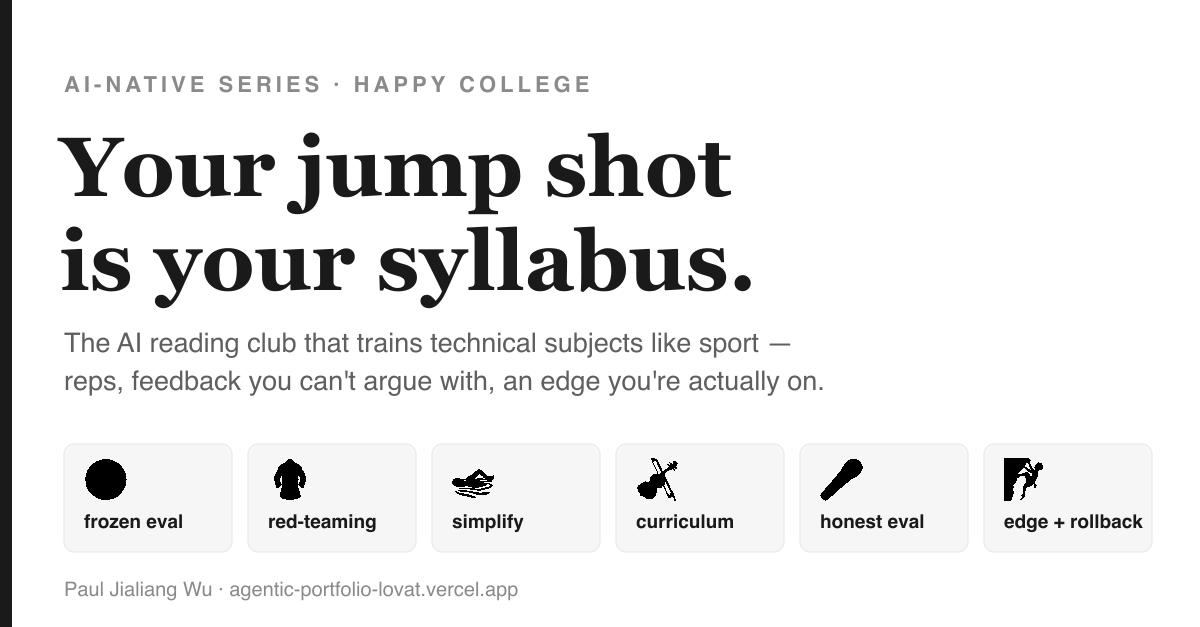
Your Jump Shot Is Your Syllabus. Welcome to Happy College.
1-minute takeaway — what you'll walk away with
You already run the world's best learning algorithm every time you train — attempt, honest feedback, adjustment, again, at your edge. Happy College is an AI reading club that points that loop at technical subjects: sports-to-ML mappings you can steal, ADEPT (Kalid Azad's five-move method, in Feynman's spirit) as the drill, and an AI stack — verified reading lists, living knowledge graphs, teach-back sparring — that makes every session end with an artifact, not annotations.
The rule that holds it together, borrowed from how we certify software: no evidence ⇒ no. ~7 min.
You already mastered something harder than linear algebra
Maybe it was a jump shot that finally stopped clanking. An armbar escape you can hit with your eyes closed. A flip turn, a clean vibrato, the crux move on a V4 you fell off of thirty times. Thousands of reps. Brutal, instant feedback. And — be honest — joy.
Nobody called that studying. That's the whole problem.
The lie we learned in school
School taught us that learning technical material means sitting still while information happens to you. Your body knows better. Every hard physical skill you own was built by the same loop: attempt → honest feedback → small adjustment → another attempt, at the edge of your ability.
Learning science has names for the pieces — deliberate practice [1], retrieval practice [2], desirable difficulties [3], the zone of proximal development [4]. A basketball court implements all of them natively. A lecture hall implements none of them. The gym gives you the one thing a lecture never will: a feedback loop you can't argue with. The rim doesn't care about your excuses. The water doesn't grade on a curve. You can't negotiate with a tap-out.
I say this with two credentials. One is a PhD. The other is a decade of being folded into origami by smaller, calmer men. The first institution charged six figures and mailed me a letter grade in December. The second charged $150 a month and told me the truth every six minutes, using my own arm as the visual aid. Only one of them let me re-enroll in the lesson immediately — and it's the one whose diploma is a bruise.
So the question isn't "can we learn transformers while playing basketball?" It's sharper: you already run the world's best learning algorithm every time you train — Happy College just points it at technical subjects.
The mapping (steal this)
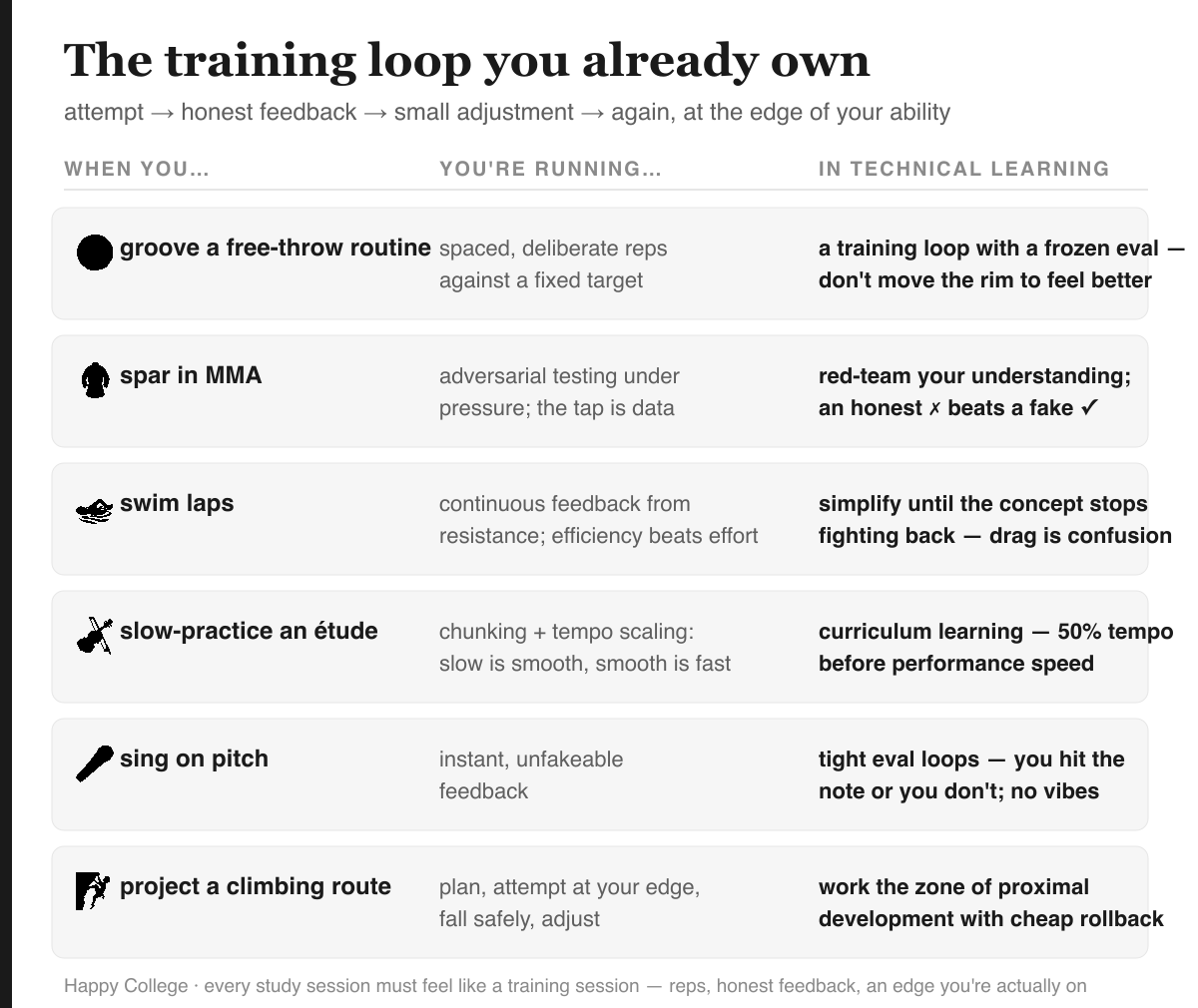
Pin that table. Every study session must have all three columns: reps, feedback you can't argue with, and an edge you're actually on.
Patterns
- Frozen eval. Rep against a fixed target; the test never moves to flatter you.
- Teach to spar. Explaining under adversarial questioning is the rep that reveals what you actually own.
- Artifact per session. The unit of progress is a thing you built, not pages you highlighted.
- AI as prolific sparring partner, human as verifier. Let the machine generate candidate moves at volume; you keep the whistle.
Anti-patterns
- Moving the rim. Changing the test (easier problems, kinder judges) to protect the feeling of progress.
- Watching game tape of someone else. Re-reading and re-watching lectures feels like training and transfers like spectating [2].
- Trusting the machine's full proof. AI output is a candidate, never a verdict — the insiders below learned this the productive way.
- Notes without artifacts. A notebook you never reopen is a gym membership you never use.
The method: ADEPT, done properly
The concept-level drill is ADEPT — created by Kalid Azad of BetterExplained [5], in the spirit of Richard Feynman's teaching style: if you can't take a concept down to an analogy a friend can follow, you don't own it yet.
- Analogy — anchor the new thing to something you've trained, not just read
- Diagram — draw it; if you can't draw it, you can't see it
- Example — one concrete case, run end to end
- Plain language — explain it to your sparring partner, no jargon allowed
- Technical — the real definition, mapped term by term back to the analogy
Sixty seconds of ADEPT on attention, the mechanism inside every modern AI model: a point guard brings the ball up and reads the floor (analogy). Every teammate is waving with some degree of openness; the pass goes mostly to the most open player — but the guard's read is a weighted blend of everyone (plain language). Draw five players with arrows thickened by openness (diagram). Run one play: "the cat sat on the ___" — which earlier words does the model pass to? (example). Technically: each word issues a query, every word offers a key; their match scores, softmaxed, weight the values that get blended — softmax(QKᵀ/√d)V — the query is the guard's read, the keys are how open each teammate is, the values are what each teammate does with the ball (technical, term by term).
That's one rep. A session runs many.
The best mathematicians alive already train this way
This isn't a metaphor we're hoping scales. It's how research-level math started working [6]. When Ernest Ryu closed a 42-year-old open problem — the convergence of Nesterov's accelerated method — the model kept handing him wrong full proofs containing correct intermediate lemmas. He sparred with it: attack, verify, keep what survives. His verdict: "The use of ChatGPT really accelerated the discovery." [6] The machine threw volume; the human kept the whistle.
When DeepMind's AlphaEvolve surfaced a hidden hypercube structure in Bruhat intervals, mathematician Geordie Williamson said: "It's a structure that's been sitting there for 50 years in front of our nose. We just hadn't noticed it." [6] Fifty years of experts reading quietly; one system doing high-volume reps found what spectating missed.
And Terence Tao, on what these systems are actually for: they're "very good at scouring big lists of problems for low-hanging fruit. It's tedious and thankless and not something humans want to do." [6] That's a Fields Medalist describing his AI exactly the way a boxer describes a heavy bag — infinite reps of the part you'd never drill alone. The mechanism, in one sentence: AI makes attempts cheap; honest verification makes them count; the human supplies taste.
The AI stack (this part didn't exist five years ago)
A reading club with a group chat is a book club. Happy College is a training facility, because the tooling finally exists:
- A verified curriculum, not a link dump. The community reading-list track (AI and AI-for-research live today; math, physics, CS, bio next): every link machine-verified, every entry carrying Statement · Quote · Evidence · Actions · Patterns · 1st Principle, every gap marked honestly.
- Living knowledge, not dead notes. Skills like
/living-knowledgeand/graphifyturn each session into a knowledge graph that stays fresh — a map you can query, not a notebook you never reopen. - A twin that tracks your becoming. Our participation engine models two selves — the one your habits are building and the one you intend — and makes the gap between them the syllabus.
- Listener → participant → creator, in one session. The club's exit criterion: you don't leave having read about attention; you leave having taught it, been sparred on it, and built one tiny artifact with it.
- One front door. allin-anything routes any intent — "master this paper" — to the right tool, so the machinery never gets between you and the rep.
What a session actually looks like (60 minutes)
- Warm-up (5 min): retrieval, not review — write what you remember from last week, cold [2]. Yes, that's a pop quiz. We rebranded it, for the same reason nobody sells "voluntary suffering" but everybody sells CrossFit.
- ADEPT sprint (20 min): one concept, five moves, ending in the term-by-term mapping.
- Sparring (20 min): pairs. You teach; your partner attacks with "what breaks if…?" questions. Tapping is data, not defeat.
- Build rep (10 min): one tiny artifact — 20 lines of code, one diagram, one worked example. Creators, not note-takers.
- Log (5 min): the artifact goes into the living knowledge graph. Next week's warm-up is drawn from it.
You leave with an artifact, not annotations. The metric is binary and public: one artifact per member per session, zero exceptions. Streaks are tracked; excuses are not a unit.
Join
Happy College is what college should have been: the joy of the gym, the rigor of the lab, and an AI stack that gives every learner what elite athletes have always had — a coach, a spar, and a scoreboard that doesn't lie.
Start where we started: pick one item off the AI reading list, bring the hardest physical skill you ever built, and come ready to map one onto the other. Want in on the first cohort? Use the ✉️ Free list button at the top of this page.
Your jump shot is your syllabus. See you at Happy College.
References
Chosen by the survival test: each has stayed load-bearing for decades of replication and practice, not one hype cycle.
- Ericsson, K. A., Krampe, R. T., & Tesch-Römer, C. (1993). The role of deliberate practice in the acquisition of expert performance. Psychological Review, 100(3), 363–406. doi:10.1037/0033-295X.100.3.363
- Roediger, H. L., & Karpicke, J. D. (2006). Test-enhanced learning: Taking memory tests improves long-term retention. Psychological Science, 17(3), 249–255. doi:10.1111/j.1467-9280.2006.01693.x
- Bjork, E. L., & Bjork, R. A. (2011). Making things hard on yourself, but in a good way: Creating desirable difficulties to enhance learning. In M. A. Gernsbacher et al. (Eds.), Psychology and the Real World (pp. 56–64). Worth Publishers.
- Vygotsky, L. S. (1978). Mind in Society: The Development of Higher Psychological Processes. Harvard University Press.
- Azad, K. Learn Difficult Concepts with the ADEPT Method. BetterExplained. betterexplained.com/articles/adept-method
- The AI Revolution in Math Has Arrived. Quanta Magazine (2026). quantamagazine.org — source of the Ryu, Williamson, and Tao quotes, verified verbatim.