AI-Native Series · Learning
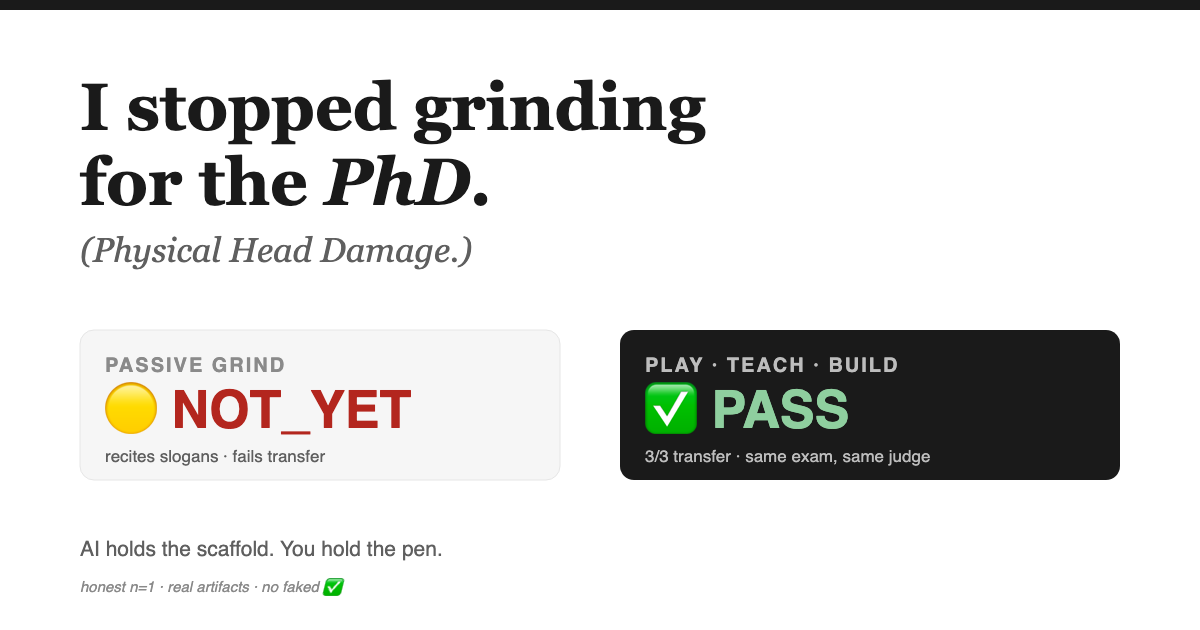
I stopped grinding for the PhD. (Physical Head Damage.)
1-minute takeaway — what you'll walk away with
The first content test of a learning method that refuses to let you offload thinking to the AI. Same exam, two learners: passive-grind recall scored NOT_YET; the play/teach/build loop scored PASS — judged by an instrument built to catch slogans. Honest n=1, real artifacts, and the one design law that makes learning and working the same act.
The old way to master hard technical material: grind slides until your head hurts, retain slogans, fail the moment a real problem looks different. I built a method that learns by playing, teaching, and building instead — and ran the first honest test on it.
Every engineer knows the grind. You open the fourteen lecture PDFs. You highlight. You re-read. Your head starts to hurt — call it the real PhD, Physical Head Damage — and at the end you can recite that "agents are more powerful than workflows" and "context engineering matters." Then a real design question arrives, shaped a little differently than the slide, and the recall evaporates. You learned the words, not the thing.
I don't think that's a discipline problem. I think it's a method problem — and a fixable one. So I built a learning method, master-anything, on one law, and then I did the thing people skip: I tested it honestly, and I'm showing you the receipts including where they're thin.
The one law: AI holds the scaffold, the human holds the pen
The trap in every AI learning tool is that it will happily do the thinking for you. Ask it to explain agents and it writes you a beautiful explanation — which you read, nod at, and forget, because reading an explanation is not the act that causes learning; generating one is. (Learning science calls this the generation effect, and it's one of the most replicated findings in the field.)
So master-anything is built to keep the effortful, generative act with the human. The AI retrieves, structures, reacts, verifies, renders, remembers — everything around the thinking. But you write the explanation. You attempt the fix before it's revealed. You predict before you're shown. The machine holds the scaffold; you hold the pen. Offloading is designed out.
Why this makes learning and working the same act: if the output is produced by your generative acts (scaffolded by AI), then the work and the learning are one activity. You finish with a real artifact and a verified understanding — from one effort, not a tradeoff.
The test: same exam, two learners
The material: the "how to design a coding agent" unit from Stanford's Modern Software Developer course — agentic loop, context engineering, when to add a tool, workflow-vs-agent. The exam: not multiple choice, but transfer probes — novel scenarios you can't answer from recall. A separate skeptical checker judges mechanism understanding, not fluency, and is built to catch slogans. (This matters: research shows self-aligned quizzes inflate scores 3–6×; transfer probes are the antidote.)
Learner A took the grind path — read it, can recite it. Learner B took the master-anything loop — compressed the source, taught it back, got probed, expressed it. Same three probes for both. A real, hard example probe:
An agent refactors 40 files over several hours, across separate
sessions — no single context window holds the job. Mid-session 3
it needs to know: was file X already done in session 1, and what
naming convention was chosen? Session 1's conversation is gone.
How does that information reach session 3?
The verdicts (same judge, opposite results)
| Learner | Verdict | What the judge actually said |
|---|---|---|
| A — passive grind | 🟡 NOT_YET | "substitutes slogans for any causal mechanism — 'agents are powerful', 'good context', 'multi-agent is good for big problems' — never engaging the specific constraints the probes introduce" |
| B — play / teach / build loop | ✅ PASS | transfer shown on 3/3 probes (per-subtask enumerability, durable state read at session start, coupling detection) |
Learner B's answer to the probe above didn't recite "state lives outside the window." It used the mechanism: session 3 doesn't need the old conversation — it reads durable artifacts at startup (a progress checklist, the git diff, a decisions file), pulling only what it needs, just-in-time. That's transfer. That's the thing recall can't fake.
Where the receipts are thin (because faking a ✅ is the one unforgivable move)
I will not oversell this. Here is exactly what this test is and isn't:
- n=1, and Learner B is a simulation, not a human. This proves two real things — the instrument discriminates recall from transfer, and the loop's artifacts are genuine — but it is not a human RCT. The human data point (a real person, a different topic, "would do again" 4/5) is separate and small; the enterprise cohort is the real evidence still to come.
- There is no official "Anthropic Claude Architect Exam." The exam here is a transfer assessment I built from the course's own learning goals. A real external certification would be stronger validation, and it doesn't exist yet. Saying otherwise would be exactly the slogan-over-substance failure the method exists to catch.
- Immediate, not delayed. Durable retention needs a +7-day probe. Not run on this topic yet.
Learn by playing, teaching, building — not grinding
The play/teach/build path isn't a motivational slogan; it's the mechanism. Teaching is the generation effect (the teach-back IS the exam). Playing — turning a concept into a song or a moving avatar — is multi-modal encoding that makes it stick and makes it fun. Building — driving a real agent loop, fixing a real seeded bug — is the artifact that proves the capability. None of them is grinding. All of them keep the pen in your hand.
The grind gives you Physical Head damage and recall that fails on contact with a real problem. The loop gives you a passed transfer exam, an artifact you keep, and — measured, not assumed — a session you'd do again. Same hard material. Opposite outcome. The difference is who holds the pen.
Everything here is real and inspectable — the exam, both explanations, the probes, the verdict JSONs, the spine events. The method, the honest limits, and the design law are all open.
Keep reading
Part of the AI-Native series. The tools are open at github.com/wjlgatech — you own the pen.