AI-Native Series · 06
You don't memorize a hard field — you disclose it onto one you already own
1-minute takeaway — what you'll walk away with
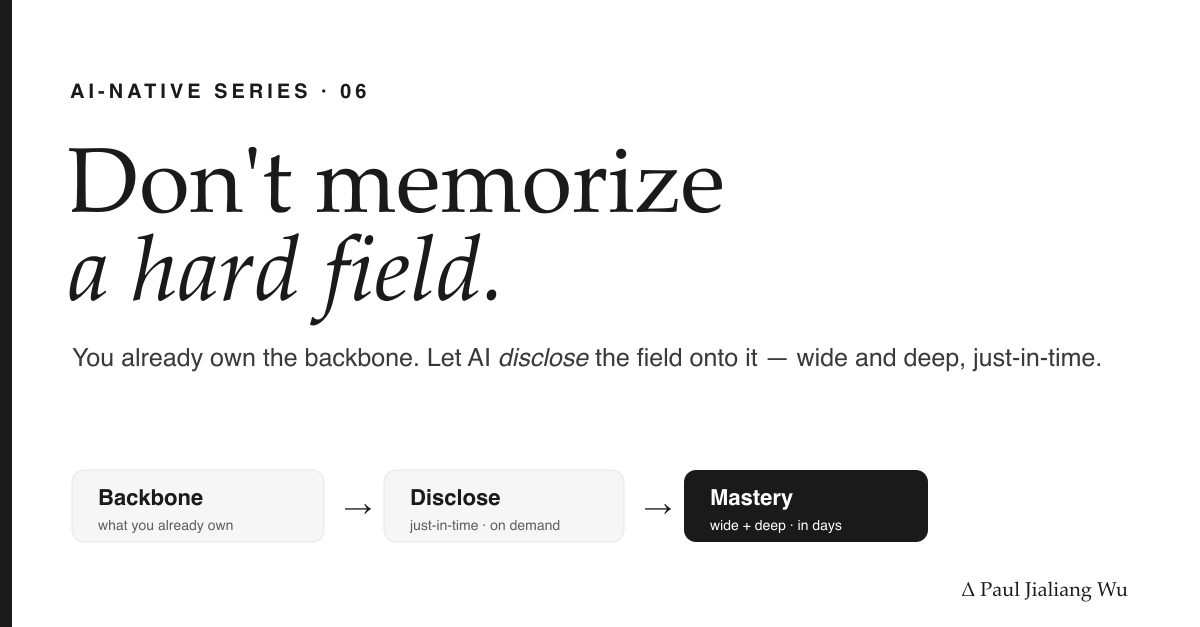
You don't master a hard technical field by cramming it into your head. You already own a world-class backbone — your lived experience — and AI progressively discloses the new field onto it, just-in-time. Backbone vs progressive disclosure, borrowed from how we build AI agents. Part of the AI-Native series.
Everyone is already a world-class expert at something real. The AI-native move is to stop learning hard new fields from zero and start renting your own experience to them. A design pattern borrowed straight from how we build AI agents. ~7 min.
The interview I had no business being ready for
A few weeks ago I prepped, in a handful of days, for a role built on a stack people list "5+ years" for: a custom access-control layer (RBAC) welded onto an MLOps platform running on Kubernetes — the kind of infrastructure-security problem where a wrong answer isn't "less elegant," it's "anyone on the network can run arbitrary code."
The old me would have opened forty tabs of documentation and read until I felt smart. By interview day I could instead walk any engineer through the whole system — the badge at the door, the rulebook behind it, the building that keeps its own promises, the two workers inside — starting at the front door and ending at a single running process, and then drop the metaphor and speak the raw vocabulary when pushed.
I'm not unusually gifted. I did one thing differently, and it's the thing almost nobody has updated since AI arrived: I stopped trying to pour the new field into my head, and started disclosing it onto a field I already owned.
The old way: bake the entire field into your backbone
Here's the mental model most of us inherited. To learn something hard, you internalize it: read the docs, memorize the vocabulary, drill the concepts until they live in your head as permanent, always-loaded knowledge. Everything gets baked into your backbone — the stuff you carry everywhere.
It has two problems. It's slow — a hard field has hundreds of terms and you were going to forget most of them by Thursday. And it's brittle — baked-in facts that name a specific technology don't transfer. Learn Kubernetes by rote and you know Kubernetes; you don't know anything new. You paid full price for a single-use tool.
A pattern stolen from how we build AI agents
When you design a serious AI agent, you face the same choice about its knowledge — and the mature answer is the opposite of "cram everything in."
You keep the agent's backbone deliberately lean: the durable, always-on principles that shape how it behaves on every task, no matter the domain. Then everything situational — the playbook for one specific tool, one hostile API, one narrow domain — is left out of the backbone and revealed only when a trigger fires. That second mechanism has a name: progressive disclosure. Load the specialized knowledge just-in-time, only when the task needs it, at exactly the depth the moment demands.
The deciding rule we actually use: if a lesson would change your behavior on an unrelated task, it belongs in the backbone. If it names a specific technology or domain, it's an attachment — kept out of the way and disclosed on demand.
Why build agents this way? Because a bloated backbone is a real cost — it makes the agent slower, more confused, and worse at the thing in front of it. Lean backbone plus just-in-time disclosure is how you get an agent that is wide (it can handle anything) and deep (it goes to full depth exactly where it's standing) without carrying the whole library on its back.
Now flip it around, because the same architecture is the answer to "how does a human master a hard field in days."
You are already carrying a world-class backbone
Here's the part nobody tells you: you already own a spectacular backbone. Everyone does. Not trivia — structure. You have rich, hard-won, deeply-held models of how some corner of the real world actually works. How a kitchen runs under pressure. How a badge decides who gets into which room. How a head office keeps a hundred branches in sync when one of them catches fire. How a family stays fed when the plan falls apart.
That knowledge is exactly what a good backbone is: durable, deeply understood, and transferable across domains. It's the treasure. And most people leave it in a drawer the second they try to learn something "technical," as if their real-life mastery didn't count once the vocabulary got scary.
It counts. It's the most valuable thing you're bringing. The only question is how to disclose the new field onto it.
AI is the disclosure engine — and analogy is the wire
This is the move. You don't ask AI to teach you the field. You ask it to map the hard new field onto the backbone you already own — one concept at a time, at your altitude, in the moment you need each piece.
For the infrastructure-security role, the backbone I reached for was a restaurant. Watch a genuinely hard security stack disclose itself onto something a twelve-year-old already understands:
| What you already own | What it discloses | The thing it actually is |
|---|---|---|
| A badge the front desk checks: is it real, and does it open this door? | Two different questions, never conflated | Authentication vs authorization — a signed token proving who you are, then a policy check on what you may do |
| You write rules for job titles, not for each of 200 people | Why the "R" is the whole point | Role-based access control — permissions attach to roles, people attach to roles; a promotion is a one-word change instead of 10,000 rules |
| A chain HQ: you promise "five lasagnas always exist," and when a kitchen burns down at 2am another one quietly starts | You declare the goal; the system makes reality match | Kubernetes — desired-state plus a reconciliation loop that self-heals without paging anyone |
| A manager with a clipboard vs a line cook who appears the instant an order hits and goes home when it's quiet | Two workers, two very different jobs — so two doors to guard | MLRun (runs the process of making models) deploying onto Nuclio (serves them, event-triggered, scale-to-zero) |
| Every door locked by default; a stolen badge gets you the fryer, not the payroll safe | Assume breach; contain the blast radius | Deny-by-default, least privilege, defense-in-depth — a proxy up front and locked hallways behind it |
Notice what happened. I didn't memorize five hard concepts. I attached five hard concepts to five things I already understood so deeply I could explain them half-asleep. The vocabulary — PEP, PDP, JWT, NetworkPolicy — became labels I hang on structures I already own, not new structures I have to build from scratch and pray they hold.
This is how you get wide AND deep at the same time
The old cruel trade was: go deep on one narrow thing over years, or stay wide and shallow forever. Disclosure onto a backbone breaks the trade, because a good analogy is nested.
The restaurant gives me width instantly — the entire system as one picture: a badge perimeter wrapping a building that contains a manager who hires a cook. I can see how it all fits before I know a single command. Then, wherever the interviewer pushes, I drop a ladder and go to real depth on that one node — just-in-time, only where it's needed. "Every serverless function gets its own network endpoint, so if it's reachable directly your whole front desk is bypassed" isn't a fact I stored; it's depth I disclosed the moment the conversation reached that door.
Wide because the backbone holds the whole shape. Deep because AI discloses full detail exactly where you're standing. Mastery, in days — not because you're faster at cramming, but because you stopped cramming and started transferring.
The guardrail: transfer is not the same as fooling yourself
An analogy that you can't cash out is a costume, and interviewers — like reality — frisk you for costumes. So there's a hard rule that keeps this honest, and it's the same gate from the last piece in this series: you have to be able to drop the metaphor and reconstruct the real thing.
The badge story is worthless if, when someone asks "so where does the token get validated, and what happens on a cache miss," you can only keep talking about freezers. The backbone gives you confidence and shape. The gate — can I speak the raw vocabulary, defend a design decision, admit what I don't know — is what makes the confidence earned instead of borrowed. Progressive disclosure gets you to the door fast. It does not let you skip the exam.
Done right, that's the opposite of impostor syndrome. You're not pretending to know a field. You're standing on something you genuinely, deeply know, and letting the new field rest on top of it exactly as far as it legitimately reaches.
The efficiency claim, stated plainly
People undersell what this collapses. Not "I read the docs faster." The claim is: real, defensible mastery of a hard field — wide in scope, deep on demand — reached in days instead of the years the job posting assumes, with confidence rather than dread. Because you were never starting from zero. You were starting from a lifetime of hard-won structure that AI finally lets you point at a new problem.
You already have the treasure. Use it.
Whatever you are quietly excellent at — a trade, a sport, running a household, a craft, a business you've watched from the inside — that is not a charming aside on your résumé. It's the backbone the next hard field is going to disclose itself onto.
Next time something technical scares you, don't ask AI to teach you the field. Hand it your backbone and say: "I already understand X deeply. Map this new thing onto X, one concept at a time, and stop me at each door so I can prove I can speak it for real."
Save this for the next intimidating thing on your list. Then tell me: what are you a quiet expert at — and what hard field would you point it at this week?
More in the AI-Native series
All of it lives in the Writing section on the home page.
Part of the AI-Native series. Backbone vs progressive disclosure is a real pattern from agentic-AI design — the same one that keeps this site's own on-page agent lean.