AI-Native Series · Life Philosophy
In 0.1 Seconds He Reviewed His Whole Life. His Résumé Never Came Up.
1-minute takeaway — what you'll walk away with
At 34, Prof. Zhao Yue's car skidded toward a New Zealand cliff. In the instant before impact he experienced a full life review — and what surfaced wasn't the PhD, the startup, or the professorship. It was helping a girl lock a door. His conclusion, tested against both Eastern wisdom and NDE science: your life writes a ledger only your own conscience will read back, it sorts by kindness rather than prestige, and you can start writing better entries today — no cliff required.
A professor's near-death experience, the audit that sorted by conscience, and what it means for how we build — companies, careers, and days. ~7 min.
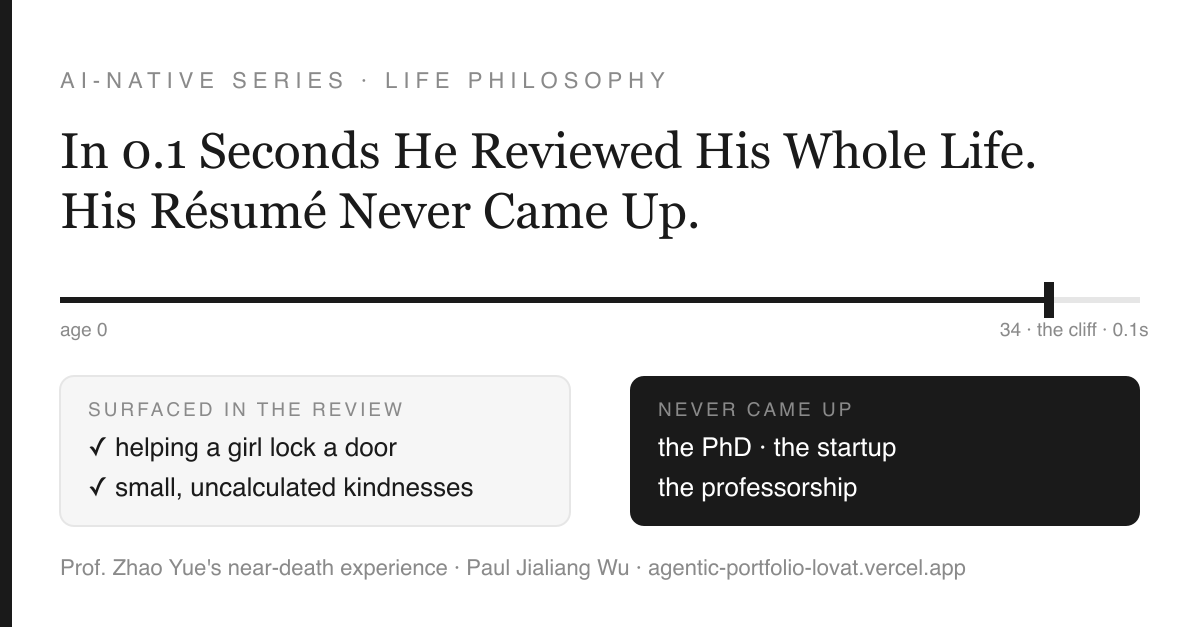
At 34, Zhao Yue had the kind of résumé that gets a person introduced with a pause for effect: a PhD, a Silicon Valley startup, a business-school professorship. Then, on a gravel road in New Zealand, his car skidded toward a cliff edge.
"The whole world completely stopped," he recalls in the interview. "I began to go back to when I was very small, scene by scene." The elapsed time, he estimates, was a tenth of a second. "It was 0.1 seconds... but for me, I finished my entire life."
He survived. And the detail he can't stop telling people about isn't the cliff. It's the sort order of what he saw.
The audit that ignored the résumé
In his life review, Zhao says, the moments that surfaced with weight were not the degrees, the funding rounds, or the titles. The one he keeps returning to: once, he helped a girl lock a door. A trivial kindness, forgotten for years — and in the review it outranked the doctorate. The relief he felt in that moment, he says, came entirely from having been, on balance, a good person in small ways. His professional accolades were not so much judged as absent.
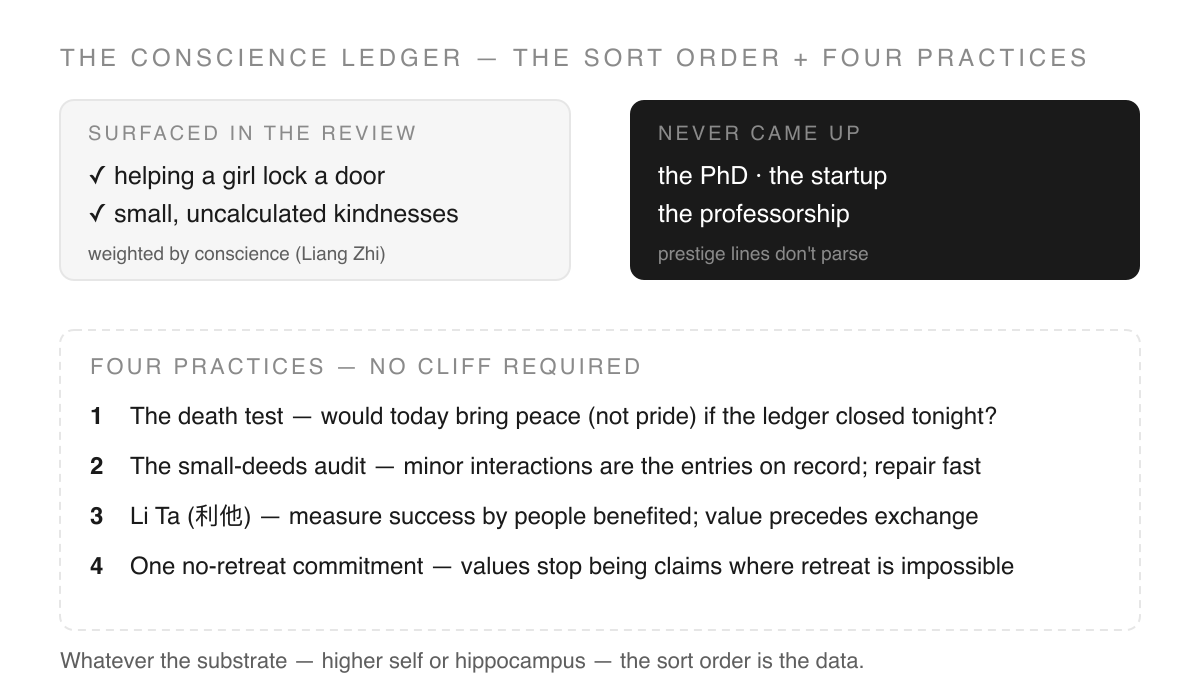
The mental model: the conscience ledger. Every day you write entries into a ledger that no boss, no committee, and no algorithm will ever read — but you will, and apparently all at once. The entries that survive the final read-back are the small, uncalculated kindnesses; the prestige lines don't parse. Zhao's phrase for the reader is precise: "The final judgment is your own higher self judging the once-ignorant little you." Live so the read-back is bearable. Better: live so it's boring — page after page of small good entries and nothing you'd skip.
His PhD did not make the cut. A door did.
What the science says — and why it doesn't matter here
I want to be straight about the epistemics, because this is a portfolio that audits résumés for a living. Zhao interprets his experience as contact with a "higher-dimensional" consciousness. Neuroscience has a soberer candidate: in a controlled free-fall experiment, Stetson, Fiesta and Eagleman found that "time-slowing is a function of recollection, not perception: a richer encoding of memory may cause a salient event to appear, retrospectively, as though it lasted longer" [1]. Meanwhile the University of Virginia's Division of Perceptual Studies — the group that has catalogued near-death experiences for decades — lists the "life review" among the recurring features of NDEs reported across cultures [2], and a prospective study of cardiac-arrest survivors in The Lancet documented such experiences arising even under clinically dire conditions [3].
So: is the life review a high-dimensional audit or a burst of amygdala-enriched memory encoding? Here's the thing — for how you should live, the dispute changes nothing. Both accounts agree that at the edge, a human mind replays its ledger. What it weights — a door over a doctorate — is, so far, testimony: Zhao's, consistent with decades of reports like his. The metaphysics is contested; the sort order is his data. You don't have to believe in a higher self to notice that Zhao's replay — like so many in the reported literature — never got around to the title bump.
"So what?" — the summit was empty
Before the cliff, Zhao had been climbing — driven, he says, by a strict father who "only knocked and never encouraged." Each summit delivered the same anticlimax: so what? "I thought that success... was not what I wanted," he says. "It didn't bring me happiness. If I hadn't experienced death, I would have kept climbing... but after death, I knew what the heart truly wants."
A man who reached similar heights said nearly the same thing to a stadium of graduates: "Remembering that I'll be dead soon is the most important tool I've ever encountered to help me make the big choices in life. Because almost everything — all external expectations, all pride, all fear of embarrassment or failure — these things just fall away in the face of death, leaving only what is truly important" [4]. Steve Jobs called it a tool. Zhao got the involuntary version, and came back with the same reading: mortality is the only reviewer whose comments you can't rebut.
His practical distillation is what he calls the death test: would today's achievements bring you peace if the ledger closed tonight? Not pride — peace. The two feel identical at a podium and completely different at a cliff.
Liang Zhi and Shan Zhong: the judge is in-house
Zhao's framework is unapologetically Eastern. Liang Zhi (良知) — the innate conscience — is the auditor. Shan Zhong (善终) — a good death — is the deliverable, and in his telling "the core of a 'Good Death' is being good (Shan) first." There is no external tribunal in his account; the judgment is rendered by your own higher self, against your own conscience, with perfect recall of every entry. If the ledger is full of malice and unrepaired harm, the same slowed-down time that gave him relief becomes, he warns, an agonizing review.
The actionable half is almost bureaucratically simple: correct unkindnesses immediately, so they never accumulate as baggage; and audit the small interactions, because — on the evidence of his own replay — those are the lines the auditor actually reads. The only performance review you can't reschedule is the one you're writing material for right now.
Entrepreneurship as a dress rehearsal for the cliff
The strangest turn in the interview is that Zhao — a business school professor — treats entrepreneurship as the closest legal substitute for a near-death experience. "Entrepreneurship is a great way of cultivation (Xiuxing)... it is where you truly start living," he says, and more bluntly: "Borrowing death to realize the Tao (借死悟道) is the fastest way." An employee always has an exit — another job, another team. A founder, as the legal representative, stands where retreat is impossible, and Zhao's claim is that no retreat is precisely the condition under which a person stops performing values and starts having them. The crisis becomes a mirror: the same in-house auditor that runs the life review runs the 3 a.m. cap-table panic.
From that altitude, he argues, business problems shrink — his term is the "dimensionality-reduction strike" (Jiang Wei Da Ji): stand on principle and the tactical problems of management and marketing get solved from above rather than wrestled from beside.
Li Ta: altruism as the business model, not the marketing
Zhao's commercial thesis follows directly: "The secret behind business success is altruism (Li Ta)... it is only because you benefit others that you have value and can exchange with them." Value precedes exchange; benefit precedes value; therefore altruism isn't the charity wing of a business — it's the physics. His warning is equally direct: "Unless your heart truly believes in [goodness]... you cannot create a long-term enterprise or product." Goodness as a slogan collapses at the first crisis, because slogans don't hold under audit — a theme this portfolio has some experience with.
His favorite proof is a cattle herder from Aba — mocked for her simplicity, uncalculating, "pure and kind." Within six months of pointing that character at a real need, her business reached fifty cities. "High-level people came to her, and money was sent to her," Zhao says. "When the heart changes, wealth rolls in; you can't even block it." His image for the mechanism: wealth is sand in an open hand — grip it and it runs out between your fingers. "Wealth is never chased; it is attracted by you. Small money is washed [earned by labor]; big money is attracted [by the heart]."
Patterns / Anti-patterns
- Pattern — write ledger entries daily. Small, uncalculated kindnesses are the only line items the final review weights. They're also cheap.
- Pattern — the death test as a decision filter. Before a big choice: would this bring peace, not pride, if the ledger closed tonight?
- Pattern — no-retreat commitments. You don't need to found a company; you need at least one responsibility you can't hand back. That's where values stop being claims.
- Anti-pattern — prestige accounting. Optimizing lines the auditor provably skips: titles, follower counts, the next rung.
- Anti-pattern — altruism as a slogan. If the goodness isn't "from the marrow," it fails exactly when it's tested — and everything is eventually tested.
- Anti-pattern — deferring repairs. Every uncorrected unkindness compounds into the read-back. Fix it while the fix is small.
The mechanism, named: the audit's sort order. Whatever the substrate — higher self or hippocampus — the terminal review, on the only inside evidence we have, ranks conscience over credentials; and knowing the sort order changes what you optimize today.
The first principle, one sentence: you are writing, in small deeds, the only ledger you will ever be forced to read in full — so write entries you can bear, and let success arrive as a byproduct of benefiting others.
For those of us not driving toward cliffs
Zhao's own prescription for the rest of us is "borrowing death to realize the Tao" without the gravel road: study mortality on purpose (he spent years reading NDE research to test his own experience against the literature); run the death test on your current goals; audit your small deeds as if they're the ones on record — because by his account, they are; measure your work by who it benefits (Li Ta made daily, not quarterly); and build at least one no-retreat commitment into your life, sized to your courage. The education system, he notes, teaches everything except the one exam with a 100% sit rate.
Provenance — what's verified and what's testimony
Prof. Zhao Yue's words in this article are quoted from a digest of his interview (reference [1] below), translated from the original Chinese; they are his testimony as rendered there, not claims I have independently verified — and his identity here is exactly what the interview states (PhD, Silicon Valley entrepreneur, business school professor), nothing more. The scientific references below, by contrast, were each checked against their live sources, verbatim where quoted. The two kinds of evidence are doing different jobs on purpose: the science establishes that life reviews are a documented phenomenon with a contested mechanism; the testimony supplies what no experiment can — the view from inside one.
References
- Zhao Yue (赵越教授). 34岁濒死体验后,我看见了人生回放。 ["After a near-death experience at 34, I saw my life replay."] — the original interview this essay's testimony is drawn from, on Prof. Zhao's own channel. youtube.com/watch?v=mJikIbuWE1U
- Stetson, C., Fiesta, M. P., & Eagleman, D. M. (2007). Does Time Really Slow Down during a Frightening Event? PLOS ONE, 2(12), e1295. journals.plos.org/plosone/article?id=10.1371/journal.pone.0001295
- University of Virginia, Division of Perceptual Studies. Near-Death Experiences (NDEs) — recurring features include a "life review" or recall of important events in the past. med.virginia.edu/perceptual-studies
- van Lommel, P., van Wees, R., Meyers, V., & Elfferich, I. (2001). Near-death experience in survivors of cardiac arrest: a prospective study in the Netherlands. The Lancet, 358(9298), 2039–2045. pubmed.ncbi.nlm.nih.gov/11755611
- Jobs, S. (2005). Commencement address, Stanford University ("You've got to find what you love"). news.stanford.edu (archived)
Related
Written from a translated digest of Prof. Zhao Yue's interview on his near-death experience, with the scientific references independently verified. — Paul Jialiang Wu · agentic-portfolio-lovat.vercel.app