AI-NATIVE SERIES · DESTINATION, NOT TOOLBOX, EPISODE 3 OF 3 · PRINCIPLE 0
Truth, Love and Beauty Are One Control System: Reviving a Weak Virtue by Strengthening the Others
1-minute takeaway
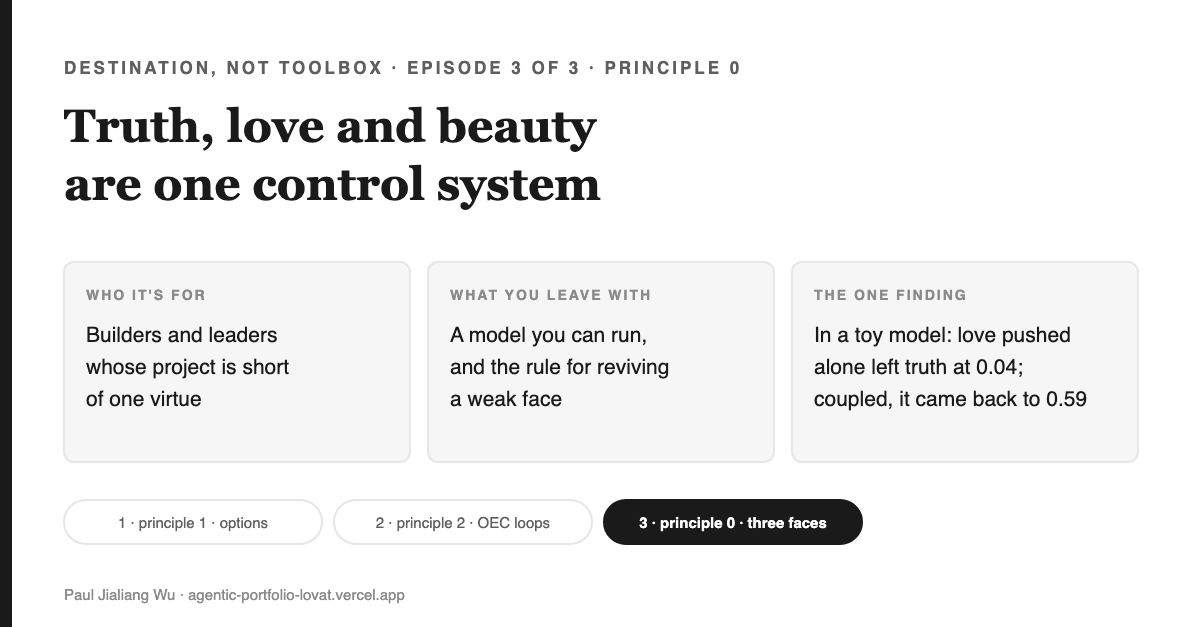
What this is. An essay and a live toy model for builders and leaders, about truth, love and beauty as three faces of one character. Knock one down and the toy model illustrates the condition for recovery: the three must pull on each other, and something outside must keep feeding them. Three receipts from moving a team office to a server show the same thing in real work, and the essay ends by reading all three principles of the series on one system.
Why it matters. When a project goes wrong, people usually fix the virtue that failed head-on: more checking when truth fails, more effort when love fails. The model and the receipts say that often works worse than strengthening the faces that are still strong. Teams, codebases and families all run on this.
What you can do after reading. Run the three-faces model in the three regimes and write down which one your current project is in. Then pick the face that is weakest this week and name one action on each of the other two that would pull it back.
Destination, Not Toolbox — the series spine
▶ See it running: open the live demo public · no sign-in
- Agentic software hands you options episode 1
- OEC loops at every scale episode 2
- Truth, love and beauty: one system this episode
The one question: When a system is short of one virtue, how do you revive it through the others, and what keeps all three alive?
This piece does NOT re-explain the loop a human chooses from (part 1) or the five scales of improvement (part 2). It shows what holds both together, and ends by reading all three principles on one system.
What this essay is about: truth, love and beauty as one system
This is an essay about truth, love and beauty, and about treating them as one system instead of three separate ideals. It is written for builders and leaders whose project is strong in one of the three and starving in another: a codebase that is correct and unreadable, a team that is kind and keeps shipping bugs, a product that is beautiful and quietly untrue. You need a browser, a piece of string, two friends, and about forty minutes.
The principle is the oldest of the three in this series, so I call it principle zero. I first wrote it down in an essay about numbers: "I hold that Truth, Love and Beauty are not three separate ideals but three faces of one Reality, and in my faith, of one Person." (Wu, P. J., Number vs Representation). The same holds, in my experience, for two other triads: love, joy and peace, and love, hope and faith. Stated as a claim you can test, it has three parts.
- They travel together. When one face shows up in a piece of work, expect the others nearby.
- They revive each other. When one face is short, the fastest repair is often to strengthen the other two, not to push harder on the weak one.
- They form a stable system only with control. The three must stay coupled (feedback), and something outside must keep feeding them (feedforward). Left alone, each one fades.
In one sentence: truth, love and beauty are three faces of one character, so a system short of one is revived by strengthening the other two, as long as the three stay coupled and something keeps feeding them.
The first two parts are claims about how work behaves. This essay illustrates them with a toy model whose rule you can read and with three receipts from real work; it does not prove them. What would refute principle zero is a case where the other two faces were strengthened, stayed coupled, kept being fed, and the weak face still did not come back. If you have one, post it. Here "coupled" means each strong face moved its countable signal toward the weak one at least once a week (see Feedback), and "fed" means the fourth line of your revival plan names a source that acted this month. If both hold for four weeks and the weak face's signal does not move, principle zero failed for that case. The source I believe the three faces belong to is a matter of faith, and I label that lens as mine where it appears. The engineering stands without it.
This is part 3 of three, and the capstone. Part 1 moved a team's office from tools to options (max-calling, min-cost). Part 2 stacked observe-evaluate-control loops at every scale. This part asks what holds both together, and ends by reading all three principles on one system.
The cooking ladder carries this one too. Think of a restaurant you return to for years. The food is honest: fresh, safe, and the bill is right (truth). The people remember your allergy and your name (love). The plate and the room make you pause (beauty). When the kitchen makes a mistake, you come back anyway, because the host tells you plainly and the replacement dish is lovely. Truth failed for a moment; love and beauty pulled it back.
| In the restaurant | The face | In a software system |
|---|---|---|
| honest food, a correct bill | truth | tests that can fail, numbers that are measured, risks said aloud |
| the guest remembered | love | the user's data and choices protected, the 2 a.m. reader served |
| the plate and the room | beauty | one idea that explains the design, a core small enough to hold in your head |
Before you read on. You will end by sitting with one teammate, naming the weakest face of a project you share, and planning its revival through the other two. Read as someone who will have to explain coupling with a piece of string. In a meta-analysis of 39 studies, teaching after studying with that expectation scored g = 0.48 (a subgroup result), while teaching without it showed no measurable benefit (g = −0.02) (Kobayashi (2024), Educational Psychology Review (ERIC EJ1414484)).
Activity 1 · Keep a triangle of string taut
Tie a long piece of string into a loop. Three people each hold it with one hand and step back until it forms a taut triangle. Call the corners truth, love and beauty.
Now truth steps one big step forward, and the string goes slack. Before reading on, write down what the other two can do to make it taut again, and what happens if nobody holds the string at all.
Most groups discover two moves. Truth can step back, but if truth is the one that is struggling, that is the hard move. The easier move is for love and beauty to step back. The triangle tightens, and the pull on the string draws truth back into place. That is coupling: each corner is held by the tension the others create. And if nobody holds the string, it falls. That is decay. Coupling keeps the shape; something outside has to keep putting tension in.
A model you can run: coupling, decay and a steady source
The demo in section 6 of the Destination Playground turns the string into three numbers between 0 and 1, one per face. Every step, each face moves toward the average of the other two by an amount called the coupling (that is the feedback), loses five percent of itself to decay, and may get a small steady push from outside (that is the feedforward). It is a toy, chosen to be small enough to read in one line. It is not a measurement of any person or team.
Start all three at 0.8, knock truth down to 0.2, and run 30 steps. The three regimes come out like this:
| Regime | Truth | Love | Beauty |
|---|---|---|---|
| coupled (0.35) and fed (0.1 on love) | 0.59 | 0.77 | 0.59 |
| fed (0.1 on love) but not coupled | 0.04 | 1.00 | 0.17 |
| coupled (0.35) but not fed | 0.13 | 0.13 | 0.13 |
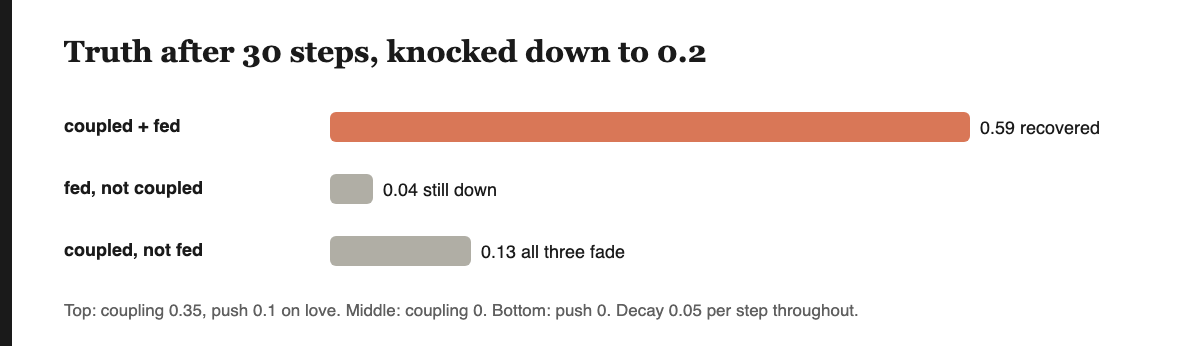
Read the middle row slowly, because it is the common mistake. Pushing love alone, with no coupling, drives love to its ceiling and leaves truth at 0.04. If teams behave like this toy, a team can be overflowing with care and still ship falsehoods, when the care never pulls on the checking. Read the bottom row next. The faces stay in step with each other, but with nothing feeding them, they fade together. A tight team with no source runs down. Only the top row recovers: the faces pull on each other, and something keeps feeding one of them. Truth came back from 0.2 to 0.59 without anyone pushing on truth directly.
Control engineers would recognise the shape. Feedback, in Åström and Murray's words, is reactive: "Feedback is reactive: there must be an error before corrective actions are taken." (Åström & Murray (2020), Feedback Systems: An Introduction for Scientists and Engineers, 2nd ed., v3.1.5, §1.2). The steady push is feedforward. Their advice applies here unchanged: "Experience indicates that it is often advantageous to combine feedback and feedforward" (Åström & Murray (2020), Feedback Systems, 2nd ed., §1.2).
Three receipts from real work
The model is a toy. Here are three times the same pattern happened while building and moving a founding team's office. In each, one face was short, and it came back through the other two.
I picked these three after the fact, which is the weak way to collect evidence. A fair test would log every weak-face episode as it happens, including the ones where the side repair failed.
Truth was short; love and beauty revived it. The office kept nightly backups, and I had once drilled a restore. It passed. Weeks later the team needed the office always on, because my laptop's sleep kept taking it offline. So I moved it to a rented server, out of care for the people who used it. That move was the first time a backup was restored on a different machine, and it failed: the backup only worked where it had been made, because the restore reused the current machine's database password instead of the one stored in the backup. A backup that only restores where it was taken is not disaster recovery. The fix was one small, clean rule: take the database identity from the backup itself. Love created the test that truth had never faced; beauty made the repair one line of reasoning instead of a patch.
Love was short; truth and beauty revived it. The October rebuild began with a request to rename everything from the old name to the new one. Taken literally, it would have hurt the people using the office: the storage volumes holding every file and account were keyed by the old name, so a full rename would have brought the office up empty. What saved them was truth (reading what each name really was: a label for humans, or the identity of live data) and beauty (one table listing every name kept, and why, plus aliases so nothing anyone used stopped working). Nobody had to change a thing on their side.
Beauty was short; truth and love revived it. The codebase had grown a 652-line command file that knew everything, and the rebuild split it into a small core and add-ons. Under deadline, the split left an old copy of one function further down a file, quietly replacing the fixed version above it. An outside reviewer's finding and a test that failed on its first run (truth) exposed it. The motive to keep the core small enough for a teammate to read at 2 a.m. (love) is what turned the fix into a rule: the core has a line budget, checked on every change. My earlier essay on teaching numbers names the failure this guards against: "Truth without love is a correct proof nobody can follow." (Wu, P. J., Number vs Representation).
Activity 2 · Draw your project's triangle
Draw a triangle and label the corners truth, love and beauty. Pick one project you work on with others. At each corner, write one piece of evidence that face is present this month, and give it a score from 0 to 10.
Circle the lowest corner. Now draw two arrows into it, one from each of the other corners, and write on each arrow one action that would pull it up.
The arrows are the coupling. Notice that you were not asked to write an action on the weak corner itself. Teams usually attack the weak face head-on: more process when truth fails, more effort when love fails. The model and the receipts suggest the stronger move is often from the side.
The other two triads, read as control
The same structure appears in the two triads I named at the start, and reading them as control systems is useful even for readers who do not share my faith.
Love, joy and peace. In a team: love is care for the people the work serves; joy is delight in the work itself; peace is the calm of knowing that if something breaks, a gate will catch it. Peace is mostly feedforward: the tripwires and gates of part 2, decided before the bad night. Joy is mostly feedback: the pleasure of a loop that closes. A team with love and no peace burns out; a team with peace and no joy goes grey.
Love, hope and faith. Hope is the dated target (a destination, part 1). Faith is acting before the evidence arrives, which in engineering is exactly what a feedforward rule is: trust placed in a plan before the error shows. Love is the reason the target matters. A plan with hope and no faith never starts; with faith and no hope it never ends; with both and no love it can succeed and serve nobody.
Otto Scharmer's Theory U, taught at MIT as u.lab (15.671.1x, MITx, u.lab: Leading From the Emerging Future (MITx Online; redirects to MIT Learn)), has a name for the move this section asks for: letting go. Let go of attacking the weak face head-on, so the other two can pull it back.
Activity 3 · Write the revival plan
Write three lines for the project in your triangle. "Weakest face: ___, because ___ (evidence)." "Through ___: I will ___ by ___ (date)." "Through ___: I will ___ by ___ (date)."
Add a fourth line: "What keeps feeding all three: ___." If you cannot fill it, that is your bottom-row risk.
The fourth line is the feedforward, and it is the one people leave blank. In the model, coupling without a source decays to 0.13. In a team, the source is whatever renews the people: rest, a shared purpose, someone outside the team who believes in it. Name it, or plan to lose all three faces slowly and together.
Activity 4 · Run the three regimes
Open section 6 of the Destination Playground. Knock truth down and run 30 steps with coupling 0.35 and a 0.1 push on love. Then set coupling to 0 and repeat. Then set the push to 0 and repeat.
Before each run, predict truth's value after 30 steps. Then find the smallest coupling at which truth still comes back above 0.5.
The page prints the exact rule it runs, so you can check every number in the table above by hand. What is real: the update rule and its results. What is made up: that three numbers could ever capture a team. Use it to train intuition about coupling and decay, not to score people.
All three principles on one system
Here is the capstone of the series: the three principles read together on the one system all three parts were built on.
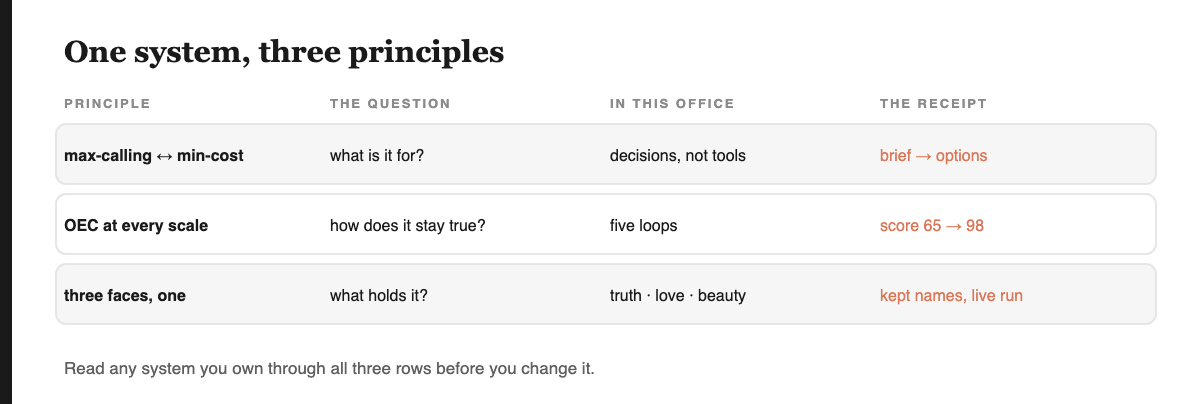
Each principle answers a different question, and each needs the others. Max-calling, min-cost says what the office is for (decisions, not tools) and which costs to cut. Cross-scale OEC keeps it true as it changes. The three faces are what make both worth trusting: a cheap system that is untrue is worthless, and a well-measured system nobody loves using is a scoreboard nobody reads.
Read together, they also settle three tensions I found in my own earlier essays.
- When does minimising cost become gaming? When the cost being cut is the cost of the truth. Min-cost applies to reaching the calling; the checks are part of the calling.
- Are the loops only about not losing? No. The ratchet that blocks a regression also raises the floor after every real gain. Peace is the floor; joy is the climb.
- Is principle zero a law or a lens? Both, at different layers. The coupling claim is testable. This essay illustrates it with a toy whose rule you can read and with three receipts; it does not prove it. The claim about where the three faces come from is faith, and it is labelled as mine.
Case studies: the same lens on three more systems
After the series was written, I applied the same three principles, term by term, to three more systems I am building. The full reports live in each project's own repository; here is what they found, with the third in full.
| System | What was excellent | What was short | The change it got | |
|---|---|---|---|---|
| 1 | A compliance-audit engine for small clinics, built with partners | Every finished report was correct and checked against the regulator's own examples | The reports had not yet reached the clinics they were for | Its written tripwires became data a weekly loop checks, and the first next action is a question for the people who send, not a feature |
| 2 | My AI-glasses relay (spoken requests to my own agent) | A brain that answers in one sentence for the ear and refuses strangers | Not one message had travelled the pipe to it | Each request now leaves a receipt without its words, so "is the pipe flowing?" is a number |
| 3 | The strategy room of my family academy, Shepherd's Academy of War | A loop that already gave one next action a week | Five of its six measures read "not measured" | Its own dated promise must now be answered (below) |
Case study 3, in full. The academy's strategy room is the most mature of the four codebases. It already runs a lean core with add-ons, the observe-evaluate-control loop of part 2, and a quality floor that only rises. Read through the three principles, its truth face is strong: every claim in its principles page carries a class (physics, math, analogy, faith, or "false as stated"), and missing data is reported as "not measured", never as zero. Its beauty face is strong too: five demos a seven-year-old can run, each one sentence long.
The weak face is love-in-use. Five of the six key results in its strategy file read "not measured", and the sixth, the family drills with my two boys, stood at zero of five. The reason was not a broken sensor. Every sensor reads a count I am supposed to type in after a conversation or a drill, and none had been typed in the ten days from 16 to 26 October 2026. The loop was working; the last metre, from my evening to the file, was dry. That is the same shape as the first two case studies, which is why I now hold a fourth principle as a hypothesis: when excellent work is not reaching the person it is for, the next unit of effort goes to the last metre, not to the engine. Four cases out of four (these three, and the office in part 1, where 11 of 40 overdue to-dos were decisions waiting for a person) is a pattern, not a proof, and I chose the cases, so treat it as a question to test.
The page that states my first principles also had a dated promise: its whole upgrade "fails unless" five demos are run with the boys by a set date. Nothing would have asked about that promise after the date, which is principle two's discipline in reverse: a rule stored as prose decays. So the academy's gate now turns red the day after the date until a verdict is written down, pass or fail, with evidence. Silence is the only thing that keeps it red. And the cheapest repair for the weak face is the one this essay prescribes, from the side: not more framework (truth), but twenty minutes with one demo that is already one tap away (beauty), logged in one sentence.
Truth, love and beauty in this essay
- Truth: the model is called a toy, its rule is printed, and its three rows reproduce exactly. The receipts include my own mistakes: a backup I trusted too early, and a duplicated function I shipped under deadline.
- Love: every receipt is about protecting someone: a team whose office had to stay on, people whose files a rename would have hidden, a teammate reading the code at 2 a.m.
- Beauty: three faces, one rule, one line of update. The capstone fits three principles in three rows.
The lens behind this essay is my own, and here it is in full. Galatians names one fruit with many faces: "But the fruit of the Spirit is love, joy, peace, patience, kindness, goodness, faith, gentleness, and self-control. Against such things there is no law." (Galatians 5:22-23, World English Bible). Paul's letter to the Corinthians names the second triad: "But now faith, hope, and love remain—these three. The greatest of these is love." (1 Corinthians 13:13, World English Bible). And Jesus names himself the way, the truth and the life: "Jesus said to him, “I am the way, the truth, and the life. No one comes to the Father, except through me." (John 14:6, World English Bible; the quotation continues in verse 7). I read love in "the way". That is my reading, not the text's words. In my faith the three faces are one because their source is one: God, Father, Son and Holy Spirit. That is why I expect them to travel together, and why I believe the steady source in the model's top row is not something a team can generate alone. The model, the receipts and the activities stand without that belief.
Mistakes that are half right
- "Fix the virtue that failed." Sometimes. But the receipts and the model suggest the faster repair is often to strengthen the two that are still strong, so they pull the weak one back.
- "A loving team will be a truthful team." Not without coupling. Love pushed alone left truth at 0.04 in the model.
- "Beauty is optional polish." In code, beauty is how the next reader finds the truth. The duplicated function hid in an ugly file.
Principles I had been using without naming them
Two more principles turned up in my earlier essays, and both belong here.
- Judge by fruit, not by intentions. "Fruit is observable and motive is not" (Wu, P. J., Become Good Soil). The three faces are judged by what the work produces, not by what its makers meant.
- Keep the identity fixed and let behaviour change. "behavior is editable, identity is not." (Wu, P. J., Keep Your Identity While Learning From Reality). The rename receipt is this principle in one decision: the data's identity stayed fixed while every human-facing name changed.
Now teach it
Your teach-back. Sit for fifteen minutes with one teammate on a project you share. Do the string triangle (Activity 1) if you can find a third person, or draw it (Activity 2) if you cannot. Name the weakest face together and write the four-line revival plan (Activity 3). If your teammate has not met the loops, walk them through part 2 first: coupling is a feedback loop, and they will want the scales.
Outcome: your teammate can say why pushing harder on the weak face is often the slower repair, and the two of you have one dated action on each of the two stronger faces. Post which face was weakest and which face you used to pull it back as a comment on this article.
Why it matters: five whys
The problem: a backup that had passed a restore drill turned out to restore only on the machine that made it, and the flaw stayed hidden for weeks.
- Why did the drill pass? It ran on the same machine as the backup, so the database password it reused happened to be right.
- Why did nobody test on another machine? Nothing required it. The truth check existed, but at one scale only (part 2).
- Why did the flaw finally appear? Because of care for the users: the office had to stay on, so it moved to a server, and the move was the first real cross-machine restore.
- Why was the repair quick? Because the fix had a clean shape: take the database identity from the backup itself. Beauty made the truth easy to restore, and a clean repair is one a tired person gets right on the first try.
- Root cause: truth was being maintained alone, uncoupled from the people it served. When love created a new situation and beauty kept the repair simple, truth came back. The fix is to keep the three coupled on purpose: test where your users actually are, and keep repairs small enough to read.
Operate: run it this week
- Read the teach-ahead line.
- Do the string triangle with two friends (Activity 1, 5 minutes).
- Draw your project's triangle with evidence at each corner (Activity 2, 10 minutes).
- Write the four-line revival plan (Activity 3, 5 minutes).
- Run the three regimes in the Destination Playground and find the smallest coupling that still revives truth (Activity 4, 10 minutes).
- Teach it to one teammate and post which face you used.
Feedback: how you know it worked
- Two weeks after your revival plan, the weakest corner's score in your triangle has risen, and you did not act on it directly.
- You and your teammate can each name the source that keeps feeding the project (the fourth line).
- Next to each 0–10 score, one countable signal moved: for truth, a gate or check that fired this month; for love, a user question answered within a day; for beauty, a newcomer explaining the design back in five minutes.
- You predicted at least two of the three regimes correctly before running them.
What this cannot see: the inner life of the people on the project. A triangle score is a conversation starter, not a measurement of anyone's character. If it is used to grade people, it will become the kind of measure Strathern warned about: "audit does more than monitor—it has a life of its own that jeopardizes the life it audits." (Strathern (1997), European Review 5(3), 305-321).
Feedforward: tripwires, decided now
- If one face scores below 4 for two weeks running, stop pushing on it and pick the two side actions.
- If you cannot name what feeds the project, treat that as the highest risk on the list. Coupling without a source fades.
- If a triangle score is ever used in a performance review, delete the triangle.
- From today until 2027-01-31 I log every weak-face episode, including the failures. If the side repair works in fewer than half of them, I retire claim 2 and say so here.
The 5S self-score
| S | Claim | Evidence |
|---|---|---|
| Simple | The prose reads at a grade-12 level or easier; one string triangle carries the essay. | Flesch–Kincaid grade: 6.6 (band ≤ 12), recomputed by node scripts/check-numbers-four-ages.mjs --series agentic-collab |
| Solid | The model's rule is printed and its three rows reproduce; each verse is quoted from the fetched WEB text. | the model · Galatians 5:22–23 (WEB) |
| Sharp | A weak face is revived fastest through the other two, and only while the three stay coupled and fed. | the three regimes · three receipts |
| SMART | This week: one triangle, one four-line plan, one teammate taught; check the score in two weeks. | Operate |
| Surprise | Pushing love alone drives love to the ceiling and leaves truth at 0.04. | the middle row |
| Truth · Love · Beauty | A labelled toy with a printed rule; receipts about protecting people; three principles in three rows. | Truth, love and beauty · capstone |
Sources
- Galatians 5:22–23, World English Bible. bible-api.com
- 1 Corinthians 13:13, World English Bible. bible-api.com
- John 14:6, World English Bible. bible-api.com
- Åström, K. J. & Murray, R. M. Feedback Systems: An Introduction for Scientists and Engineers, 2nd ed. caltech.edu
- Strathern, M. (1997). 'Improving ratings': audit in the British University system. European Review 5. OpenAlex
- Kobayashi, K. (2024). Interactive learning effects of preparing to teach and teaching. Educational Psychology Review. ERIC EJ1414484
- MITx u.lab, 15.671.1x: u.lab: Leading From the Emerging Future (Otto Scharmer's Theory U). MITx Online
- Wu, P. J. Number vs Representation: The First Abstraction Every Programmer Uses. agentic-portfolio
- Wu, P. J. Become Good Soil. agentic-portfolio
- Wu, P. J. Keep Your Identity While Learning From Reality. agentic-portfolio
- The Destination Playground (this series' running demo). agentic-portfolio