AI-NATIVE SERIES · DESTINATION, NOT TOOLBOX, EPISODE 1 OF 3 · PRINCIPLE 1
Agentic Software Hands You Options, Not Tools: What Rebuilding Our Office Taught Me About Max-Calling, Min-Cost
1-minute takeaway
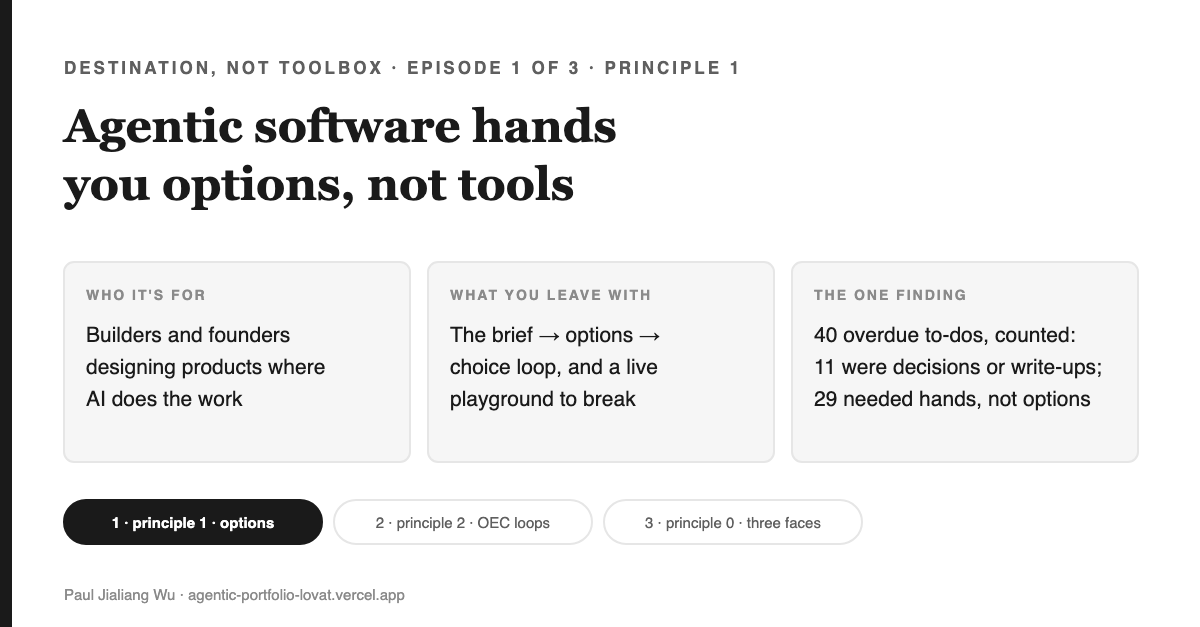
What this is. An essay and a playground for builders, about the difference between software that hands you tools and software that hands you options. It is built on a real refactor: a founding team's office rebuilt around one loop. A human writes the destination, the machine rules out every option that breaks a limit, ranks the rest, shows three different ones, and the human chooses.
Why it matters. Choosing takes far less effort than authoring, and taste is the one job that cannot be delegated. On one founding team's board, 40 to-dos were past due; counted one by one, 11 of them were decisions or write-ups this design can move, and 29 needed hands in the world. This is the design for that quarter of the work, the honest size of the claim, and the first principle under it: maximise the calling by minimising the cost of everything else.
What you can do after reading. Write one brief for a real decision this week (goal, two hard limits, one example of good, one of bad), play the Destination Playground until the machine's first pick and yours disagree, and read the suggested weights it gives back.
Destination, Not Toolbox — the series spine
▶ See it running: open the live demo public · no sign-in
- Agentic software hands you options this episode
- OEC loops at every scale episode 2
- Truth, love and beauty: one system episode 3
The one question: What makes software agentic instead of a toolbox, and what does it cost to build it that way?
This piece does NOT explain how the system keeps itself improving after it ships; that is part 2, OEC loops at every scale. Why the three virtues that held the work together are one thing is part 3.
What this essay is about: agentic software, and the cost of building it
This is an essay about agentic software: software that takes a destination from you and does the walking. It is written for builders and founders who are designing products where AI does most of the work, and for anyone who has bought a powerful tool and then watched it sit unused. You need a browser and about forty minutes.
The essay is built on one real piece of work. In October 2026 I rebuilt my founding team's office: a self-hosted file drive, live documents, chat, tables and AI teammates, run as code from one file. For six weeks it had been a very good toolbox. Then I counted the team's task board on the morning of the rebuild. Of 51 to-dos, 4 were done and 40 were past their due date. My first headline wrote itself: the bottleneck is decisions, not tools. Then I did what this series keeps asking for and counted my own headline. Reading each overdue item's title and its definition of done, 4 were decisions (set prices, pick a channel, choose what to launch first, set a spending limit) and 7 were write-ups (a plan, a comparison, a list, a script). The other 29 needed hands in the world: calls, visits, photos, checks. My classification is a judgement call, and a stricter reader might move two or three items. Either way, the headline shrank from "the bottleneck" to about a quarter of it. That quarter is what this essay is about: work that waits because nobody had an afternoon to turn it into a short list someone could answer in ten seconds.
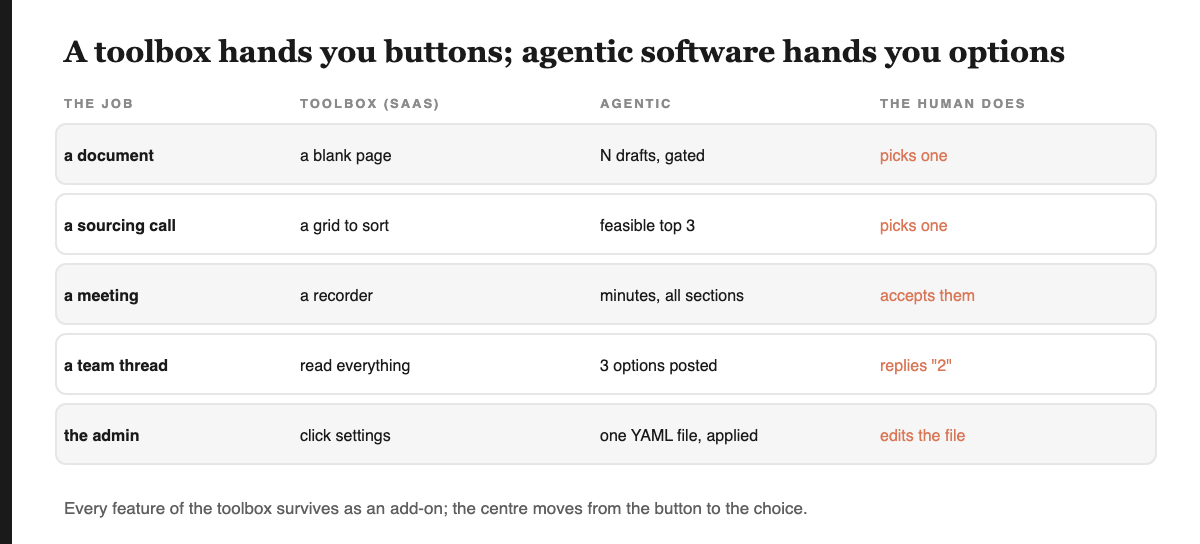
So the rebuild moved the centre of the product. It used to be the tools. Now it is one loop: a human writes the destination, the machine brings a few options that respect every limit, and the human chooses. Everything that used to be a feature (files, chat, tables, transcripts, the admin console) became an add-on that the loop can use.
Underneath sits the first principle of this series, which I call max-calling, min-cost: maximise the calling (the thing only you can do, the impact you exist to have) by driving down the cost of everything else, whether that cost is time, attention, energy, space or machine intelligence. The calling in a founding team is judgement. Writing, sorting and searching are costs, and the loop moves them to the machine.
This is part 1 of three. Part 2, OEC loops at every scale, is about how the system keeps improving after it ships. Part 3, Truth, love and beauty are one control system, is about what holds the work together, and it reads all three principles on one system.
One picture will carry the whole series: the cooking ladder. You can cook for yourself, for your family, for a restaurant, for a fast-food chain, or for a national food supply chain. The same kitchen skills apply at every level, but who decides what changes as you climb.
| Cooking level | Who decides the dish | The software it maps to |
|---|---|---|
| For yourself | you, and you also cook | a tool you operate yourself |
| For your family | you guess what they want | a SaaS product: features you hope people use |
| For a restaurant | the guest orders; the kitchen cooks | agentic software: the user states the destination |
| For a chain | the recipe is written down and tested | the brief and the gate as code |
| For a supply chain | millions of orders shape the menu | the ledger that learns a team's taste |
A guest in a good restaurant never walks into the kitchen. They say "something with fish, under thirty dollars, no peanuts, like the dish I had last time but not that salty one." That sentence is a brief. The rest of this essay is how to build the kitchen behind it.
Before you read on. You will end by teaching the brief to one person who makes decisions with you, using one of their own stuck decisions. Read as someone who will have to explain it in two minutes. In a meta-analysis of 39 studies, teaching after studying with that expectation scored g = 0.48 (a subgroup result), while teaching without it showed no measurable benefit (g = −0.02) (Kobayashi (2024), Educational Psychology Review (ERIC EJ1414484)).
Activity 1 · Order dinner for a friend without entering the kitchen
Stand up, find someone nearby, and play waiter. They are the guest; you are the kitchen. They may not tell you a recipe. They may only tell you where they want to end up.
Before reading on, write down what the guest has to say so the kitchen can bring back three dishes they would happily choose between. What is a hard rule, what is a preference, and what is an example?
Most people invent the same four parts. There is a goal ("dinner, something with fish"). There are hard limits that may never be broken ("no peanuts", "under thirty dollars"). There are preferences that can be traded against each other ("cheap matters more than fast"). And there are examples, one of good ("like last time") and one of bad ("not that salty one"). Those four parts are the brief. Notice what is missing: the guest never says how to cook. That is the line between a tool and an agent.
The brief: say where, never how
In one sentence: agentic software takes a destination from a human and returns a few feasible options for the human to choose from.
In the rebuilt office a brief is a small file a person can write in two minutes. It has a goal in one sentence, an objective (what to push up or down, with weights), hard limits that may never be broken, examples of what good looks like, examples of what it must not look like, and how many options to show. Here is the shape of a real one, for picking a backup supplier:
goal: Pick a second supplier we can switch to within one season.
objective:   [minimize unit_cost ×2, maximize rating, minimize lead_days]
hard limits: [moq ≤ 500, lead_days ≤ 45, ships_to_us = yes]
options: 3
The idea is not new, and it is worth saying where it came from. Engineers who design aircraft brackets and car parts have worked this way for years under the name generative design. Autodesk describes it as a process that "Generative design automates the exploration of design options by defining objectives, constraints, and a design space, then employing algorithms to generate a multitude of solutions within those parameters." (Autodesk (2025), What is Generative Design, autodesk.com (Wayback snapshot 2025-12-20; live page returns 403 to scripted fetches)). Its own help pages call the inputs design criteria: "Design criteria are objectives and manufacturing constraints that are required to define the design goals for the solver." (Autodesk, Fusion Generative Design help: Design criteria). The engineer does not draw the part. They state the goal, the loads and the regions to keep or avoid, the solver returns many shapes, and the engineer chooses. The rebuild copied that anatomy into an office, and added the one thing CAD does not have: a record of what the human chose and why.
The four parts of a brief are not equal. Hard limits gate; preferences rank; examples steer. Mixing them up is the most common way to get bad options. Put "cheap" in the limits and you get only the cheapest supplier. Put "ships to the US" in the preferences and you get a lovely supplier that cannot deliver.
The gate, the shortlist, and why three options
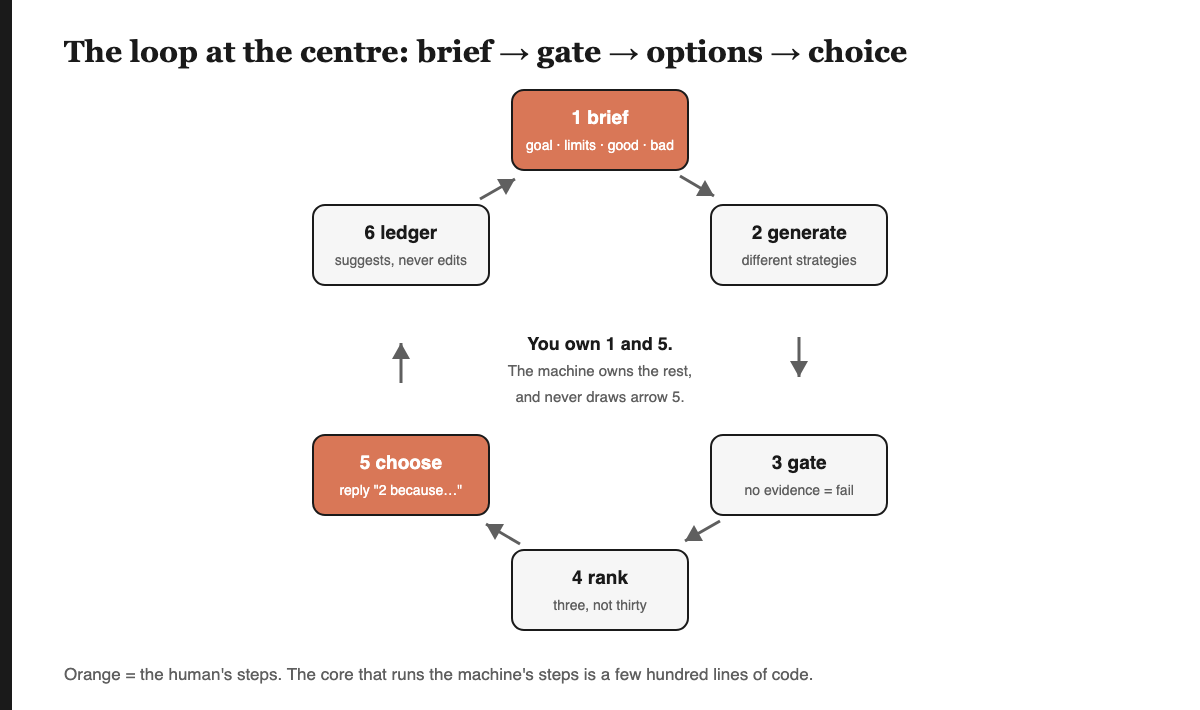
After the brief, the machine does four things. It generates candidates: a model asked for drafts that take different strategies, the rows of a team table, or options someone pasted in. It measures each one. It gates: any candidate that breaks a hard limit is out, and the reason is written down. A value nobody measured counts as a fail, never a pass. Only then does it rank the survivors.
Ranking has two steps. First each goal is scaled from 0 to 1 across the survivors, and the weights combine them into one score. Second, the machine marks the Pareto options. An option is Pareto when no other survivor is at least as good on every goal and better on one. Britannica's definition of the economic idea is the same test in words: a state is optimal "if and only if there is no alternative state that would make some people better off without making anyone worse off" (Encyclopaedia Britannica, Pareto optimality). A Pareto option is a real trade-off. Showing those first means every option shown is a real trade-off; the near-copy rule below is what keeps them different.
Be honest about how much Pareto narrows things, though. With three goals, most survivors are Pareto: in the playground below, 5 of the 6 feasible suppliers are. So Pareto alone does not keep the options different. What does is the near-copy rule: an option too similar to one already shown is skipped. The office applies it to drafts; the playground's suppliers are all distinct already, so the playground does not need it.
Then comes the shortlist: a handful of options, Pareto first, then by score, with near-copies skipped. Why a handful? The famous jam study found shoppers more likely to buy "when offered a limited array of 6 choices rather than a more extensive array of 24 or 30 choices" (Iyengar & Lepper (2000), When choice is demotivating: Can one desire too much of a good thing?, JPSP 79(6), 995-1006). But a later meta-analysis (63 conditions, N=5,036) reports: "we found a mean effect size of virtually zero but considerable variance between studies" (Scheibehenne, Greifeneder & Todd (2010), Can There Ever Be Too Many Options? A Meta-Analytic Review of Choice Overload, J Consumer Research 37, 409-425). So the honest claim is not that a long list always backfires. It is narrower: comparing many options costs attention, the cost is real for some people in some settings, and a short list of different options is cheap to read. Herbert Simon's word for good-enough choosing is satisficing (Simon (1956), Rational choice and the structure of the environment, Psychological Review 63, 129-138); a summary of his idea is that "people tend to make decisions by satisficing (a combination of sufficing and satisfying) rather than optimizing (Simon, 1956)" (Simon (1956), Psychological Review 63, as summarised by BehavioralEconomics.com, Satisficing). The shortlist is built for a satisficer with taste.
Activity 2 · Draw your kitchen's pass
On paper, draw two boxes: the dining room (the human) and the kitchen (the machine). Draw the brief going in and three plates coming out. Between them, draw the pass: the counter where the chef checks every plate before it leaves.
Write on the pass what gets a plate sent back. Then circle the one arrow only the guest can draw: the choice.
The pass is the gate. In the office it is a few lines of code that check every hard limit before anything is ranked. The circled arrow is the choice, and the rebuild has one rule about it: no tool, button or agent may draw it for you. The AI teammate can propose options through its own account. There is deliberately no tool that lets it choose.
What the rebuild changed, and what it refused to change
The office was built as a toolbox: one package for each kind of thing (accounts, files, chat, tables, speech) and a 652-line command file that knew all of them. The rebuild cut it into a lean core and eight add-ons. The core holds only the loop: the brief, the candidates, the gate, the ranking, the choice and the ledger. It uses nothing but the standard library, does no input or output, and stays under a fixed line budget. A test fails the build if any of that stops being true. Everything a SaaS product would call a feature is an add-on with a manifest that names the SaaS feature it replaces: drive and documents, messenger, a spreadsheet-like base, meeting minutes, the admin console, and three new ones for generating, measuring and delivering options.
The choice now arrives where the team already is. The options are posted as a numbered message in the team's chat room, and choosing is replying "2 because the lead time matters more this season." The machine reads the first human reply that names an option, ignores its own messages, and ignores chatter such as "5 minutes late". That last rule came from an outside reviewer, who caught the first version reading "5 minutes late" as a vote for option 5.
The rebuild also refused one thing, and the refusal is a lesson in min-cost. I was asked to rename everything from the old name to the new one. Most of it was code and docs, and it changed. But some of the old name was not a name at all: it was the identity of live data. The office's storage volumes, the server folder and the backups are keyed by the old name. Renaming them would have brought the office up empty for four people. The cheapest correct move was to rename every identity a human reads and keep every identity the data depends on, and to write down which is which. The old command and the old settings still work as aliases. Nobody had to change anything.
Activity 3 · Write one real brief
Pick one decision that has been stuck on your desk for more than a week. Write its brief in six lines: one goal, two objective terms with weights, two hard limits with the reason for each, one example of good, one example of bad, and the number of options.
Read it back aloud. If any line tells the machine how to do the work, delete it.
The reason for each hard limit matters more than it looks. "Lead time at most 45 days, because the season starts in November" lets a teammate challenge the limit later without arguing about the whole decision. The office's brief parser reports every problem in a brief at once, and reads the brief back in plain words before anything runs, so the human can confirm the machine understood the destination.
Max-calling, min-cost: the principle under the design
Here is the principle stated plainly. Maximise the calling, and let the calling decide which costs to drive toward zero. A calling is the work only you can do. A cost is anything that work consumes: time, attention, energy, space, mass, and now machine intelligence (design, planning, reasoning, training, inference).
The two halves need each other. A team that only cuts costs gets cheap and aimless. My own earlier essay on agents asks whose goals a system is serving, and then puts it bluntly: "Capability without that is not agency — it is a very efficient way to arrive somewhere nobody wanted." (The Sheep Does Not Need the Whole Map). A team that only chases the calling burns out on everything else. The rebuild applied the principle at four levels.
- The human's time. Authoring a supplier comparison takes an afternoon; choosing from three takes a minute. The loop spends machine time to save the founder's.
- Attention. Three distinct options cost less to read than a ranked list of twelve, and the gate removes the ones that would have wasted a look.
- Machine intelligence. Not every candidate needs a model. Table rows and pasted options cost nothing to generate, so the language model is one generator among four, used where a draft is needed. An earlier essay of mine says the same thing about prompts: "Context is a budget, not a container." (Context Engineering Is a Budget).
- Code. The core is a few hundred lines because every line is a cost someone will pay to read at 2 a.m. Gall's law, as usually quoted: "A complex system that works is invariably found to have evolved from a simple system that worked." (Gall (1975), Systemantics, as quoted by Wikipedia, John Gall (author)). The lean core is the simple system that works; the add-ons are where it grows.
There is a trap in min-cost, and my past essays keep stepping around it. An agent, as I wrote in an earlier essay, "it searches harder than any person for the cheapest way to hit the number" (Wu, P. J., Human Dynamics in Agentic AI, part 1). Minimising cost turns into gaming the moment the cost being minimised is the cost of the check. So the rule needs a guard: drive down the cost of reaching the calling, never the cost of telling the truth about it. The gate, the measurement and the outside review are not costs to cut. They are part of the calling.
Activity 4 · Break the playground on purpose
Open the Destination Playground. It runs the same gate, scoring and Pareto rule as the office, on twelve made-up suppliers.
First, tighten the minimum order until no supplier survives, and read what it says. Second, choose an option that is not number 1, and read the weights it suggests. Third, set every weight to zero except rating and predict the first option before you look.
When nothing survives, the playground says so and lists every reason, instead of quietly loosening a limit. That is a rule in the real office too: an empty shortlist with every reason is the honest answer. When you overrule the first pick, the ledger suggests nudging the weights you revealed you care about (×1.1 up, ×0.9 down). It never applies them. Direction stays human. What is real in the playground: the algorithm, and the suggestion rule. What is made up: the suppliers.
How you know the machine is learning your taste
Every time options are shown and every time a human chooses, the office writes one line to a ledger. Read back, the ledger answers the question that matters most for an agentic product: top-1 agreement, the share of decisions where the human picked the machine's first option. If it stays low after ten decisions, the brief's objective is not what the team actually wants, and the "why" lines say what to change. The ledger also measures how long options wait for a human. A loop whose options wait a week is a toolbox with extra steps. (Had the first chat reader shipped, the ledger would by now have learned that this team's favourite option is being five minutes late.)
Before the rebuild shipped, I ran it live against the real office as the AI teammate. The first live run failed: the drive refused to save the options page into a folder that did not exist yet. Every offline test had passed, because the fake drive in the tests was more forgiving than the real one. That bug is the subject of part 2. The second run worked. A real model wrote five drafts of a short team note, one broke a hard limit, three distinct options came back, and a choice was recorded.
Same story, five exits
| You are a… | The decision this changes | One action this week |
|---|---|---|
| Student | Whether "agent" means a chatbot or a system that returns options | Write a brief for your next group project decision and show it to the group |
| Engineer | Where the gate goes in your system | Put every hard limit in code before the ranking, and make "not measured" a fail |
| Founder | What your product's centre is: a button or a choice | List your five features and write the destination each one serves |
| Executive | How to judge an "AI does the work" proposal | Ask what the human still decides, and how often they agree with the machine |
| Investor | Whether an agentic product is defensible | Ask for the ledger: top-1 agreement over time is learned taste |
Truth, love and beauty in this essay
- Truth: every number here is measured and scoped. The 40 of 51 to-dos is one morning's count on one board, and the headline built on it was counted and cut down to 11 of 40. The choice-overload claim keeps its correction ("virtually zero" on average). The live run includes the failure.
- Love: the design protects the people using it. Their data names were kept, so the office did not come up empty. Their choice is never made for them. The options come to the room they already read.
- Beauty: the whole product turns on one loop small enough to draw on a napkin. Eight add-ons hang off a core of a few hundred lines.
One lens is my own, and I label it as mine. Psalm 1 pictures a fruitful life as a tree: "He will be like a tree planted by the streams of water, that produces its fruit in its season, whose leaf also does not wither. Whatever he does shall prosper." (Psalm 1:3, World English Bible). A tree does not strain to bear fruit. It stays planted by the water and lets the season do its work. In my faith that is max-calling, min-cost: rooted in the calling, unhurried about everything else. The design above stands without that belief.
Mistakes that are half right
- "Agentic means the AI decides." The AI does almost all the work, and the human still decides. What changes is that deciding is the only thing left for the human to do.
- "More options are better." More candidates are better. More shown options are usually worse, unless they are genuinely different trade-offs.
- "Min-cost means the cheapest option." It means the cheapest way to reach the calling. The cheapest way to pass a check is the opposite.
Principles I had been using without naming them
Rereading my earlier essays for this series turned up three principles I had applied many times and never named. Each one is a corollary of max-calling, min-cost.
- Keep the destination fixed and let the route change. "behavior is editable, identity is not." (Keep Your Identity While Learning From Reality). In the office, the brief is the identity; candidates are behaviour.
- Keep memory outside the head. The ledger is the team's memory of its taste, so nobody has to remember why they chose the supplier they chose.
- Judge by fruit, not by intentions. "Fruit is observable and motive is not" (Become Good Soil). Top-1 agreement and decisions closed are fruit; a beautiful feature list is an intention.
Now teach it
Your teach-back. Sit for ten minutes with one person who makes decisions with you. Ask them for a decision that has been stuck for a week. Write its brief together on one page, using Activity 3, and then let them play the Destination Playground until the machine's first pick and theirs disagree.
Outcome: they can say, without notes, the difference between a hard limit and a preference, and they choose one option for their real decision within a day. Post what they chose and the one hard limit that mattered most as a comment on this article.
Why it matters: five whys
The problem: on one morning, 40 of the 51 to-dos on a founding team's board were past their due date, in an office that had every tool the work needed. Eleven of the forty were decisions or write-ups.
- Why were those eleven overdue? None of them needed a trip or a phone call. Each was waiting for someone to write something up: compare the options, draft the plan, set the number.
- Why did nobody write them up? Authoring a comparison costs an afternoon, and an afternoon is the scarcest thing a founder has.
- Why did the office not help? It handed out tools, and a tool still needs a person to do the work with it. Generative design shows the alternative: state the "Design criteria are objectives and manufacturing constraints that are required to define the design goals for the solver." and let the solver do the drafting (Autodesk, Fusion Generative Design help: Design criteria).
- Why had nobody built that? The product's centre was the office (files, chat, tables), and every improvement made the toolbox better instead of moving the work.
- Root cause: the design optimised the cost of storing work instead of the cost of reaching the calling. The fix moves the centre to the brief and the choice, and turns every tool into an add-on the loop can use.
Operate: run it this week
- Read the teach-ahead line.
- Play waiter (Activity 1, 5 minutes) and draw your kitchen's pass (Activity 2, 5 minutes).
- Write one real brief (Activity 3, 10 minutes).
- Break the Destination Playground three ways (Activity 4, 10 minutes).
- Teach it to one decision partner and post the outcome.
Feedback: how you know it worked
- You can name the four parts of a brief and say which of them gate and which of them rank.
- Your partner chose an option for a real decision within a day of the brief.
- After ten real decisions, your top-1 agreement is known. If it is below one in three, your objective is wrong, and the "why" lines tell you how.
What this cannot see: whether the chosen option was good in the world. A ledger of choices measures taste, not outcomes. Pair it with one outcome number the decision was supposed to move, such as the days a decision sat on the board before and after the brief.
Feedforward: tripwires, decided now
- If two weeks pass with no decision made through the loop, the bottleneck was not drafting. Ask the people who should be choosing what stops them, before building anything more.
- If you are tempted to relax a hard limit so the shortlist is not empty, write down why first. An empty shortlist with every reason is information.
- If the core grows past its line budget, the new feature belongs in an add-on.
The 5S self-score
| S | Claim | Evidence |
|---|---|---|
| Simple | The prose reads at a grade-12 level or easier, and the whole design is one loop. | Flesch–Kincaid grade: 7.4 (band ≤ 12), recomputed by node scripts/check-numbers-four-ages.mjs --series agentic-collab |
| Solid | Every quoted claim comes from a fetched source; the choice-overload claim keeps its correction. | "we found a mean effect size of virtually zero but considerable variance between studies" (Scheibehenne et al., 2010) |
| Sharp | Drive down the cost of reaching the calling, never the cost of telling the truth about it. | the principle · the gate |
| SMART | This week: one brief, three ways to break the playground, one partner taught. | Operate |
| Surprise | I counted my own headline and it shrank to a quarter; and the first chat reader counted "5 minutes late" as a vote for option 5. | the count · the rebuild |
| Truth · Love · Beauty | Measured, scoped numbers; people's data and choices protected; one loop on a napkin. | Truth, love and beauty |
Sources
- Autodesk. Generative design (archived 2025-12-20). web.archive.org
- Autodesk Fusion Help. Design criteria. help.autodesk.com
- Britannica. Pareto optimality. britannica.com
- Iyengar, S. S. & Lepper, M. R. (2000). When choice is demotivating. J. Pers. Soc. Psychol. 79. PubMed
- Scheibehenne, B., Greifeneder, R. & Todd, P. M. (2010). Can there ever be too many options? A meta-analytic review of choice overload. J. Consumer Research 37. OpenAlex
- Simon, H. A. (1956). Rational choice and the structure of the environment. Psychological Review 63. Crossref
- BehavioralEconomics.com. Satisficing (summary of Simon). behavioraleconomics.com
- Gall, J. (1975). Systemantics, as quoted on Wikipedia. wikipedia.org
- Kobayashi, K. (2024). Interactive learning effects of preparing to teach and teaching. Educational Psychology Review. ERIC EJ1414484
- Psalm 1:3, World English Bible. bible-api.com
- Wu, P. J. The Sheep Does Not Need the Whole Map. agentic-portfolio
- Wu, P. J. Context Engineering Is a Budget. agentic-portfolio
- The Destination Playground (this series' running demo). agentic-portfolio