AI-NATIVE SERIES · NUMBERS AT FOUR AGES, EPISODE 3 OF 4 · AGE 15
Place Value: How Ten Symbols Write Every Number, Exactly One Way Each (for Age 15)
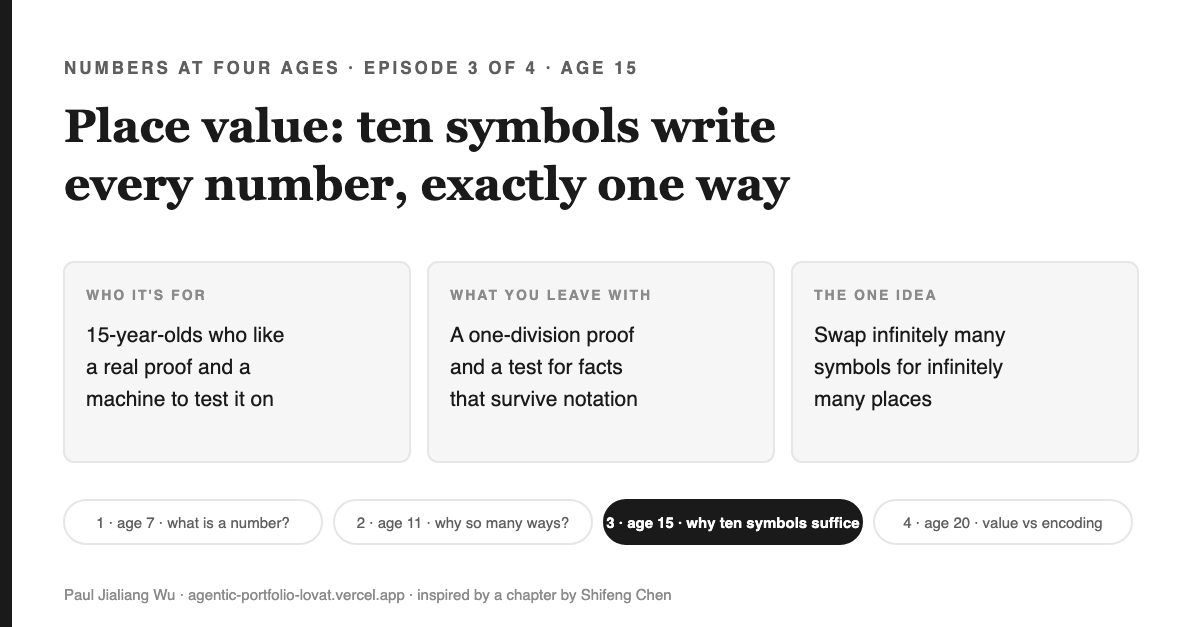
1-minute takeaway
What this is. A guided proof-and-play article for 15-year-olds. Place value gets unlimited numbers out of ten symbols by letting position carry value. Each number has exactly one spelling in any base, and you can even drop zero and still write every positive number.
Why it matters. The same idea runs every odometer, clock, computer and spreadsheet. The invariance test (change the base and see what survives) is the first tool for telling a fact about the world from a fact about how we write it down.
What you can do after reading. Prove uniqueness with one division, run the carry machine in base 3 and zero-free mode, sort ten sentences with the N-or-R test, then teach an 11-year-old to invent a number system.
Numbers at Four Ages — the series spine
▶ See it running: open the live demo public · no sign-in
- Age 7 · What is a number? episode 1
- Age 11 · Why so many ways to write numbers? episode 2
- Age 15 · Ten symbols, every number this episode
- Age 20 · Number vs representation episode 4
The one question: How can ten symbols write every number there is, exactly one way each?
This episode does NOT cover how computers store numbers, or why the difference between a number and its representation matters in code; that is episode 4 (age 20).
What this episode is about: place value
This is a proof-and-play article about place value, the idea that lets ten symbols write every whole number there is. It is for readers of about fifteen who like a real argument and a machine to test it on. You need paper, both hands, and a browser.
It is episode 3 of four. Episode 1 showed a 7-year-old that a number is not its name. Episode 2 let an 11-year-old invent number systems and watch place value win. This episode asks why it wins: how can ten symbols write every number, and why does each number get exactly one spelling? The ideas follow a chapter by 陈诗峰 (Shifeng Chen), co-author of this series, whose key sentence is worth learning by heart: place value turns the infinity of symbols into an infinity of places.
The series runs on one picture from the kitchen, climbing a ladder. Episode 1 was eggs in a bowl at home and episode 2 a busy restaurant. Here we run the stockroom of a fast-food chain. Napkins come in packs of 10, packs ship in boxes of 10, and boxes stack on pallets of 10. When the shelf says 3 pallets, 0 boxes and 5 packs, the manager writes 305. The 0 is not "nothing". It is an empty slot on the shelf that must not be skipped. A manager who writes 35 instead of 305 has just made 270 packs of napkins vanish. Accounting will call it theft. Mathematics calls it a missing placeholder.
Before you start. When you finish, you will coach an 11-year-old through inventing their own number system, and then show them why 105 needs its 0. Read with that conversation in mind: studying with the expectation of teaching is what makes the teaching pay off. Across 39 studies, teaching after studying to teach scored g = 0.48, and teaching without that expectation scored g = −0.02 (Kobayashi (2024), Educational Psychology Review (ERIC EJ1414484)).
Activity 1 · The two-hand counter (invent it before you read the rule)
Hold up your right hand with no fingers raised. That is zero. Raise one finger for each tap on the table: one, two, three, four.
Now the fifth tap. You have no fifth finger left on that hand if the thumb stays down. Invent a rule using your left hand so you can keep counting without losing anything.
Count to 13 with your rule. Then write down what your two hands look like at 13, as two digits.
Last, add 8 and 9 on your hands. Write the answer in your two-digit way before reading on.
If you folded the right hand back to zero and raised one finger on the left, you invented base 5 and its carry rule. Each finger on the left hand is worth a whole right hand: five. Thirteen is two fives and three ones, written 23 in base 5. And 8 + 9 = 17, which is three fives and two ones: 32 in base 5. The rule you used ("when a place fills, empty it and carry one to the left") is the one Chen states for every base: when you reach N, carry one.
How place value works
Write a number as a row of digits. Give each place a value: 1, then N, then N times N, then N times N times N, as far left as you need. A digit says how many of that place's value you have. That is place value. When the place values are the powers of one number N, and the digits run from 0 to N − 1, it is called base N.
In base ten: 555 = 5 × 100 + 5 × 10 + 5 × 1. Three identical symbols, three different values. The only thing that changed is the place.
Why does carrying happen at N? The largest digit is N − 1. Add one more and you have N, which is exactly one of the next place, written 10. So in base N, (N − 1) + 1 = 10. Chen puts it as a rule children can chant: when you reach N, carry one. In base ten it is the 9 + 1 = 10 you learned in first grade. In base 5 it is 4 + 1 = 10. Your left hand was doing it.
How long does a number get? In base b, a positive number n needs 1 + ⌊log_b n⌋ digits (1 + ⌊log_b n⌋, Weisstein, MathWorld, "Digit"). Tally marks need n marks. So one million takes a million tally marks but only seven base-ten digits: each extra digit lets you go ten times bigger. That is what the stockroom is doing when it packs napkins into boxes and boxes onto pallets.
The proof: every number has exactly one spelling
Additive systems let you write 27 as 10 + 10 + 5 + 1 + 1 or as 10 + 5 + 5 + 5 + 1 + 1. Place value never does that. Here is Chen's proof, in one division.
Take any whole number a and write it in base ten with digits a_n … a_1 a_0, so a = a_n × 10^n + … + a_1 × 10 + a_0.
- Every term except the last is a multiple of 10, and a_0 is between 0 and 9. So when you divide a by 10, the remainder is a_0, the last digit.
- When you divide a whole number by 10, the quotient and the remainder are completely fixed: there is only one possible answer. So a_0 is forced. Nobody gets to choose it.
- Take away a_0 and divide by 10. The quotient is a_n × 10^(n−1) + … + a_1, a smaller number. Its last digit, a_1, is forced the same way.
- Repeat until nothing is left. Every digit was forced. So there is exactly one way to write a, as long as we agree never to write leading zeros (0352 is not a second spelling of 352; it is 352 wearing a hat). Nobody chose the digits: not you, not your teacher, not the Ministry of Education.
Try it on 352: 352 ÷ 10 = 35 remainder 2. Then 35 ÷ 10 = 3 remainder 5. Then 3 ÷ 10 = 0 remainder 3. Read the remainders backwards: 352. Ten symbols write every whole number exactly one way, because a position multiplies. The same steps with 3 instead of 10 give 352 in base 3: the remainders are 1, 0, 0, 1, 1, 1, so 352 is 111001 in base 3 (check: 243 + 81 + 27 + 1 = 352).
A bonus from the same idea: with no leading zeros, a number with more digits is always bigger, and two numbers of the same length compare digit by digit from the left. That is why you can see at a glance that 1,000 beats 999.
Zero holds a place, and you can do without it
In 105 the middle place has no tens. Skip it and you get 15, a different number. So in place value, a place cannot vanish just because it is empty. Zero's first job is to hold it.
Now Chen's twist. Is zero required for place value? Try base ten with digits 1 to 9 plus a new digit κ for ten, and no 0 at all. Places are still worth 1, 10, 100 and so on. Then:
- 15 is still 15.
- 100 = 9 × 10 + κ, so it is written 9κ.
- 105 = κ × 10 + 5, written κ5.
- 3020 is 2κ1κ: 2 × 1000 + κ × 100 + 1 × 10 + κ.
- One million is 99999κ, which looks like a typo and is in fact perfectly correct.
Every positive whole number still has exactly one spelling. The proof is the same, with one change: the last digit is the remainder on dividing by 10, except that a remainder of 0 is written κ. Mathematicians call this zero-free system bijective numeration, and it is in your spreadsheet: column labels A to Z, then AA, AB… are zero-free base 26. So history did not pick zero because place value needs it. Chen saves the real reason for later: zero is a number with useful properties of its own, and it makes adding, subtracting, multiplying and dividing simpler.
Activity 2 · Drive the carry machine
Open part 3 of the Number Playground, the carrying machine.
Set the base to 5. Press +1 until you reach 13. Does the machine show 23, the number your hands made?
Set the base to 3. Count to 11. Watch two places carry at once.
Now switch on zero-free mode at base ten. Count from 8 to 21. Where does κ appear, and what never appears?
Last, go to part 2 and type 3020. Find the zero-free row. Did you predict 2κ1κ?
The test that separates the number from its spelling
Chen's sharpest tool is a test. Change the base. If a statement is still true, it is about the number. If it breaks, it was only about how the number is written. It settles cases that look obvious and aren't:
- "Every even number ends in 0, 2, 4, 6 or 8." In base 3, four is 11. It ends in 1 and is still even. So this is a fact about base ten, not about evenness.
- "7 + 8 = 15." The fact that seven and eight make fifteen survives any base. The string "15" does not: in base 3 the same fact reads 21 + 22 = 120.
- "If the digits add up to a multiple of 3, the number is divisible by 3." Being divisible by 3 is about the number. The digit-sum shortcut is about the base. In base b it works exactly for the divisors of b − 1 (Weisstein, MathWorld, "Divisibility Tests"), so in base ten it works for 3 and 9 because 10 − 1 = 9. In base 3 it fails: thirteen is 111, its digits add to 3, and 13 is not divisible by 3.
Play all ten sentences in part 4 of the Playground and argue about the two border cases.
Does a number have a body? A map, and where it breaks
There is a way of looking at this that the series owes to Paul's "play-engineering" notes. A body has a spirit that makes it one person, bones that hold it up, flesh that does the work, and skin that meets the world. Does a number system have the same parts? Treat it as a hypothesis to test, not a fact.
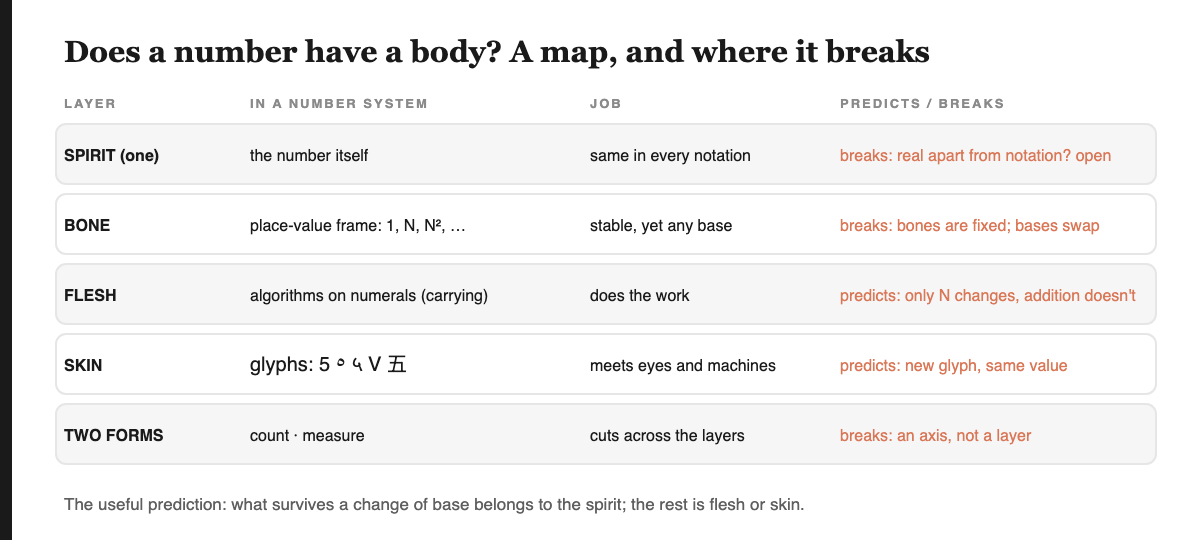
- Spirit: the number itself. It is the same in every notation. Two piles have the same number exactly when they pair up one to one: mathematicians call this Hume's Principle (Zalta, Stanford Encyclopedia of Philosophy, "Frege's Theorem and Foundations for Arithmetic").
- Bone: the place-value frame, with places worth 1, N, N², … It is stable, because the proof above makes every spelling unique. It is flexible, because any base works, even a zero-free one.
- Flesh: the algorithms on numerals, such as carrying, comparing and digit tests. They do the work.
- Skin: the glyphs. 5, ٥, ५, Ⅴ and 五 all carry the numeric value 5 in the Unicode standard computers use (Unicode Character Database (UnicodeData.txt) and Unihan (U+4E94)).
The map earns its place by predicting something. What survives a change of base belongs to the spirit; what does not is flesh or skin. So addition is spirit and carrying is flesh. The carry rule is one rule with N in it ("when you reach N, carry one"); change the base and only the N changes, while addition itself never changes. It also sorts both of Chen's border cases above, without memorizing anything.
Where it breaks:
- A body's bones are fixed, but you can swap a number's base and keep its spirit. The map is a lens, not an anatomy.
- "Two forms" (counting things one by one versus measuring a length that flows) is not a layer. It cuts across all of them. Aristotle split quantity this way: "Quantity is either discrete or continuous." (Aristotle, Categories, Part 6, tr. E. M. Edghill (MIT Internet Classics Archive)). Every number in this episode is a count.
- Is the spirit real on its own? Would five exist if nobody had ever written anything? Some philosophers say yes: on that view numbers exist, are abstract, and do not depend on minds (Linnebo, Stanford Encyclopedia of Philosophy, "Platonism in the Philosophy of Mathematics"). Others say there is no abstract five at all, only collections and the marks we use for them (Bueno, Stanford Encyclopedia of Philosophy, "Nominalism in the Philosophy of Mathematics"). This is an open question. Nobody can settle it for you, and that is worth knowing at fifteen.
Common mistakes that are half right
- "More digits means bigger." True only without leading zeros: 007 has three digits and is smaller than 10. The idea is right; the condition was missing.
- "Zero means nothing." Half right. Zero is the number of an empty pile, but in 105 it is also a placeholder that says "this place exists and is empty". A child who only knows the first meaning reads 206 as 26.
- "The digit-sum rule shows something deep about 3." It shows something about 10. Change the base and it moves to other divisors.
Now teach it
Your teach-back. Find an 11-year-old and run Activity 2 of episode 2 with them: they invent their own number system and write 276 in it. Don't correct it. Then race it together in the Playground and let them find out where it loses. Finish by asking them to write one hundred and five without a zero, and to tell you what goes wrong.
Outcome: the 11-year-old explains in their own words why 105 needs the 0, and you can show them the two-hand counter carrying at five. Post their age and their explanation as a comment on this article.
Why it works: five whys
The problem: a student can add 478 + 365 in columns perfectly, but cannot add in base 5, or explain what "carry the one" means.
- Why can't they add in base 5? They learned "carry the one when you pass 9" as a fact about the digit 9. It is really a fact about the place filling up.
- Why learn it as a fact about 9? Because they only ever saw base ten, so the carry rule (flesh) and the place-value frame (bone) looked like one thing.
- Why does that matter? A rule tied to one representation breaks the moment the representation changes: the digit-sum shortcut works for divisors of b − 1 in base b, and fails elsewhere (Weisstein, MathWorld, "Divisibility Tests").
- What would separate them? Changing the base. Inventing base 5 on two hands, before reading the rule, shows the carry as "the place is full", which is the same in every base (Schwartz & Martin (2004), "Inventing to Prepare for Future Learning", Cognition and Instruction 22).
- Root cause: we teach the algorithm (flesh) without the frame (bone), and the frame without the number it serves (spirit). The fix is this episode's order: invent a base, see the frame, prove uniqueness, then test every rule by changing the base.
Operate: run it in an evening
- Read the teach-ahead line.
- Build the two-hand counter and add 8 + 9 in base 5 (10 minutes).
- Work the proof on 352 in base 10 and base 3 by hand (15 minutes).
- Drive the carry machine in base 5, base 3 and zero-free mode (10 minutes).
- Sort the ten N-or-R sentences, then teach an 11-year-old.
Feedback: how you know it worked
You can do these three things without notes:
- Write 100 in base 5 and in zero-free base ten. The answers are 400 and 9κ.
- Explain in two sentences why the last digit of a number is forced.
- Say whether "an even number's last digit is even" is about the number or the notation, and prove it with a base-3 example.
Repeat them a week later. Testing beat restudying for memory at 1 week (Roediger & Karpicke (2006), "Test-Enhanced Learning", Psychological Science 17). What this cannot measure: whether you will spot a notation-only "fact" in the wild. Episode 4 is about where that bites in code.
Feedforward: tripwires, decided now
- If you cannot do the base-3 version of the proof, redo the two-hand counter with three fingers per hand before touching the algebra.
- If zero-free base ten feels like a trick, convert 20 and 30 by hand (1κ and 2κ) before using the machine.
- If the 11-year-old's invented system is better than you expected, let it win a round. The goal is that they meet the problem place value solves, not that they lose.
Truth, love and beauty in this episode
- Truth: you can check every claim: the proof by remainders on any number you like, and every border case by changing the base.
- Love: the half-right mistakes are taken seriously, and you finish by coaching someone younger at their pace, not yours.
- Beauty: the infinity of symbols became an infinity of places. Ten symbols will be enough for every number anyone will ever write. (Episode 1's egg is now on a pallet: 3 pallets, 0 boxes, 5 packs. It still counts as one.)
The 5S self-score
| S | Claim | Evidence |
|---|---|---|
| Simple | The prose reads at a grade-10 level or easier. | Flesch–Kincaid grade of the prose: 5.8 (band ≤ 10), recomputed by node scripts/check-numbers-four-ages.mjs |
| Solid | The proof is complete; the digit formula and the divisibility rule are sourced. | Digits: 1 + ⌊log_b n⌋ (MathWorld); divisibility tests |
| Sharp | Addition belongs to the number; carrying belongs to the numeral. The base-change test sorts any rule. | The anatomy map and the invariance test |
| SMART | One evening; success is the three feedback tasks done without notes, repeated after a week. | Feedback · carry machine |
| Surprise | Zero is not needed for place value: one million is 99999κ, and your spreadsheet already counts that way. | Zero-free base ten |
| Truth · Love · Beauty | Checkable proof; half-right mistakes; symbols turned into places. | Truth, love and beauty |
Sources
- 陈诗峰 (Shifeng Chen), draft chapter 《第一章 数和数的表示形式》 ("Numbers and Their Representations"), 2026. Read the original chapter (PDF, Chinese). Co-author of this series.
- Weisstein, E. W. "Digit." MathWorld. mathworld.wolfram.com
- Weisstein, E. W. "Divisibility Tests." MathWorld. mathworld.wolfram.com
- Microsoft. "Excel specifications and limits." support.microsoft.com
- Zalta, E. N. "Frege's Theorem and Foundations for Arithmetic." Stanford Encyclopedia of Philosophy. plato.stanford.edu
- Aristotle. Categories, Part 6, tr. E. M. Edghill. MIT Internet Classics Archive. classics.mit.edu
- Linnebo, Ø. "Platonism in the Philosophy of Mathematics." Stanford Encyclopedia of Philosophy. plato.stanford.edu
- Bueno, O. "Nominalism in the Philosophy of Mathematics." Stanford Encyclopedia of Philosophy. plato.stanford.edu
- Unicode Character Database, UnicodeData.txt. unicode.org
- Schwartz, D. L. & Martin, T. (2004). Inventing to prepare for future learning. Cognition and Instruction 22. doi:10.1207/s1532690xci2202_1
- Kobayashi, K. (2024). Interactive learning effects of preparing to teach and teaching. Educational Psychology Review. ERIC EJ1414484
- Roediger, H. L. & Karpicke, J. D. (2006). Test-enhanced learning. Psychological Science 17. doi:10.1111/j.1467-9280.2006.01693.x