AI-NATIVE SERIES · NUMBERS AT FOUR AGES, EPISODE 1 OF 4 · AGE 7
What Is a Number? Five Apples, Five Stones and One Five (a Play Script for Age 7)
1-minute takeaway
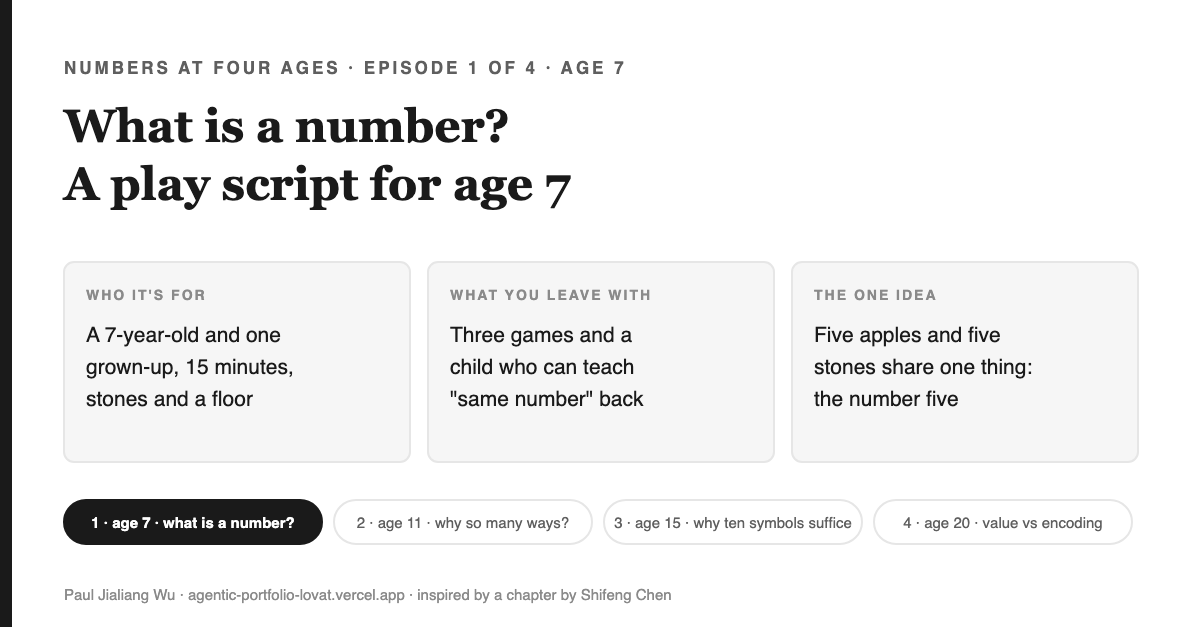
What this is. A play script for one child of about 7 and one grown-up. Through matching, clapping and jumping, the child discovers that five apples and five stones share something, the number five, and that "5", "five" and five tally marks are only names for it.
Why it matters. Most children learn to say and write "5" long before they know what it names. The grown-up gets a 15-minute game that builds the idea underneath every later math lesson, and learns which mistakes are actually half-right.
What you can do after reading. Play the three games tonight with things you already have, then let the child teach the matching game back to you. You play the student who keeps getting it wrong.
Numbers at Four Ages — the series spine
▶ See it running: open the live demo public · no sign-in
- Age 7 · What is a number? this episode
- Age 11 · Why so many ways to write numbers? episode 2
- Age 15 · Ten symbols, every number episode 3
- Age 20 · Number vs representation episode 4
The one question: What is a number, if it isn't the squiggle "5"?
This episode does NOT explain why we write numbers with digits and places; that is episode 2 (age 11).
What this episode is about: what a number is
This is a play script about what a number is, for one child of about seven and one grown-up. It takes 15 minutes and needs a handful of stones (or buttons, or dry beans), a few spoons, and a bit of floor. The grown-up reads the boxed parts aloud. The child does the moving.
It is episode 1 of four. Each episode tells the same idea to an older reader: 7, 11, 15, then 20. The idea comes from a chapter by the mathematician-teacher 陈诗峰 (Shifeng Chen), who co-wrote this series: a number is what equal piles share, and "5" is only its name. Children learn to say and write "5" long before they know what it names. This script builds the thing underneath.
Before you start, say this to the child: "Today you learn a secret. At the end, you will be the teacher and I will be the student." Saying it first matters. A review of 39 studies found that teaching helps learning when people expected to teach while they learned (an effect size of g = 0.48, a medium effect), and made no difference when they did not (g = −0.02) (Kobayashi (2024), Educational Psychology Review (ERIC EJ1414484)). Most of those studies were of older students, so with a seven-year-old treat it as a good bet, not a promise.
One picture carries the whole series, and it comes from the kitchen: we start where every cook starts, putting eggs into a bowl for the family. Later episodes climb the kitchen ladder to a restaurant, a fast-food chain and a national food supply chain. The numbers get bigger; the idea stays the same.
Game 1 · Partners (no counting allowed)
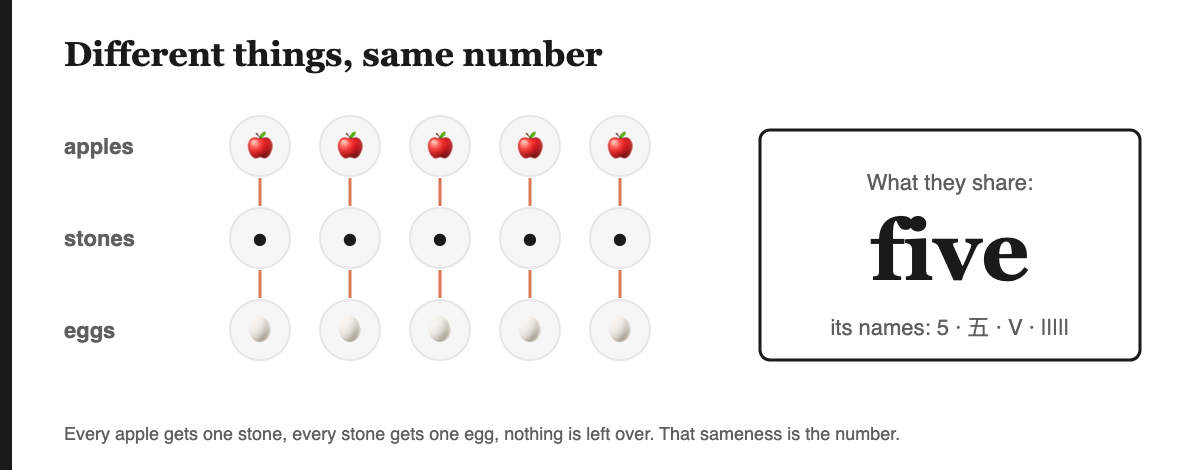
Set-up: put five stones and five spoons in a messy heap on the table. Don't say how many there are. The game only works if the child has to find out.
Here are some stones. Here are some spoons.
Are there as many stones as spoons? Here is the rule. You may not count. Not one, not two. No counting at all! (If you count, the spoons win. Spoons love winning.)
How can you find out? Try it. Think. Move them.
Did you give each spoon one stone? Good. That is the trick.
Look. Every spoon has a stone. Is a stone left? Is a spoon left? No? Then they are the same. Same number!
Now take one spoon away. Is a stone left now? Yes. So there are more stones.
Here is the big secret. Same number means every one gets a partner and nobody is left over.
Can an egg be a partner? Yes! An egg can't count. But an egg can hold hands with a stone. That is all we need.
What just happened. The child found "same number" without numbers. That pairing, one thing to one thing with nothing left over, is how mathematicians define "the same number": Frege's version is called Hume's Principle, two collections have the same number exactly when there is a one-to-one correspondence between them (Zalta, Stanford Encyclopedia of Philosophy, "Frege's Theorem and Foundations for Arithmetic"). It is also the first of the counting principles children build: one-to-one, stable order, cardinality (Gelman & Gallistel (1978), summarised by Emmerton (Tufts)). Let the child invent the pairing. If they are stuck after a minute, put one stone in one spoon and wait. Children often find the symbols and ways they invent more meaningful than the ones they are taught (Hughes (1986), Children and Number, Blackwell (publisher description)).
Game 2 · Five claps, five jumps
Put five stones in a row. Now clap once for each stone. Clap, clap, clap, clap, clap!
Now jump once for each stone. Jump, jump, jump, jump, jump! (The stones do not jump. Stones are lazy.)
Hold up one finger for each stone. Look at your hand. A whole hand!
Stones are not claps. Claps are not jumps. Jumps are not fingers. They are all so different!
But they have one thing the same. Can you say what it is?
Yes. They are all five. Five is not a stone. Five is not a clap. Five is the same thing in all of them.
Why the body. A stone, a clap, a jump and a finger have nothing in common except the number, so the number is the only thing left to notice. This is Chen's opening move: apples, stones and eggs, three unlike piles that share one quantity. The body is not decoration. Third and fourth graders who were taught to make the gestures themselves kept 85% of their gains four weeks later, against 33% for those taught with speech alone (Cook, Mitchell & Goldin-Meadow (2008), Cognition 106(2)). First graders who walked a number line on the floor beat a group doing the same task without walking (Link, Moeller, Huber, Fischer & Nuerk (2013), Trends in Neuroscience and Education 2(2)). Finger awareness in first grade predicts number skill 15 months later (Noël (2005), Child Neuropsychology 11(5)). Use plain stones, not toy pizza: plain objects taught better than realistic ones (d = 0.77 against 0.28, Carbonneau, Marley & Selig (2013), Journal of Educational Psychology 105(2)).
The empty bowl
Look at this bowl for eggs. It has no eggs in it. Look at this plate. It has no stones. Draw them both!
Can we make partners? There is no one to pair! Nothing is left over.
So the bowl and the plate have the same number. That number is zero. Zero is a number too!
Zero is the number of an empty pile. Notice that the tally-mark name for zero is a blank, and a blank is easy to misread ("did you write nothing, or not answer?"). Chen points this out, and it is one reason people later invented a symbol for zero. Next, the names. The story of the zero symbol is episode 2.
Game 3 · Many names for one five
I will write five on cards. Look: 5. five. 五. V. And this one: ||||| .
Which card is the real five? Point to it!
Here is the secret. None of them is the real five. They are all names for it.
You have a name. Your name is on your cup. But your name is not you. If I call you a pet name, you are still you!
Five is like that. People call it 5. They call it five. In China they write 五. Long ago in Rome they wrote V.
The names are not the same. The five is the same.
The one idea of the whole series. The symbol is not the number, the way a person's name is not the person. That sentence is Chen's, and it is the seed of everything in episodes 2 to 4: number systems, place value, and how computers store values. Want to see five names at once, and a lot more? Open the Number Playground, a free page that works on a phone. Its first game, "Match them up", is Game 1 on a screen: add apples and stones and it tells you whether anything is left over.
Now you are the teacher
Now you are the teacher. I am the student. I am a silly student!
Teach me Partners. Then I will make a mistake. Catch me!
The grown-up's job: be wrong on purpose. Set out two rows of five stones, side by side, partnered. Then spread one row out so it looks longer and say: "This row has more, because it is longer!" Let the child correct you. If they agree with you, don't correct them. Push the spread row back together and ask again, then spread it once more. Most children cannot pass this kind of test at four or five, and most can by ages 6–8 (Wikipedia, "Conservation (psychology)" (on Piaget's number-conservation task)); a child who catches you is reasoning from the pairing, not from the look. Then switch: the child sets a trap for you.
Outcome: the child corrects you by pairing ("each one has a partner"), not by how long the rows look, and can point at 5, 五 and ||||| and say they are names for one five. Tell us how it went: post the child's age and whether they caught you as a comment on this article.
Who teaches next? This child is the first rung. An 11-year-old in the family can run these three games with a younger child as their teach-back from episode 2.
Why it works: five whys
The problem: a child can say and write "5", yet thinks a spread-out row of five stones has "more" than a bunched row.
- Why does the child say the long row has more? They are judging by how the row looks (its length), not by pairing. In classic number-conservation tasks most children manage it by ages 6–8 (Wikipedia, "Conservation (psychology)" (on Piaget's number-conservation task)).
- Why judge by looks? Because the counting words were learned first, as a chant, before the idea they name. Counting is really three principles at once: one-to-one, stable order, cardinality (Gelman & Gallistel (1978), summarised by Emmerton (Tufts)). Saying the chant is not the same as having the principles.
- Why were the words learned first? Words and written symbols are easy to show and easy to test, so teaching starts there. The idea underneath, one-to-one pairing, does not fit on a worksheet.
- Why doesn't the idea fit on paper? Because pairing is something you do: move a stone, touch a spoon, clap once per thing. Gesture and movement make that kind of learning last (Cook, Mitchell & Goldin-Meadow (2008), Cognition 106(2), Link, Moeller, Huber, Fischer & Nuerk (2013), Trends in Neuroscience and Education 2(2)).
- Root cause: we teach the name before the number. The fix is the order of this script: body first (pairing, claps, jumps), then the picture (the empty bowl), then the names (5, five, 五, V, |||||). That order is Chen's chapter, and it is Bruner's enactive → iconic → symbolic sequence behind Singapore's concrete–pictorial–abstract method.
Operate: run it tonight
The game runs with what is on the kitchen table. Three steps, 15 minutes:
- Say the teaching line first: "At the end, you will be the teacher."
- Play Partners, Five claps, and Many names, in that order. The child moves, you read the boxes.
- Swap roles: the child teaches you Partners, and you make the spread-row mistake.
The online version is Game 1 of the Number Playground, for a rainy day or a second round.
Feedback: how you know it worked
It worked if, without counting, the child says the spread-out row and the bunched row are the same number, and explains it with pairing ("each one has a partner"). It also worked if they can point at 5, 五 and ||||| and say "those are all names for five".
What this test cannot see: whether the idea lasts. Check again in a week with a new pair of things (socks and shoes). Being tested later strengthens memory more than going over it again: testing beat restudying at 1 week (Roediger & Karpicke (2006), "Test-Enhanced Learning", Psychological Science 17).
Feedforward: tripwires, decided now
- If the child counts instead of pairing, praise the count, then ask: "Now show me without numbers." Counting is not wrong; it is a different tool.
- If the child still says the longer row has more, stop and play again another day. Don't explain it to them. The idea arrives through the hands, not the ears.
- If the child is bored before Game 3, end the session and do the role swap now. The teach-back matters more than finishing the list.
Truth, love and beauty in this script
- Truth: the child can check "same number" for themselves, by pairing. Nobody has to take the grown-up's word for it.
- Love: two people, one game. The grown-up plays the student and is wrong on purpose so the child can be right. A child's mistake (the long row has more) is half right: they are noticing something real, length, just not the thing that counts.
- Beauty: five is not in any one pile. It is in all of them at once: the stones, the claps, the jumps, your hand.
The 5S self-score
| S | Claim | Evidence |
|---|---|---|
| Simple | The read-aloud parts are at a first-to-third-grade reading level or easier. | Flesch–Kincaid grade of the boxed text: -0.9 (band ≤ 3; below zero means easier than first grade), recomputed by node scripts/check-numbers-four-ages.mjs |
| Solid | Every research number comes from a checked source. | Gesture kept 85% of gains (Cook et al. 2008); all numbers are re-checked against content/series/numbers-four-ages/evidence.yml |
| Sharp | The insight: "same number" is defined by pairing, not counting, which is the mathematicians' own definition. | Hume's Principle (SEP) |
| SMART | 15 minutes tonight; success means the spread-row test passed without counting; recheck in a week. | Feedback section · Playground Game 1 |
| Surprise | The grown-up loses on purpose, and the child wins by catching them. | Now you are the teacher |
| Truth · Love · Beauty | Checkable by the child; written for two people; one wonder sentence. | Truth, love and beauty in this script |
Sources
- 陈诗峰 (Shifeng Chen), draft chapter 《第一章 数和数的表示形式》 ("Numbers and Their Representations"), 2026. Read the original chapter (PDF, Chinese). Co-author of this series.
- Zalta, E. N. "Frege's Theorem and Foundations for Arithmetic." Stanford Encyclopedia of Philosophy. plato.stanford.edu
- Gelman, R. & Gallistel, C. R. (1978). The Child's Understanding of Number. Summary: Tufts Avian Visual Cognition
- Cook, S. W., Mitchell, Z. & Goldin-Meadow, S. (2008). Gesturing makes learning last. Cognition 106(2). PMC2265003
- Link, T., Moeller, K., Huber, S., Fischer, U. & Nuerk, H.-C. (2013). Walk the number line. Trends in Neuroscience and Education 2(2). KOPS
- Noël, M.-P. (2005). Finger gnosia: a predictor of numerical abilities in children? Child Neuropsychology 11(5). UCLouvain
- Carbonneau, K. J., Marley, S. C. & Selig, J. P. (2013). A meta-analysis of the efficacy of teaching mathematics with concrete manipulatives. Journal of Educational Psychology 105(2). doi:10.1037/a0031084
- Kobayashi, K. (2024). Interactive learning effects of preparing to teach and teaching: a meta-analytic approach. Educational Psychology Review. ERIC EJ1414484
- Hughes, M. (1986). Children and Number. Blackwell. Wiley
- Roediger, H. L. & Karpicke, J. D. (2006). Test-enhanced learning. Psychological Science 17. doi:10.1111/j.1467-9280.2006.01693.x