AI-NATIVE SERIES · NUMBERS AT FOUR AGES, EPISODE 2 OF 4 · AGE 11
Number Systems: Why People Kept Inventing New Ways to Write the Same Numbers (for Age 11)
1-minute takeaway
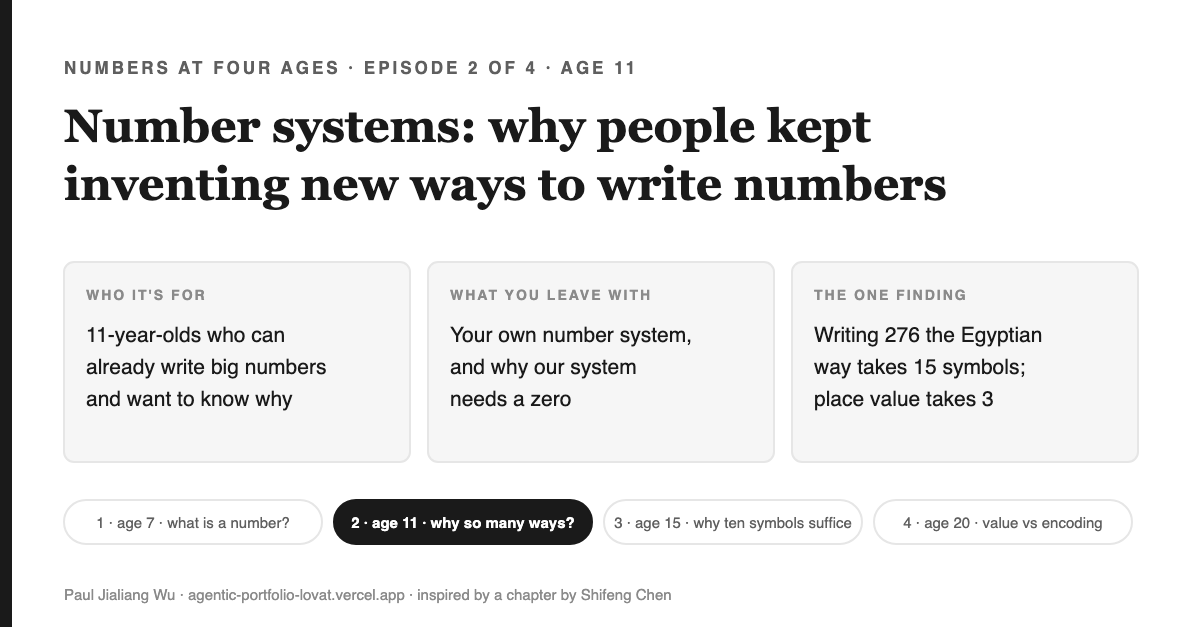
What this is. An activity article for 11-year-olds. You invent your own way to write numbers, then follow humans from tally marks to place value, and see that each new way of writing fixed the last one's biggest problem.
Why it matters. In one study only half of 4th graders could say what the 1 in 16 stands for. This article builds that missing idea, that a digit's place changes its value, by letting the reader reinvent it.
What you can do after reading. Invent a number system, use the Number Playground to race it against base ten, then teach the age-7 matching game to a younger child and explain why five apples and "5" are not the same thing.
Numbers at Four Ages — the series spine
▶ See it running: open the live demo public · no sign-in
- Age 7 · What is a number? episode 1
- Age 11 · Why so many ways to write numbers? this episode
- Age 15 · Ten symbols, every number episode 3
- Age 20 · Number vs representation episode 4
The one question: Why did people keep inventing new ways to write the same numbers?
This episode does NOT prove why ten digits are always enough, or why each number has exactly one way to be written; that is episode 3 (age 15).
What this episode is about: number systems
This is an activity article about number systems: the different ways people have written down numbers, and why they kept inventing new ones. It is written for readers of about eleven, with a grown-up nearby for the activities. You need paper, a pencil, a partner, and a phone or laptop for one part.
It is episode 2 of four. Each episode tells the same idea to an older reader. Episode 1 showed a 7-year-old that a number is what equal piles share, and "5" is only its name. This episode asks the next question: if "5", "五", "V" and "|||||" are all names for one number, why do we have so many names, and why did one way of writing win? The ideas follow a chapter by 陈诗峰 (Shifeng Chen), co-author of this series.
One picture carries the series. It comes from the kitchen, and it climbs a ladder: episode 1 put eggs in a bowl at home. This episode works in a busy restaurant, where orders must be counted fast and money must be counted right.
Read this first. At the end of this article, you will teach a younger child the three games from episode 1, and explain why five apples and the squiggle "5" are not the same thing. Keep that in mind while you read: people who learn something expecting to teach it remember it better (Nestojko, Bui, Kornell & Bjork (2014), Memory & Cognition 42).
Activity 1 · The order race
You work in a dumpling restaurant. Your partner is the waiter. For one minute, the waiter calls out "One order!" again and again, as fast or as slow as they like.
Your job is to keep count on paper. Make one mark for each order: | | | |.
When the minute is up, how many orders were there? Count your marks. How long did that take?
Now swap jobs. This time, the counter groups the marks in fives. Draw four lines and then cross them with a fifth. Or use the Chinese way: build the character 正 one stroke at a time. It has five strokes.
Count again. Which was faster to read at the end?
(A waiter who shouts "One order!" forty times in one minute is either very good at the job or very bad at it. Either way, you need a better way to count.)
Activity 2 · Invent your own number system
Now you are the inventor. Make up your own way to write numbers. You can draw any symbols you like: stars, dots, little dumplings, letters.
There is one rule. Someone else must be able to read your number and know exactly how many.
Write these two numbers in your system: 276, and one million.
Count how many symbols each one needs. Write the count down. Keep your paper. You will need it later.
Why people kept inventing new ways
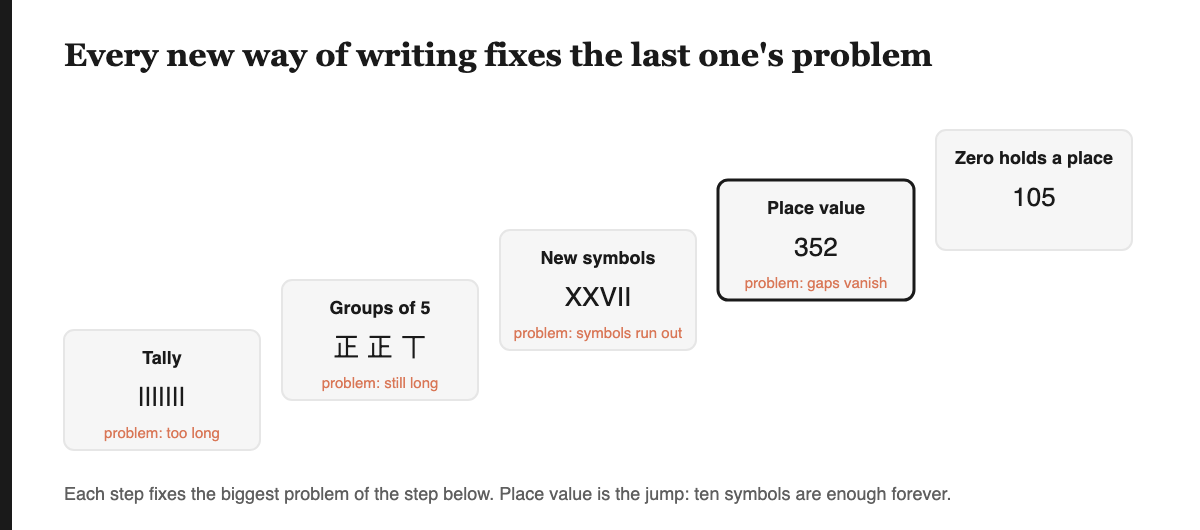
Here is the story your invention just walked through. Every way of writing numbers fixed the biggest problem of the one before it. People kept inventing shorter ways to write the same numbers, and place value won.
Step 1: tally marks. One mark for each thing. It is the simplest number system there is, and it is great for counting live: you just add a mark, and you never have to rub anything out. That is why restaurants and elections still use it. But big numbers get very long, and 99 marks look almost the same as 100.
Step 2: groups. Grouping marks in fives (four lines and a cross, or the five strokes of 正) makes them easier to read. Your eye can take in a small group at a glance without counting it. But it is still one stroke per thing.
Why does grouping work so well? The psychologist George Miller explained it in 1956. Your short-term memory holds only a few "chunks", but you can pack more into each chunk. He described recoding "18 binary digits into a sequence of 6 octal" digits: six chunks to hold instead of eighteen (Miller (1956), "The magical number seven, plus or minus two", Psychological Review 63). That is what a 正 does to tally marks, and what every later number system does even better: it packs more number into each thing your eye has to hold.
Step 3: new symbols for groups. Why draw five marks when one new symbol can stand for five? The Romans wrote V for five, X for ten, L for fifty and C for a hundred. You find the value mostly by adding: XXVII is 10 + 10 + 5 + 1 + 1 = 27. (A small symbol written before a bigger one subtracts, as in IV = 4. That trick was used alongside IIII for a long time and became a fixed school rule only later.) Try ordering 3,888 dumplings in Roman numerals: MMMDCCCLXXXVIII. That is fifteen symbols. It is not an order any more. It is a spell. It is exactly like paying at the restaurant's cash drawer with notes of fixed sizes. The ancient Egyptians did the same with powers of ten. They had a stroke for 1, a cattle hobble for 10, a coil of rope for 100 and so on, up to a god with raised arms for a million (Wikipedia, "Egyptian numerals" (Gardiner sign V20)). Writing 276 their way takes 15 symbols (O'Connor & Robertson, MacTutor, "Egyptian numerals").
These systems have two problems, and Chen names both:
- The symbols run out. Bigger numbers need ever more new symbols. Nobody can remember an endless list.
- There is more than one way to write a number. In a pure adding system, 27 can be 10 + 10 + 5 + 1 + 1, or 10 + 5 + 5 + 5 + 1 + 1. The Romans needed extra rules (use the biggest symbols first) to stop that.
Step 4: place value. Here is the jump. Look at the 1 in 1, 10, 100 and 1000. It is the same symbol each time, but it means one, then ten, then a hundred, then a thousand. The place changes its value. So we only need ten symbols, 0 to 9, forever, because there are always more places to the left. Chen puts it beautifully: we swap the infinity of symbols for an infinity of places.
Step 5: zero holds a place. Try writing "one hundred and five" with place value. There is 1 hundred, no tens and 5 ones. If you just leave out the empty tens place, you get 15, which is a different number! (The customer who ordered 105 dumplings and got 15 is going to have questions.) So in our system the empty place needs a symbol of its own: the 0 in 105 means "this place is here, and it is empty". We call that a placeholder. (There is a clever system that manages without a zero at all. It is in episode 3.)
For the grown-up: who invented zero? No single person. Babylonian scribes, who counted in sixties, began marking an empty place about 400 BC, but only between digits, never at the end, so 1 and 60 could still look the same (O'Connor & Robertson, MacTutor, "A history of Zero"). The Indian mathematician Brahmagupta wrote rules for zero as a number in 628 (O'Connor & Robertson, MacTutor, "Brahmagupta"). The first dated Indian zero that everyone agrees is genuine is in an inscription at Gwalior from 876 (O'Connor & Robertson, MacTutor, "A history of Zero"). Fibonacci's book of 1202 brought place value and the ten digits to Europe (O'Connor & Robertson, MacTutor, "Fibonacci"). You may read that a birch-bark manuscript called the Bakhshali manuscript holds a far older zero. That headline came from a 2017 carbon date. A 2024 re-dating found that early date inaccurate and puts the manuscript's start at 799–892 CE (Chivall, Lladó-Buisán, Howell & Evison (2024), Radiocarbon dating of the Bakhshālī manuscript, ORAU/Bodleian). Dates in history move when the evidence moves.
Activity 3 · The race: your system against place value
Open the Number Playground on a phone or laptop. Type 276 in the box.
It shows 276 written nine ways: tally marks, 正, Roman, Egyptian, base ten, and more. Next to each one, it counts the symbols.
Now get your invention from Activity 2. How many symbols did your 276 need? Where does your system sit in the race?
Now type 1000000, one million. Look at the tally row. Look at base ten. Did your system beat seven symbols?
Try 105. Then imagine you had no zero. What would go wrong?
Most invented systems land in the middle: shorter than tally marks, longer than base ten. That is the point. You have just rediscovered why people moved from adding symbols up to letting the place carry value. Children often find the symbols they invent more meaningful than the ones they are given (Hughes (1986), Children and Number, Blackwell (publisher description)), and inventing before being told helps later learning (Schwartz & Martin (2004), "Inventing to Prepare for Future Learning", Cognition and Instruction 22).
Activity 4 · About the number, or about how it is written?
Some facts are about a number. Some facts are only about how we write it. Here is a test to tell them apart.
Imagine aliens with three fingers. They count in threes. They write four as 11, because it is one three and one more.
Now read each sentence. Ask: would it still be true for the aliens?
First sentence: eight is bigger than five. Is it still true for the aliens? Yes! Eight things beat five things for anyone. That fact is about the number.
Second sentence: every even number ends in 0, 2, 4, 6 or 8. The aliens write four as 11. It ends in 1, but four is still even. So that fact is only about how we write.
Play the full game in part 4 of the Number Playground. It has ten sentences. Two of them are tricky on purpose. Argue about them with someone!
This is Chen's sorting experiment, and it is the sharpest tool in the series. A fact that survives a change of notation is about the number; a fact that doesn't is about the representation. Episode 3 turns it into a proof.
Mistakes that are half right
Two common mistakes show what this article is building:
- Before school, many children write "six hundred forty-two" as 600402 (Byrge, Smith & Mix (2014), Child Development 85(2)). That is not careless. They have the right digits in the right order. They just write each part in full (600, 40, 2) instead of letting the place do the work.
- In one classic study, children were asked what the 1 in 16 stands for. Only 33% of third graders and 50% of fourth graders said "ten" (Kamii & Joseph (1988), as reviewed by Önal & Çilingir Altiner (2021), European Journal of Education Studies 8(4)). They could write 16. They had never had to invent the idea that the place gives the 1 its value.
If you just invented a number system and watched it race place value, you know what the 1 in 16 means.
Now teach it
Your teach-back. Find a younger child, about seven. Run the three games from episode 1 with them: Partners (no counting allowed), Five claps, and Many names. Then show them 5, five, 五, V and ||||| and ask: "Which one is the real five?" Help them find out that they are all names for one number.
Outcome: the younger child decides "same number" by pairing, without counting, and you can explain to a grown-up why your invented number system is longer or shorter than base ten. Post the younger child's age and what happened as a comment on this article.
Why it works: five whys
The problem: a child can write 16, yet does not know that the 1 means ten.
- Why don't they know what the 1 means? They learned "16" as one shape with one name, like a word, not as one ten and six ones. The data: only 50% of fourth graders could say it (Kamii & Joseph (1988), as reviewed by Önal & Çilingir Altiner (2021), European Journal of Education Studies 8(4)).
- Why learn it as a shape? Because place value was handed to them finished. They never met the problem it solves.
- What problem does it solve? Length and running out of symbols. Writing 276 the Egyptian way takes 15 symbols (O'Connor & Robertson, MacTutor, "Egyptian numerals"), and every bigger number needs new ones. Place value fixes both with ten symbols and the place.
- Why does meeting the problem help? Learners who invent first, then see the real method, learn more from it (Schwartz & Martin (2004), "Inventing to Prepare for Future Learning", Cognition and Instruction 22). Struggling with the messy version first helps transfer (Kapur (2008), "Productive Failure", Cognition and Instruction 26).
- Root cause: we teach the answer (place value) without the question (how do you write big numbers short?). The fix is this article's order: invent your own system, race it, and only then name place value and zero.
Operate: run it this week
- Read the teach-ahead line. You will be teaching at the end.
- Run the order race with a partner (5 minutes).
- Invent your own system and write 276 and one million (10 minutes).
- Race it in the Number Playground, then play its N-or-R game (10 minutes).
- Teach the episode 1 games to a younger child.
Feedback: how you know it worked
It worked if you can answer three questions without looking:
- What does the 1 in 16 stand for?
- Why does 105 need the 0?
- Is "every even number ends in 0, 2, 4, 6 or 8" about the number or about how we write it?
Answer them again a week later. Testing yourself later beats rereading: it won at 1 week (Roediger & Karpicke (2006), "Test-Enhanced Learning", Psychological Science 17). What this cannot measure: whether you can use place value in a new setting. That is episode 3's job.
Feedforward: tripwires, decided now
- If your invented system beats base ten on one million, check it with the rule: could someone else read it and know exactly how many? If it needs a new symbol for every size, you have invented an additive system. It will run out.
- If the younger child counts instead of pairing, don't stop them. Ask them to do it again without numbers.
- If the alien test feels confusing, use the Playground game first, then come back. The two tricky sentences are meant to start an argument.
Truth, love and beauty in this episode
- Truth: you checked the claim yourself, by racing your own invention against place value and counting symbols.
- Love: the mistakes here are half right. 600402 has the right digits in the right order. And you end by teaching someone younger, at their speed.
- Beauty: ten symbols are enough forever, because the places never run out.
The 5S self-score
| S | Claim | Evidence |
|---|---|---|
| Simple | The child-facing boxes are at a grade-6 reading level or easier. | Flesch–Kincaid grade of the boxes: 2.1 (band ≤ 6), recomputed by node scripts/check-numbers-four-ages.mjs |
| Solid | History and data come from checked sources, including the re-dated Bakhshali manuscript. | Egyptian 276 takes 15 symbols (MacTutor); 2024 re-dating |
| Sharp | Each number system fixes the last one's biggest problem; place value trades symbols for places. | The ladder and its figure |
| SMART | About 30 minutes this week; success is the three feedback questions answered unaided, then again a week later. | Feedback · Playground |
| Surprise | Your own invented system loses the race, and that is the lesson. | Activity 3 |
| Truth · Love · Beauty | Checked by racing; half-right mistakes; ten symbols forever. | Truth, love and beauty |
Sources
- 陈诗峰 (Shifeng Chen), draft chapter 《第一章 数和数的表示形式》 ("Numbers and Their Representations"), 2026. Read the original chapter (PDF, Chinese). Co-author of this series.
- O'Connor, J. J. & Robertson, E. F. "Egyptian numerals." MacTutor. mathshistory.st-andrews.ac.uk
- "Egyptian numerals" (Gardiner sign V20, the hobble). Wikipedia. en.wikipedia.org
- O'Connor, J. J. & Robertson, E. F. "A history of Zero." MacTutor. mathshistory.st-andrews.ac.uk
- O'Connor, J. J. & Robertson, E. F. "Brahmagupta." MacTutor. mathshistory.st-andrews.ac.uk
- O'Connor, J. J. & Robertson, E. F. "Fibonacci." MacTutor. mathshistory.st-andrews.ac.uk
- Chivall, D., Lladó-Buisán, V., Howell, D. & Evison, R. (2024). Radiocarbon dating of the Bakhshālī manuscript. ORAU / Bodleian. ora.ox.ac.uk
- Byrge, L., Smith, L. B. & Mix, K. S. (2014). Beginnings of place value. Child Development 85(2). UEA ePrints
- Önal, H. & Çilingir Altiner, E. (2021), reviewing Kamii & Joseph (1988). European Journal of Education Studies 8(4). ERIC EJ1331358
- Schwartz, D. L. & Martin, T. (2004). Inventing to prepare for future learning. Cognition and Instruction 22. doi:10.1207/s1532690xci2202_1
- Kapur, M. (2008). Productive failure. Cognition and Instruction 26. doi:10.1080/07370000802212669
- Hughes, M. (1986). Children and Number. Blackwell. Wiley
- Nestojko, J. F., Bui, D. C., Kornell, N. & Bjork, E. L. (2014). Expecting to teach enhances learning. Memory & Cognition 42. PubMed 24845756
- Roediger, H. L. & Karpicke, J. D. (2006). Test-enhanced learning. Psychological Science 17. doi:10.1111/j.1467-9280.2006.01693.x