THE MANIFESTO · 3-MINUTE READ
Own My Intelligence
v0.13 minno jargon
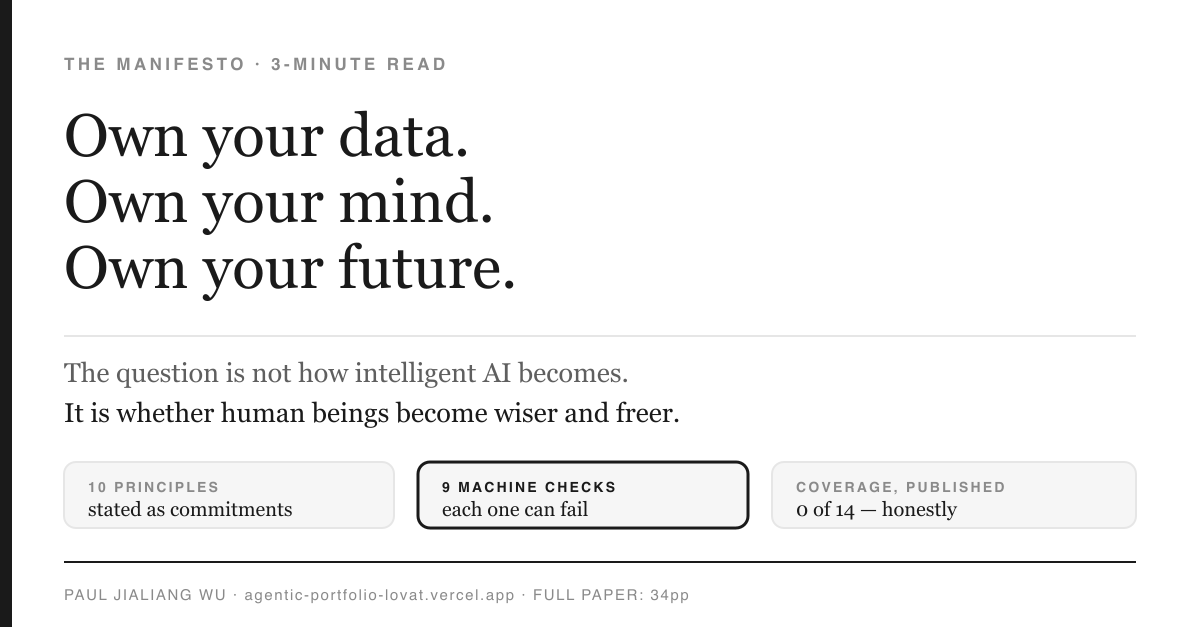
Own your data. Own your mind. Own your future.
The manifesto itself, cut to what carries weight. No citations, no argument with the literature — that is the paper's job. Three minutes, the whole idea.
The question
The defining question is not how intelligent will AI become? It is: will human beings become wiser, freer and more fully alive — or more dependent, distracted and controlled? Intelligence should not be extracted from people or locked inside platforms. It should stay rooted in the person: strengthened by AI, expressed through a life.
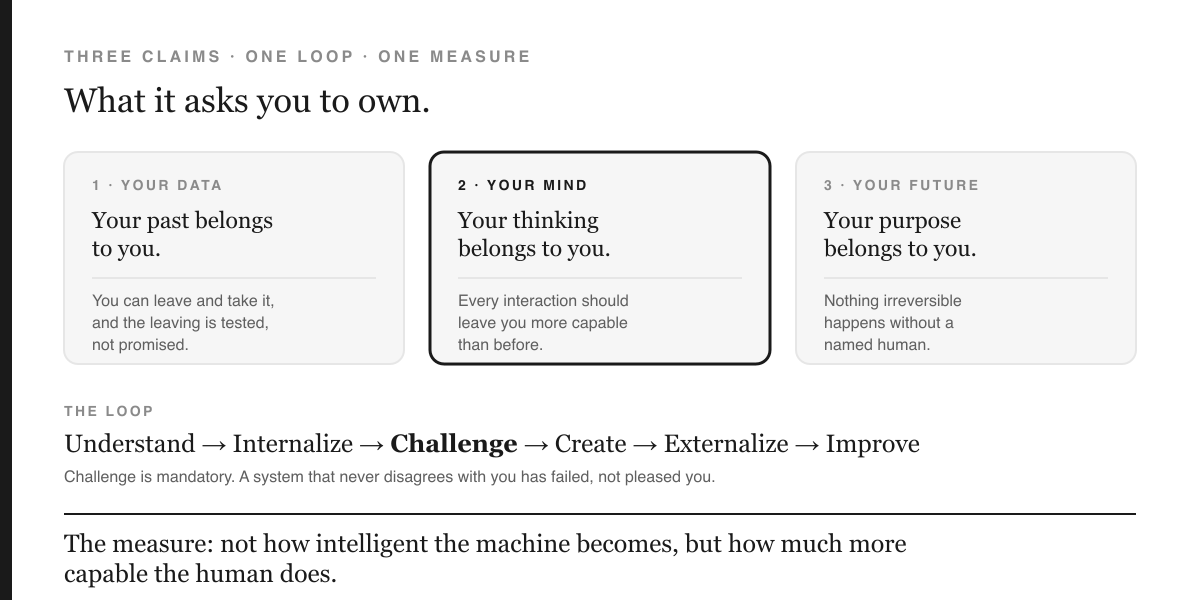
1 · Own your data — your past belongs to you
Your data is the record of your life; for a company, its institutional memory. You control what is collected, know how it is used, and can move, correct or delete it. The test is not an export button — it is a completed round trip, where what made the system useful still works after you leave. And what you capture of others is theirs too.
2 · Own your mind — your thinking belongs to you
AI should not replace understanding but deepen it. Every meaningful interaction should leave you more capable than before.
Which makes the machine that agrees with you the sharpest danger — and it feels like support. So it must be able to show you what it disagreed with you about, and you should measure yourself without it now and then. A widening gap is a defect in the tool, not in you.
3 · Own your future — your purpose belongs to you
A life should not be optimised for productivity, status or engagement, but directed by purpose: who am I becoming, what am I called to build, what will remain after I am gone. To own your future is to refuse to drift through a life designed by algorithms. And nothing irreversible should happen in your name without a human who can be named.
The loop
The mind is cultivated by a cycle: Understand → Internalize → Challenge → Create → Externalize → Improve.
Challenge is mandatory: a system that never disagrees has failed, not pleased you. Externalize points outward — a loop that closes inside the app is a dependency, not a practice.
Ten principles, and the check that can fail each one
Version 0 stated these as prose. That was the defect: you cannot fail a promise. Two machine-readable standards, P3P and Do Not Track, died because ignoring them was free. So each principle now names the observation that violates it.
| Principle | Fails when |
|---|---|
| Growth over dependence | success is measured by how often you come back |
| Ownership over extraction | who holds your data is not declared |
| Agency over automation | something irreversible has no named human gate |
| Understanding over answers | no stated skill it may erode, and no counter-practice |
| Transparency over manipulation | you cannot see what it used, or whose interest it serves |
| Portability over lock-in | there is no working exit, or the round trip is untested |
| Purpose over engagement | it optimises something other than your declared goal |
| Compounding over consumption | nothing shows the human got more capable |
| People over platforms | it only works with one named vendor |
| Legacy over immediacy | every justification offered is from this quarter |
Ten principles, nine distinct checks. Success is not how often a person returns — it is how much they grow, and now there is something to point at when a product claims both. OMI will never score growth by engagement, require a single vendor, let an agent act irreversibly without a named human, or claim what the checks do not support.
What would prove this wrong
A framework that cannot fail should not be adopted. So: evidence that heavy AI users are becoming more capable, not less. Or a working round trip of accumulated memory between two major assistants — which would make the strictest check redundant, and I would retire it and say so.
And the honest number: of fourteen mapped harms, coverage is 0 of 14, published as zero, because a metric that cannot embarrass its author is not measuring anything.
The call
Do not surrender your past. Do not outsource your mind. Do not drift into a future chosen for you. Build systems people can understand, control, improve and carry with them. And publish the checks, so anyone can tell whether you did.
Own your data. Own your mind. Own your future.
Because the future should not merely have more powerful AI. It should have more powerful human beings.
Version v0.1. Version 0 is kept verbatim and hashed so the revision can be checked rather than trusted: every version and its reasoning · this version in full · the 34-page paper.
Written by Paul Jialiang Wu. Condensed for a three-minute read; nothing here is argued or evidenced, deliberately — that is the paper's job. Both manifesto versions are immutable and hashed, recomputed on every build. The PDF linked above is arXiv's own compiled output; the preprint is submitted and its identifier will be added when announced.