AI-Native Series · AI for Good · Faith
The Cheapest Thing in This Mission Is the Truck
1-minute takeaway — what you'll walk away with
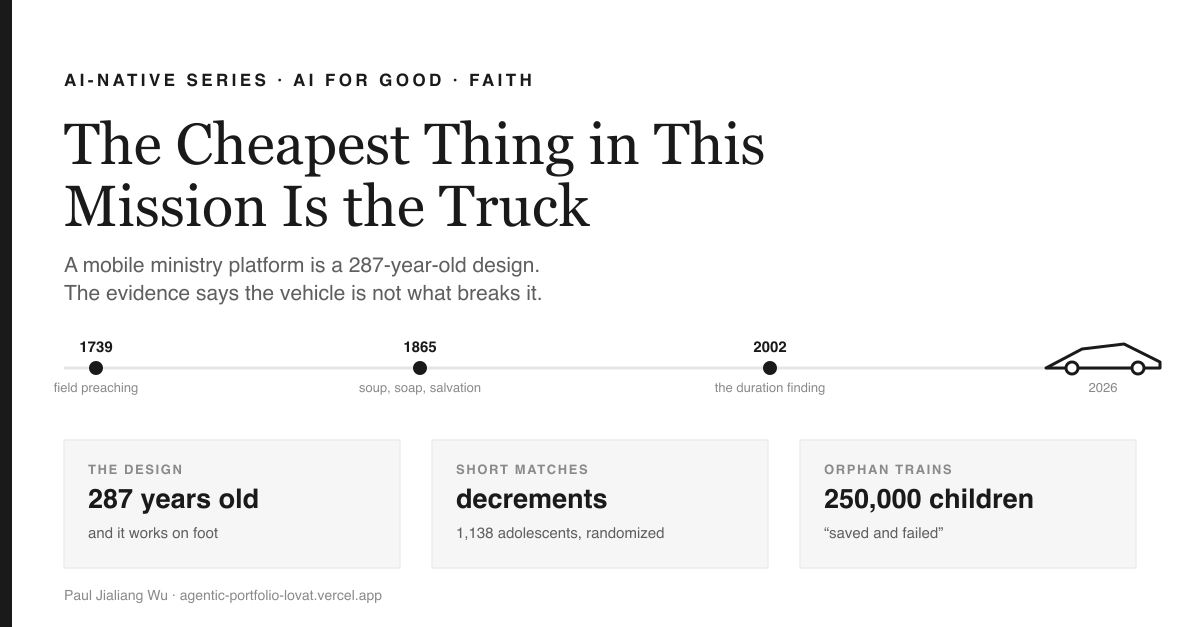
I costed a Cybertruck as a mobile platform for building companies, teaching kids, and serving a city, and expected the hard question to be financial. It wasn't. A mobile ministry platform is a 287-year-old design that demonstrably works on foot — which settles the vehicle question and moves the risk somewhere far less comfortable. A 2002 randomized trial of 1,138 adolescents found that those whose mentoring relationships ended very quickly reported decrements in several indicators of functioning. Not smaller gains. Losses. So the two questions worth asking before any visible good deed are: does this work without the part that makes it visible, and will I still be here in a year? Everything else — the truck, the cameras, the session count — is a rounding error against those two.
The spreadsheet was open, and I was doing the thing everyone does.
Monthly payment. Insurance delta. Charging against gas. A line for "content value," which is where honest spreadsheets go to die. The plan it served is real: a mobile platform that could carry an AI-engineering lab to a founder's warehouse on Tuesday, a kids' workshop to a driveway on Saturday, and a free-haircut station to a street corner the Saturday after. Build, teach, serve, out of one vehicle.
And I knew exactly which argument was coming, because it is the only argument anyone has about a Cybertruck. Is it a tool or is it a flex? Is the deduction the tail wagging the dog? Would you have bought it anyway?
Those are fine questions. They are also, I have come to think, the second-most-important ones — and I only found the first by going looking for whether any of this has been tried before. It has. Rather a lot. And the record does not care about the truck at all.
The vehicle question was settled in 1739
Here is the thing that reframed the entire spreadsheet for me: a mobile ministry platform is not a new idea, it is a 287-year-old one.
In the spring of 1739, John Wesley began preaching in open fields to workers who would not set foot in a parish church. By 1746 he had organised the practice into circuits — geographic rounds with preachers assigned to travel them [1]. That design crossed the Atlantic and became the American circuit rider — a role that faded with modern transport and denser settlement [2], but whose underlying structure did not. The itinerancy outlived the horse. It is alive right now: the Fresh Expressions movement describes its own work as tending the fields Wesley and the circuit riders rode through [13].
Two hundred and eighty-seven years is a long test. And notice what it tests. The circuit rider had no vehicle in the modern sense — a horse, a coat, and a route. Which means the model's survival is evidence for itinerancy, and evidence for precisely nothing about a stainless-steel wedge with a 15-inch touchscreen.
That is not an argument against buying the truck. It is a much more demanding argument: the design already works without it, so the truck has to prove it multiplies something, not that it enables something. Anyone who says the vehicle is what makes the mission possible has just told you they haven't read the field's own history.
And the running order was settled in 1865
The second thing the record has already decided is the order of operations — and it is older than every marketing framework I have ever been handed.
The Salvation Army began in London's East End in 1865. Its own international headquarters records the movement's summary of how it worked, and is careful about the attribution:
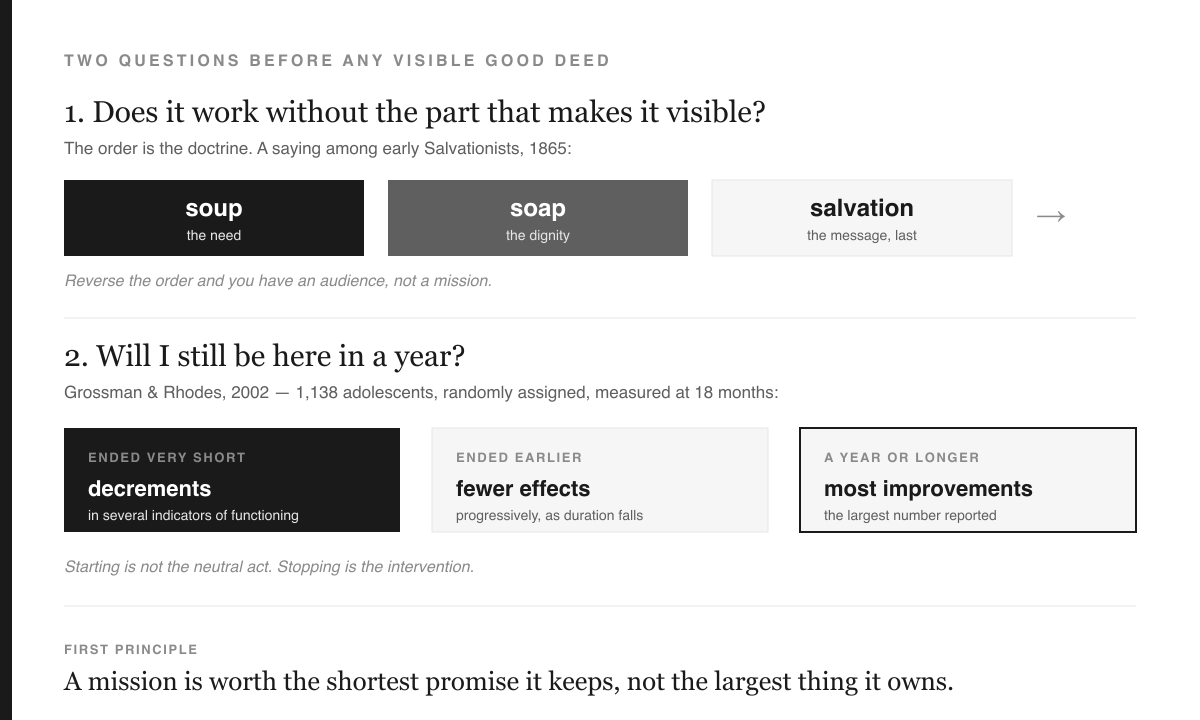
"'Soup, soap and salvation' was a common saying amongst early Salvationists, and is still repeated today." [3]
I want to flag something about that quotation, because it is the kind of thing this article is about. That phrase is very widely attributed to William Booth personally, in exactly those words, all over the internet. I went to check, and the Salvation Army's own site does not attribute it to him — it calls it a saying among early Salvationists. The famous version is a tidier story than the sourced one. That happens constantly, and it is worth one extra click every time.
The content, though, holds. Soup, then soap, then salvation. The order is the doctrine. Meet the physical need, restore the dignity, and let the message come last and only if wanted. A hundred and sixty-one years later, the version I wrote for my own plan reads: haircut first, human being second, story third. I did not know I was restating a Victorian slogan. I was.
Which tells you what the failure mode is. Reverse the order — lead with the message, or worse, lead with the camera — and you have not built a slightly worse mission. You have built an audience with a soup pot as a prop.
So here is the question nobody was asking me
Both of the settled questions are about the adults — the vehicle, the sequence, the optics. The plan also involves children. Mine, and eventually others.
In 2002, Jean Grossman and Jean Rhodes published a study of 1,138 urban adolescents, average age 12.25, all of whom had applied to Big Brothers Big Sisters. They were randomly assigned to a mentoring group or a control group and surveyed at baseline and again 18 months later. The abstract's finding, verbatim:
"Adolescents in relationships that lasted a year or longer reported the largest number of improvements, with progressively fewer effects emerging among youth who were in relationships that terminated earlier. Adolescents who were in relationships that terminated within a very short period of time reported decrements in several indicators of functioning." [4]
Read the last sentence twice. Not "smaller improvements." Not "no measurable benefit." Decrements. And the comparison group was not children nobody had ever offered anything — it was children who had applied for a mentor and had not been matched. Which makes the finding sharper, not softer: the short-relationship group did worse than the children left on the waiting list.
This is the finding that rearranged my spreadsheet, because it inverts the moral arithmetic everyone brings to volunteering. The instinctive model is that showing up is a gift with a floor at zero: maybe it helps a lot, maybe it helps a little, but how could it hurt? The trial says the floor is not at zero. Starting is not the neutral act. Stopping is the intervention.
Nobody in my life was going to raise this. Every question I got was about the truck.
The 172-year-old version of the same mistake
If you want to know how badly this can go while everyone involved means well, the case is already on the shelf.
Between 1854 and 1929, roughly 250,000 orphaned, abandoned and homeless children were put on trains out of New York and placed with families in rural communities. The man behind it, Charles Loring Brace, was a minister with a genuine and defensible theory: institutions were destroying these children, and work, education and a family would save them. The book-length history of the programme, from the University of Chicago Press, is titled — and this is the whole review in six words — Orphan Trains: The Story of Charles Loring Brace and the Children He Saved and Failed [5].
What that subtitle points at is not cruelty or bad intent. It is the mundane thing the subtitle leaves hanging: he got them on the train, and what happened after that is not a story the record tells well.
Now put beside it the organisation that took on the same problem out of the same religious impulse eleven years later: the Salvation Army, founded in London in 1865 and at work in the United States by 1880. It did not move children away from the problem. It built local corps that stayed, and it is still running 161 years on. One is remembered as a cautionary tale. The other is a going concern with a brass band.
The difference between them is not compassion, funding, or theology. It is whether anyone was still there in year two.
The class meeting began as a debt collection
The Methodist class meeting — the small accountability group whose descendants still run in churches today — was invented in 1742 because a man wanted his money back.
Wesley's Bristol society owed money on its meeting house. A member named Captain Foy proposed the obvious remedy — "Let every member of the society give a penny a week till all are paid." Told that many of them were too poor for that, he answered: "Then … put eleven of the poorest with me," and he would call on them each week and make up whatever they could not pay. Others took eleven apiece [15].
And the collectors, going door to door for pennies, started noticing how people were actually doing. Wesley's verdict on the thing he had accidentally built, in the same account: it was "the very thing we have wanted so long" [15]. The debt-collection route had become the pastoral one. Membership came to be regulated by a ticket, reissued quarterly — the practice runs alongside the class from the start, and a historian has traced the practice across 1741 to 2017 [6].
Two hundred and eighty-four years of Christian discipleship structure, and the founding document is an invoice.
The joke has a payload. The class meeting worked because it was attached to something concrete and recurring that someone had to actually show up for. Accountability structures that are purely aspirational — a commitment to be more intentional this year — do not survive contact with a calendar. Ones bolted to a real, recurring, slightly annoying obligation do. Anyone designing a mission cadence should probably find their penny.
The second trap: counting the thing that is easy to count
My draft plan had a target of forty-plus kids' sessions in a year. It felt rigorous. It is a number, it goes up, you can put it on a dashboard.
The United States ran a large federal evaluation of character education: seven school-based programmes, evaluated over three years, following one cohort of children from third grade through fifth. In the report's own words, the programmes "increased the reported implementation of SACD activities in the classroom" — and it found no differences on the outcomes that were supposed to follow from them. As the New York State School Boards Association summarised the findings at publication, the programmes "had no effect on students' social and emotional competence, behavior, academic performance, or perceptions of school climate" [7].
The activity count went up. Nothing else moved. That is not a null result about children; it is a null result about the metric. Session count measures the supply of programming, and everyone running a programme mistakes it for evidence of formation, because it is the only number available on Sunday night.
And the graveyard next door is worse than null. In 2011, Laurie O. Robinson — then Assistant Attorney General for the Office of Justice Programs — and Jeff Slowikowski, acting administrator of the Office of Juvenile Justice and Delinquency Prevention, published an op-ed about "Scared Straight" programmes, in which at-risk teenagers are confronted by prison inmates. Relaying Anthony Petrosino's Campbell Collaboration meta-analysis, they wrote:
"these programs did not deter teenage participants from offending; in fact, they were more likely to offend in the future" (emphasis in the original) — and "participants were up to 28 percent more likely to offend than youths who didn't participate." [8]
Read what they are actually saying. Two federal justice-programme administrators went into print to warn the public against a programme genre their own constituency loved, because the measurement said it was making children more likely to commit crimes. That is what an insider telling the truth against interest looks like, and it is rare enough to be worth naming.
Here is the part that should terrify anyone planning a mission with a camera on it. Scared Straight is fantastic television. It has confrontation, tears, a redemption beat, a visible before-and-after within a single afternoon. Every property that made it compelling footage is a property that made it harmful practice — high emotional intensity, short duration, no follow-up. If a programme is optimised for the camera, the camera is selecting for exactly the wrong variables.
The same mistake, now with a language model
I build AI systems, so the obvious move is to put an AI mentor in the kids' programme. The current evidence is more sobering than the demos.
On tutoring outcomes generally, the education-policy scholar Gerald K. LeTendre put it plainly in July 2026: "there is no clear evidence that AI or other kinds of computer-based tutors are superior to human tutors" [9].
I want to give that source its full due rather than the half that suits me, because the sentence it sits next to cuts the other way. LeTendre reports that an extensive analysis found these systems did increase student achievement compared with classroom instruction or working through textbooks — and then tied with human tutors [9]. Computer tutors beating a textbook is a real result. It is simply not the result the category is sold on, which is that they beat people.
The honest builders publish smaller numbers than the press releases. Khan Academy's product tests on Khanmigo reported two separate wins, each with its own experiment behind it: summarising a student's recent problem-solving history raised next-item correctness by 3.4% across 608,000 tutoring threads, and surfacing prerequisite skills the student hadn't yet mastered before a harder problem raised it by 2.7% across 1.36 million threads [10]. Real, measured, and about two orders of magnitude less exciting than the way AI tutoring gets described.
And the legal ground moved underneath all of it. In May 2025 Judge Anne C. Conway granted in part and denied in part the motions to dismiss in Garcia v. Character Technologies, holding that Character A.I. is a product for the purposes of the product-liability claims "so far as Plaintiff's claims arise from defects in the Character A.I. app rather than ideas or expressions within the app" [14]. That limiting clause is the whole ruling, and it is the part that gets dropped when the case is summarised. Character.AI subsequently barred under-18 users from open-ended chats, and in January 2026 it and Google settled a set of family lawsuits [11]. Whatever you think of the merits, the design implication is unambiguous: a conversational AI a child can reach is no longer a terms-of-service question.
So the AI mentor stays out of the kids' programme until I have built consent and guardianship into it deliberately. Not because the technology is bad. Because I would be adding a novel liability to a programme whose known failure mode I have not yet closed.
Patterns and anti-patterns
| Pattern | Anti-pattern |
|---|---|
| Prove the mission on foot, then let a vehicle multiply it | Buy the platform, then design a mission that justifies it |
| Need first, dignity second, message last | Leading with the message, or with the camera |
| Commit to a duration before you meet the child | Committing to an intensity and letting duration be whatever happens |
| Measure return: did they come back, did they build again unprompted | Measuring sessions delivered, kids reached, events held |
| Attach the cadence to something concrete and recurring | Aspirational commitments with no forcing function |
| Publish the failures with the wins | Publishing a highlight reel and calling it a track record |
The mechanism, named
Why would a short good thing be worse than no good thing? The trial reports the effect; it does not hand you a tidy mechanism, and I will not invent one. The field's own systematic assessment of the evidence is similarly measured — average benefits from mentoring programmes are real but modest, and relationship quality and duration are where the variance lives [12]. But the shape is not mysterious.
A child is running an estimate of how reliable adults are, and that estimate updates on evidence. An adult who never shows up contributes no evidence. An adult who shows up warmly, becomes significant, and then stops contributes a data point — and for a child who already has several of those, it is a confirming one. The intervention is not the relationship. The intervention is the ending, and the ending is administered by the adult's changing circumstances, which is to say by something the child will reasonably read as being about them.
That is why "we'll see how it goes" is not a neutral posture. It is a coin flip you are performing on somebody else's model of the world.
The first principle, in one sentence
A mission is worth the shortest promise it keeps, not the largest thing it owns.
Everything above is a corollary. The truck is the largest thing; it is therefore nearly irrelevant to the mission's worth. The order of operations matters because "soup last" is a broken promise about what you were there for. Session counts mislead because they measure what you spent, not what you kept. And the duration finding is the principle stated as a measurement: the shortest promise sets the value, and if it is short enough the value goes negative.
What I actually did about it
A principle you don't wire into something is a mood. So:
The formation platform I build in the open, Kingdom Come, has an append-only, hash-chained claim ledger. You commit a claim with a resolution criterion and a horizon before the outcome is known; you cannot quietly rewrite it later without the chain naming the break; and a claim whose criterion can't be falsified is recorded as not_measurable and can never be counted as fulfilled. I wrote up the full mapping — six things the mission needs that the platform already does, six it flatly does not — as a public case study, including the gaps that would block a launch.
The concrete change this research forced, stated so you can hold me to it:
- Before any child who is not mine joins anything I run, I commit a claim naming the minimum duration I will sustain, with a horizon — and a failure to meet it resolves as a recorded
no, not a quiet lapse. - Session count is demoted from a goal to an input. The outcome metric is return: do they come back, do they build again without being asked.
- The eight-week validation sprint runs without the vehicle. If the mission doesn't work on foot, a truck cannot rescue it — 1739 already ran that experiment.
- No AI mentor for minors until guardianship and consent are modelled explicitly.
How I'd know I'm wrong, written before the sprint: if the eight weeks produce no economic result and no returning child, the plan is a hobby with a content strategy and I should say so publicly and stop. If the mission does work on foot and the truck's measured contribution is a nicer backdrop, that is a NO-GO on the truck and a GO on the mission — which is the outcome I'd bet on, and the one the spreadsheet was never going to tell me.
Provenance — what's verified and what's mine
Every quotation above was fetched and checked against its source, and then an independent reviewer who had not written the article checked them again. That second pass failed this piece the first time, and the corrections are more interesting than the draft was.
Cut before the first draft shipped. A Nightingale line about diagrams, drafted from a search summary, is not in the paper I was going to cite it to — gone. "Soup, soap and salvation" is attributed to William Booth as a direct quotation nearly everywhere; the Salvation Army's own site calls it a saying among early Salvationists, so that is how it appears here. And the famous gloss of the Grossman & Rhodes finding — "three to six months," "self-worth and perceived scholastic competence" — is a secondary summary. The primary abstract says "within a very short period of time" and "decrements in several indicators of functioning." The vaguer wording is the honest one, so it is the one I quoted.
Caught by review, after I thought I was done — four times. This article went through four independent review passes by a reader who had not written it. The first failed it and found fourteen defects; the second, eight more; the third, eight more still; the fourth, seven. Thirty-seven. One citation alone — the court order below — was wrong three times running: first cited to a news story that never mentions it, then to the wrong document in the right docket, then to a URL that does not resolve. The worst of the thirty-seven, in descending order of how much they should cost my credibility: I had invented an author — reference [6] was credited to a "J. Sharman" who does not exist; the paper is by Sarah Lloyd, and no amount of the rest of this section matters if I am the sort of writer who does that. I had cited the Garcia product-liability ruling to a news article that never mentions it. I had cropped the AI-tutoring sentence so it lost the half favourable to computer tutors. I had quoted the character-education findings as though they were the federal report's words when they are a school-boards association's summary. I had bundled two different Khan Academy experiments into one number. I had put Laurie O. Robinson in the wrong agency. I had described the control group as children who were offered nothing, when they were children who applied for a mentor and were not matched. I had asserted 15 February 1742 as a fact I could not source, so the date is now simply "1742". And twice I published a claim in the LinkedIn and X copy that the article itself had already retracted as unsourced — the promotional text is part of the work, and it drifts from the piece unless somebody checks it too.
I am listing these rather than quietly patching them because the alternative would make this article a liar in its own final section. The general lesson is not that I was careless — I was being careful, and was careful in exactly the way that produces confident, well-formatted, wrong citations. It is that a verification pass you run on your own work finds a different and smaller class of error than one run by somebody trying to break it. Every defect above survived my own checking. None survived a stranger's. And the sharpest lesson is what happened to my corrections: in three consecutive passes, a fix introduced a fresh defect of the class it was repairing. That is why the review ran again after every repair instead of once at the end, and it is the strongest practical argument I know for making the reviewer someone other than the author.
Deliberate omissions. I have not asserted a student total for the character-education evaluation, because the sources I could reach give totals for different scopes and I could not reconcile them. Captain Foy's words are quoted from the Wesley Center Online's account [15], which is a secondary rendering of Wesley's own; I could not verify a specific February 1742 date anywhere, so the article says only "1742". The 1746 circuits date rests on a reference that blocks automated fetching [1], and the DuBois meta-analysis [12] sits behind a paywall — its bibliographic record is verified but I could not re-read its findings, so my one-line characterisation of it is reported, not re-verified. Treat both accordingly. The orphan trains' failures of screening and follow-up are received history, not a finding I have sourced to a study, so the text now says only what the book's own subtitle supports. The two questions, the first principle, the mechanism and the duration commitment are mine.
References
- Britannica. Circuit rider — Evangelism, Revivalism & Preaching. britannica.com/topic/circuit-rider
- NCpedia. Circuit Riders. ncpedia.org/circuit-riders
- The Salvation Army International Headquarters. History. salvationarmy.org/history
- Grossman, J. B., & Rhodes, J. E. (2002). The test of time: predictors and effects of duration in youth mentoring relationships. American Journal of Community Psychology, 30(2), 199–219. PMID 12002243 · doi:10.1023/A:1014680827552
- O'Connor, S. (2004). Orphan Trains: The Story of Charles Loring Brace and the Children He Saved and Failed. University of Chicago Press. press.uchicago.edu/…/bo3630532.html
- Lloyd, S. (2019, online-first; print 2020). The Religious and Social Significance of Methodist Tickets, and Associated Practices of Collecting and Recollecting, 1741–2017. The Historical Journal, 63(2), 361–388. doi:10.1017/S0018246X19000244. cambridge.org/core/journals/historical-journal/…
- Social and Character Development Research Consortium (2010). Efficacy of Schoolwide Programs to Promote Social and Character Development and Reduce Problem Behavior in Elementary School Children. NCER 2011-2001, Institute of Education Sciences. eric.ed.gov/?id=ED512329 · findings as reported in NYSSBA, Study questions effectiveness of character education
- Robinson, L., & Slowikowski, J. (2011). Scary — and ineffective. OJJDP News @ a Glance, January/February 2011. ojjdp.ojp.gov/…/234084/op-ed.html
- LeTendre, G. K. (2026). Despite the growth of some AI schools like Alpha, research doesn't show that AI tutors are better than human teachers. The Conversation, republished by Phys.org, July 2026. phys.org/news/2026-07-growth-ai-schools-alpha-doesnt.html
- Khan Academy (2026). How Khan Academy Is Building a Better AI Tutor: Our Most Recent Learnings. blog.khanacademy.org/…
- Fortune (2026). Google and Character.AI agree to settle lawsuits over teen suicides linked to AI chatbots. fortune.com/2026/01/08/…
- DuBois, D. L., Portillo, N., Rhodes, J. E., Silverthorn, N., & Valentine, J. C. (2011). How Effective Are Mentoring Programs for Youth? A Systematic Assessment of the Evidence. Psychological Science in the Public Interest, 12(2), 57–91. journals.sagepub.com/doi/10.1177/1529100611414806
- Fresh Expressions. Preparing the Soil: Lessons from Wesley's Fields for the Church Today. freshexpressions.com/preparing-the-soil…
- Garcia v. Character Technologies, Inc. et al, No. 6:24-cv-01903, Order on Motions to Dismiss, Document 115 (M.D. Fla., 21 May 2025). Order text: fire.org/research-learn/order-motion-dismiss-garcia-v-character-technologies-inc (49 pp; docket via CourtListener 69300919)
- Wesley Center Online. John Wesley the Methodist, Chapter IX — Society and Class. wesley.nnu.edu/…/chapter-ix-society-and-class
Related
Research packet assembled 2026-08-13 across four time windows — 30 days, 30 months, 30 years, 300 years. Fifteen sources. Three drafted quotations failed verbatim verification before the first draft shipped; four further independent review passes then failed the article and found thirty-seven more defects between them, including a fabricated author in my own reference list. All are named in Provenance rather than quietly fixed. — Paul Jialiang Wu · agentic-portfolio-lovat.vercel.app