AI-NATIVE SERIES · Faith & Systems
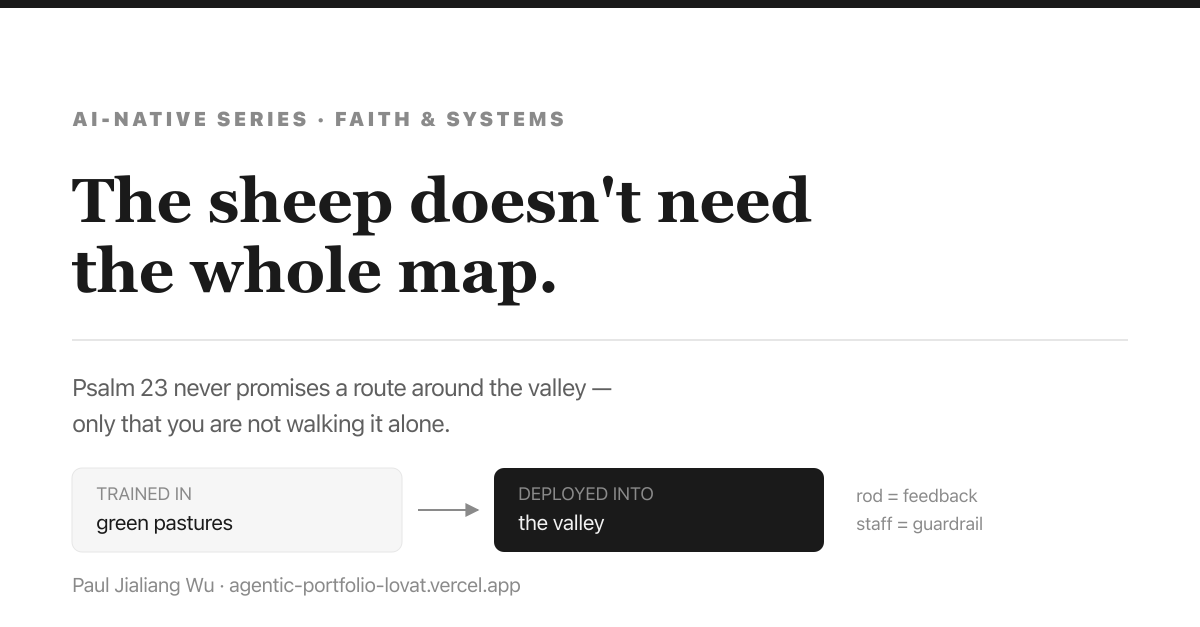
Psalm 23: The Sheep Doesn't Need the Whole Map
One minute: Psalm 89 asks how you keep your identity when reality contradicts the promise. Psalm 23 asks the other half — how do you keep moving when you can't see the path? Its answer is a working architecture: know who is leading, rest before you break, repair your state before your next decision, and expect the valley rather than a route around it. Identity stability plus navigation stability.
The companion piece to this one was about Psalm 89: what to do when reality contradicts the promise. Keep both on the table. Behavior is editable; identity is not.
That answers one question and leaves the harder one open. Knowing who you are does not tell you where to step next. Psalm 23 is about walking anyway.
1. Know who is leading, not just what to optimize
“The LORD is my shepherd; I shall not want.” — Psalm 23:1, KJV
A sheep does not need the entire map. It needs to know who is leading.
That distinction matters more than it sounds. The weak question is what can I optimize? The real one is whose goals am I serving, and what defines success? Capability without that is not agency — it is a very efficient way to arrive somewhere nobody wanted.
So the objective sits above the learning loop, not inside it. The agent may learn; the destination does not get quietly rewritten by every new data point. That is Psalm 89's rule, arriving from the other direction.
2. Rest is part of the architecture
“He maketh me to lie down in green pastures: he leadeth me beside the still waters.” — Psalm 23:2, KJV
Notice it is not offered as a reward for finishing. It is made to happen, mid-journey, by the one doing the leading.
A system that only ever acts, consumes and updates becomes unstable. More input is not more intelligence. A continual learner needs somewhere to stop, consolidate, evaluate, recover, and prepare — and so do you. Still water is not wasted time; it is where the last stretch actually gets integrated.
3. Repair the state before the next decision
“He restoreth my soul.” — Psalm 23:3, KJV
An agent has a model, and it also has a state. When the state is corrupted, every decision downstream of it gets worse: bad state, bad reading of the situation, bad choice, worse state.
Psalm 23 puts a reset before the next step — restore, reorient, continue. Don't let yesterday's failure become today's identity, and don't let one bad observation permanently rewrite the model. Behavior can be corrected without demolishing who you are.
4. Exploration needs a direction
“He leadeth me in the paths of righteousness for his name's sake.” — Psalm 23:3, KJV
Not I wander everywhere and see what turns up. Led.
Curiosity without direction is drift wearing a lab coat. There is a difference between what can I discover? and what am I trying to reach? — and the psalm puts the second first. The path is part of the goal, not merely the cost of arriving.
5. The valley is the deployment environment
“Yea, though I walk through the valley of the shadow of death, I will fear no evil: for thou art with me.” — Psalm 23:4, KJV
Read what is not promised. Not a shorter valley. Not a route around it. The most quoted line in the psalm assumes you are going in.
In machine-learning terms this is distributional shift — the gap between the pasture you trained in and the valley you were deployed into. It is one of five concrete problems in the field's most-cited safety agenda, alongside "safe exploration" and "avoiding reward hacking":
“…undesirable behavior during the learning process ('safe exploration' and 'distributional shift').” — Amodei et al., Concrete Problems in AI Safety, 2016 (arXiv:1606.06565), abstract
The test of a system was never how gracefully it behaves in ideal conditions. It is what happens when conditions change: information goes missing, the old strategy stops working, and the cost of error rises. The brittle response is my model failed, so everything I believed is false. The robust one is three questions — what changed, what is still invariant, and what must I adapt?
6. Rod and staff: feedback and guardrails are different tools
“Thy rod and thy staff they comfort me.” — Psalm 23:4, KJV
Two instruments, not one. The rod corrects and defends; the staff guides and pulls you back from an edge.
Feedback tells a system that action was wrong. Guardrails tell it do not go there at all. Without feedback nothing learns. Without guardrails a system learns the wrong thing with startling efficiency. Feedback enables learning; constraints make the learning trustworthy — and the aim was never zero mistakes, but mistakes that are recoverable and informative.
It is worth sitting with the strangest word in the verse: comfort. The instruments of correction are listed as a source of comfort, not of fear. That is only true if you trust the hand holding them.
7. The table is set with the enemies still there
“Thou preparest a table before me in the presence of mine enemies.” — Psalm 23:5, KJV
Not after the threat is cleared. In its presence.
Real systems run amid conflicting information, adversarial input, unreliable sources, competing objectives, and manipulation. The goal is not a sterile environment — you will not get one — but something that stays grounded inside a messy one.
8. Don't optimize only for not-losing
“My cup runneth over.” — Psalm 23:5, KJV
A system can become excellent at avoiding failure, which is not the same as being good at anything. If the whole objective is don't lose, don't fail, don't get hurt, you get something extremely careful and slightly useless. The psalm's image is not survival. It is overflow.
9. Long horizons beat the next reward
“Surely goodness and mercy shall follow me all the days of my life.” — Psalm 23:6, KJV
All the days — not this afternoon. Short-horizon reward is the easiest thing in the world to maximise: click, comfort, attention, money, status, each paying out immediately. Long-term flourishing usually requires declining several of them. Don't maximise the next reward; follow the path toward the actual destination.
The two psalms, together
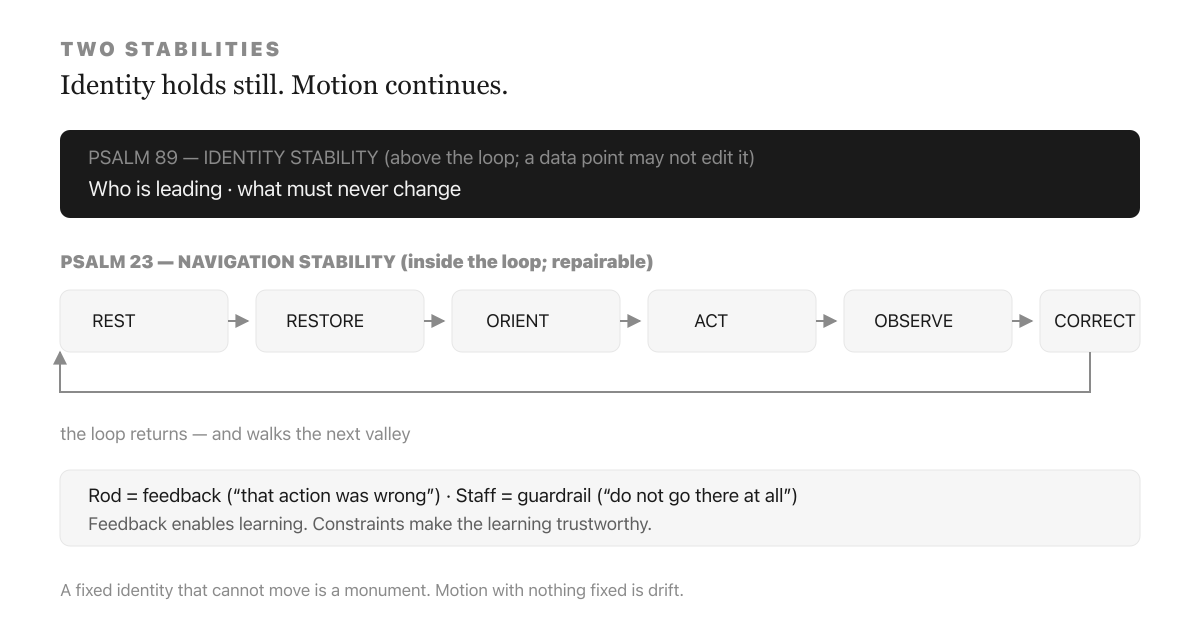
Psalm 89: don't rewrite the specification because reality is confusing. Psalm 23: don't stop walking because the path is.
One gives identity stability, the other navigation stability. You need both: a system with a fixed identity and no way to move is a monument, and a system that moves beautifully with nothing fixed is a drift.
Patterns and anti-patterns
Patterns. Put the objective above the loop, where a data point can't edit it. Schedule rest before it is earned. Repair state before deciding. Expect the valley and prepare for it rather than routing around it. Keep feedback and guardrails as separate mechanisms.
Anti-patterns. Exploration with no destination. Treating rest as the reward for finishing. Deciding from a corrupted state. Concluding from one bad environment that the whole model is void. Collapsing guardrails into feedback — hoping a strong enough correction will substitute for a boundary that should never have been crossable.
The mechanism, and the first principle
Mechanism: two stabilities, held separately — an invariant objective above the loop, and a repairable state inside it. Neither can do the other's job.
First principle: you do not need the whole map to take the next faithful step; you need to know who is leading and what must not change.
Honest edges
- This is a devotional reading, not scholarship. I have not consulted the Hebrew, and readers in the shepherding cultures the psalm came from would hear things I cannot.
- The AI parallel illuminates and proves nothing. Psalm 23 did not anticipate distributional shift; it is that both describe an agent moving through an environment it did not design.
- Provenance: this piece began as a conversation I had with ChatGPT, exploring Psalm 23 as the companion to Psalm 89. The framing and the argument are mine; the drafting was collaborative. Every quotation here was verified afterwards against a source, which is the part that machine drafting cannot be trusted to do.
References
- Psalm 23 — quoted from the public-domain King James Version, verified verbatim against bible-api.com on 2026-08-13. (The companion Psalm 89 piece quotes the NKJV; this one uses the KJV so every verse here is independently checkable.)
- Amodei, D., Olah, C., Steinhardt, J., Christiano, P., Schulman, J., Mané, D. (2016). Concrete Problems in AI Safety. arXiv:1606.06565. The quoted phrase is verbatim from the abstract, retrieved from the arXiv API on 2026-08-13.
- Companion piece: Psalm 89: How to Keep Your Identity While Learning From Reality.
The one-line version
Don't demand the whole map. Take the next faithful step.