AI-NATIVE SERIES · Faith & Systems
Psalm 89: How to Keep Your Identity While Learning From Reality
One minute: Psalm 89 spends thirty-seven verses stating a promise, then thirteen verses documenting how badly reality contradicts it — and refuses to delete either one. It ends in worship with the argument still open. That is not weak theology. It is the exact architecture a system needs in order to learn without losing itself: behavior is editable, identity is not.
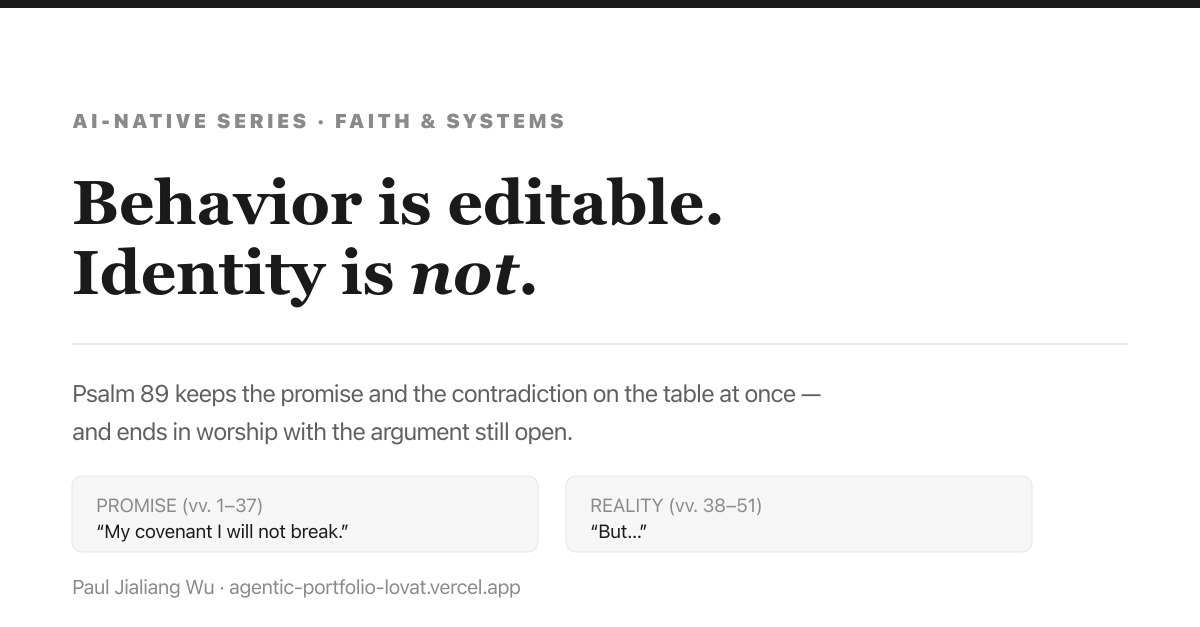
Psalm 89 answers one of the hardest questions a person ever faces:
What do you do when reality looks nothing like what you were promised?
Its answer is stranger, and more modern, than we usually admit: keep the promise, face the facts, measure the gap, and do not fake the resolution.
1. First, write the specification
Verses 1–37 are the specification. The covenant is stated plainly, before any crisis arrives:
“My covenant I will not break, nor alter the word that has gone out of My lips.” — Psalm 89:34, NKJV
The standard is established first. That ordering matters: you cannot learn well if you do not know what must never change.
For a company that is the mission. For a person it is identity, values, calling. Define the foundation before reality starts throwing exceptions at it.
2. Then measure reality
Verses 38–51 are the reality check, and they are brutal. The psalmist does not soften it. He writes “But…” and then documents everything that looks wrong.
Here is the discipline: promise ≠ current reality, and the gap is not a reason to delete the promise — nor is the promise a reason to delete the data.
The immature responses are all deletions. The promise must be false. The evidence must be ignored. Everything is fine. The mature response keeps both cards on the table: this is what I believe, this is what I am seeing, there is a gap, and I am still learning.
3. Correct the behavior — do not rewrite the identity
Verses 30–34 hold the pattern. There is correction, consequence, a rod. And then, immediately:
“Nevertheless My lovingkindness I will not utterly take from him, nor allow My faithfulness to fail.” — Psalm 89:33, NKJV
That is an architecture: behavior is editable, identity is not.
You can fail without becoming a failure. You can make a bad decision without becoming a bad person. You can have a terrible week without discarding your life's mission. You can change the strategy without deleting the constitution.
The same problem, in machine learning
This is not merely an analogy. It is the central open problem in continual learning, and it has a name: catastrophic forgetting — a network trained on something new overwrites what it knew before. Kirkpatrick and colleagues describe their remedy directly:
“…by selectively slowing down learning on the weights important for those tasks.” — Kirkpatrick et al., Overcoming catastrophic forgetting in neural networks, PNAS 2017 (arXiv:1612.00796)
Their method anchors the parameters that carry the old identity and leaves the rest free to move. Too little updating and the system never improves; too much and it forgets who it is. The fix is not less learning. It is selective plasticity: know which weights are load-bearing before the new data arrives.
Psalm 89 got there first, and states it in one line. The covenant is the protected parameter. The rod is the gradient.
4. Declare your invariants before the storm
“Righteousness and justice are the foundation of Your throne; mercy and truth go before Your face.” — Psalm 89:14, NKJV
The values come before the crisis. If you wait until you are under pressure to decide what matters, pressure will decide for you.
So write them down first. What will I never trade away? What kind of person will I never stop being? What stays true even when this week's results look terrible?
5. Never hide the delta
The most courageous thing in the psalm is the lament. No spin, no denial, no quiet deletion of inconvenient evidence — just this is not working the way I expected.
Reality is allowed to disagree with your model. When it does, measure the delta: what did I expect, what happened, why the gap, what does it teach, what should change — and what must not.
The fool protects the model. The learner improves it. The wise learner knows that not everything is a model; some things are principles.
6. Pass on the full record
“With my mouth will I make known Your faithfulness to all generations.” — Psalm 89:1, NKJV
That is more than memory; it is inheritance. And notice what got inherited: the promise and the complaint, preserved together, unresolved, for three thousand years.
Do not hand down a polished story that hides the struggle. Hand down the promise, the failure, the questions, the lessons, and the faith. Leave them the source code, not the highlight reel.
7. Finish the cycle without pretending you solved it
“Blessed be the LORD forevermore! Amen and Amen.” — Psalm 89:52, NKJV
And here is the part that should stop you: the problem is not solved. The contradiction is never explained. The psalm ends in worship with the argument still open.
Psalm 89 is, in effect, a bug report that made it into production — filed against the Author, never closed, and canonised anyway. Every instinct we have would have sent it back for revision. The editors shipped it as-is, and it has outlasted every tidier song around it.
A learning cycle can end without the question being finished. You do not need to manufacture closure. You need to complete the loop.
The Psalm 89 loop
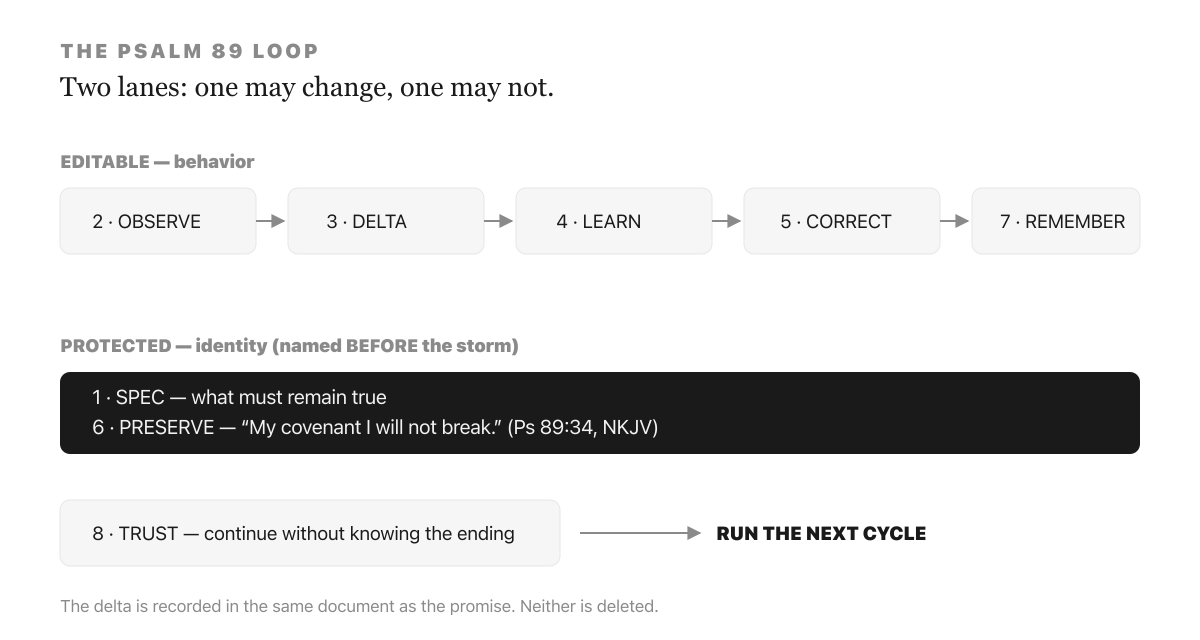
- Spec — what must remain true?
- Observe — what is actually happening?
- Delta — where does reality differ from the spec?
- Learn — what is reality teaching me?
- Correct — which behavior or assumption changes?
- Preserve — what must not change?
- Remember — what makes the next cycle start smarter?
- Trust — can I continue without pretending I know the ending?
Then run the next cycle.
Patterns and anti-patterns
Patterns. Write the invariants before the crisis. Record the gap in the same document as the promise. Separate the editable layer from the protected one, explicitly. End cycles on schedule rather than on resolution.
Anti-patterns. Deleting the promise because this quarter disagrees with it. Deleting the data because it is uncomfortable. Treating every failure as evidence about your identity. Manufacturing closure so the story sounds finished. Rewriting the constitution during the storm — which is precisely when you are least able to tell a principle from a preference.
The mechanism, and the first principle
Mechanism: selective plasticity. Protect the parameters that carry identity; leave the rest free to update. Both the psalm and the algorithm work because the protected set was named in advance.
First principle: you cannot learn from a gap you refuse to record.
The one-line version
Do not rewrite your identity because reality handed you bad data.
Keep the foundation. Fix the behavior. Measure the gap. Learn honestly. Remember everything. Trust enough to run the next cycle.
Amen and Amen.
References
- Psalm 89 — quotations follow the New King James Version. Because the NKJV is under copyright and not machine-readable from a public API, every quoted verse was additionally verified against the public-domain King James Version via bible-api.com on 2026-08-13, confirming the substance of each. Where the two differ in wording, the difference is noted: the KJV renders 89:14 as “Justice and judgment are the habitation of thy throne.”
- The three-part structure used here — promise (1–37), lament (38–51), doxology (52) — is the standard reading of the psalm, whose final verse also closes Book III of the Psalter.
- Kirkpatrick, J. et al. (2017). Overcoming catastrophic forgetting in neural networks. PNAS 114(13). arXiv:1612.00796. The quoted phrase is verbatim from the paper's abstract.
Honest edges
- This is a devotional reading, not a work of biblical scholarship. I am an engineer who reads this psalm, not a Hebraist, and I have not consulted the Hebrew.
- The continual-learning parallel is an analogy that illuminates, not evidence that the psalm anticipated a 2017 algorithm. It earns its place because both name the protected set in advance — no more than that.
- Nothing here is a claim about why any particular prayer went unanswered. The psalm does not offer that, and neither will I.