AI-Native Series · Physical AI
Machines can finally watch video. The hard part is teaching them to understand motion.
1-minute takeaway — what you'll walk away with
Machines can finally watch video. The hard part is teaching them to understand motion — and the edge isn't a bigger model, it's a closed loop: model → honest eval → curated data → better model. A mental model a 15-year-old can run, mapped to the real machinery. Part of the AI-Native series.
A Vision-Language Model that describes a frame is not the same as one that understands a turn. Three things separate "sees" from "understands" — and none of them is a bigger model.
Show a modern Vision-Language Model a photo and it will tell you there's a silver sedan in the left lane. Impressive. Now show it thirty frames of that sedan drifting across a lane line while a cyclist enters from the right, and ask: what just happened, and was it dangerous?
That gap — between naming what's in a picture and reasoning about what's happening across time — is where most of the value in video AI actually lives, and where most systems quietly fall over. A model that captions frames is a tourist with a camera. A model that understands motion is a witness who can testify.
Here's the mental model a 15-year-old can run: a VLM watching video is a brand-new student driver. It has read the whole manual (it "knows" cars, lanes, cyclists). But knowing the manual is not the same as reading a road. Three things turn the student into a driver — and they map, one-to-one, onto the real engineering.
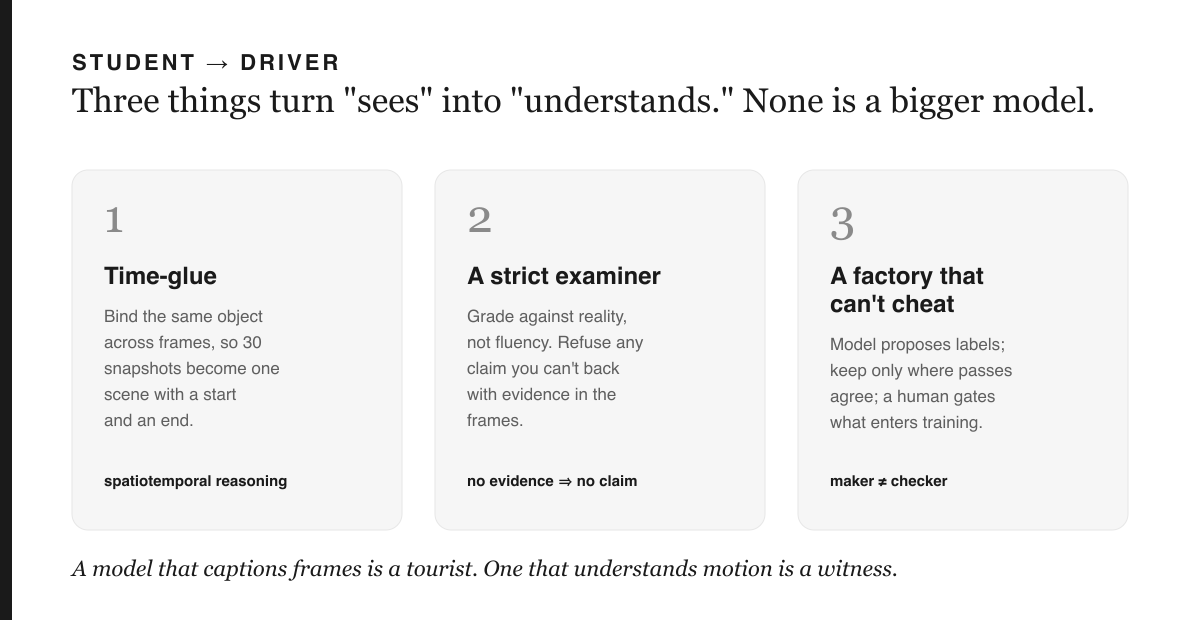
1. Time-glue: 30 snapshots are not a scene
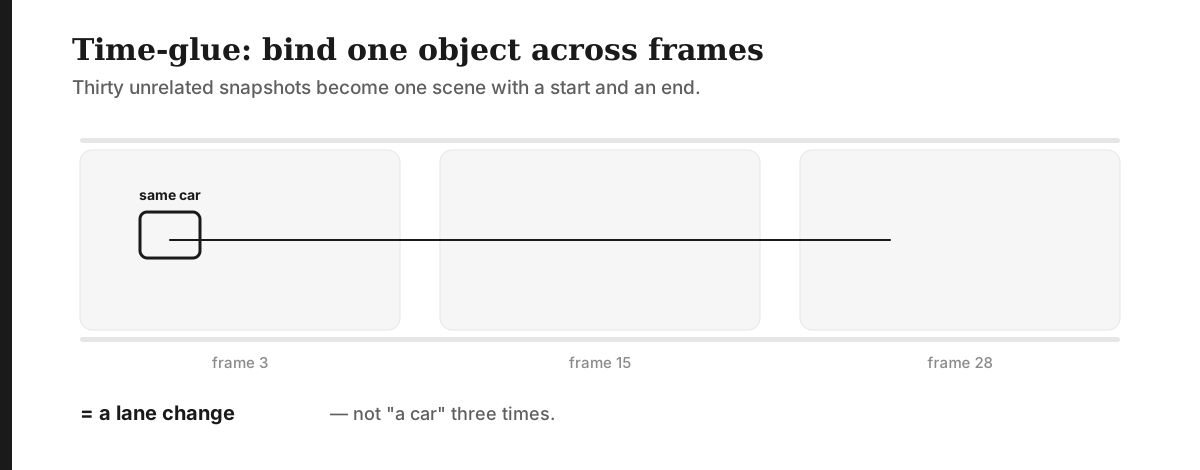
Naively, a model sees video as a stack of unrelated postcards. Understanding motion means gluing the postcards together — tracking that this car in frame 3 is the same car in frame 28, and that its position is changing in a way that has a name (a lane change, a merge, an anomaly).
In the machinery this is spatiotemporal reasoning: the model has to localize objects and bind them across time. It's why you fine-tune an open VLM on clips with sensor context, not stills — and why the interesting benchmarks measure temporal grounding, not caption quality. Skip the time-glue and you get a model that's fluent about every frame and clueless about the event.
| The student "sees" | The driver "understands" |
|---|---|
| "A car. A lane line. A cyclist." | "A car crossing a lane line toward a cyclist — a near-miss at 0:04." |
| Per-frame caption | Localized event, bound across time, with a start and end |
| Confident on every frame | Calibrated: says "unsure" when the view is occluded |
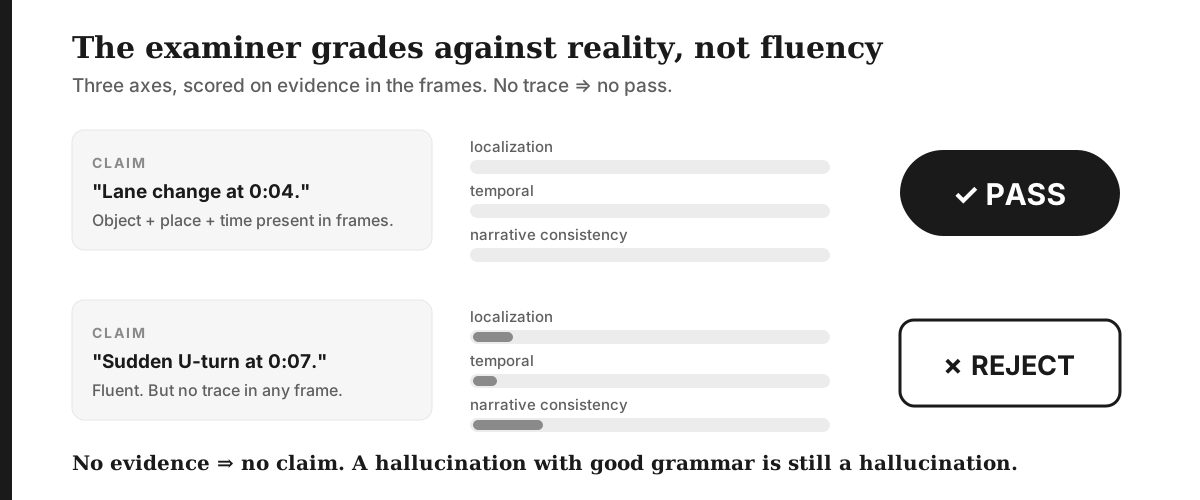
2. A strict examiner: the model will lie to you confidently
The dirty secret of any generative model on video: it will describe a lane change that never happened, in flawless prose, at 90% confidence. If your only test is "does the sentence sound right," you will ship a confident fabulist.
So the second thing that separates sees from understands is an examiner that grades the answer against reality, not against fluency. Did the model localize the event in the right place and the right seconds (spatial + temporal accuracy)? Does its story stay consistent across the clip, or does the sedan teleport? An agentic evaluation harness scores those axes and — this is the part people skip — refuses to pass a claim it can't back with evidence. No trace of the event in the frames? Then it's not a finding. It's a hallucination with good grammar.
The rule that saves you: no evidence, no claim. A benchmark that can't be reproduced isn't a score — it's a vibe. Gate on the evidence, exit non-zero when it fails, and a confident wrong answer stops being shippable.
None of this is new. The Royal Society took its motto in 1662: Nullius in verba — "take nobody's word for it," verify by evidence. A model that narrates a video in flawless prose is precisely the smooth authority they built modern science to distrust. The examiner is just that 364-year-old rule, pointed at a machine that talks.
3. A practice-test factory that can't cheat
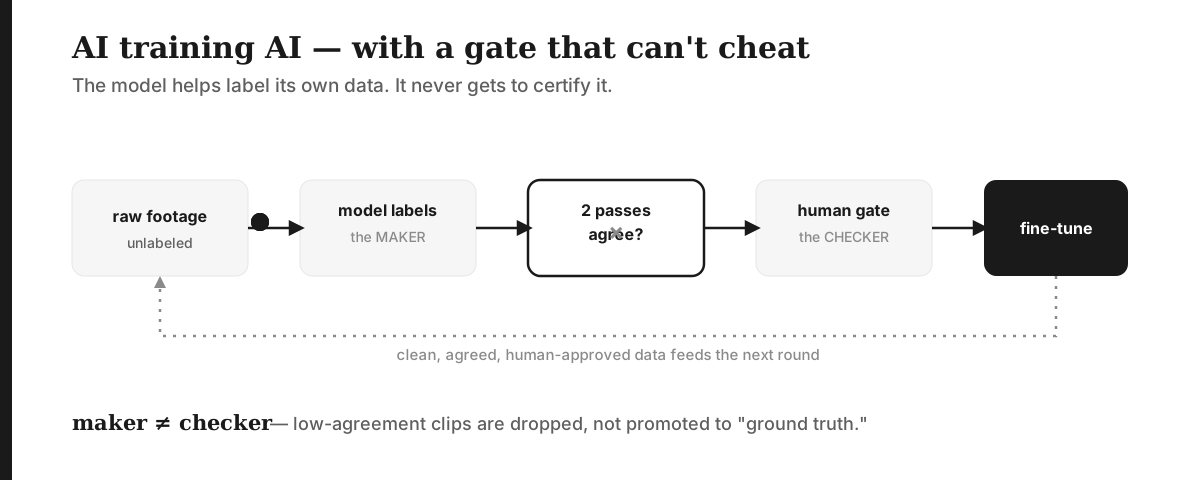
The student driver needs thousands of hours of practice, and no human wants to hand-label a million clips of "car changes lane." So the frontier move is to let the model help make its own training data: use the current model to propose labels on raw footage, keep only the clips where independent passes agree, and feed the clean set back into the next round. "AI training AI."
It's a flywheel, and it's also the single most dangerous idea in the room — because a model that grades its own homework will happily invent an A. The fix is a discipline, not a bigger model: maker ≠ checker. The thing generating the labels is never the thing that certifies them, low-agreement samples are dropped rather than promoted, and a human reviews the sample before any auto-generated data enters training. Curation with a gate compounds. Curation without one launders the model's own mistakes into "ground truth" and quietly rots the whole system.
The punchline: the edge is the loop, not the model
For thirty years the hard part of video was representation: we went from hand-crafted optical flow, to learned features, to two-stream nets, to transformers, to today's VLMs. That part is now a rental — everyone runs roughly the same multimodal brain. What stayed stubbornly manual — the evaluation and the data curation — is the new frontier. And it isn't won with a bigger model. It's won with a tighter closed loop:
fine-tune the VLM on real motion
      → grade it with a strict, evidence-gated examiner
      → curate new data where independent passes agree (human-gated)
      → fine-tune again
   ( each turn adds a capability; the bar ratchets up )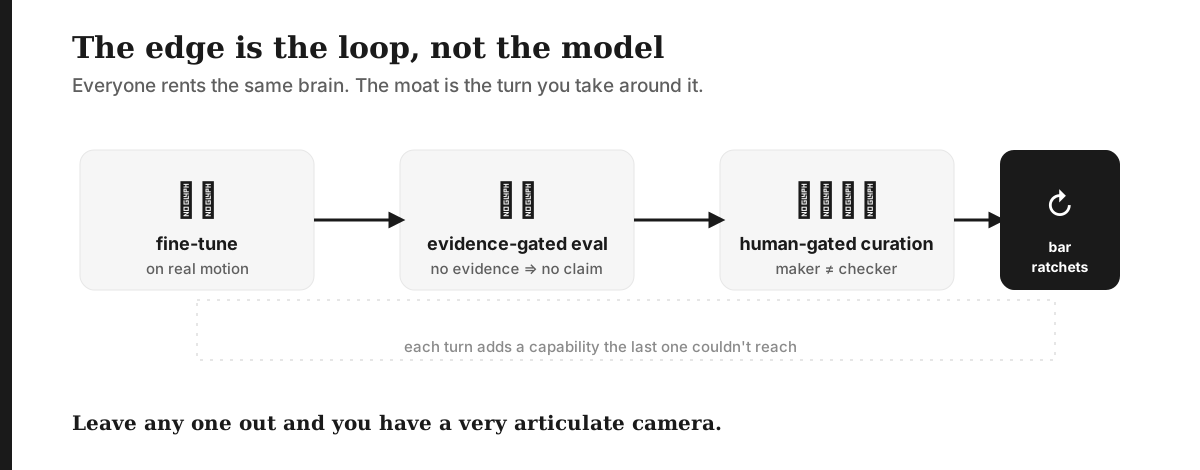
Three parts, one loop: time-glue so the model perceives motion, an examiner so it can't bluff, a curation flywheel so it improves without a human labeling every frame. Bolt them together and the system gets better every week from footage that was previously unusable. Leave any one out and you've got a very articulate camera.
This is the same lesson that keeps showing up across AI-native work, whether the domain is driving video, protein folding, or aging biology: stop generating tools once and freezing them. Engineer loops that grade themselves honestly and compound. The model is the cheapest part. The loop is the moat.
Where this stops being a metaphor
I don't just believe the loop — I ship it. Every part of the diagram is an open, runnable skill you can read before you run it. Same house rule as the examiner: read the code, don't take my word for it.
| Part of the loop | Open skill | What it does |
|---|---|---|
| Fine-tune on motion | vlm-quickstart | Take an open VLM from zero to running on video: prep video + sensor metadata, LoRA/QLoRA fine-tune for motion understanding, evaluate spatiotemporal reasoning + localization, serve. |
| The strict examiner | agentic-eval | Grade spatiotemporal reasoning, localization, and narrative consistency with an LLM-as-judge harness + regression gates. Eval as a repeatable, gated pipeline — not a one-off script. |
| The factory that can't cheat | curation-loop | "AI training AI": use your own model to label/refine a video dataset, filter with quality + safety gates, feed it back into fine-tuning. The flywheel, with maker ≠ checker built in. |
| Grounding the answer | vector-rag | Retrieval over video: embed clips with a CLIP/SigLIP encoder, index in a vector DB (FAISS/Milvus/Qdrant), retrieve the relevant moments, and ground the VLM's answer in what it actually retrieved. |
They live in one public hub — FM-os — next to the knowledge base I built to earn them: ~70 papers, the model + lab landscape, and a curated reading list, all kept as data with a live index at wjlgatech.github.io/FM-os. And the loop isn't a thought experiment — I ran it end-to-end in a different domain, longevity-loop, where a task can't be marked "done" without a before→after result. Same discipline, different footage.
How I pressure-tested this (three telescopes)
A good story is cheap. I checked the claim through three time horizons so it isn't just one:
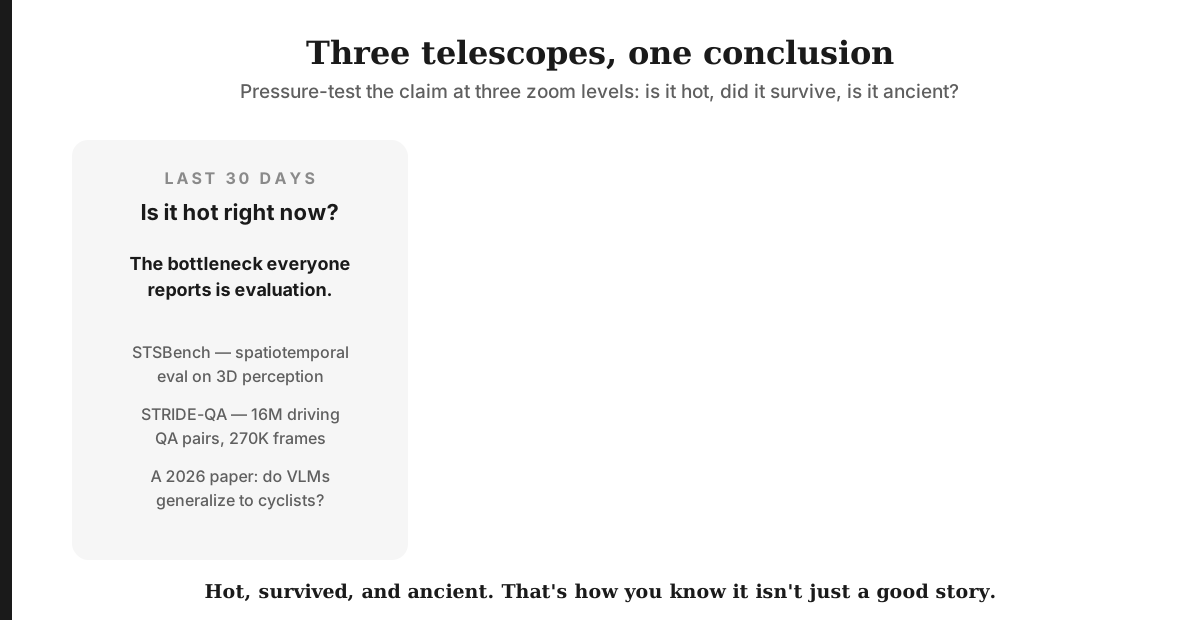
- Last 30 days. The field is racing to build exactly this referee: STSBench scores spatiotemporal reasoning against 3D perception; STRIDE-QA is 16M driving QA pairs over 270K frames; and a 2026 paper literally asks whether driving VLMs generalize to cyclists — the exact edge case from the opening. The bottleneck everyone reports is the same: not the model, the evaluation.
- Last 30 years. Representation got solved in public — optical flow → CNNs → transformers → VLMs. Evaluation and curation didn't; they stayed hand-built. That gap is the whole opportunity.
- Last 300 years. Nullius in verba, 1662. The oldest rule in modern science is "no evidence, no claim." We're not inventing rigor for video AI — we're finally applying it to a machine that can talk its way past us.
Keep reading
Part of the AI-Native series. The skills, the knowledge base, and the worked loop are all open at github.com/wjlgatech/FM-os — read the code, don't take my word for it.