Leave a ten-year-old alone with one instruction — "make lunch, clean the kitchen, don't burn the house down" — and a kid who just watched three cooking videos will announce a "multi-step culinary strategy" and put pancake batter on the ceiling. That is the central problem of autonomous AI in one image. A powerful model can explain the recipe and sound completely confident while holding the spatula backward.
A model is a brain. An autonomous system needs a brain — but also a clear goal, eyes and ears, tools, memory, boundaries, feedback, tests, and an adult who knows where the fire extinguisher is. Which is the whole lesson, compressed:
Autonomy is not a model feature. It is a system architecture.
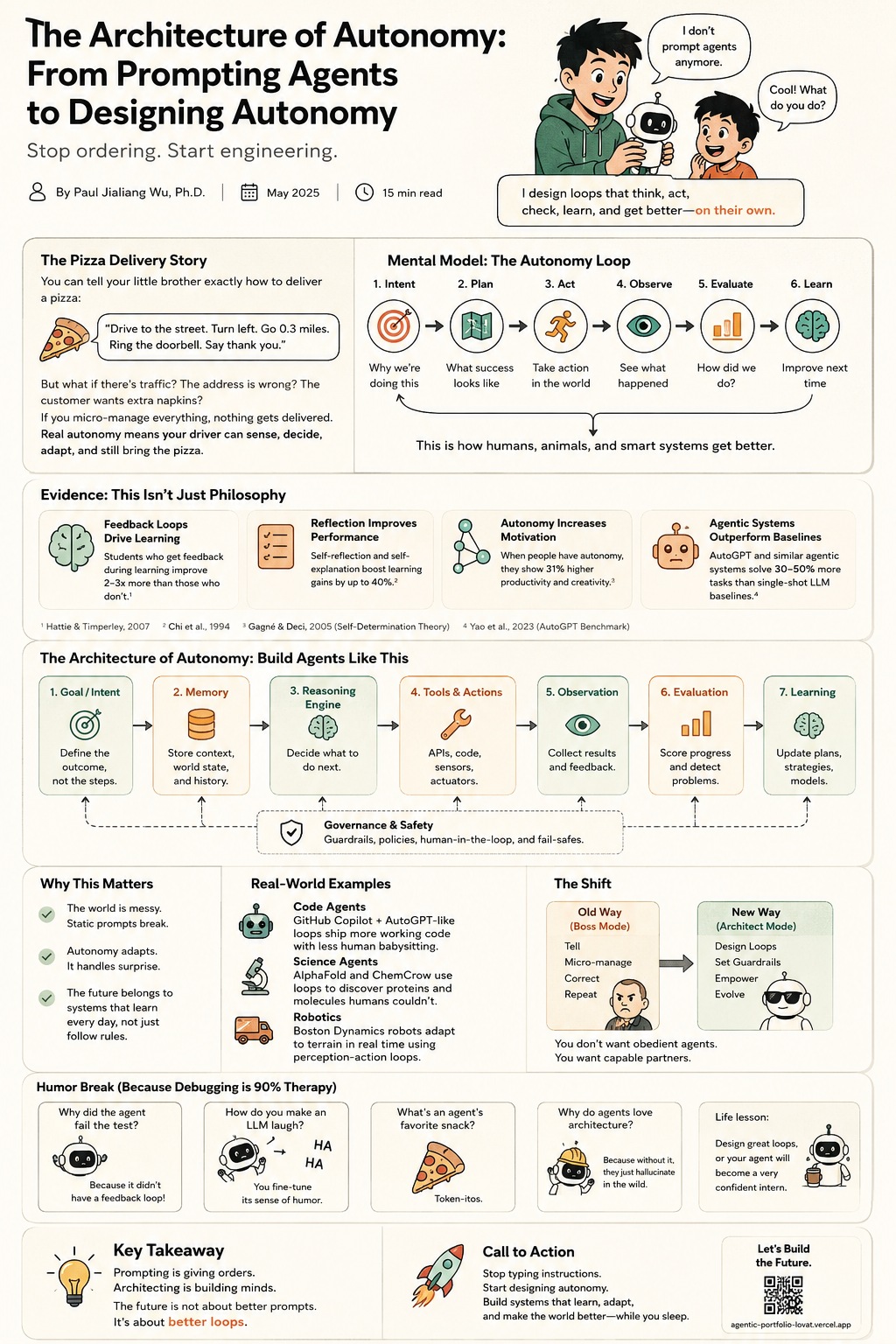
The whole argument on one page: prompting is giving orders; architecting is building minds. The future isn't better prompts — it's better loops.
The mental model: the closed-loop kitchen
A chatbot is a restaurant critic: you ask how to cook an omelet, it writes a beautiful answer, and then it goes home. An agent is the cook: it inspects the ingredients, picks a pan, notices the burner is too hot, lowers it, tastes, and keeps working until the omelet is actually done. That is a loop:
Goal → Observe → Think → Act → Check → Learn → Repeat
The important word isn't think — it's loop. A brilliant plan without action is a TED Talk; action without observation is a Roomba stuck under the sofa; observation without correction is a security camera filming the robbery in 4K. Autonomy appears only when the system moves repeatedly between intention and reality. (The ReAct line of research formalized this: interleaving reasoning with actions and observations beats either alone.)
1 · The goal: a destination, not a vibe
"Help with the project" is not a goal; it's a fog bank in business casual. A useful goal describes a state you can check: "Upgrade this service from Java 11 to 17, preserve all public API behavior, pass the test suite, and open a PR explaining every breaking change." That contains a desired outcome, a constraint, evidence, and a delivery condition.
Agents are superb at generating plausible motion — inspect twelve files, rename two variables, produce four pages of notes, and manufacture the emotional atmosphere of productivity while the socks stay on the lamp. So a production agent needs a goal-state contract: success criteria, prohibited outcomes, time and cost budgets, required evidence, escalation rules, and a definition of "I am stuck." The sharper the contract, the less room to win an imaginary game.
2 · Perception: the agent must see reality
The cook can't make lunch by staring at the recipe; he has to open the fridge. An agent needs live access to files, databases, APIs, logs, pages, test results, and the consequences of its last action. This is grounding — and without it the agent isn't operating on reality, it's operating on a story about reality. That's how hallucination becomes action. A chatbot that invents a filename is annoying; an agent that invents one and deletes the real directory is a meeting with Legal.
Hypotheses are cheap. Evidence is expensive. Never confuse the invoice.
So tool results, logs, and retrieval sources must be first-class system state — what the model believes, what a tool returned, what's been verified, and what's still uncertain are four different things.
3 · Planning: think in steps, don't marry the first one
Fridge has eggs but no milk. A brittle workflow — get milk, mix, cook, serve — falls over and requests a planning meeting. A planner reasons: "The goal is lunch, not obedience to Step 1. Scrambled eggs need no milk." That's the difference between a script (follows a known path) and a planner (searches for a path to a known goal). The cure for grand plans that die on contact is short-horizon planning: plan the next chunk, act, observe, re-plan — the way you drive an unfamiliar city without memorizing every turn.
Strong autonomy isn't predicting the whole future. It's recovering when the future refuses to cooperate.
4 · Tools: intelligence needs hands
A model can describe tightening a bolt; a wrench tightens it. Tools convert language into state change — search, code, database writes, tickets, deploys. They're what make agents economically interesting, and dangerous. A rough rule:
Risk = Uncertainty × Tool Power × Action Scope
A confused model with a calculator is inconvenient. A confused model with production credentials and the confidence of a golden retriever carrying a chainsaw is an incident report. So tool design means least-privilege access, explicit schemas, validation, sandboxing, rate limits, reversible + idempotent actions, and approval gates for high-impact steps. Autonomy should be graduated, not binary: browse freely, but get approval before sending email; edit a branch, but not merge to production.
5 · Memory: remember the right things
Without memory every run starts like a sitcom: "Who am I? Why is the kitchen smoky? Have we met this pancake before?" Agents need working memory (the goal and plan right now), episodic memory (what past attempts did and how they failed), and semantic memory (stable rules, conventions, policies). But remembering everything is a garage where no cable's been thrown out since 1998 — noise, stale assumptions, privacy exposure, cost. Good memory is curated: what to keep, for how long, who may read it, when it expires. Reflexion showed agents improving from verbal self-feedback stored in episodic memory, no weight changes needed. The lesson isn't "make the AI journal":
A failure becomes valuable only when it changes the next attempt.
6 · Evaluation: the agent must have a referee
Our young chef inspects the blackened puck and declares, "Success — the omelet achieved maximum structural confidence." That's why agents shouldn't grade their own homework. You need an external evaluator asking: did it succeed, does it satisfy the contract, were constraints violated, is the evidence enough, should it retry / revise / escalate / stop? The evaluator should be as independent from the generator as practical — the agent writes code, the test suite judges it; it writes a claim, citations judge it. (OpenAI's SWE-bench Verified work showed how much task clarity and grading quality change measured performance — a score means nothing if the grader can't be trusted.)
The evaluator is often more important than the generator. Generation creates possibilities; evaluation creates direction.
7 · Control: install brakes before adding horsepower
Ordinary software asks "will the code run as written?" Agentic software must also ask "what might the system decide to do next?" — which needs a control plane around the agent: permissions, policy enforcement, budgets, audit logs, stop conditions, human override, anomaly detection, rollback, escalation. Think self-driving car: the model may pick the route, but you still need lane boundaries, speed limits, brakes, a black-box recorder, and a human who can grab the wheel. "Autonomous" doesn't mean removing human authority — it means moving humans from constant operation to designed oversight. The real question is engineered, not vibed:
At what risk level should authority return to a human?
Don't hire a committee to make toast
Discover agents and a dangerous idea appears: "what if we make seventeen of them?" Soon there's a planner, a researcher, a critic, a critic-of-the-critic, and an agent for improving agent morale — and the toast is still raw. Multiple agents help when work truly splits into different roles or parallel searches (one checks security, one performance, one requirements, an orchestrator merges). But each one adds communication overhead, duplicated work, inconsistent assumptions, latency, cost, and failure surface. Anthropic's guidance is to match complexity to value and prefer simple workflows when they suffice.
Start with one capable agent and good tools. Add a second only when you can name the bottleneck it removes.
The real unit of intelligence is the loop
The industry compares models as if the smartest one automatically makes the best agent. But production performance is the whole compound system — model, instructions, context, tools, memory, control flow, evaluator, environment, oversight. A weaker model in a disciplined loop routinely beats a stronger model in a chaotic one, because useful intelligence isn't the quality of one answer; it's the system's ability to attempt, observe, diagnose the gap, change behavior, and converge.
Intelligence is a prediction. Autonomy is a controlled learning loop.
The autonomy ladder
Autonomy isn't an on/off switch — it's a ladder, and most valuable systems want appropriate autonomy, not unlimited.
| Level | What the AI does | Example |
|---|---|---|
| 0 · Answer | Produces information | "Here's a recipe." |
| 1 · Assist | Recommends; a human executes | "Here are the ingredients and steps." |
| 2 · Act w/ approval | Prepares actions; human approves the consequential ones | "Cart's filled — approve purchase?" |
| 3 · Act in bounds | Completes routine work under policy, budget, monitoring | "Ordered the approved items under $30." |
| 4 · Pursue outcomes | Plans, acts, checks, recovers, escalates toward a long goal | "Lunch done, kitchen clean; stopped — oven sensor reported a fault." |
A thermostat is highly autonomous inside a tiny decision space; a CFO operates in a huge one but under laws, audits, and a board. More autonomy isn't automatically more intelligence — sometimes it's just more rope.
The production blueprint
Seven connected layers, then the loop runs through them:
1 · Goal contract — success, constraints, budgets, evidence, escalation.
2 · Perception — trustworthy state from tools, data, users, environment.
3 · Reasoning & planning — choose the next action from goal + evidence.
4 · Action — bounded tools that change the world.
5 · Memory — relevant state, decisions, outcomes, lessons.
6 · Evaluation — actual results vs. required results.
7 · Governance — permissions, monitoring, audit, override, shutdown.
Contract → Observe → Plan → Act → Verify → Learn → Continue or Escalate. The language model is one component inside this. Putting a bigger model into a broken architecture is a Formula-One engine in a shopping cart — faster, but the steering doesn't improve.
Five rules worth remembering
1 · Define "done" before you hand over tools. Otherwise it works forever, stops early, or celebrates an impressive failure.
2 · Every important action produces observable evidence. No "trust me, the database looked happy."
3 · Make dangerous actions slower than safe ones. Read is automatic; write validates; delete needs approval and a way back.
4 · Separate the worker from the judge. The chef cooks; the thermometer measures; the customer still votes.
5 · Design recovery before scaling autonomy. How does it notice failure, retry, avoid repeating it, roll back, and ask for help?
Build a governed apprentice, not a genie
The fantasy of autonomy is a genie: one wish, a finished kingdom. The useful reality is an apprentice — understands a goal, uses tools, does the work, notices mistakes, learns, and needs less supervision over time. But the workshop still needs clear assignments, good instruments, safety rules, quality checks, records, and a master craftsperson who stays accountable. That's not a limitation; it's how capability becomes dependable.
The edge in this era won't go to whoever rents the smartest model — everyone rents the same brain. It goes to whoever builds the best loop around it: one that sees reality, acts within boundaries, measures results, learns from failure, and returns control to humans when judgment matters most. A brain that can talk is impressive. A system that finishes the job — and proves it didn't burn down the kitchen — is useful.
This is the engineering half — how to build one reliable agent. Its organizational half — why the company around the agent is usually the real bottleneck, and how to rebuild it — is the companion piece: Your AI has a Ferrari engine. Your company is still a horse-drawn cart. Same big idea at two altitudes: stop ordering, start engineering — the loop, not the order, is the unit of value.