AI-Native Series · 05
How to learn any field 10× faster with AI — wide and deep, without fooling yourself
1-minute takeaway — what you'll walk away with
Learn any field 10x faster with AI — wide AND deep — without fooling yourself. The Map · Ladder · Gate mental model, mapped term-by-term to the cognitive science. Part of the AI-Native series.
A mental model a 12-year-old can run, mapped term-by-term to the real cognitive science, with jokes engineered to make it unforgettable. ~7 min.
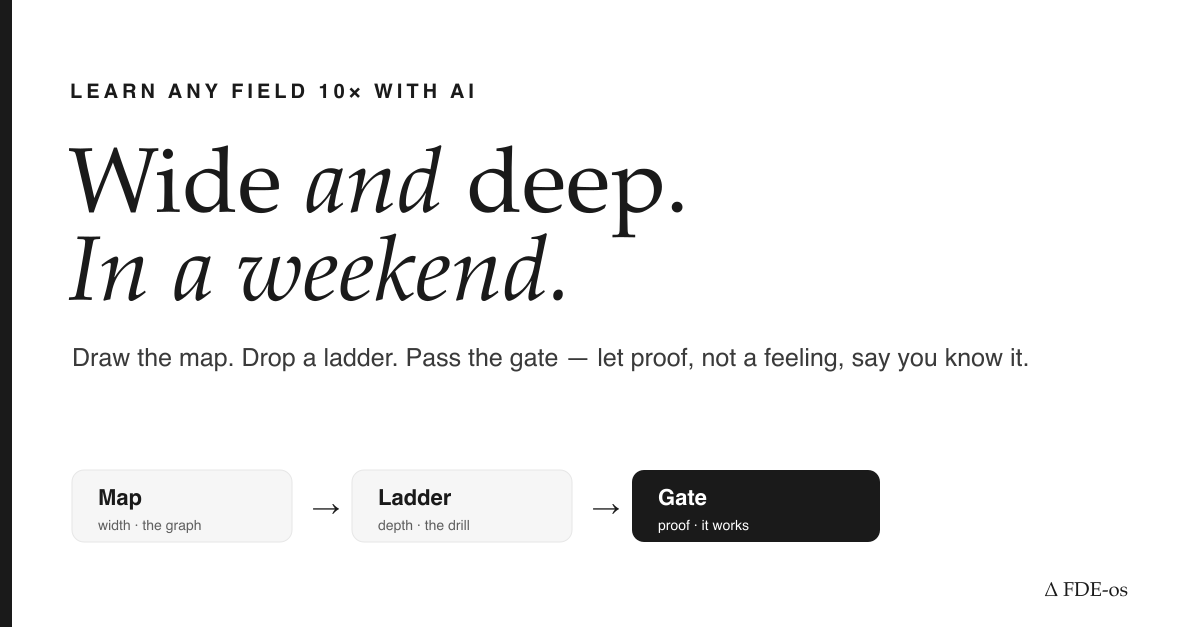
The weekend that shouldn't have been possible
Last week I had about 48 hours to get ready for a role built on a stack I had never touched — an MLOps platform plus an access-control layer, the kind of thing people list "5+ years" for.
Old me would have panic-read documentation until my eyes bled and I felt smart. New me did something different, and by Sunday night I had a map of the whole territory (32 concepts, linked) and a working proof that actually ran and passed its own test. Wide and deep. In a weekend.
Check the receipt instead of trusting the story — both are open: the 32-concept map, and the proof — a custom RBAC authorization layer (a Policy Decision Point + an enforcement middleware) with a (subject, action, resource) → allow/deny test table that passes. Try it live →
I'm not special. I just stopped learning the way we were taught, because AI quietly broke the old rules — and almost nobody has updated their mental model. Here's the one I use. A 12-year-old can run it. It also happens to be exactly what the learning-science literature has been screaming for 40 years.
First, kill the word "better." Define it or it's useless.
You asked the right question: 10× better in what sense?
Not "knows more facts." Knowing is cheap now; a chatbot knows more facts than any human who ever lived and still can't ride a bike. Better = you can deliver a verified result. You can do the thing, and something outside your own head confirms it works. Comprehension is a feeling. Competence is a receipt.
Hold that, because it's the whole game: the fastest way to fool yourself with AI is to mistake a warm feeling of understanding for the ability to produce a result. More on that con artist shortly.
The mental model: Map, Ladder, Gate
Picture learning a new field as exploring a mountain range.
- The Map is width. The whole territory from above — every peak, and the trails connecting them. You can't climb a map, but without one you don't even know which mountain matters.
- A Ladder is depth. You pick one spot and go straight down until you can actually operate there — not admire it, operate it.
- The Gate is proof. At the bottom of the ladder there's a turnstile that only opens if the thing you built actually works. No receipt, no pass.
Old-school learning forced a cruel trade: spend years on one ladder (deep but narrow — the person who knows everything about one bolt and nothing about the bridge), or wander the map forever (wide but shallow — the person at the party with a hot take on everything and the ability to build none of it).
AI ends the trade. It draws the entire map in an afternoon and builds you a ladder on demand, anywhere you point. T-shaped is so 2015. AI makes you comb-shaped: one wide bar across the top, and a whole row of ladders you drop wherever the ground gets interesting. (Yes, your career is now a hair-care product. I don't make the metaphors, I just ship them.)
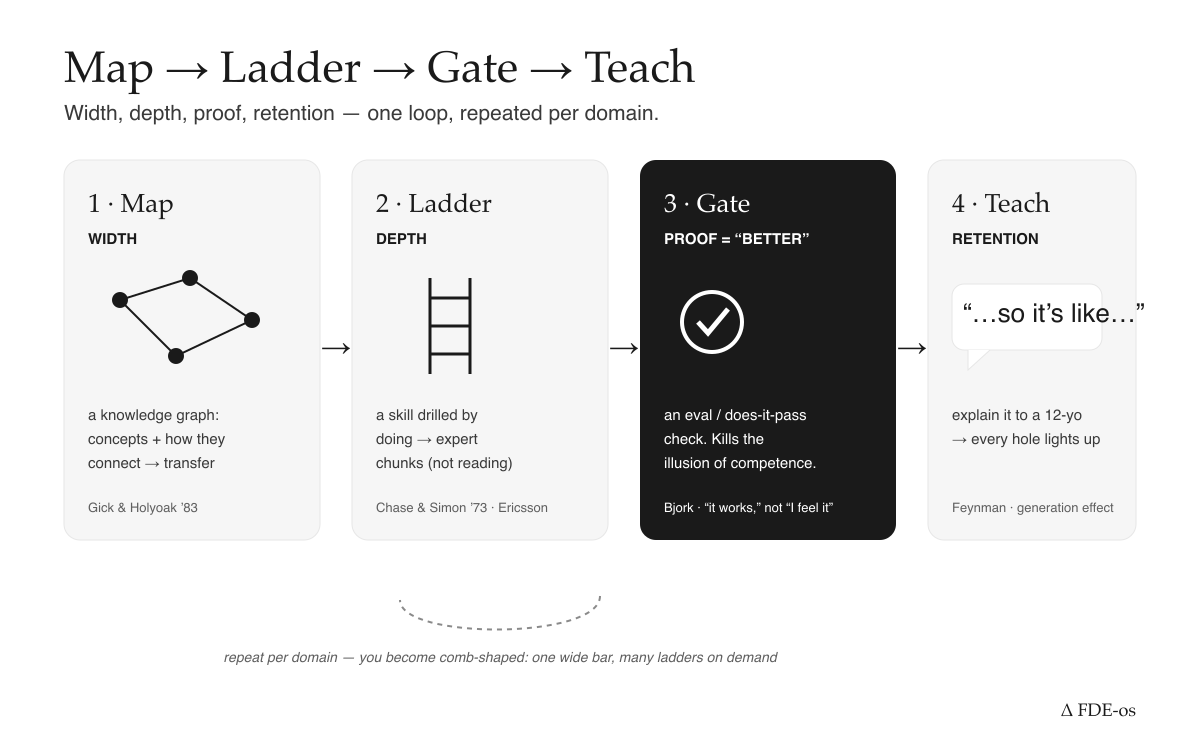
The same model, mapped term-by-term to the real thing
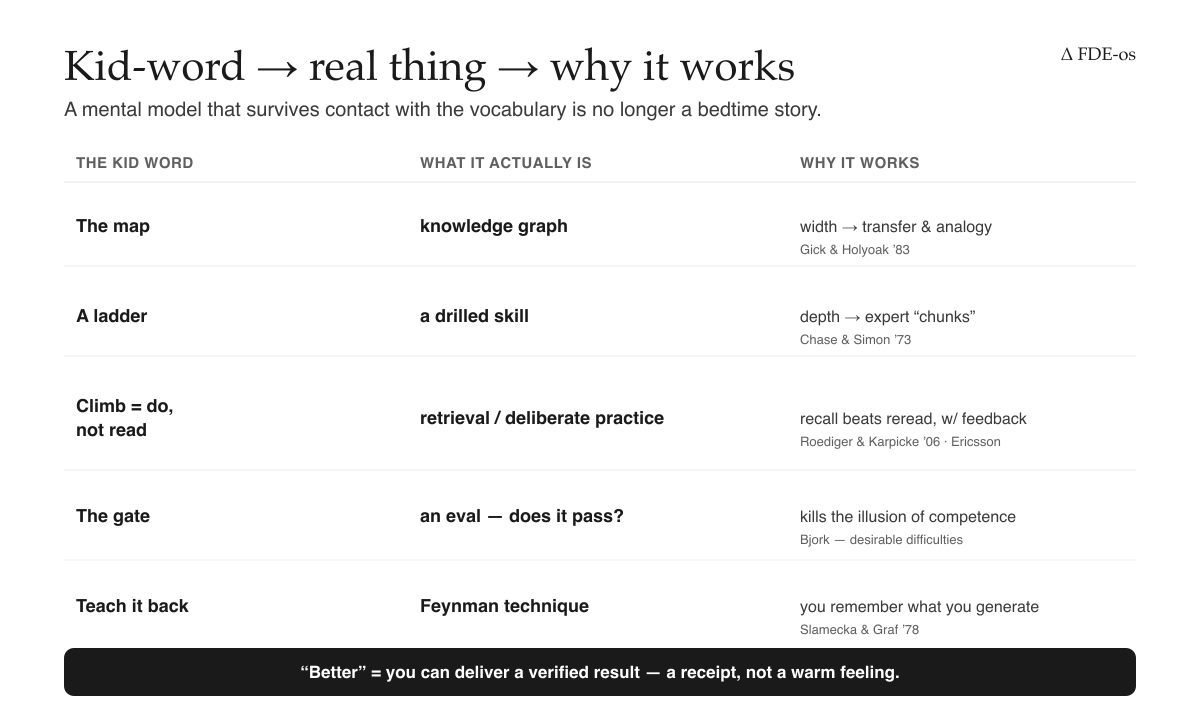
Because a mental model that can't survive contact with technical vocabulary is just a bedtime story:
| Kid word | What it actually is | Why it works |
|---|---|---|
| The map | a knowledge graph — concepts as nodes, relationships as edges | Width fuels transfer: you solve a new problem by analogy to a far one. Gick & Holyoak (1983). |
| A ladder | a skill drilled to a passing bar | Depth is chunking: experts see bigger patterns, not better memory. Chase & Simon (1973). |
| Climb = do, not read | retrieval / deliberate practice | Recall beats reread (Roediger & Karpicke, 2006); climb with feedback (Ericsson). |
| The Gate | an eval — does it actually pass? | Antidote to the illusion of competence (Bjork's desirable difficulties): fluency feels like mastery and isn't. |
| Teach it back | the Feynman technique / generation effect | You remember what you generate, not what you read (Slamecka & Graf, 1978). |
The con artist in the lab coat (the one trap that ruins everything)
You ask AI to explain a hard thing. It writes a gorgeous, fluent, confident explanation. You read it, nod, feel the warm click of "ah, I get it." You move on.
You got nothing. You rented a feeling.
That warm click is the illusion of competence — a tiny con artist who lives in your head, wears a lab coat, and whispers "you totally understand this" right up until someone asks you to build it, at which point he grabs his coat and leaves through the window. AI is rocket fuel for this con, because it makes the explanations frictionless while the doing stays exactly as hard as it ever was.
Reading a manual about swimming is not swimming. AI can hand you the greatest swimming manual ever written in three seconds. You will still drown — now with excellent theoretical posture.
The Gate is how you evict the con artist. He cannot survive a passing test.
So what does AI actually 10× — and what stays stubbornly human?
AI is a genie that draws the treasure map and 3D-prints the shovel. It does not dig. And if you skip the digging, it will cheerfully walk you off a cliff while you nod along.
What AI collapses from months to hours: drawing the map (synthesize a field into a graph of what connects to what); building the ladder's rungs (worked examples, a drill, a tireless 2am critic); standing up the Gate (an instant pass/fail on what you built).
What is still, gloriously, on you: the climbing (reps, retrieval — AI builds the pool, the coach, and the stopwatch in ten minutes; you still get in the water); choosing which ladder is load-bearing; and passing the Gate honestly, instead of deleting the failing test because it hurt your feelings.
The 10× isn't "read faster." It's "build the pool, the coach, and the stopwatch instantly, then actually swim" — same swimming, radically less setup, and a stopwatch that never lies to you.
The loop, in four moves you can run this afternoon
- Map it (width). Have AI fan out the field and hand you a graph: the concepts and how they connect.
- Drop a ladder (depth). Pick the load-bearing node. Get worked examples + a drill + the term-by-term mapping. Climb by doing.
- Pass the Gate (better). Build the smallest real artifact and check it against something outside your head. It runs? It passes? That's the receipt.
- Teach it back. Explain the map to a 12-year-old (or a rubber duck, or LinkedIn). The holes light up. Patch them. Now it's yours.
Try it (one afternoon, one field you're scared of)
Pick a domain. Run the loop: ask AI to graph the territory → drill the one load-bearing node by doing → build a tiny artifact and gate it → teach it back. Ship the artifact publicly. The tooling I use to make each step real (a knowledge-graph builder, a drill-as-gate, a readiness self-check) is open:
github.com/wjlgatech/FDE-osThe one line to remember
Old rule: you could be wide or deep, pick one, and it took years.
New rule: AI hands you wide and deep in a weekend — but only if you let a Gate, not a feeling, decide when you actually know it.
Save this if you're about to learn something hard and scary. What's the field you'd map this weekend if drawing the map took an afternoon instead of a year?
More in the AI-Native series
All of it lives in the Writing section on the home page.
Part of the AI-Native series. The tools are open at github.com/wjlgatech/FDE-os — you own the Publish button.