AI-NATIVE SERIES · HUMAN DYNAMICS IN AGENTIC AI, PART 4 OF 4
Win-Win-Win: Executives, Startups and Engineers in One Loop
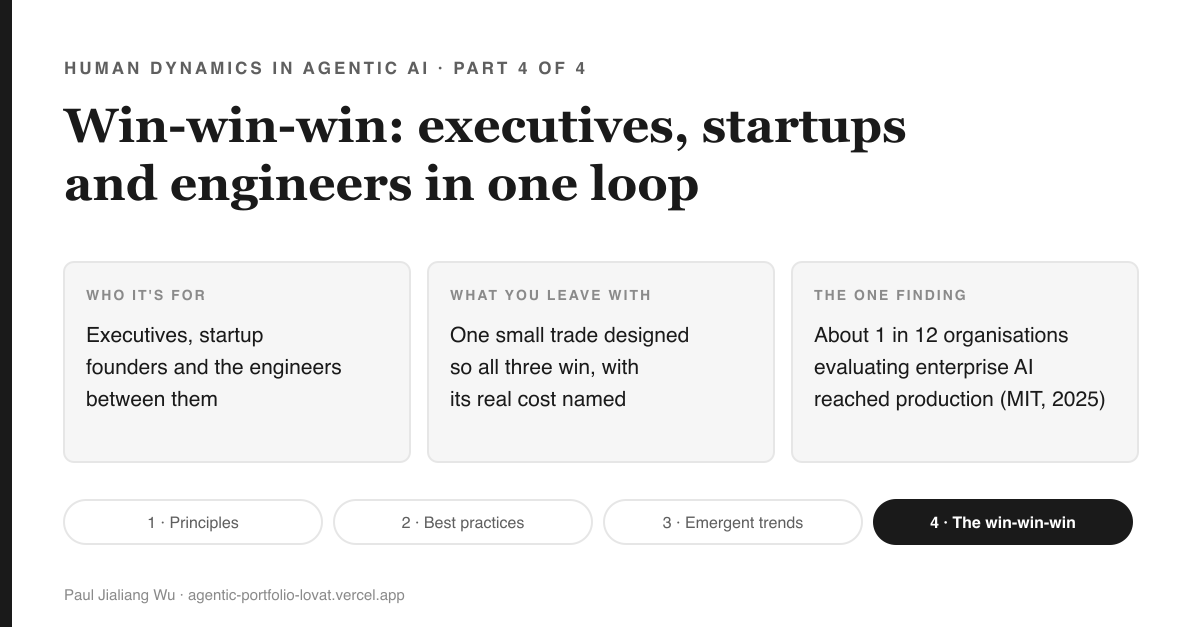
1-minute takeaway
What this is. Part 4 of the series: the people around the agents. It designs one small trade so an executive, a startup and the engineers on both sides all win, using a talk-to-pilot series as the worked case.
Why it matters. In MIT's 2025 study, of organisations that evaluated enterprise-grade AI tools, about one in twelve reached production. A deal that serves only one party breaks the first time another party speaks.
What you can do after reading. For one AI initiative, write one sentence per party, executive, startup and builders: what they win and what it costs them. If you can't fill in all six, fix that before the next meeting.
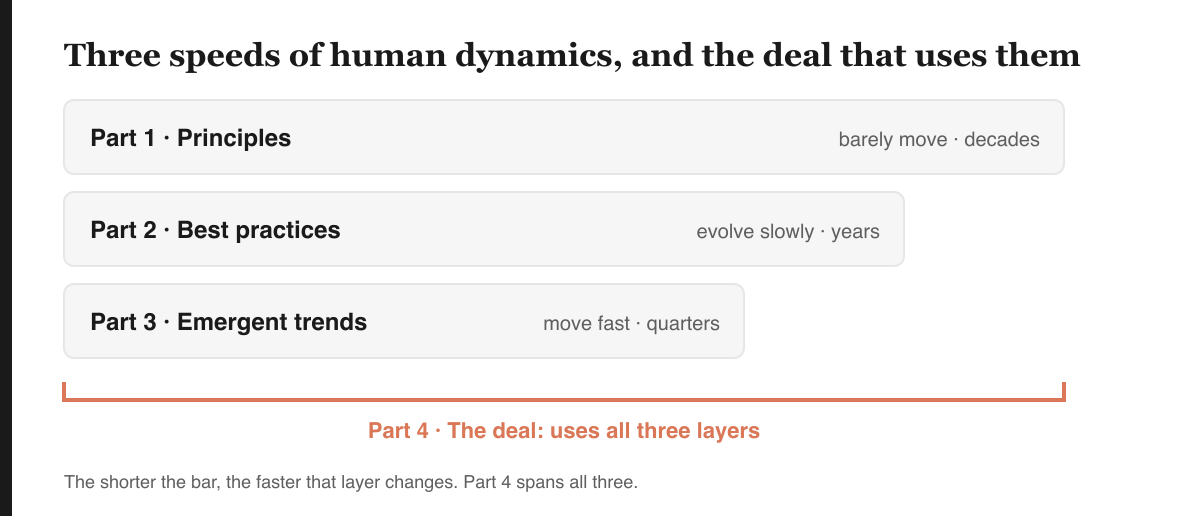
Human Dynamics in Agentic AI — the series spine
- Principles that barely move episode 1
- Best practices that evolve slowly episode 2
- Emergent trends that move fast episode 3
- The win-win-win this episode
How to read the labels: EVIDENCE is sourced, DESIGN is how the practice is designed, OPEN is not yet tested, and LENS is my own conviction.
Executives want proof before they spend, startups want a real customer, and engineers want frontier work that counts. A big vendor evaluation rarely serves all three. A small pilot with its pass mark set in advance, feedback first and credit named is designed to. The executive pays no fee; the cost is a named problem and some engineering hours.
What this episode covers: a win-win-win in agentic AI collaboration
This part is about the people around the agents: the executive who decides, the startup that builds, and the engineers on both sides. The worked case is Future Makers Strategic Collab (FM-SC), a talk-to-pilot series I run at the Accenture Advanced AI Center. It has run one talk: a design under test, not a track record. Views are my own.
Make a bet first
In an MIT study of 2025 enterprise AI, of the organisations that evaluated enterprise-grade AI tools, what share got them into production?
- A. About half.
- B. About a quarter.
- C. About one in twelve.
Three parties, three pains
The executive. EVIDENCE The answer to the bet is C, with caveats: 5 of the 60 is about one in twelve, if the funnel is nested. MIT's preliminary report found that "Sixty percent of organizations evaluated such tools, but only 20 percent reached pilot stage and just 5 percent reached production," where "such tools" are enterprise-grade systems, custom or vendor-sold (MIT NANDA, The GenAI Divide, v0.1, 2025). It rests on 52 interviews and 153 conference survey responses, and its authors call the figures "directionally accurate." EVIDENCE Gartner, as widely reported, forecast that "Over 40% of agentic AI projects will be canceled by the end of 2027" (Gartner, June 2025). That's a forecast, not a measurement, but it names the pain: hype, and pilots that stall.
The startup. EVIDENCE A survey by the venture firm Wing of 181 chief-level technology, security, data and AI leaders found enterprises expect "a median of 50% of AI pilots to convert to production," and large enterprises named integration and data as their top challenges (Wing VC, 2025). Wing's report also questions the MIT figures. LENS The two surveys count different things, pilots versus organisations, and disagree on the size of the problem. Both point at the same step, pilot to production, which is where a startup's purchase order lives or dies. Gregor Gimmy, who coined the "venture client" model at BMW, put the startup's dream in two lines: "But the client is king. Always." And: "if a BMW boss says I'm betting on your technology, here's a purchase order, then you're done. That's success" (via Global Venturing).
The builders. EVIDENCE In Stack Overflow's 2025 survey of developers, "autonomy and trust at work were ranked highest for reasons to be happy at work, but competitive pay, ranked second, was frequently ranked first, too" (Stack Overflow, 2025). LENS So frontier work and credit matter, and so does pay. The credit should be something they can use where pay is decided: a written finding with their names on it, not just a thank-you.
Why the usual deal fails all three
LENS The usual deal is a big vendor evaluation. The executive commits budget before knowing if the tool works, the startup spends months in a pilot with no purchase order at the end, and the engineers test a tool they didn't choose on a problem that isn't theirs. It's part 1's autopilot handback, three ways: everyone finds out at the end whether it worked, when it's too late to steer. It's also part 1's principal–agent problem: nobody measures what all three want, which is whether the tool solved a real problem.
The deal designed to make all three win
DESIGN FM-SC is designed around one small trade, and each piece is there for one party:
- The executive pays no fee. The cost is a named problem and some hours of engineering time. The pilot is small, supported by the startup, and its pass mark is written before it runs and ruled by someone other than the person who invited the startup.
- The startup gets a real customer moment. A real problem, engineers who give measured feedback first, and a dated decision on paid follow-up work if the pilot passes, paid by whichever team or client wants it next. FM-SC doesn't make that buying decision.
- The builders get frontier work that counts. They bring the problem, run the pilot, and their names go on what they found.
- Interests are disclosed. Any commercial or alliance interest in a startup is disclosed before a pilot is proposed.
EVIDENCE Why feedback comes first: across 128 studies, tangible rewards made contingent on doing a task reduced people's free-choice motivation, while positive feedback increased it (Deci, Koestner & Ryan, Psychological Bulletin, 1999). LENS So FM-SC's thanks is feedback, and it never depends on a verdict. The paid follow-up is a separate business decision made on the pilot's evidence, not a reward for a good talk.
Why a portfolio of small bets persuades
EVIDENCE Daniel Kahneman and Dan Lovallo found that managers make timid choices and bold forecasts because they judge each decision on its own; their remedy is to see decisions as a set (Kahneman & Lovallo, Management Science, 1993). DESIGN So FM-SC presents pilots as a portfolio of small, capped bets, each with its own pass mark, judged together over a year rather than one at a time.
EVIDENCE Time is the other constraint. Michael Porter and Nitin Nohria tracked 27 CEOs around the clock for 13 weeks; their article puts it plainly: "Time is the scarcest resource leaders have" (Porter & Nohria, HBR 2018). LENS Those were CEOs, but the constraint is likely similar for any senior leader. Hence sixty words with links to more, not a deck.
The map: four layers, one deal
| Principle (part 1) | Practice (part 2) | Trend (part 3) | In the deal | |---|---|---|---| | The more you automate, the more the human matters | Know the frontier; protect how novices learn | Skills that fade, and skills that never form | Builders run the pilot themselves | | Calibrate reliance | Start simple; say what it can do; design against over-reliance | The felt-versus-measured gap | Pass mark written before the run | | Judgment, not just control | Gate the irreversible | — | The pass mark is ruled by someone other than the person who invited the startup | | Delegation is a contract | thin in published guidance | Agents with named owners; the role shift to reviewer | One named owner per commitment; interests disclosed | | Systems copy the organisation | thin in published guidance | Shared protocols | One owner per hand-off between teams | | Measures become targets | thin in published guidance | Numbers that go stale | Judged on whether the problem was solved | | Competence, autonomy, relatedness, safety | thin in published guidance | Skills that fade, and skills that never form | A written finding with their names on it |
How to tell the story to each party
The same trade, three openings, each with its honest cost:
- To an executive: "Many pilots stall before production. Name one stuck problem; we'll look for a startup working on it. No fee, a few engineering hours, a pass mark on a date."
- To a startup: "A real enterprise problem, engineers ready to test, feedback first, and a dated decision on paid follow-up if it passes."
- To builders: "Bring the problem you can't crack. Test a frontier tool on it, with your name on the result."
What we don't know
OPEN We don't know senior consulting leaders' dreams in their own words: every published source we found surveys CEOs, the C-suite or mixed staff. So the dream used here, "first to a proven client story, without betting budget on hype," is a hypothesis for five to eight short conversations. And with one talk run, whether the trade works stays an open question until a pilot is ruled and a startup converts.
How this could fail
- One party quietly loses. If startups support pilots that never convert, word spreads and the best ones stop coming.
- The pass mark moves after the run. Then it's a demo, not a test, and executives learn to discount the next result.
- "No fee" hides the real cost. A free pilot is like a free puppy: the price is in the care. Name the engineering hours and reviews up front, or the first surprised manager ends the programme.
- An undisclosed interest. If there's any commercial link to a startup and it surfaces late, trust in every past result goes with it.
Your move this week
Write down one AI initiative you're involved in. For each party, the executive, the vendor or startup, and the builders, write one sentence: what do they win if it succeeds, and what does it cost them? If you can't fill in all six, that's the part to fix before the next meeting.
Next
That's the end of this series. Principles barely move, practices move slowly, trends move fast, and the people around the agents decide whether any of it turns into value. If you know a frontier lab, builder or researcher whose work should be in a future talk, tell us.
Sources
- MIT NANDA (2025). The GenAI Divide: State of AI in Business 2025 (preliminary report v0.1; third-party mirror). https://mlq.ai/media/quarterly_decks/v0.1_State_of_AI_in_Business_2025_Report.pdf
- Gartner (2025-06-25). Over 40% of agentic AI projects will be canceled by end of 2027 (forecast; quote as reported by several outlets). https://www.gartner.com/en/newsroom/press-releases/2025-06-25-gartner-predicts-over-40-percent-of-agentic-ai-projects-will-be-canceled-by-end-of-2027
- Wing VC (2025). The State of AI in the Enterprise (survey of 181 enterprise leaders). https://www.wing.vc/content/the-state-of-ai-in-the-enterprise
- Global Venturing. The venture client model (Gregor Gimmy). https://globalventuring.com/corporate/venture-client-model/
- Stack Overflow (2025). 2025 Developer Survey results. https://stackoverflow.blog/2025/07/29/developers-remain-willing-but-reluctant-to-use-ai-the-2025-developer-survey-results-are-here/
- Deci, E. L., Koestner, R. & Ryan, R. M. (1999). A meta-analytic review of experiments examining the effects of extrinsic rewards on intrinsic motivation. Psychological Bulletin, 125(6). https://doi.org/10.1037/0033-2909.125.6.627
- Kahneman, D. & Lovallo, D. (1993). Timid choices and bold forecasts. Management Science, 39(1). https://ideas.repec.org/a/inm/ormnsc/v39y1993i1p17-31.html
- Porter, M. E. & Nohria, N. (2018). How CEOs manage time. Harvard Business Review. https://hbr.org/2018/07/how-ceos-manage-time