AI-NATIVE SERIES · HUMAN DYNAMICS IN AGENTIC AI, PART 3 OF 4
Emergent Trends That Move Fast: Old Principles, Measured Again
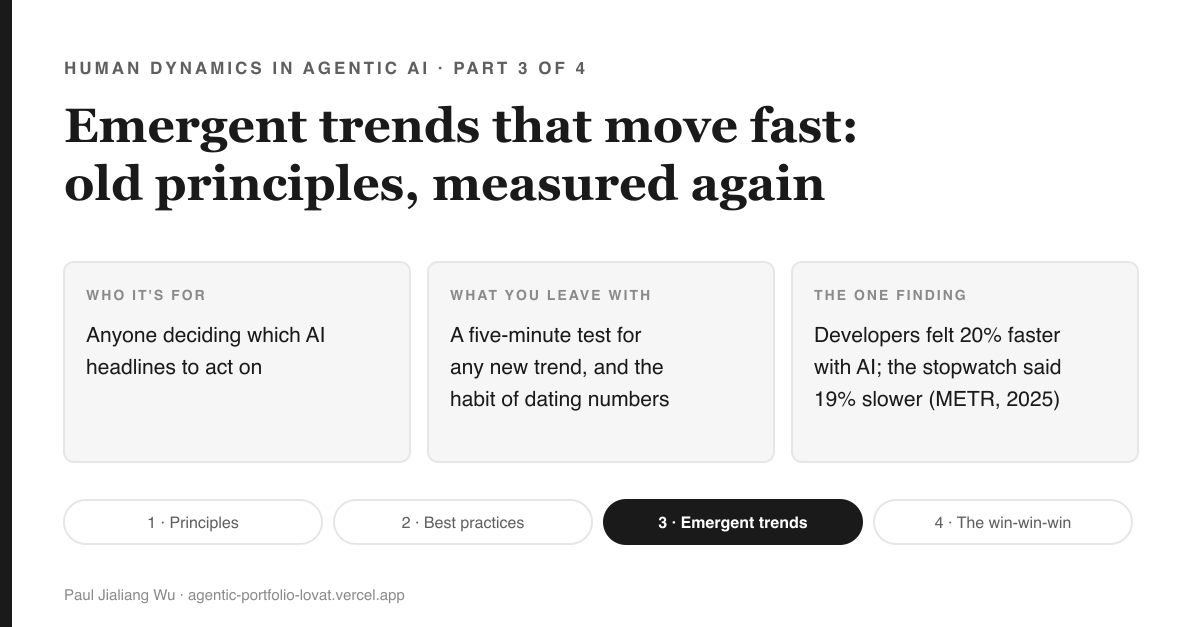
1-minute takeaway
What this is. Part 3 of the series: six emergent trends in how people work with AI agents, with the best evidence for each, the version of that evidence, and the old principle each one measures again.
Why it matters. Several 2025 headlines are already stale. "AI makes developers 19% slower" is one: its authors later said they couldn't re-measure it. A number without a date can quietly mislead a decision.
What you can do after reading. Find one AI number in a deck or memo you'll use this month, add its date and version, and drop it if you can't find either. Then judge the next trend with the article's five-minute test.
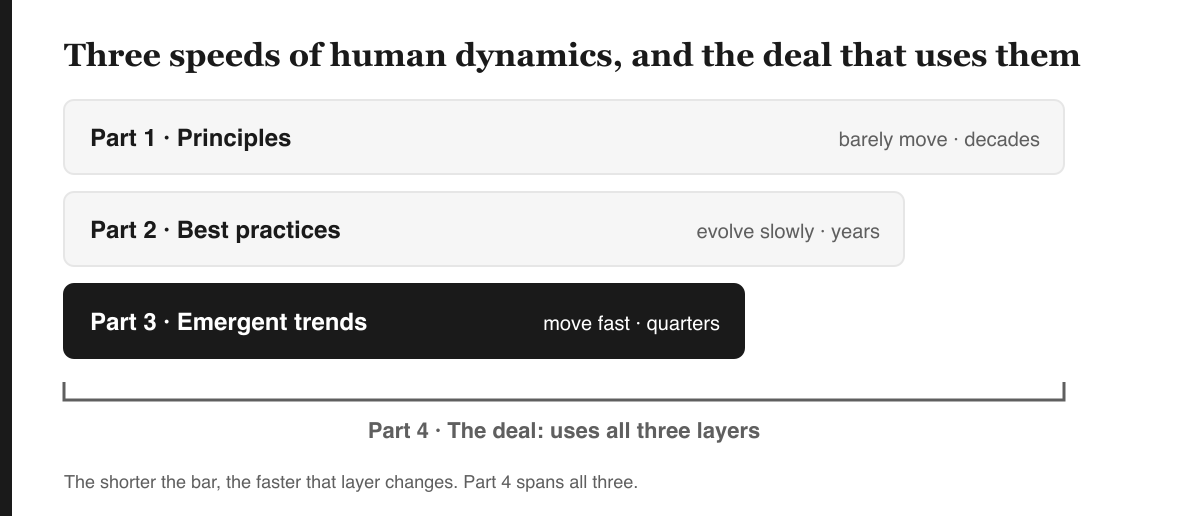
Human Dynamics in Agentic AI — the series spine
- Principles that barely move episode 1
- Best practices that evolve slowly episode 2
- Emergent trends that move fast this episode
- coming episode 4
How to read the labels: EVIDENCE is sourced, DESIGN is how the practice is designed, OPEN is not yet tested, and LENS is my own conviction.
Headlines about agents and people change every quarter. Read through part 1's principles, nearly every 2025–26 trend is an old law measured again: deskilling is Bainbridge, junior hiring is the learning gap, agent identities are delegation contracts. The result: a quick way to judge a new trend, and the habit of dating every number before you reuse it.
What this episode covers: emergent trends in human-agent work, 2025–2026
This is the fast layer. Six trends from the last eighteen months, each with its best evidence, the version of that evidence, and the part 1 principle it re-measures. It's for anyone who has to decide which headlines to act on, which is everyone who reads them.
A rule before we start: a trend number carries a date. One of the six below has been revised since it first made headlines, and another could not be re-measured. A trend number without a date is like milk without one: probably fine, until it isn't.
Make a bet first
In mid-2025, a careful study timed experienced open-source developers fixing real issues in their own projects, with and without AI tools. Before starting, they expected AI to cut their time by about a quarter. What did the stopwatch say?
- A. About 25% faster, as they expected.
- B. No measurable difference.
- C. Slower, while they still believed they'd been faster.
Trend 1: the felt-versus-measured gap in developer speed
EVIDENCE The answer is C. In METR's study of 16 developers and 246 tasks, "developers forecast that allowing AI will reduce completion time by 24%. After completing the study, developers estimate that allowing AI reduced completion time by 20%. Surprisingly, we find that allowing AI actually increases completion time by 19%" (METR, arXiv 2507.09089). The authors were careful to say what they did not show, beginning with: "AI systems do not currently speed up many or most software developers."
Then METR said its follow-up couldn't measure it. In February 2026 it reported that the new data "gives us an unreliable signal," partly because of "developers choosing not to participate in the study because they do not wish to work without AI," and that it believed developers were likely "more sped up" by early 2026 (METR update, 2026).
LENS So "AI makes developers 19% slower" is already a stale headline. The finding worth carrying forward is the gap between how fast people felt and how fast they were: part 1's calibration principle, measured on people instead of the machine. OPEN The follow-up didn't re-measure that gap, so whether it persists is an open question. Measure it in your own team before you trust either.
Trend 2: the deskilling evidence arrives
EVIDENCE Part 1's Bainbridge predicted that monitoring automation erodes the skill it replaces. In 2025 that was measured in medicine. After doctors had worked with AI-assisted colonoscopy, their detection rate on standard procedures without it fell "from 28·4% (226 of 795) before to 22·4% (145 of 648) after exposure to AI" (Lancet Gastroenterology & Hepatology, 2025). It was an observational study in four centres, so it shows the shape rather than proving the size.
EVIDENCE In software, a 2026 randomised trial measured a related effect: learning, not erosion. Fifty-two mostly junior engineers learned a new library, with or without AI help, and then took a quiz on concepts they'd just used: "participants in the AI group scored 17% lower than those who coded by hand," while the speed gain "was not statistically significant." In this sample, people who asked for explanations learned more (Anthropic research, 2026). That study came from a model vendor examining its own product category, so weigh it accordingly. The autopilot problem now has two names: skills that fade, and skills that never form.
Trend 3: fewer first rungs on the ladder
EVIDENCE Stanford's Digital Economy Lab found that employment for 22-to-25-year-olds in the most AI-exposed occupations is "19% below where it would be had it kept pace with that of their less-exposed peers," working "primarily through reduced hiring of young workers rather than increased separations," and also that "we find no evidence of widespread, economy-wide job displacement" (Brynjolfsson, Chandar & Chen, revised 2026-08-12).
Cite the version. Earlier editions of the same paper gave lower figures, and the authors describe the results as descriptive, not causal. LENS Put trends 2 and 3 together and you get part 1's autopilot at the scale of a labour market, with fewer pilots trained to take the controls back: if fewer juniors are hired and the juniors who are hired practise less, where do the experts who check the agents come from in ten years?
Trend 4: agents get identities, owners and offboarding
EVIDENCE Enterprise identity systems now treat agents as first-class identities. Microsoft's documentation (page last updated 2026-05-01; read 2026-10-13) describes "first-class identity and access management to AI agents," with "owners, sponsors, and managers" for each one, and sponsor-handoff workflows "to prevent orphaned agents" (Microsoft Entra Agent ID).
LENS That is part 1's delegation contract getting paperwork. An agent now has a principal by name, and when that person leaves, the agent has to be handed over or switched off: the same lifecycle as a contractor's badge.
Trend 5: the "agent boss"
EVIDENCE Microsoft's 2025 Work Trend Index introduced the "agent boss": "Someone who builds, delegates to and manages agents to amplify their impact and take control of their career in the age of AI" (Microsoft, 2025).
LENS If the role shift happens as Microsoft expects, more people will spend more of their time specifying, delegating and reviewing, which is part 1's principal–agent relationship becoming a job description.
Trend 6: shared plumbing, governed in the open
EVIDENCE The Model Context Protocol, the open standard for connecting agents to tools and data, was donated to a new Linux Foundation body in December 2025, with "more than 10,000 active public MCP servers" and "97M+ monthly SDK downloads," figures reported by the donor (Anthropic, 2025).
LENS Here Conway's law works in reverse: a shared protocol lets organisations that don't talk to each other still build agents that do.
The six, on one page
| Trend | Re-measures (part 1) | Best evidence, with its date | |---|---|---| | Felt versus measured speed | calibrate reliance | METR, July 2025; follow-up Feb 2026 could not re-measure | | Skills that fade, and skills that never form | the ironies of automation | Lancet Gastro. Hep. 2025 (observational); Anthropic RCT, Jan 2026 | | Fewer first rungs | the ironies, at labour-market scale | Stanford, revised 2026-08-12 (descriptive) | | Agents with owners and offboarding | delegation as a contract | Microsoft Entra Agent ID, page updated 2026-05-01 | | The "agent boss" | delegation as a job | Microsoft Work Trend Index, April 2025 (vendor survey) | | Shared plumbing | Conway's law | MCP donation, December 2025 (donor-reported) |
How to read the next trend in five minutes
- Which principle does it re-measure? If none, be suspicious, or be excited, but check twice.
- Which version is the number? No date, no decision.
- Who measured it, and do they sell the thing? Vendor research can be right; it can't be the only witness.
- Is it felt or measured? Trend 1 is the warning.
- Is it causal or descriptive? Trend 3's authors said which. Most headlines don't.
What we don't know
OPEN Whether deskilling is permanent or a transition cost is not yet known. Part 1's Brooks question is still open too: whether adding agents to late work slows it down the way adding people does. The colonoscopy and coding studies measured the drop, not the recovery. Nor do we know whether lower junior hiring is a pause or a new floor. Both are open questions worth tracking by date, not by headline.
How this could fail
- Every trend forced into an old box. Some genuinely new dynamics will appear. Rule 1 says be suspicious, not dismissive.
- Stale numbers in your own deck. The fix is a date and a version on every figure, and a review before reuse.
- Fear as strategy. Deskilling and hiring trends are real signals. They argue for designing practice into the work, not avoiding agents.
Your move this week
Find one AI number in a deck or memo you'll use this month. Add its date and version. If you can't find either, replace it or drop it.
Next
Part 4 puts all three layers to work on one question: how do executives, the startups they partner with, and the engineers on both sides all win from the same work, not one at the others' expense?
Sources
- METR (2025). Measuring the impact of early-2025 AI on experienced open-source developer productivity. arXiv 2507.09089. https://arxiv.org/pdf/2507.09089
- METR (2026-02-24). Uplift update. https://metr.org/blog/2026-02-24-uplift-update/
- Lancet Gastroenterology & Hepatology (2025). Multicentre observational study of endoscopist performance after exposure to AI in colonoscopy. https://wrap.warwick.ac.uk/id/eprint/191005
- Anthropic (2026). How AI assistance affects coding skills (randomised trial). https://www.anthropic.com/research/AI-assistance-coding-skills
- Brynjolfsson, E., Chandar, B. & Chen, R. Canaries in the coal mine (revised 2026-08-12). https://digitaleconomy.stanford.edu/publication/canaries-in-the-coal-mine-six-facts-about-the-recent-employment-effects-of-artificial-intelligence/
- Microsoft (2026). What's new in Entra Agent ID. https://learn.microsoft.com/en-us/entra/agent-id/whats-new-agent-id
- Microsoft (2025). 2025 Work Trend Index: the Frontier Firm is born. https://blogs.microsoft.com/blog/2025/04/23/the-2025-annual-work-trend-index-the-frontier-firm-is-born/
- Anthropic (2025). Donating the Model Context Protocol and establishing the Agentic AI Foundation. https://www.anthropic.com/news/donating-the-model-context-protocol-and-establishing-of-the-agentic-ai-foundation