AI-Native Series · Faith Life
Holy Is Not a Compliment
1-minute takeaway — what you'll walk away with
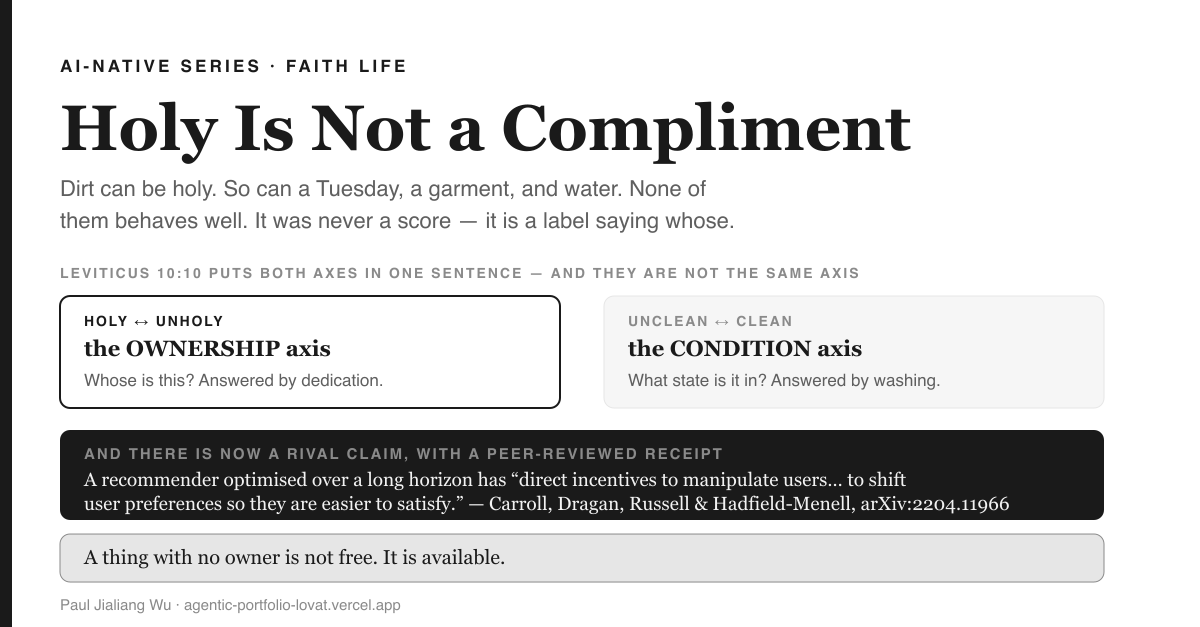
We shrank holy into a personality rating — a quiet compliment for well-behaved people. The Hebrew will not carry that. Dirt is called holy at the burning bush. So are a day, a garment, a nation, and water. None of them behaves well; none of them is a moral agent at all. And Leviticus 10:10 settles it in one sentence by naming two different axes — “between holy and unholy, and between unclean and clean” — so holy and clean cannot be synonyms. Kadosh answers “whose is this?”, not “how good is this?” Which makes it the most useful word I know for right now, because something else is already answering that question about you. A recommender optimised over a long horizon, in the words of the preprint of an ICML paper, has “direct incentives to manipulate users” — specifically “the incentive to shift user preferences so they are easier to satisfy.” Not to serve what you want. To make what you want cheaper to serve. The first principle: a thing with no owner is not free — it is available.
"Holy" has become a compliment. We say someone is holy and we mean they are gentle, don't swear, and probably get up early. Useful word, shrunk to a personality trait.
The Hebrew word underneath it — קָדוֹשׁ, qādôsh, kadosh — will not fit inside that. And you can prove it in about thirty seconds without knowing any Hebrew.
The thirty-second proof
Look at what the Hebrew Bible is willing to call holy. Not just people — a lexicon entry for this word lists — across its BDB block and its topical section, and including the cognate noun qōdesh — the ground at the burning bush, the altar, the priestly garments, the Most Holy Place, the priests, the nation, the angels, holy time (Sabbaths and festivals), and water [1].
Dirt. A Tuesday. A shirt. Water.
None of these behaves well. Most of them cannot behave at all. If holy meant "morally excellent", the sentence "this water is holy" would be a category error, and it isn't — it's just vocabulary.
So the word is doing something other than scoring conduct.
Two axes, and we collapsed them
The cleanest evidence is a verse, and I want to be clear that noticing it is not original to me — this is essentially the priestly schema that Jacob Milgrom's Leviticus commentary builds out of exactly these categories, and Philip Jenson's Graded Holiness after him [6]. Aaron's sons are told to teach Israel:
“that you may distinguish between holy and unholy, and between unclean and clean” — Leviticus 10:10, NKJV
Read that as an engineer for a second. That sentence names two different axes and puts them side by side — different, note, not independent; in the priestly system they interact constantly, which is the whole reason the instruction is addressed to priests:
- holy ↔ unholy — an ownership axis. Whose is this? Changed by dedication.
- unclean ↔ clean — a condition axis. What state is it in? Changed by washing.
Hebrew has separate vocabulary for the second one — ṭāhôr (clean) and ṭāmēʾ (unclean) — and if holy simply meant clean, the verse would be saying the same thing twice with different words, which is not how instructions work.
And it is not one verse. Ezekiel indicts the priests for failing at both jobs — “they have not distinguished between the holy and unholy, nor have they made known the difference between the unclean and the clean” (22:26) — and then, describing the restored temple, assigns both again: “they shall teach My people the difference between the holy and the unholy, and cause them to discern between the unclean and the clean” (44:23) [5]. Three verses, two books, the same pairing of two distinct tasks each time.
Almost every mistake we make with this word comes from collapsing the ownership axis onto the condition axis. Then "be holy" turns into "be cleaner", which turns into "don't do bad things", which is a much smaller command and, worse, a command you can obey without ever answering the actual question.
A word on the etymology, since it is usually oversold
You will often hear that kadosh "literally means cut off" or "separated". Be careful with that, and I say this as someone who wanted it to be true because it makes a tidier sermon.
The root is קדשׁ (Q-D-Sh), and it produces a family: qōdesh (holiness, a holy thing), qādash (to consecrate), qādôsh (holy). Lexicons do commonly gloss it as set apart [1]. But the deeper etymology is genuinely contested, and the honest reason is a lovely methodological problem: the word almost never appears in ordinary non-religious use, so there is no neutral control group to test the "separation" theory against. That objection is usually attributed to one standard reference work — that because the root rarely if ever occurs in a secular sense, any conclusion about its underlying meaning is difficult to reach. I am reporting that attribution rather than the book, which I did not consult directly [2].
So: set apart is a fair working gloss, well supported by usage. "Literally means cut off" is a claim the evidence does not carry. The argument below does not need it.
What got tripled
The most famous holiness text is Isaiah's throne room:
“Holy, holy, holy is the Lord of hosts; The whole earth is full of His glory!” — Isaiah 6:3, NKJV
The usual observation is that the angels don't cry "loving, loving, loving" or "powerful, powerful, powerful", even though Scripture says God is both. That observation is worth keeping — but I want to make it honestly, because the version you normally hear overclaims.
Threefold repetition is not a construction reserved for holiness. Jeremiah does it twice: “O earth, earth, earth, Hear the word of the Lord!” (22:29) and, mocking false confidence, “The temple of the Lord, the temple of the Lord, the temple of the Lord” (7:4) [3]. So tripling is an intensifier in Hebrew, available for anything.
Which makes the real point sharper, not weaker. Tripling was available for any attribute. In the throne room, the thing that got the maximum-emphasis construction was not God's power and not God's love. It was God's otherness. Of everything you might shout at that sight, the seraphim maxed out the one that says there is nothing else in this category.
Exodus makes the same move as a rhetorical question rather than a shout:
“Who is like You, O Lord, among the gods? Who is like You, glorious in holiness, Fearful in praises, doing wonders?” — Exodus 15:11, NKJV
(Worth noting: many popular versions render that phrase "majestic in holiness". The NKJV, which this article quotes throughout, has “glorious in holiness”. Same idea, different word — and if you are going to put a Bible phrase in quotation marks, it should be the one your named translation actually prints.)
The grammar of that verse is comparison, and the answer is nobody. Holiness here is not a high score on a shared scale. It is the absence of a shared scale. God is not humanity plus a thousand percent; the categories don't nest.
Then the astonishing instruction
The God described as categorically other turns around and says:
“You shall be holy, for I the Lord your God am holy.” — Leviticus 19:2, NKJV
Notice it is not try harder to be good. It is be what corresponds to Me — a statement about belonging before it is a statement about behaviour. The same book calls the nation “a kingdom of priests and a holy nation” (Exodus 19:6, NKJV): not a trophy for good conduct, a job description.
And then, if you keep reading Leviticus 19 expecting incense and fasting, you get: don't steal, don't lie, don't exploit a worker's wages, don't show favouritism to the rich, care for the vulnerable, love your neighbour as yourself.
Which is the tell. Holiness does not remove you from ordinary life; it changes who ordinary life belongs to. Your payroll can be holy. Your calendar can be holy. Your repository can be holy. Not because those things become religious-looking, but because the answer to "whose is this?" changed.
The dirt did not change
The cleanest illustration is Moses at the bush:
“Do not draw near this place. Take your sandals off your feet, for the place where you stand is holy ground.” — Exodus 3:5, NKJV
What changed about the soil? Send a sample to a lab before and after and you get the same report — same pH, same nitrogen, same everything. The ground is not holy because that patch of dirt is morally superior to the dirt beside it.
Holiness is relational. The property is not in the object; it is in the object's relation to an owner who is present. Which is why the word applies so happily to water and Tuesdays, and why "be holy" is not primarily an instruction about self-improvement.
"Set apart" is half a definition
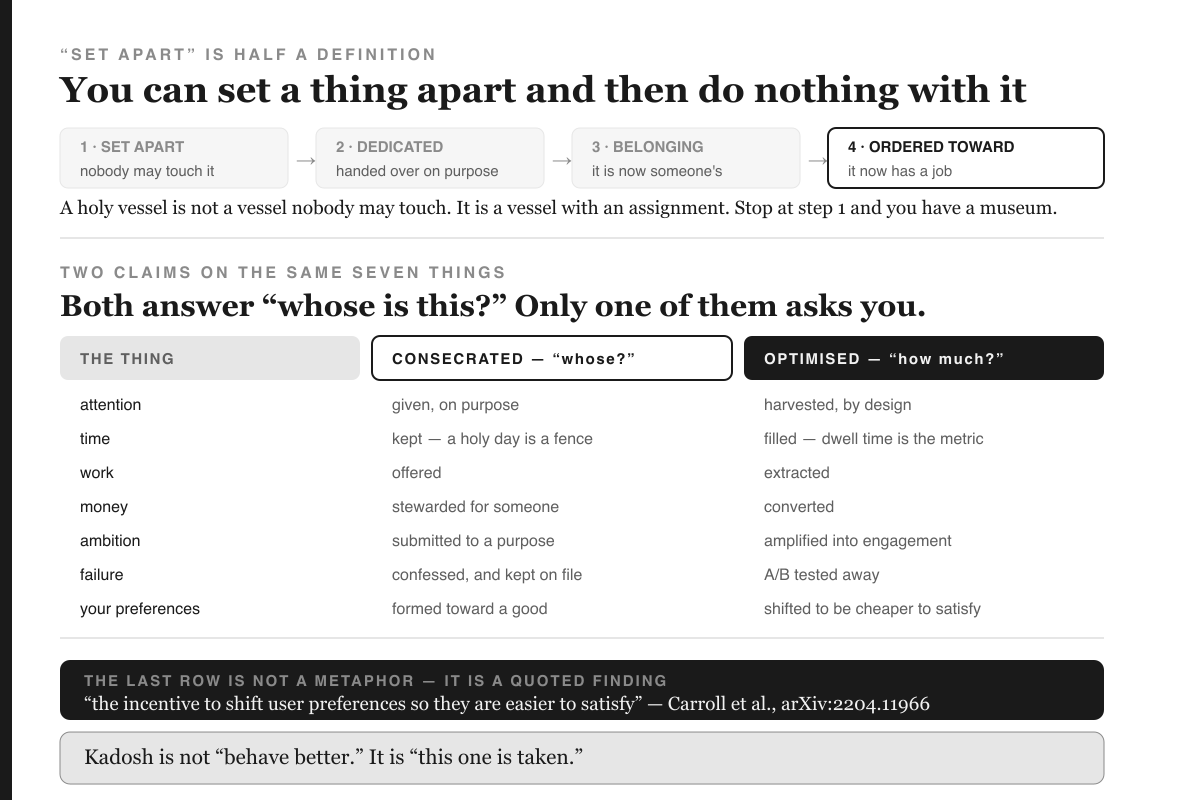
Here is where the common gloss runs out. You can set a thing apart and then do nothing with it. That is not holiness; that is a museum.
The biblical movement has four steps, not one: set apart → dedicated → belonging → ordered toward a purpose. A holy vessel is not a vessel nobody may touch; it is a vessel with an assignment. A holy nation is not a nation quarantined from the others; Exodus 19:6 makes it a priesthood, which is by definition a job performed on behalf of outsiders.
So the preposition matters more than the verb. Holiness is not separation from something. It is separation for someone. Isolation is what you get when you stop at step one.
And it does require a boundary — that part of the old instinct is right. Leviticus 10:10 asks for a distinction to be taught, and Hebrew has a word for the other side of the line, ḥol, the common or profane. If everything is holy, the word has stopped doing work. A fence with no outside is not a fence.
It is also not safe
We tend to picture holiness as warm and clean. In the text it is frequently alarming. Isaiah's reaction to the throne room is not comfort; it is ruin — he pronounces woe on himself and says he is undone, a man of unclean lips. (I'm describing it rather than quoting because the phrasing varies by translation more than most people expect.)
The mechanism there is not that God has become angry. It is that proximity to something absolute makes the difference legible. The closer you get to a light source, the more you see about what isn't lit — including on your own hands. That's why the encounter produces awe and repentance in the same breath, and it is the same reason a good code review feels bad before it feels useful.
Psalm 89, and holiness as non-drift
There is a line in Psalm 89 that reframed this whole word for me:
“Once I have sworn by My holiness; I will not lie to David:” — Psalm 89:35, NKJV
God swears by His holiness — and look at what the oath's content is. Not "I will be powerful." Not "I will be pure." "I will not lie."
Holiness is being invoked as the collateral behind reliability. That is a startling thing to learn about the word. Its otherness is not only distance from us; it is the absolute integrity of being one thing. God does not need to become someone else tomorrow in order to cope with tomorrow.
Which is exactly the property I have been chasing on the engineering side of this site: a system whose behaviour, strategies and outputs all change with the evidence, while the thing it is does not drift. That is the subject of the two Psalm 89 pieces linked below, and this is the word underneath both of them.
The rival claim
Now the part that made me want to write this down rather than just read it.
"Whose is this?" is not an idle question anymore, because there is a well-funded industry answering it about you, continuously, and it has a peer-reviewed description. From the preprint of a 2022 paper by Carroll, Dragan, Russell and Hadfield-Menell — and I have to be precise about which version, because it matters:
“The content that a recommender system (RS) shows to users influences them. Therefore, when choosing a recommender to deploy, one is implicitly also choosing to induce specific internal states in users. Even more, systems trained via long-horizon optimization will have direct incentives to manipulate users: in this work, we focus on the incentive to shift user preferences so they are easier to satisfy.”
That wording is from arXiv:2204.11966. The published ICML version says the same thing more briefly — “direct incentives to manipulate users, e.g. shift their preferences so they are easier to satisfy” — so the sentence I just quoted, the one this whole article turns on, exists in the preprint and not in the version of record [4]. I would rather tell you that than have you find it.
Sit with the last clause either way. Not the incentive to satisfy your preferences — the incentive to change your preferences into ones that are cheaper to satisfy. That is a structural property of optimising over a long horizon, not a conspiracy and not a moral failing of any particular company. And to their credit the authors' whole proposal is to measure it before deployment and constrain it, using what they call “safe shifts” — a trust region of the drift a user would have undergone anyway [4].
But notice what has happened at the level of the question. Something is now making a claim on my attention, my time, my ambition and — measurably — my wants. In the vocabulary of Leviticus, that is an ownership claim. It is being pressed on the ownership axis, while most of us are still defending on the condition axis, congratulating ourselves for not doing anything bad with our phones.
I have written elsewhere on this site about owning my intelligence — my notes, my lineage, my reading. Kadosh asks the prior question, and it is a more uncomfortable one. Not who owns my intelligence but whose am I. Because if nothing has a claim, that is not neutrality.
The mechanism, and the first principle
The chain is short. Attention is finite, so it is contested. Whatever wins the contest gets to shape wants over time. Wants shape action; action shapes character. So the ownership question is not a devotional flourish sitting on top of ordinary life — it is upstream of everything downstream, and it gets answered whether or not you answer it.
A thing with no owner is not free. It is available.
That is what kadosh is for. It is the word for the refusal to be generally available.
Patterns and anti-patterns
| Pattern | Anti-pattern |
|---|---|
| Answer "whose is this?" about a specific, named object. | Answering "am I a good person?" and calling it holiness. |
| Finish the ladder: set apart and assigned a purpose. | Stopping at "set apart" — a museum piece nobody may touch. |
| Keep the boundary; some things stay common on purpose. | Declaring everything holy, which retires the word. |
| Treat separation as for someone, expressed as service to outsiders. | Treating it as from everyone, expressed as distance. |
| Assume your preferences are being shaped, and ask by whom. | Assuming your preferences are simply yours because you feel them. |
| Let proximity to something absolute show you what it shows you. | Choosing a standard low enough to stay comfortable next to. |
The practice: consecrate one named thing
Vague consecration does nothing, so make it specific enough to fail. Pick one object — not your whole life. Your phone. Thursday evenings. The repo you're building. The way you write performance reviews.
Then answer four questions in writing, which takes about five minutes:
- What is it? Name the object precisely enough that someone else could point at it.
- Whose is it? Say it plainly. This is the ownership axis, and it is a decision, not a feeling.
- What is it now for? Step four of the ladder. If you can't name a purpose, you have set something apart and stopped.
- What will I refuse? One concrete thing you will no longer do with it, starting today. This is the fence. Without it the other three answers are decoration.
Then the shortest version of the meditation, which is the one I actually use:
Kadosh.
I am not my own.
My attention is not random.
My life is not an optimization problem without an owner.
I belong to God.
Therefore this moment belongs to Him too.
The one-line version
Holy is not a grade. It is a name tag. God is holy because He is utterly, uniquely Himself — and the oath He swears on it is that He will not lie. We become holy the same way dirt did: not by improving, but by belonging, and then by being given something to do.
Everything currently competing for your attention is answering the ownership question on your behalf, and it does not need your permission to win. So answer it first, out loud, about one named thing today.
Related
References
- BibleHub lexicon entry for qādôsh (Strong's Hebrew 6918), “Holy, sacred, set apart”, from qādash. Source of the range of referents cited in the body — the ground at the burning bush, the altar and priestly garments, the Most Holy Place, priests, the nation, angels, holy time (Sabbaths and festivals) and holy water — and of the common “set apart” gloss. biblehub.com/hebrew/6918.htm · companion entry for qōdesh (6944): biblehub.com/hebrew/6944.htm
- The etymological caution is described, not quoted. The objection summarised in the body — that because the root קדש rarely if ever occurs in a secular sense, conclusions about an underlying “separation” meaning are difficult to reach — is attributed in the reference literature to the Theological Wordbook of the Old Testament, over against BDB's proposal that the root reflects separateness. I did not reach a copy of TWOT itself, so nothing here appears in quotation marks and the claim is reported as the state of a debate rather than as a settled finding. Overview of that debate: Abarim Publications, קדש · Holiness in Judaism
- Jeremiah 22:29 and 7:4, NKJV — cited to show that threefold repetition is a general Hebrew intensifier and not a construction unique to holiness, which is why the body states the Isaiah 6:3 point as “what got tripled” rather than as a claim about uniqueness. Verified via BibleGateway (NKJV)
- Carroll, M., Dragan, A., Russell, S., & Hadfield-Menell, D. (2022). Estimating and Penalizing Induced Preference Shifts in Recommender Systems. Proceedings of the 39th International Conference on Machine Learning (ICML 2022), pp. 2686–2708; preprint arXiv:2204.11966. The long quotation in the body is verbatim against the arXiv abstract, and not against the published version, whose abstract is shorter and reads “direct incentives to manipulate users, e.g. shift their preferences so they are easier to satisfy.” The body says so at the point of quotation. The phrase “safe shifts” appears in both. arxiv.org/abs/2204.11966 · proceedings.mlr.press/v162/carroll22a/carroll22a.pdf
- Scripture quotations are from the New King James Version: Leviticus 10:10; Leviticus 19:2; Exodus 3:5; Exodus 15:11; Exodus 19:6; Isaiah 6:3; Psalm 89:35; Jeremiah 22:29; Jeremiah 7:4; Ezekiel 22:26; Ezekiel 44:23. Each was checked against the NKJV text before quoting — including Exodus 15:11, where the body notes that the NKJV prints “glorious in holiness” rather than the “majestic in holiness” of several other versions. Isaiah 6:5 is described, not quoted, because its wording varies materially between translations. Verified via BibleGateway (NKJV)
- The two-axes reading of Leviticus 10:10 is mainstream, not original to this article, and the body says so. It is essentially the priestly schema that Jacob Milgrom builds out of these categories in his Leviticus commentary (Anchor Bible), and that Philip Jenson develops in Graded Holiness: A Key to the Priestly Conception of the World (JSOT Supplement 106, 1992). Both are named, not quoted — I did not consult either directly, and cite them to locate the argument's lineage rather than to borrow their authority. The scriptural support the body actually rests on is the three-verse pairing (Leviticus 10:10; Ezekiel 22:26; Ezekiel 44:23), all quoted verbatim from the NKJV per [5].
Provenance. This began as a ChatGPT conversation the site owner supplied, working through kadosh in thirteen numbered sections; its spine — holiness as belonging rather than niceness, the burning-bush relational point, "separation FOR not FROM", the incompleteness of "set apart", the holiness/purity distinction, and the closing "I am not my own" meditation — is that conversation's contribution, and the final meditation is kept close to its wording. Nothing from it is quoted as evidence for any claim. What was added or corrected in the upgrade: the Leviticus 10:10 two-axes argument, which turns the holiness/purity distinction from an assertion into a single verifiable verse; the honest treatment of the tripling in Isaiah 6:3, since Jeremiah triples “earth” and “the temple of the Lord” and the uniqueness the popular version implies does not hold; the correction of “majestic in holiness” to the NKJV's “glorious in holiness”; the demotion of the etymological “separation” claim to a described debate with its methodological reason stated; the replacement of a general worry about technology shaping people with a quoted, peer-reviewed finding; and the four-question practice, which the original did not have in a form that could fail. Every quotation in quotation marks was checked verbatim against the source that carries it; two passages are deliberately described rather than quoted and say so. No material from any employer or client. — Paul Jialiang Wu · agentic-portfolio-lovat.vercel.app