AI-Native Series · Knowledge Curation
The First Bug My New Repo Caught Was Me.
1-minute takeaway — what you'll walk away with
I claimed my new repo indexed 31 repositories. The machine said 30. GodView-anything is a knowledge repo whose marketing adjectives have to compile: 'comprehensive' is a metric, 'up to date' is a weekly measured sync, 'in-depth' is a SHA-pinned digest requirement.
GodView-anything — a knowledge repo whose marketing adjectives have to compile. Seeded by the fastest-growing repo of 2026. ~6 min.
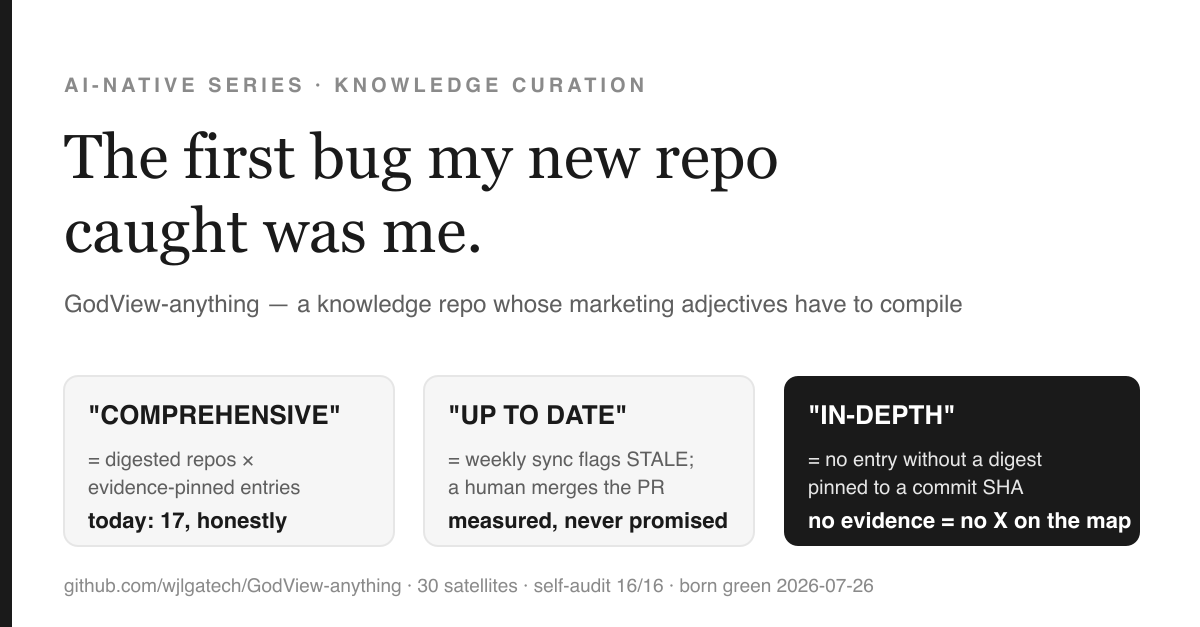
I claimed my new repo indexed 31 repositories. The machine said 30.
That off-by-one was the first bug my own quality gate ever caught — and the culprit was me, padding my launch notes like a kid rounding up his allowance. That moment is the whole idea, so let me give it to you properly.
The mental model: a treasure map where every X is checked before it's drawn. Most curated knowledge on GitHub is a map drawn from rumors — someone heard there's gold on that island, so an X goes on. Nobody sails back. GodView-anything is the other kind of map: an X only appears after someone dug, and the map re-checks the digging weekly.
Why now: the fastest-growing repo of 2026 taught me the pattern
World Monitor went from zero to 74,461 stars in about six and a half months — a real-time, Palantir-style world dashboard: 500+ news feeds, 65+ data providers, AI-synthesized briefs on a 3D globe. I digested it commit-by-commit (pinned at 88bfbac, 2026-07-26) and the deepest thing it teaches has nothing to do with maps:
it never promises freshness — it measures it. Its 500+ feeds are grouped into 35 source groups with per-group staleness tracking. Stale sources are detected by the system, not discovered by disappointed users.
Now look at the curation world through that lens. The Book of Secret Knowledge — 235,000 stars of ops-and-security wisdom — has been dormant since November 2024. public-apis — 452,000 stars — is alive and CI-validated to this day. Same genre, same fame. The difference isn't the maintainer's passion; it's whether the repo audits itself.
So I stole the principle from a world monitor and pointed it at knowledge itself.
What GodView-anything actually is
A meta-repo that studies top-rated repos and distills each into three pillars, every entry pinned to evidence:
- Transferable knowledge — the system design, decision patterns, antipatterns, and first principles under the stars. From the seed digest alone: agent-native product surface (MCP + REST + CLI + SDKs +
/llms.txtshipped alongside the human UI), local-first AI fallback (core features run keyless on Ollama; cloud LLMs are upgrades), derived-indices-are-the-product (raw feeds are commodity; the Country Instability Index is the moat). - Agentic tooling — skills, plugins, hooks, workflows, MCP servers — trust-labeled, because the ecosystem now contains star-inflated clone repos. One "skills" repo I found had 26,600 stars and the contributor graph of a ghost town. It's in my registry under
rejected:, with the reason on record. - Community — the humans. Elie Habib shipping ~25 commits a day, solo, to a 74k-star project (with a contributor literally named
claudeat 52 commits — the agents are already on the team). Kalev Leetaru's GDELT project, whose event data feeds half the conflict maps on Earth yet has no client library above ~300 stars. Sindre Sorhus, whose awesome-lint quietly invented curation-with-a-linter a decade before it was cool.
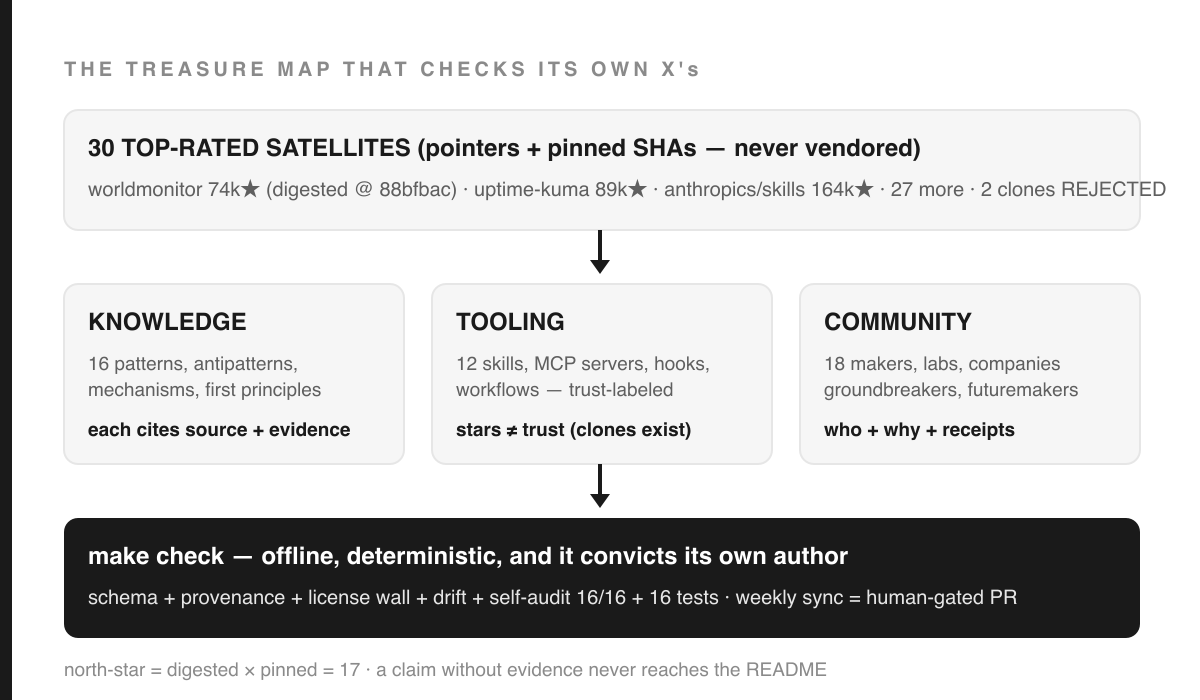
Day-one census, all machine-verified: 30 satellite repos across three buckets, 16 knowledge entries, 12 tooling entries, 18 community nodes, 16 tests, and a self-audit scoring 16/16 operating principles. make check — offline and deterministic — is the only judge of "done."
The mechanism: adjectives become computations
Here's the insider trick, one layer down. Every knowledge repo markets itself with the same three adjectives, so I compiled the adjectives into checks:
- "Comprehensive" = a north-star metric: digested repos × evidence-pinned entries. Today it prints 17. Small number, honestly earned — and it can only grow the way it started.
- "Up to date" = a weekly job that refreshes every repo's stars, SHA, and push date, flags what went stale, and opens a pull request a human must merge. Freshness is measured, never promised.
- "In-depth" = a repo enters only after a pinned digest extracts why it works — and anything unverified inside is labeled UNCONFIRMED rather than smoothed over.
The validator refuses ghosts: mark a repo "digested" without the digest file naming the exact SHA, and the build fails. It also enforces the license wall — World Monitor is AGPL dual-licensed, so it is indexed as a pointer, never vendored. My gate caught a real one within minutes of existing: I'd filed a CC-BY-licensed project under the permissive policy, and the build went red until I corrected the paperwork. Then it caught the 31-vs-30.
I built a lie detector and it opened its career with two convictions of its author. That's not embarrassing — that's the product working. The map now refuses to draw an unchecked X, even when the hand holding the pen is mine.
What it can't do yet
- One digest. Thirty satellites, but only World Monitor has the full SHA-pinned treatment. The other 29 are verified candidates — real metadata, no deep dive yet.
- The weekly sync hasn't survived a week — it exists and opens PRs, but cadence is proven by consecutive merged Mondays, and there have been zero Mondays.
- Bus factor of one. I am currently the entire curation committee, which is exactly the failure mode I wrote about three paragraphs ago. The gate-dispute issue template is open.
- A digest is a snapshot. Facts hold at the pinned commit; the sync flags drift, it doesn't re-verify prose.
The frontier
The repos everyone stars are already teaching everything — architecture, licensing strategy, community mechanics — but only to people who read commits for fun. The question I'm sitting with: if every adjective in your README had to compile, what would yours say?
GodView-anything is MIT, open source, and takes nominations by PR — the candidacy bar is in the registry file, and yes, the machine checks your homework too.
Related
Paul Jialiang Wu · AI-Native Series · 2026-07-26 · More writing →