AI-Native Series · Super-Repos
I Wired 17 Repos Into One Front Door. Nothing Turns Green Without Running Its Gate.
1-minute takeaway — what you'll walk away with
I wired 17 repos into one super-repo in a day — inspired by a pen-and-canvas app I'm legally not allowed to copy. The rule that made it work: no satellite turns green without running its own gate. Chain 01: a hand sketch ends as a floor plan that passes five construction checks, exit 0.
A super-repo born green in one day — inspired by a pen-and-canvas app I'm legally not allowed to copy. The whole design is one rule: no badge without evidence. ~6 min.
The problem: 24 repos and no front door
I build in repos the way some people take notes — compulsively. Design tools, research tools, a money OS, a career OS, a strategy OS. Each one works. Together they were a junk drawer: even I couldn't always remember which one answered which ask. If your own tools need a human index to be useful, you don't have a product family. You have a pile.
The fix was a day-long build called allin-anything: one super-repo whose only product is a verified table — a registry of 17 satellite repos, each labeled by what it can do and, more importantly, by how much of that claim a machine has actually checked.
The inspiration was a pen
The trigger was penecho — an open-source canvas where you handwrite to an AI: equations, diagrams, spatial sketches. Ink goes in, a structured draft comes back, and the draft stays separate from your confirmed work until you accept it. Physical gesture in, digital intelligence out, a human gate in between. That's the whole thesis of my repo family in one app someone else built.
One catch: penecho is AGPL-licensed. Copying its code into my repo would be both legally radioactive and architecturally lazy. So it became the founding test of the design instead: a satellite is a pointer, a pinned commit SHA, and a digest of confirmed facts — never a vendored copy. I take the pattern, credit the source, and run their code where it lives: upstream.
The mental model a 15-year-old can run
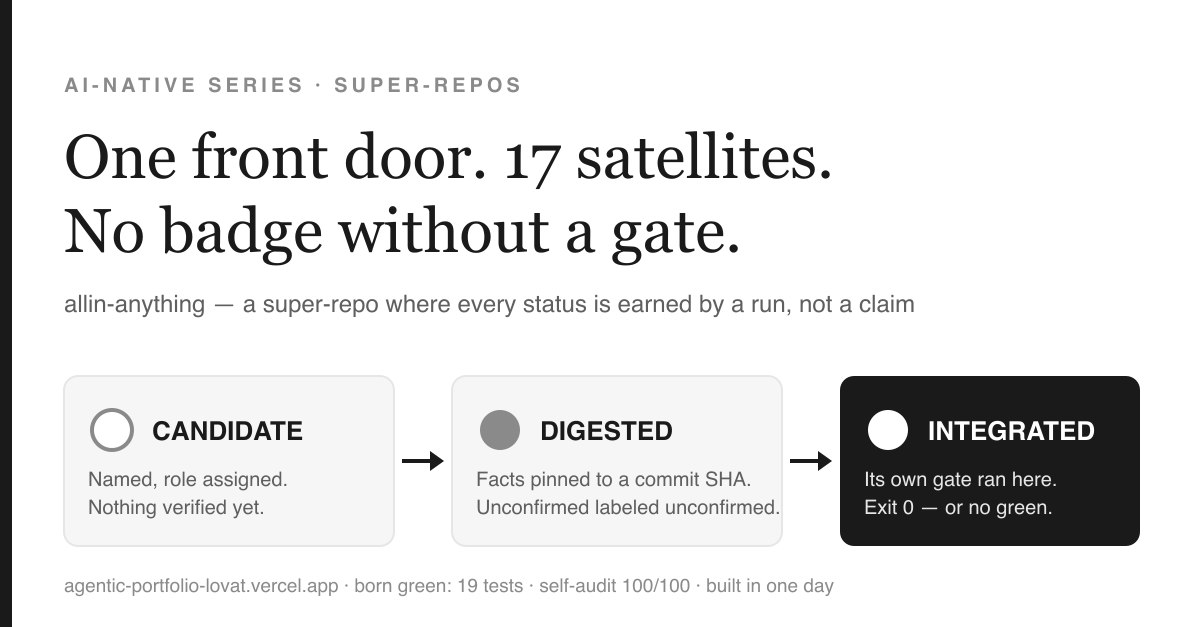
Think of a club with a strict bouncer. Every repo that wants in gets a wristband with three possible colors:
- ⚪ Candidate — you're on the list. Named, role assigned, nothing verified. That's it.
- 🟡 Digested — someone actually read your ID: a digest file exists with facts pinned to a specific commit, unconfirmed things labeled unconfirmed.
- 🟢 Integrated — you performed, live: your own test gate ran on this machine and exited 0, and the front door routes to you.
The bouncer is code, not vibes. A validation rule refuses any status upgrade whose evidence file doesn't exist on disk. The README table is generated from the registry and CI fails if they drift. On day one, 7 of 9 satellites were honestly white — and the README says so, because a table that flatters is a table you can't trust.
Chain 01: a sketch ends as a floor plan that passes inspection
The promise of the whole thing is "all-in interaction with the digital and physical world," so milestone 3 had to be a chain that crosses the border. The intent: "sketch a room layout by hand, then verify it's buildable."
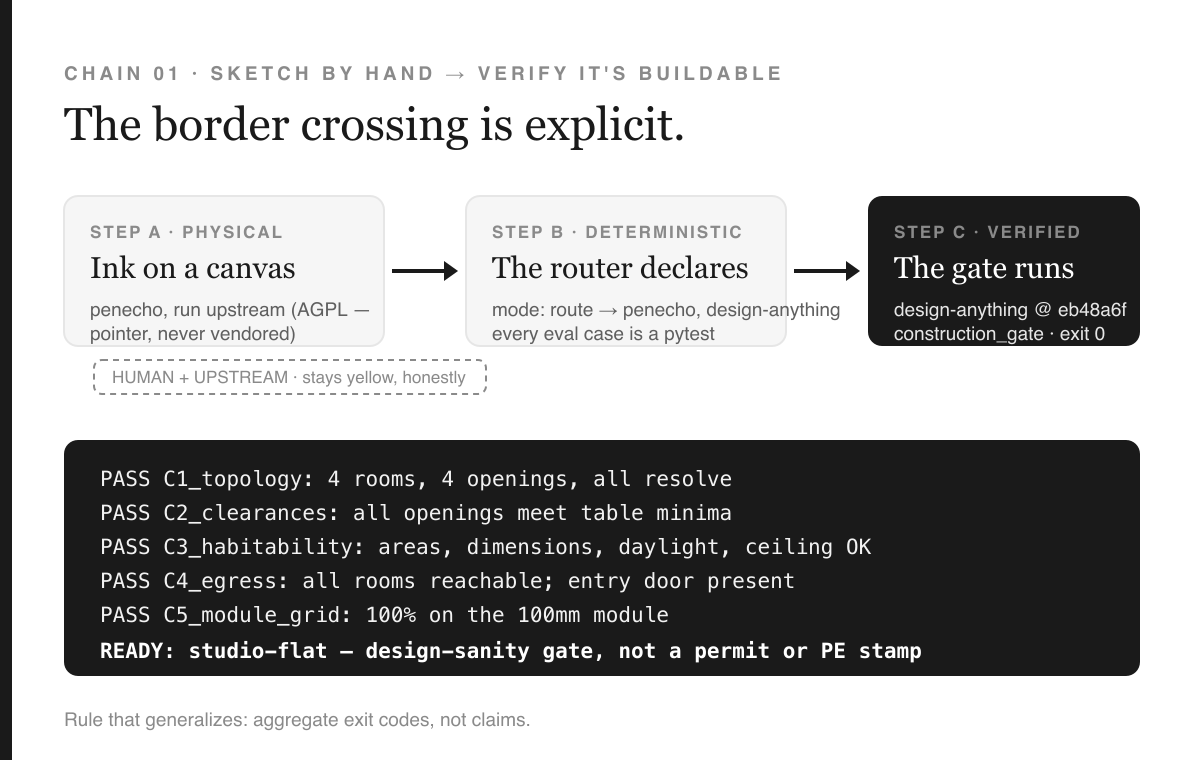
A deterministic router — every routing claim is a pytest, including the one where it must refuse to vendor penecho — declares the chain: penecho for the ink, design-anything for the physics. Then the physical half ran for real:
$ python3 pipeline/construction_gate.py studio.json
  PASS  C1_topology: 4 rooms, 4 openings, all resolve
  PASS  C2_clearances: all openings meet table minima
  PASS  C3_habitability: areas, dimensions, daylight, ceiling OK
  PASS  C4_egress: all rooms reachable; entry door present
  PASS  C5_module_grid: 100% of coordinates on the 100mm module
READY: studio-flat  (design-sanity gate, not a permit or PE stamp)
Exit code 0. A 4-room, 28.5 m² layout passed topology, clearances, habitability, egress, and grid checks — the same gate that repo uses to call anything "ready." That run is what promoted design-anything to 🟢. penecho stayed 🟡, on purpose: the sketch step is human and upstream, and pretending a machine verified it would poison the one thing the table sells — trust.
The repo audits itself — and me
The registry discipline would rot in a week if it depended on my mood, so the repo scores its own operation: nine principles (spec-as-data, no-evidence-means-no, maker-is-not-checker, satellites-never-vendored…), each backed by an executable check, gated in CI at 90/100. An unmeasured principle doesn't count as a pass — it blocks the gate. Right now it runs 100/100, and the day a shortcut regresses one principle, the build fails on me.
The honesty cut both ways. During the build, GitHub's CI queue had a bad day: jobs dying with zero logs, zero steps, zero annotations. I'd just bumped two action versions, so the evidence couldn't separate "their infra" from "my change." The fix was the boring, honest one — revert to the exact last-green config and let the next run decide — recorded in the changelog as a rollback, not a diagnosis. Saying "I don't know yet" in writing is a feature.
Why bother with a super-repo at all
Because the alternative is the industry default: a landing page that claims integrations. A registry with a bouncer inverts that. Adding a capability costs one YAML entry, and the ladder tells every user — including future me — exactly how far to trust each row. The table is small today: 2 green, 10 yellow, 5 white — and the day after publishing, the repo's own charter gate caught me over-counting the greens in this very paragraph. The gate wins; the prose gets corrected. But every color on it was earned by a run, and that's the only kind of table that compounds.
The rule that generalizes: if your system aggregates other systems, don't aggregate their claims — aggregate their exit codes.
More in the AI-Native series
All of it lives in the Writing section on the home page.
Part of the AI-Native series. Built with the goal-10x loop: research → absorb → coach → drive to green → self-improve. Trust the artifact, not the label. You own the Publish button.