AI-NATIVE SERIES · THE TWO ENDS OF MATH, EPISODE 1 OF 1 · AGE 20
Discrete vs Continuous Mathematics: The Two Ends of Math, and How They Turn Toward Each Other (for Age 20)
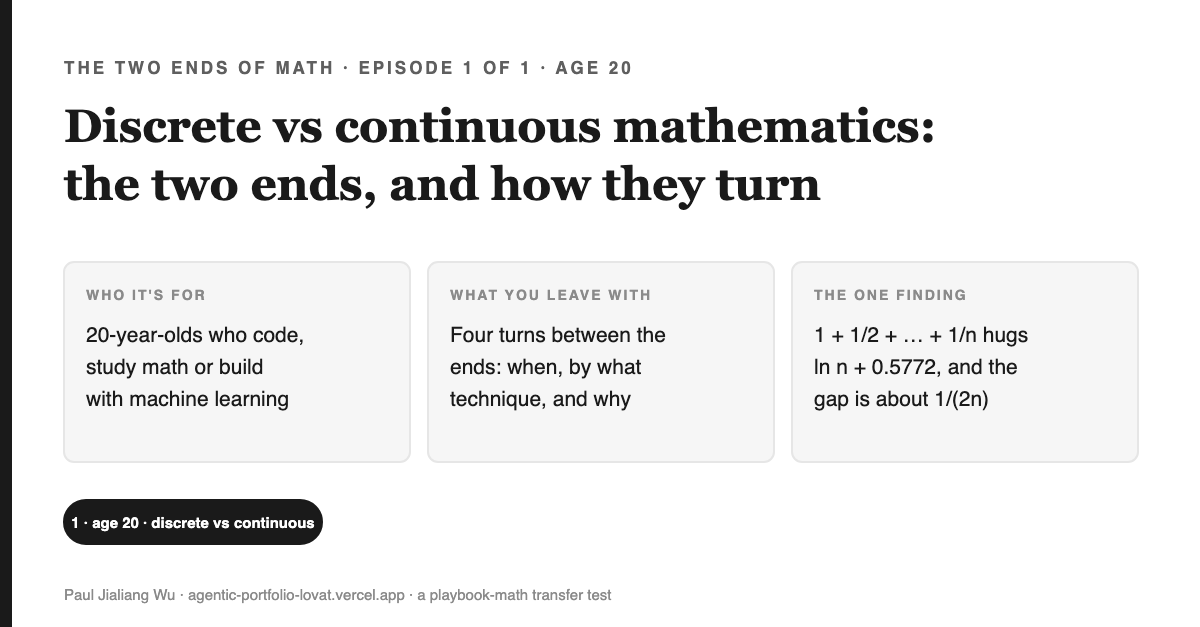
1-minute takeaway
What this is. An essay for 20-year-olds on the two ends of mathematics: discrete (things you count, with gaps) and continuous (things you measure, with none). It maps four turns where each end borrows the other, the condition that triggers each turn, the technique, and the motive behind it.
Why it matters. Most of modern engineering lives on a turn between the ends: your audio is a continuous wave stored as samples, machine learning trains discrete choices with continuous gradients and then rounds weights to integers, and the first proof of how the primes are spread out came from curves. Knowing which turn you are on tells you what can go wrong.
What you can do after reading. Run the three live demos (two with sliders, one live table), check that 1 + 1/2 + … + 1/n hugs ln n + 0.5772 with a gap of about 1/(2n), name the turn behind one tool you use, then teach the staircase-to-slide idea to a 15-year-old.
The Two Ends of Math — the series spine
▶ See it running: open the live demo public · no sign-in
- Discrete vs continuous this episode
The one question: How do discrete and continuous mathematics differ, and when, how and why does each turn toward the other?
This piece does NOT re-teach how numbers are written down; that is Number vs Representation (age 20). It stays with the whole numbers and the real line, and leaves complex analysis as a named bridge, not a lesson.
What this essay is about: discrete vs continuous mathematics
This is an essay about discrete vs continuous mathematics, the two ends of the subject. Discrete mathematics counts things that come in separate pieces: whole numbers, graphs, strings, steps. Continuous mathematics measures things with no gaps: lengths, time, temperature, the real line. It is written for readers of about twenty who code, study math, or build with machine learning. You need a laptop with Python and twenty minutes for the exercises.
The question is not only how the two ends differ. It is when, how and why each one turns toward the other. Mathematics keeps swinging between them, and most of modern engineering lives on one of those swings. The essay names four turns. For each it gives the condition that triggers it, the technique that carries it, and the motive that drives it. The motives come in three kinds: truth (proving something), love (serving someone), and beauty (compressing many cases into one).
It is also a test. This essay was written with playbook-math, a method built for the series Numbers at Four Ages, to see whether the method carries to a new subject. The running thing it was built on is the Two Ends Playground, a free page with three live demos of one end turning into the other.
One picture carries the essay, from the top rung of the kitchen ladder: a national food supply chain. Eggs are discrete. You count them, and nobody ships half an egg. Flour is continuous. You weigh it, and any number of grams is possible. A national chain must plan both at once, every morning, and every one of the four turns shows up in its planning office.
Before you read on. You will end by teaching a 15-year-old the "staircase that becomes a slide" idea, using the playground. Read as someone who will have to explain it. In a meta-analysis of 39 studies, teaching after studying with that expectation scored g = 0.48 (a subgroup result), while teaching without it showed no measurable benefit (g = −0.02) (Kobayashi (2024), Educational Psychology Review (ERIC EJ1414484)).
Activity 1 · Count a slide (invent before you read on)
Cross the room three times. First in big hops, and count them. Then in tiny heel-to-toe steps, and count those. Then slide your feet the whole way without lifting them.
How many slides was that? There is no number, only a distance. Now invent a way to measure the slide using only counting, with no ruler that has marks you did not make. Write down your method before reading on.
Most people invent the same thing: take smaller and smaller steps, count them, and multiply by the step length. As the steps shrink, the count of steps times the step size settles toward the length of the slide. That is the first and oldest turn between the two ends: a discrete count, pushed to tiny steps, becomes a continuous measure. Zeno thought this kind of endless dividing made motion impossible. By his logic nobody would ever reach the fridge. Mathematics took about two thousand years to make the move rigorous.
The two ends, and the line between them
The split is old. Aristotle opens his account of quantity with it: "Quantity is either discrete or continuous." (Aristotle, Categories, Part 6, tr. E. M. Edghill). His test for telling them apart is a sharp one: in a discrete quantity the parts meet at no shared border. In his example, "two fives make ten, but the two fives have no common boundary, but are separate". A line, by contrast, is made of parts that touch.
One word needs pinning down first. In this essay "discrete" means built from separate, countable pieces, like the whole numbers. Fractions are countable too, even though they crowd the line so closely that there is always another between any two. "Continuous" means a line with no gaps at all.
For most of history the continuous end was the mysterious one. Zeno's paradoxes of motion (Dichotomy, Achilles and the Tortoise, Arrow and Stadium, Huggett, Stanford Encyclopedia of Philosophy, Zeno's Paradoxes) attack the idea that a line can be cut forever. The fractions seemed to fill the line, since between any two there is another, yet they still leave holes. Dedekind called the rationals "a gappiness, incompleteness, discontinuity" (Bell, Stanford Encyclopedia of Philosophy, Continuity and Infinitesimals (quoting Dedekind 1872)). In 1872 he filled the holes using only the countable fractions: define each real number by how it cuts the fractions into a left pile and a right pile (MacTutor, Richard Dedekind). The continuum was built out of countable pieces.
Then Cantor showed the two ends are not even the same size. In 1874 he proved that the real numbers cannot be listed one after another, while the whole numbers and the fractions can (MacTutor, Georg Cantor). His better-known diagonal argument followed in 1891 (Wikipedia, Cantor's diagonal argument). So the line has more points than there are names you could ever write down. Not everyone accepted the construction: Weyl's Das Kontinuum (1918) tried to rebuild analysis without it (Stanford Encyclopedia of Philosophy, Hermann Weyl).
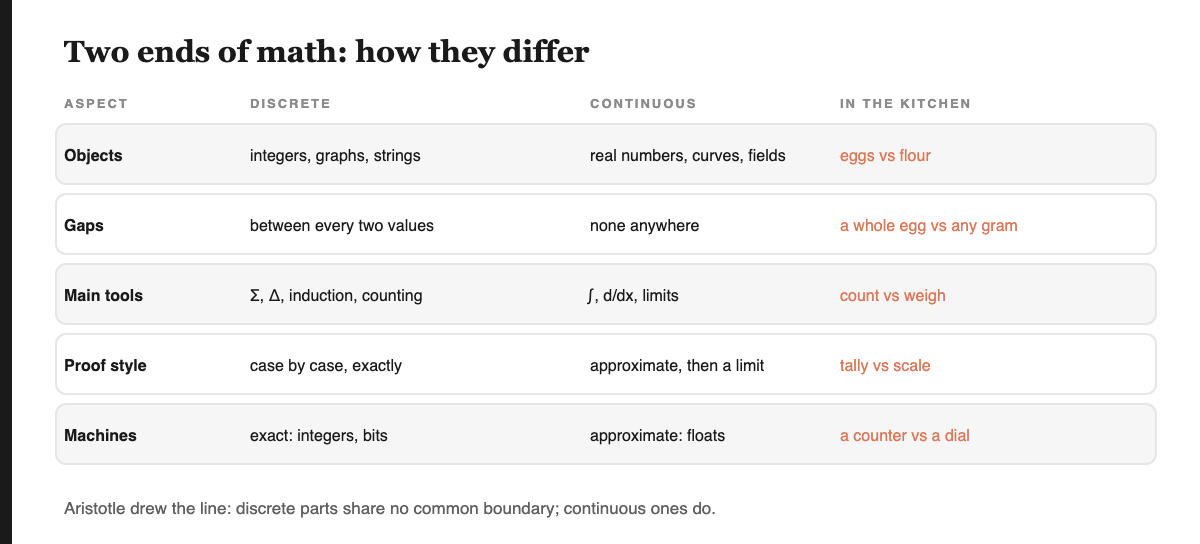
Each end brings its own toolkit. Discrete math sums with Σ, takes differences with Δ, proves things by induction, and counts cases exactly. Continuous math integrates with ∫, differentiates with d/dx, and proves things by approximating and taking a limit. The two toolkits mirror each other more closely than most courses admit: "The finite difference is the discrete analog of the derivative." (Weisstein, MathWorld, Finite Difference). Σ undoes Δ exactly the way ∫ undoes d/dx. Graham, Knuth and Patashnik built a whole book on that mirror and named it after it: "Concrete Mathematics is a blending of CONtinuous and disCRETE mathematics." (Graham, Knuth & Patashnik, Concrete Mathematics, publisher description (InformIT)).
Activity 2 · Draw the staircase
On paper, draw the curve y = x² from x = 0 to x = 1. Under it, draw four rectangles of width 1/4, each as tall as the curve at its right edge.
Add up their areas. Then open part 1 of the Two Ends Playground and slide the number of rectangles from 4 to 100. Watch the staircase turn into a slide, and the error shrink.
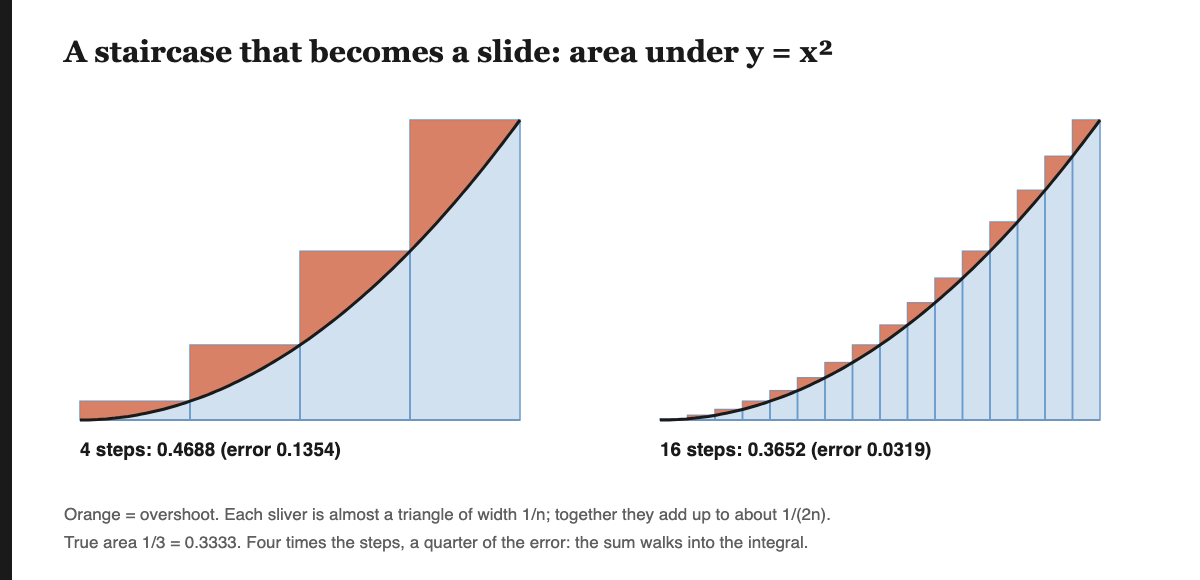
Four rectangles give 0.46875; the true area is 1/3. With 100 rectangles the sum is 0.33835, an error of about 0.005, which is almost exactly 1/(2n) (computed; the playground shows it live). Double the rectangles and the error halves. That is the definition of the integral Riemann made precise in 1854 (MacTutor, Bernhard Riemann), long after Leibniz first wrote ∫ as a sum, published from 1684 (MacTutor, The rise of calculus).
The four turns
Mathematics does not sit at either end. It rotates between them. Each turn has a condition that triggers it, a technique that carries it, and a motive that drives it. Each arrow in the figure points to where the turn delivers its result. Limits deliver a smooth formula (turn 1). Analysis delivers a fact about whole numbers (turn 2). Sampling delivers numbers a machine can hold (turn 3). Relaxation goes over to the smooth end and comes back with a whole answer (turn 4, a round trip).
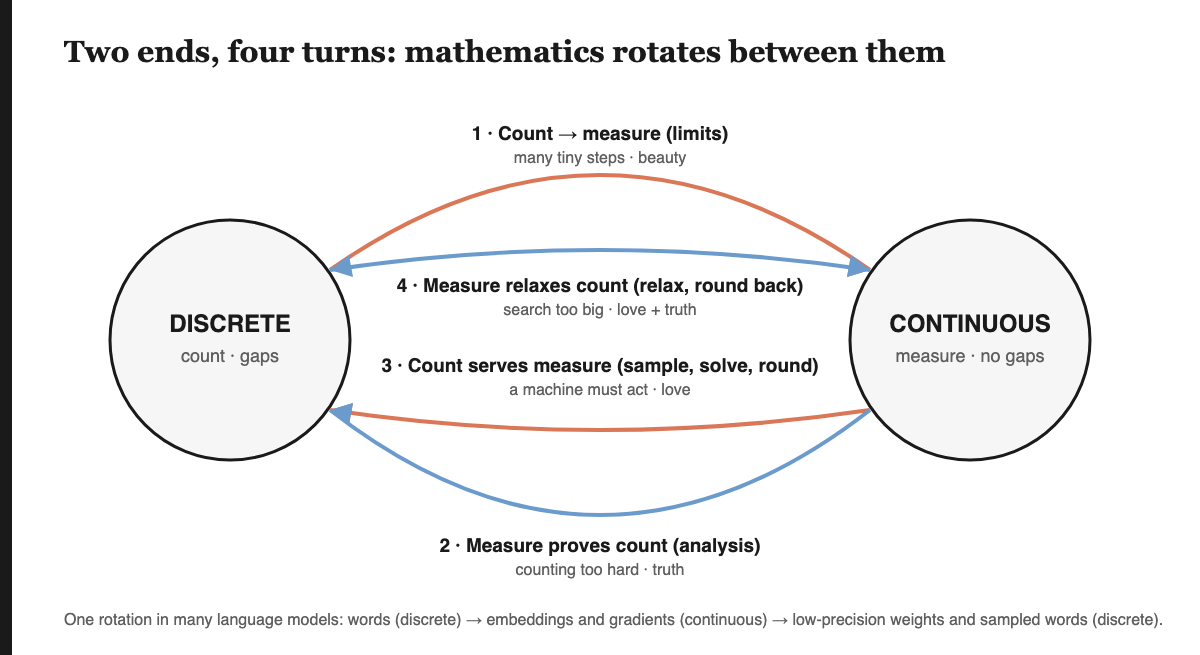
Turn 1 · Count → measure: when there are many tiny steps
The condition: a discrete problem with a huge number of small pieces.
The technique: let the pieces shrink and take a limit, so a sum becomes an integral and a histogram becomes a curve.
The examples:
- Stirling's formula (1730, MacTutor, James Stirling) replaces n! with a smooth expression, √(2πn)(n/e)ⁿ. At n = 10 the approximation is already only 0.83% below 10! (computed).
- In 1733 de Moivre showed that the number of heads in many coin flips follows the bell curve (MacTutor, Abraham de Moivre).
- In 1837 the Poisson distribution appeared, the limit for many rare events (MacTutor, Simeon Poisson).
Part 2 of the Two Ends Playground shows the coins. With 100 flips, the exact chance of 50 heads is 0.079589 and the bell curve's height there is 0.079788 (computed).
The motive is mostly beauty: one curve stands in for a million separate cases. In the kitchen, the planning office stops forecasting each customer's order and fits a smooth demand curve to the whole country.
Turn 2 · Measure proves count: when counting is too hard
The condition: a question about whole numbers that counting alone cannot crack.
The technique: wrap the discrete sequence in a continuous function and use calculus on the function. Wilf's image is the best: "A generating function is a clothesline on which we hang up a sequence of numbers for display." (Wilf, generatingfunctionology).
The great example is the prime numbers, the most discrete objects there are.
- In 1859 Riemann attacked them with the zeta function, treated as a function of a complex variable (Riemann, On the Number of Primes Less Than a Given Magnitude, tr. D. R. Wilkins).
- The prime number theorem, that there are about x / ln x primes below x, was proved in 1896, independently by Hadamard and de la Vallée Poussin, using exactly that continuous machinery (Weisstein, MathWorld, Prime Number Theorem).
- Euler's sum of 1/n² equals π²/6, a circle constant appearing in a sum of whole numbers (written 1735, Euler Archive, E41 De summis serierum reciprocarum).
The motive is truth: the continuous end reached facts the discrete end could state but, for a long time, not prove. Not forever: in 1949 Selberg and Erdős found a proof of the prime number theorem that uses no complex analysis at all (MacTutor, Atle Selberg). The turn got there first; it was not the only road.
Turn 3 · Count serves measure: when a machine or a person must act
The condition: a continuous world that someone has to act on with a finite device: a computer, a sensor, a hand.
The technique: sample it, chop it into pieces, or round it to a finite set of numbers.
The examples:
- Shannon's sampling theorem (1949) says when nothing is lost: "If a function f(t) contains no frequencies higher than W cps, it is completely determined by giving its ordinates at a series of points spaced 1/2W seconds apart" (Shannon (1949), Communication in the Presence of Noise, Proc. IRE 37(1)). That is why a song can live in a file.
- The fast Fourier transform (1965, Cooley & Tukey (1965), Math. Comp. 19(90), Crossref record) made the discrete version of frequency analysis cheap enough to run everywhere.
- The finite element method, first used numerically by Courant in 1943 (MacTutor, Richard Courant), chops a bridge or a wing into small pieces so a machine can solve it.
- Floating point (IEEE 754-2019, IEEE Standards Association, IEEE 754-2019) gives every computer a finite menu of numbers to stand in for the line.
The machine underneath is discrete to its core: a Turing machine's tape holds "exactly one symbol" per square (Stanford Encyclopedia of Philosophy, Turing Machines).
The motive is love, in the plain sense of serving someone: the engineer, the listener, the patient in the scanner. In the kitchen, a thermostat cannot read the oven continuously. It samples the temperature a few times a second, and the bread comes out fine.
Nature itself sometimes answers on the discrete side: Planck introduced energy in whole quanta on 14 December 1900 (MacTutor, Max Planck). Whether space and time are grainy at bottom is still open.
Turn 4 · Measure relaxes count: when the search is too big
The condition: a discrete choice with too many options to try one by one.
The technique: pretend the choice is continuous, solve the easy smooth problem, then round back. In optimisation this is the linear-programming relaxation: let a yes-or-no variable take any value between 0 and 1. The price is the integrality gap, the worst-case ratio between the best whole answer and the smooth one (Wikipedia, Linear programming relaxation).
In the kitchen (an illustration, not a real plan), the chain's optimiser plans 2.7 eggs for one shop. No one has ever ordered 2.7 eggs. The optimiser does it every morning, then rounds.
Machine learning makes the same move constantly:
- The Gumbel-softmax trick passes gradients through a continuous stand-in for a discrete choice. It was found twice in one week of 2016 (Jang, Gu & Poole (2016), Categorical Reparameterization with Gumbel-Softmax, arXiv 1611.01144; Maddison, Mnih & Teh (2016), The Concrete Distribution, arXiv 1611.00712).
- Quantisation-aware training simulates 8-bit integer rounding during training (still this turn: a smooth problem shaped by the discrete one), so that weights and activations can later run with integer-only arithmetic (Jacob et al. (2017), Quantization and Training of Neural Networks for Efficient Integer-Arithmetic-Only Inference, arXiv 1712.05877). Running them on that hardware is turn 3.
The motive is love, with truth where it can be had. For LP relaxation the smooth problem gives a usable answer and a provable bound on how far off it can be. Gumbel-softmax gives no such bound. Its gradients are a biased estimate, controlled by a temperature setting, and engineers accept that for speed.
The rotation, not a one-way trip
The four turns are not four separate tricks. Real work goes around the circle, often more than once.
A language model, start to finish:
- Words are discrete tokens.
- Training lifts them into continuous vectors and adjusts weights by gradients. That is turn 4, relaxing a discrete problem into a smooth one. Some pipelines also simulate integer rounding during training, which is still turn 4.
- Many deployed models then run on low-precision integers, such as 8-bit, on the serving hardware. That is turn 3, back to a machine that must act. (Plenty of models serve in 16-bit floating point instead; the rotation still ends in a finite, discrete set of numbers.)
- Its output is sampled one discrete token at a time.
Discrete, continuous, discrete: one full rotation per answer you read.
A bridge simulation:
- The physics is continuous.
- The engineer chops the bridge into finite elements, a discrete mesh (turn 3).
- Then they refine the mesh again and again, checking that the answers settle as the pieces shrink (turn 1, the limit).
The trust in the final number comes from having gone around the circle and seen it hold.
The same rotation explains how the three motives act in practice:
- Beauty and truth pull a problem toward the end where it can be seen whole or proved.
- Love pulls it toward whichever end someone can use: a machine's finite menu in turn 3, a smooth problem a solver can handle in turn 4.
Activity 3 · Watch the hinge in code
Before running it, predict: how far apart are 1 + 1/2 + … + 1/n and ln n + 0.5772 when n is a million? Then run the code below, or read part 3 of the playground.
import math
g = 0.5772156649015329   # Euler-Mascheroni constant
for n in (10, 100, 1000, 10**6):
    H = math.fsum(1/k for k in range(1, n+1))
    print(n, H - (math.log(n) + g), 1/(2*n))
n = 100   # coin flips: exact count vs bell curve
exact = sum(math.comb(n, k) for k in range(56)) / 2**n
Phi = lambda z: 0.5*(1 + math.erf(z/math.sqrt(2)))
print(exact, Phi((55.5 - 50)/5))
Here γ is the Euler–Mascheroni constant, 0.5772…, the amount by which the sum 1 + 1/2 + … + 1/n stays above ln n in the long run. The gap comes out as 0.0492, 0.00499, 0.000500 and 0.000000500. That is almost exactly 1/(2n) each time (computed). The coin line computes the chance of at most 55 heads in 100 flips, exactly by counting (0.864373) and by the bell curve with a half-step continuity correction (0.864334). This is the hinge between the two ends: the Euler–Maclaurin formula, which says exactly how a sum and an integral differ, term by term. Euler and Maclaurin found it independently, around 1735 (Wikipedia, Euler-Maclaurin formula). The leftover 1/(2n) is its next term. Kronecker reportedly said "God created the integers, all else is the work of man." (MacTutor, Leopold Kronecker (an attributed remark, reported second-hand)). The hinge shows the two ends are closer to each other than either is to that quarrel.
Truth, love and beauty: why mathematicians turn
The four turns are not just tricks. Each is made for a reason, and the reasons fall into three kinds.
- Truth: the turn proves something. Turn 2 is the clearest case: curves gave the first proof of how the primes are spread out. Turn 4 earns a bound when it is an LP relaxation, a guarantee of how far off the rounded answer can be.
- Love: the turn serves someone. Turn 3 exists because people need music in files, safe bridges and working scanners. Turn 4 exists because a planner needs tomorrow's egg order tonight.
- Beauty: the turn compresses many cases into one. Turn 1 replaces a million coin flips with one curve. The hinge replaces a whole table of sums with ln n + γ + 1/(2n). Hardy made it the bar for the whole subject: "Beauty is the first test: there is no permanent place in the world for ugly mathematics." (Hardy (1940), A Mathematician's Apology).
Each motive alone fails in a recognisable way:
- Truth without love gives an existence proof nobody can compute with. It is true that a best egg plan exists, and that does not feed anyone tomorrow.
- Love without truth gives an answer trusted without its check. The optimiser's 2.7 eggs, rounded up to 3 at every shop with no look at the gap, ships 11% more eggs than anyone planned (computed: 3 ÷ 2.7). Kind to every shop, and the warehouse floor is covered in omelettes.
- Beauty without truth gives a gorgeous argument that is not yet a proof. Euler's first derivation of π²/6 (written 1735) used steps nobody could justify. A proof he accepted came in 1741 (Wikipedia, Basel problem). The answer was right; the beauty arrived before the truth.
One lens here is my own, and I label it as mine. I hold that truth, love and beauty are three faces of one Reality, and in my faith of one Person. You do not need that belief to use the checklist above. You may notice what Wigner noticed about mathematics fitting the world, though: he called it "a wonderful gift which we neither understand nor deserve" (Wigner (1960), The Unreasonable Effectiveness of Mathematics in the Natural Sciences, Comm. Pure Appl. Math. 13(1)).
Does a number have two forms?
The series this essay tests used a body lens:
- a spirit that makes a thing one;
- bones, flesh and skin as its layers;
- two forms, discrete like particles and continuous like a flow or a wave.
This essay is that last row, opened up. The lens predicts that the two forms are an axis cutting across every layer, not a layer of their own. The turns confirm it: each turn changes the form, while the thing being studied (the count of primes, the sound, the egg order) stays the same.
The lens breaks where physics stays open. Planck's quanta make energy grainy, but quantum theory still uses smooth waves, and whether space is grainy is unknown. Mathematics does not have to choose. It keeps both forms and turns between them as the problem demands.
The same idea at four ages
The playbook requires one idea that stays true at every age. Here it is at four sizes. Only the last is written out in full here.
| Age | The kernel | The body or hands first |
|---|---|---|
| 7 | Some things you count, like steps, and some you measure, like a slide. Tiny steps start to feel like a slide. | Hop and count, then slide your feet: "how many slides?" |
| 11 | Counting numbers have gaps, a line has none, and thin rectangles sneak from one to the other. | Stack blocks along a ruler |
| 15 | A sum is a jumpy integral and an integral is a smooth sum: Δ is to Σ what d/dx is to ∫. | The playground staircase |
| 20 | Discrete math counts with gaps, continuous math measures without them, and each end keeps borrowing the other to prove, to serve or to compress. | Run the hinge in code |
Same story, five exits
| You are a… | The decision this changes | One action this week |
|---|---|---|
| Student | Whether to treat discrete math and calculus as one subject with a mirror between them | Prove Σ undoes Δ on one example, then compare with ∫ undoing d/dx |
| Engineer | Which failure mode to test for in a tool: aliasing, the integrality gap, or rounding | Write the one-line turn note (Operate, step 5) for a tool you ship |
| Founder | Whether a "smooth" product promise survives a discrete reality (whole units, whole trucks) | Ask your planner for the gap between the relaxed plan and the rounded one |
| Executive | Whether a forecast curve is being treated as an order book | Ask for the rounding rule behind one forecast-driven order |
| Investor | Whether a startup's claimed precision is a property of the world or of its encoding | Ask which turn its core model rests on, and what it does when the turn fails |
Mistakes that are half right
- "Computers work with real numbers." They work with a finite menu of rationals that stands in for the line. The instinct is right, because the menu is extremely good, but almost no real number is on it.
- "Calculus was rigorous from the start." The method worked long before the proof did. Dedekind's continuum came in 1872, almost two centuries after Leibniz.
- "Discrete math is the computer kind and continuous math is the physics kind." Each turn above crosses that line. The primes were first tamed with calculus, and physics found quanta.
Now teach it
Your teach-back. Sit with a 15-year-old and open part 1 of the Two Ends Playground. Before moving the slider, ask them to guess the area under y = x² from 0 to 1 using four rectangles drawn by hand. Then slide to 100 and let them notice the error halving when the rectangles double. Don't say "integral" until they have described it themselves.
Outcome: the 15-year-old predicts, before you run it, that 1 + 1/2 + … + 1/1000 is about ln 1000 + 0.5772 ≈ 7.485, and explains why more rectangles mean less error. Post their age and their prediction as a comment on this article.
Why it matters: five whys
The problem: students take discrete mathematics and calculus as two unrelated courses, and are surprised when a sum hugs an integral or a curve proves a fact about primes.
- Why the surprise? They never saw a turn. Each course stays at one end, so the bridges look like coincidences, though they are named theorems with dates, such as de Moivre in 1733 (MacTutor, Abraham de Moivre).
- Why does each course stay at one end? Departments and syllabi split by topic: combinatorics here, analysis there. The mirror between Δ/Σ and d/dx/∫ belongs to neither (Weisstein, MathWorld, Finite Difference).
- Why does the mirror matter? Because the turns run on it. Euler–Maclaurin, Stirling and generating functions are all ways of crossing it (Wilf, generatingfunctionology).
- Why does crossing matter to a working engineer? Their tools sit on a turn: sampled audio (Shannon (1949), Communication in the Presence of Noise, Proc. IRE 37(1)), relaxed optimisers (Wikipedia, Linear programming relaxation), quantised models (Jacob et al. (2017), Quantization and Training of Neural Networks for Efficient Integer-Arithmetic-Only Inference). Not knowing which turn you are on hides the failure mode: aliasing, the integrality gap, rounding error.
- Root cause: the turns are taught as tricks instead of a map. The fix is this essay's frame: for any tool, name its turn, the condition that triggered it, the technique and the motive, and you know what to check.
Operate: run it this week
- Read the teach-ahead line.
- Count a slide (Activity 1, 3 minutes).
- Draw the four-rectangle staircase, then slide part 1 of the Two Ends Playground to 100 (10 minutes).
- Run the hinge code and compare it with part 3 (5 minutes).
- Pick one tool you use (an audio format, a solver, a quantised model) and write one line: its turn, the condition, the technique, the motive, and the thing it can get wrong.
- Teach the staircase to a 15-year-old.
Feedback: how you know it worked
You can do three things without notes:
- Name the four turns and one example of each.
- Predict the gap between 1 + 1/2 + … + 1/n and ln n + γ (about 1/(2n)).
- For one tool you use, name the failure mode its turn introduces.
What this cannot measure: whether you will spot a turn in a codebase under pressure. The one-line tool note from Operate step 5 is the habit that can.
Feedforward: tripwires, decided now
- If you sample a signal, write down its highest frequency first. The sampling theorem assumes nothing above it; real signals need a filter before sampling.
- If you round a relaxed solution, report the gap. An answer without its bound is love without truth.
- If an argument is beautiful and the steps are not checked, call it a conjecture until they are. Euler's 1735 argument is the reminder.
The 5S self-score
| S | Claim | Evidence |
|---|---|---|
| Simple | The prose reads at a grade-13 level or easier. | Flesch–Kincaid grade of the prose: 7.6 (band ≤ 13), recomputed by node scripts/check-numbers-four-ages.mjs --series two-ends-of-math |
| Solid | Every date and quotation comes from the ledger (a few rows are secondary sources and say so); every computed number can be rerun. | Prime number theorem 1896 (MathWorld); the hinge code |
| Sharp | Four turns, each with a condition, a technique and a motive; Euler–Maclaurin as the hinge. | The four turns and their figure |
| SMART | This week: three demos, one tool note, one teach-back. | Operate · Two Ends Playground |
| Surprise | The most discrete objects in mathematics, the primes, were first tamed with curves; the optimiser orders 2.7 eggs every morning. | Turns 2 and 4 |
| Truth · Love · Beauty | The three motives, each with its one-sided failure, and Euler's beautiful unproved step. | Truth, love and beauty |
Sources
- Aristotle. Categories, Part 6, tr. E. M. Edghill. classics.mit.edu
- Huggett, N. "Zeno's Paradoxes." Stanford Encyclopedia of Philosophy. plato.stanford.edu
- Bell, J. L. "Continuity and Infinitesimals." Stanford Encyclopedia of Philosophy. plato.stanford.edu
- O'Connor, J. J. & Robertson, E. F. "Richard Dedekind." MacTutor. mathshistory.st-andrews.ac.uk
- O'Connor, J. J. & Robertson, E. F. "Georg Cantor." MacTutor. mathshistory.st-andrews.ac.uk
- "Cantor's diagonal argument." Wikipedia. en.wikipedia.org
- "Hermann Weyl." Stanford Encyclopedia of Philosophy. plato.stanford.edu
- O'Connor, J. J. & Robertson, E. F. "The rise of calculus." MacTutor. mathshistory.st-andrews.ac.uk
- O'Connor, J. J. & Robertson, E. F. "Bernhard Riemann." MacTutor. mathshistory.st-andrews.ac.uk
- Weisstein, E. W. "Finite Difference." MathWorld. mathworld.wolfram.com
- Graham, R. L., Knuth, D. E. & Patashnik, O. Concrete Mathematics, publisher description. informit.com
- O'Connor, J. J. & Robertson, E. F. "James Stirling." MacTutor. mathshistory.st-andrews.ac.uk
- O'Connor, J. J. & Robertson, E. F. "Abraham de Moivre." MacTutor. mathshistory.st-andrews.ac.uk
- O'Connor, J. J. & Robertson, E. F. "Siméon Poisson." MacTutor. mathshistory.st-andrews.ac.uk
- Riemann, B. (1859). On the Number of Primes Less Than a Given Magnitude, tr. D. R. Wilkins. maths.tcd.ie
- Weisstein, E. W. "Prime Number Theorem." MathWorld. mathworld.wolfram.com
- Euler, L. E41, "De summis serierum reciprocarum." Euler Archive. scholarlycommons.pacific.edu
- "Basel problem." Wikipedia. en.wikipedia.org
- Wilf, H. S. generatingfunctionology. math.upenn.edu
- Shannon, C. E. (1949). Communication in the presence of noise. Proc. IRE 37(1). PDF
- Cooley, J. W. & Tukey, J. W. (1965). An algorithm for the machine calculation of complex Fourier series. Math. Comp. 19(90). Crossref
- O'Connor, J. J. & Robertson, E. F. "Richard Courant." MacTutor. mathshistory.st-andrews.ac.uk
- IEEE 754-2019, Standard for Floating-Point Arithmetic. standards.ieee.org
- O'Connor, J. J. & Robertson, E. F. "Max Planck." MacTutor. mathshistory.st-andrews.ac.uk
- "Turing Machines." Stanford Encyclopedia of Philosophy. plato.stanford.edu
- "Linear programming relaxation." Wikipedia. en.wikipedia.org
- Jang, E., Gu, S. & Poole, B. (2016). Categorical Reparameterization with Gumbel-Softmax. arXiv:1611.01144
- Maddison, C. J., Mnih, A. & Teh, Y. W. (2016). The Concrete Distribution. arXiv:1611.00712
- Jacob, B. et al. (2017). Quantization and Training of Neural Networks for Efficient Integer-Arithmetic-Only Inference. arXiv:1712.05877
- Hardy, G. H. (1940). A Mathematician's Apology. archive.org
- O'Connor, J. J. & Robertson, E. F. "Leopold Kronecker." MacTutor. mathshistory.st-andrews.ac.uk
- Wigner, E. P. (1960). The Unreasonable Effectiveness of Mathematics in the Natural Sciences. Comm. Pure Appl. Math. 13(1). PDF
- Kobayashi, K. (2024). Interactive learning effects of preparing to teach and teaching. Educational Psychology Review. ERIC EJ1414484