Here's a mystery worth a few trillion dollars. Almost every company now has AI that can write code, draft contracts, and summarize a 40-page report before you finish your coffee. And yet, at most of them, nothing is actually moving faster. Payroll is the same. The quarter looks the same. Somebody spent a fortune on a superpower and the org chart shrugged.
Economists have a name for this: the productivity paradox. I have a blunter one: we bolted a jet engine onto a horse cart and are confused that the horse is still tired.
The mental model: a young heart in an old body
Picture an 80-year-old man who gets a brand-new heart — a strong, young, tireless one. Amazing. Now ask him to sprint 1,000 meters. He can't. The heart is ready to fly; the knees, the lungs, the brittle bones did not get the memo. The new part isn't the limit. The old body around it is.
That's your company with AI. The model is the young heart. The operating model — how work is chopped up, handed off, and signed off — is the old body. You can drop the most powerful heart on Earth into that skeleton and it still won't run, because the bones are the bottleneck.
Make it even simpler. Imagine your class gets a genius robot for the group project. But the teacher insists you still do it the old way: the robot writes a paragraph, hands it to Timmy, Timmy reads it after lunch, passes it to Sara, Sara reformats it, someone emails it to the teacher. The robot could finish the whole project in ninety seconds — instead it spends the day waiting in line for humans to pass notes. We gave the office a genius and then made it wait for Gary in Accounting to get back from lunch.
The genius isn't the bottleneck. The passing-notes assembly line is. That's every company right now.
We are repeating the electricity mistake of 1900
This exact movie already played once — with electricity — and the ending is on record. In 1882, Edison's company (the outfit that became General Electric) fired up Pearl Street Station in Manhattan and lit up the neighborhood. Electric power: available, obvious, world-changing. So how fast did factories adopt it?
By 1900 — roughly two decades later — only about 5% of factory mechanical power was electric. Two decades of the future sitting right there, mostly ignored. Why?
Because the first factory owners made the "young heart, old body" mistake precisely. Old factories ran on one giant steam engine that spun a line shaft — a long rod bolted to the ceiling — with belts and pulleys dropping down to power every machine. When electric motors arrived, owners did the lazy thing: they yanked out the steam engine, bolted in one giant electric motor, and kept the ceiling shaft and all the belts. New heart, same skeleton. The machines were still frozen in the layout the old steam engine had dictated. Result: barely any gain. A shrug.
The explosion came only when engineers threw out the central shaft and gave every machine its own small motor. Suddenly the layout was free. You could arrange machines around the flow of the work instead of around a rod on the ceiling — and that rearrangement is literally what became the assembly line. Economic historian Paul David made this the classic case study ("The Dynamo and the Computer," 1990): the productivity payoff of a general-purpose technology shows up decades late, and only after you redesign the workplace around it. The power source was never the hard part. The redesign was.
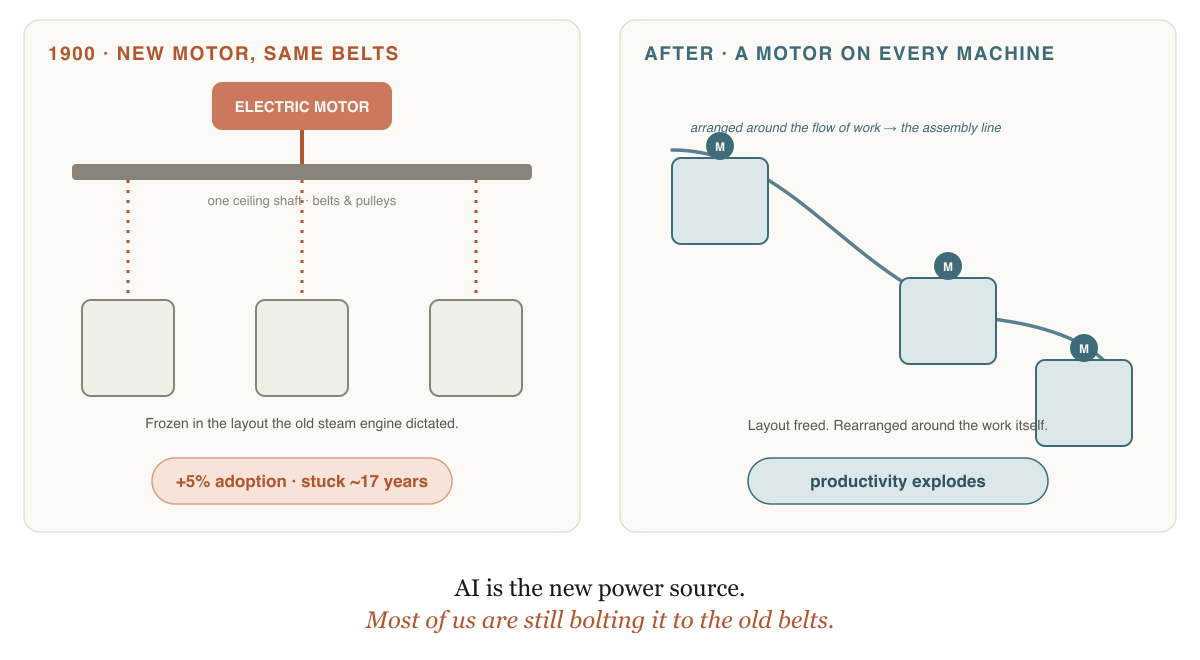
Same power source, two different bodies. Swapping the engine bought a shrug; redesigning the floor around the flow bought the 20th century. AI is the new engine — the question is whether you keep the belts.
Using AI to draft one email or summarize one meeting is the "one big motor on the old shaft" move. It's fine. It's also a shrug. The gain is trapped because everything around the task is still shaped for a pre-AI world.
The real unlock is chaining, not tasks
Here's the counterintuitive part, and it's the whole game. Research from MIT Sloan on where AI value actually comes from points not at individual task performance but at task chaining — the ability to link a bunch of dependent steps into one continuous, autonomous run with no human hand-off in the middle.
Every hand-off between a human and a machine has a hidden price: someone has to stop, re-read, re-load the context in their head, check it, and pass it on. Call it the handoff tax. Three hand-offs in a workflow, three taxes. It's why a teacher preparing a lecture (mostly linear, plan-it-once work) is wildly automatable, while a tutor (endless unpredictable back-and-forth) keeps tripping over hand-offs.
And now the punchline that breaks most people's intuition: the AI doesn't have to be better than a human at every single step to win. If chaining three steps together deletes three handoff taxes, the whole system gets faster and cheaper even if the AI is a little worse at one of the steps. You're not optimizing the runner; you're deleting the relay-race baton passes where everyone drops the baton.
So the ladder of getting value out of AI has three rungs, and almost everyone is stuck on the first:
1 · Do a task cheaper. Point AI at one isolated chore. (This is the shrug. It's where most companies live.)
2 · Optimize a workshop. Redesign one team's whole loop around AI, not one task.
3 · Rebuild end-to-end. Re-chain the entire workflow around what AI is uniquely good at. (This is the assembly line. This is where the money is.)
Same work, two architectures. Task-by-task, the baton stalls at every human↔AI hand-off — three hand-offs, three taxes. Chained into one autonomous run, the hand-offs vanish and it finishes first. The unlock isn't a faster runner; it's deleting the baton passes.
Organize for outcomes, not processes
Most companies are organized around how work gets done — the departments, the approval steps, the "that's not my table" — instead of what it's supposed to achieve. Traditional software just made the old steps faster. It automated the belts. It never questioned the shaft.
The upside of fixing this is not small. L.E.K. Consulting found that human creativity produces up to 20× more high-value ideas when it's paired with AI the right way. Capturing that means organizing around decision domains — "how we price," "how we allocate capital" — units of outcome that cut straight across the old departments.
The leaders aren't waiting. At Shopify, CEO Tobi Lütke told the company you can't get a new hire approved unless you can first prove AI can't do the job. Read that again: the default headcount is now zero, and humans are the exception you justify. BNY Mellon has trained tens of thousands of employees on its own AI platform so autonomous agents can carry real work in risk and customer service. They're rebuilding the body, not just transplanting the heart.
Traditional tech made your tasks easier. It was still driving the process. The job now is to drive the outcome.
From tool to teammate — and how much rope to give it
The shift underneath all of this: AI stops being a tool you wield and becomes a teammate you delegate to. A tool waits for you to pick it up and swing it. A teammate perceives, reasons, acts, and learns — you give it a goal, not a click-by-click script.
| AI as a tool (the assistant) | AI as a teammate (the agent) | |
|---|---|---|
| Autonomy | Low — follows fixed rules | High — perceives, reasons, acts on its own |
| What it needs | Constant, specific prompts | A goal; it figures out the steps and improves |
| Its role in a decision | Hands you info to review | Makes and executes decisions inside its lane |
You don't have to hand over the keys all at once. The real design choice is how much rope — and there are three settings (a framing from researchers at the Silesian University of Technology):
- Human-in-the-loop: AI suggests, a human decides everything. (Training wheels.)
- Human-on-the-loop: AI runs the show; a human watches and taps the brakes only when needed. (Supervisor, not driver.)
- Human-out-of-the-loop: AI runs solo in tightly-bounded, predictable jobs — think automated logistics. (Autopilot on a known route.)
The catch: two black boxes staring at each other
None of this works if nobody trusts anybody, and there's a real trust problem hiding here — the double black box (again, the Silesian group). The machine's reasoning is opaque to the human (why did it do that?), and the human's messy, intuitive reasoning is opaque to the machine (why do you want that?). Two minds, each unable to see inside the other, trying to co-pilot the same plane.
The way out is explainable AI — the agent has to be able to show its work — plus vigilance against de-skilling: lean on autopilot too hard and your own ability to fly quietly rots. (Ask anyone who can no longer navigate without a map app.) L.E.K.'s field-tested recipe for rolling this out is refreshingly un-mystical:
1 · Coalition of the willing — start with the team that's already AI-fluent, not the loudest skeptic.
2 · Define the outcome — work backward from the result you want, not the tasks you happen to have.
3 · Deploy — add agents gradually; find the right human-to-AI ratio.
4 · Measure & adapt — feedback loops make the AI teammate better over time.
5 · Scale — expand one decision domain at a time.
The other body: you're rebuilding the people too
Everything so far has been about the hardware — the floor plan, the chaining, the decision domains. But a factory isn't only machines; it's the people standing on the floor. And there's a second body getting a transplant here, one the engineering diagrams leave out: the human one. Two pieces of research argue that this is the half that actually decides whether your rebuild survives contact with Monday morning.
The first — Harvard Business Review's "How Behavioral Science Can Improve the Return on AI Investments" — lands one blunt point: most AI projects fail because leaders treat adoption as a tech purchase when it's a behavioral-change problem. People resist tools that disrupt their routines, and they wildly overreact to a single visible AI error (one hallucinated number and the whole team quietly stops trusting it). The second — "The Psychological Costs of Adopting AI" — names the bill directly: working with AI imposes a psychological cost, a set of quiet debts in autonomy ("the machine decides how I work now"), competence ("I'm not sure what I'm even good for"), and identity ("this was the part of the job that made me me"). Left unpaid, those debts can cancel the entire efficiency gain — motivation drops faster than throughput rises.
Here's the uncomfortable overlap, and it's the crux: every upgrade this article celebrates is, seen from the human side, a threat. "Unbundle the burrito" means your job just got taken apart on a whiteboard. Shopify's "prove AI can't do it before we hire" means prove you're not the thing being unbundled. "Delete the hand-offs" quietly deletes the moments where a person felt needed. The structural win and the psychological cost are not two problems — they are the same move, viewed from two sides of the desk. Rebuild the floor too fast and you don't get the assembly line; you get quiet-quitting on the assembly line. The line-shaft you forgot to rip out turns out to be made of people's sense of autonomy and identity — and that one does not yield to a reorg memo.
Two bodies, one transplant. The operating model (how work is chained and signed off) and the human system (motivation, trust, identity) are both "old bodies" around the new heart.
Move only the first and people resist the change that would have saved them. Move only the second and there's no new capability to adopt. The rebuild holds only when both move together.
But notice what the two camps agree on, because it's the same sentence this whole essay has been shouting: the model was never the bottleneck. Both say stop treating AI as something you buy and start treating it as something you reorganize around. This article reorganizes the work; the behavioral research reorganizes people's relationship to the work. They're two halves of one job, and each is useless alone.
So — who does this benefit most, and when? Structural reconstruction (this article) pays off for the enterprise — margin, speed, the P&L — and it pays off late, after the toll booth, delivered by leaders redrawing decision domains. Behavioral design pays off for the people — motivation, trust, whether they stay — and it pays off early, delivered by the very people whose work is being rebuilt, but only if they help design it. The durable winner runs both in a deliberate order: let the "coalition of the willing" not just pilot the tools but co-author the reconstruction, so unbundling happens with people rather than to them; frame AI as identity-affirming (it takes the drudgery, not the person); design a little purposeful friction so humans stay in the loop enough to keep their skills sharp (the de-skilling guardrail from earlier, now doing double duty); and measure trust and adoption, not just throughput. The structural redesign is the engine. Paying down the psychological debt is what lets the power reach the people who have to run it.
Rebuild the factory, yes. But the hardest belt to cut isn't on the ceiling — it's the one people have tied to their own sense of worth. Cut that one with them, or the new engine spins and nothing moves.
The bottom line: unbundle the job
Here's the mindset shift that ties it together. Most job titles aren't a role — they're a burrito. A bunch of loosely-related tasks got wrapped together into one job because, in a pre-AI world, it was convenient for a single human to carry them all. "Marketing coordinator" is really eleven unrelated chores in a tortilla.
In an AI-first world you have to unwrap the burrito: break the bundle into its actual tasks, then re-chain them around who — or what — is best at each. Some go to an agent, some stay with a human, and the seams between them get engineered instead of assumed.
MIT Sloan's warning is the sober note to end on: until you actually reorganize, the costs of AI — the retraining, the restructuring, the data plumbing — genuinely outweigh the gains. That's not a reason to wait; it's the toll booth on the bridge. It's exactly why so many CEOs are staring at big AI bills and small returns right now. They're paying the toll and refusing to cross.
So the winning edge in this era will not go to the company with the biggest, shiniest LLM. Everyone can rent the same heart. It goes to the company brave enough to rebuild the body around it — to let the power actually flow.
Buy the Ferrari engine, sure. But for heaven's sake, get out of the cart.
This piece is the organizational half — why the company around the AI is the bottleneck. Its engineering half — how to build one reliable autonomous agent (the loop, the seven layers, the autonomy ladder) — is the companion: The Architecture of Autonomy: from prompting agents to designing autonomy. Same big idea at two altitudes: stop ordering, start engineering.