AI-Native Series · Learning Engineering
The most important AI paper of 2004 never mentions AI
1-minute takeaway — what you'll walk away with
In 2004 the GPU already out-muscled the CPU, but programming it meant speaking triangle. Brook for GPUs picked the lock with three abstractions — streams, kernels, reductions — and the unlocked warehouse became CUDA (2006), then AlexNet on two gaming cards (2012), then the AI era. The mental model: dormant compute sits behind locked doors, and the abstraction is the key. Sara Hooker's "hardware lottery" names the rule; your own tools have locked warehouses too.
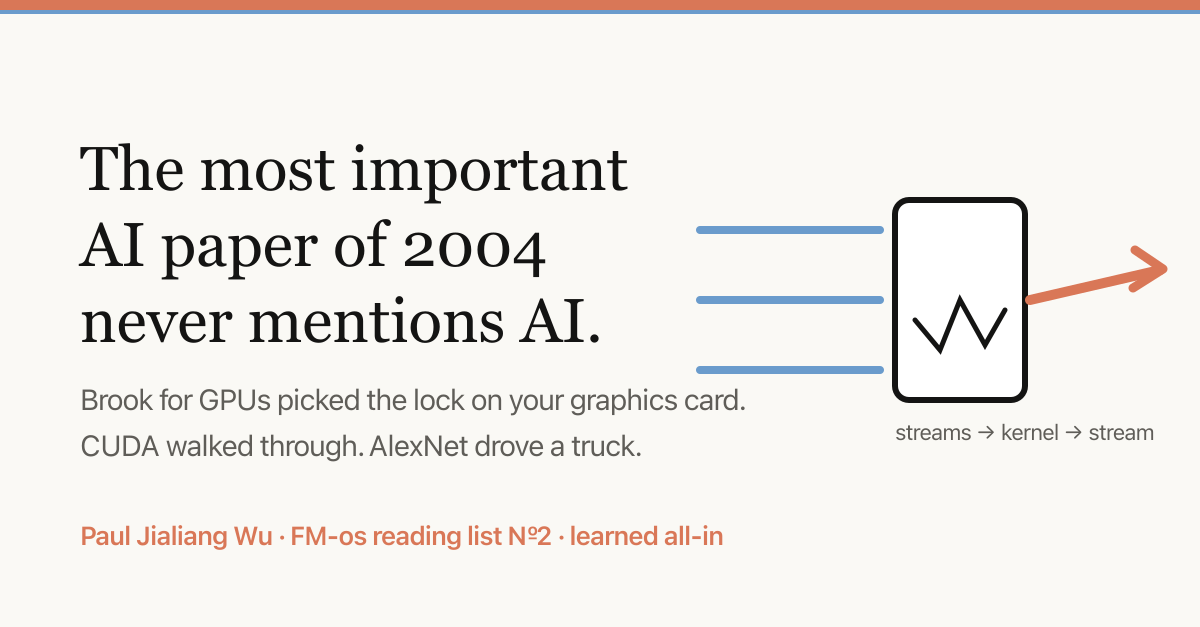
In 2004, seven Stanford researchers published a paper about graphics cards. I ran the search so you don't have to: the words "neural," "artificial intelligence," "machine learning," and "deep learning" appear in it exactly zero times. It is paper №2 on my frontier-AI reading list anyway — ahead of almost everything that does say AI — and by the end of this page I think you'll agree it earned the slot.
A warehouse full of horsepower, and no door
Here was the absurd situation in 2004: the graphics card in a gamer's PC already delivered more raw arithmetic than the CPU it sat next to. All that force was locked behind shader assembly and graphics APIs — to use it, you had to disguise your math as a rendering job. The Brook authors put it plainly[1]:
Imagine a warehouse of engines nobody can start because the ignition only accepts keys shaped like triangles. That's not a metaphor I invented for color — it is the paper's entire reason to exist:
not the silicon
① the locked warehouse — the taller bar was always there; watch what happens when the cage lifts
Three words that picked the lock
Brook's move was not faster hardware. It was a vocabulary. Verbatim from the abstract[1]:
And from the contributions[1]: "Through the use of streams, kernels and reduction operators, Brook abstracts the GPU as a streaming processor." A stream is your data flowing in parallel lanes; a kernel is one function applied to everything flowing past; a reduction folds the flood into an answer. Any problem you can say in those three words — and matrix multiplication says it fluently — runs on the warehouse's engines without ever whispering the word triangle. The receipts, same paper: Brook programs ran "up to seven times faster than their CPU counterparts."[1] This figure is real ink — I drew the paper's whole idea by hand on a pen canvas, and its own renderer exported it:

② the same figure as motion — three blue streams become one orange one; the kernel never moves, the data does
The fuse this paper lit
Follow the actual people. Brook's lead author is Ian Buck. After the paper, he went to NVIDIA — where he created CUDA and today runs the company's hyperscale and HPC computing business[2]. CUDA (2006) is Brook's vocabulary grown industrial. Six years later, two graduate students trained a neural network on gaming hardware, won ImageNet by a margin that embarrassed the field, and closed their paper with the most consequential shrug in AI history — verbatim[3]:
Read that again: the paper that started the deep-learning era ends with a hardware upgrade request. Not a new theory. Not a cleverer prior. Waiting for faster GPUs — engines from the warehouse Brook unlocked eight years earlier, in a paper that never said AI.
Brook: the key 2006
CUDA: the industry door 2012
AlexNet: 2 gaming cards today
the AI era's rent bill
③ the fuse — twenty-two years from "please stop making me draw triangles" to trillion-parameter training runs
The rule underneath, named by an insider
Sara Hooker (Google Brain, later head of Cohere For AI) gave this pattern its permanent name in 2020. Verbatim from her abstract[4]:
Her reasoning cuts both ways, and that's what makes it an insider's insight rather than a slogan: neural networks themselves are an old idea that spent decades losing the lottery — cast as a failure while the hardware they needed didn't exist. Brook and CUDA didn't just speed up computing; they changed which ideas got to be true. If you read my Bitter Lesson piece, here is the joint: Sutton says general methods riding compute win in the long run — Hooker adds the fine print: only the compute someone has bothered to unlock. The Bitter Lesson names the tide; Brook built the harbor.
④ the abstraction ladder — each rung makes the one below invisible; that invisibility is the achievement
Pattern: hardware/software co-design — when capability outruns usability, the highest-leverage work is the abstraction, not the next benchmark. Brook's authors didn't make the GPU faster; they made it speakable.
Anti-pattern: expressing your problem in the hardware's native tongue — triangles in 2004, and today, contorting research ideas to fit whatever the current accelerators reward. That is the hardware lottery's dark side: the warehouse decides what you're allowed to think.
Mechanism: virtualization. Streams/kernels/reductions form a minimal complete language for data-parallelism, so ANY conforming problem — image segmentation in 2004, matrix multiplication forever — maps onto graphics silicon without the silicon changing at all.
Find your locked warehouse this week (the SMART part)
Specific: inventory the compute and tools you own but can't actually drive — the GPU idling in your desktop, the API you pay for and call twice a month, the agent stack that only its author dares touch. Actionable: for the biggest one, write the Brook sentence: "extend [thing I already speak] so that [locked capability] becomes a [noun I can reason about]." That sentence is a spec. Measurable: you've won when someone who couldn't use the thing last week ships with it this week — Brook's own bar was non-graphics developers running code seven times faster[1]. Timeboxed: the inventory is an evening; the sentence is ten minutes; the abstraction is the quarter. Relevant: Hooker's lottery is still drawing tickets — the next AlexNet is stuck behind somebody's triangle-shaped ignition right now.
How this page was made (receipts, briefly)
One sentence to my allin-anything router: "learn the Brook for GPUs paper deeply, with an animation for each key idea, and sketch its stream-through-kernel pipeline by hand." Three organs answered, each one's own test suite green before trust — the teach-back loop, the animation-craft linter, and the penecho canvas (200 tests at its pinned commit) whose own exporter produced the ink above. Every quote here was fetched from the primary source and matched character-for-character. The chain stopped at the one step machines don't own: publishing was my click. Receipts — exit codes, pinned commits, the run journal — live in the repo[5].
References (each link verified at publication)
- Buck, I., Foley, T., Horn, D., Sugerman, J., Fatahalian, K., Houston, M. & Hanrahan, P. (2004). Brook for GPUs: Stream Computing on Graphics Hardware. SIGGRAPH 2004 — all quotes verbatim from the PDF (fetched and matched at publication); project page: graphics.stanford.edu/projects/brookgpu.
- NVIDIA Newsroom. Ian Buck — bio — Brook's lead author; creator of CUDA; VP, Hyperscale and HPC Computing.
- Krizhevsky, A., Sutskever, I. & Hinton, G. (2012). ImageNet Classification with Deep Convolutional Neural Networks. NeurIPS — the "two GTX 580 3GB GPUs" and "waiting for faster GPUs" lines verbatim from the PDF.
- Hooker, S. (2020). The Hardware Lottery. arXiv:2009.06489 — definition quoted verbatim from the abstract.
- The run's receipts — router verdict, organ test counts, exit codes, the AutoRunner journal —
in github.com/wjlgatech/allin-anything
(walkthrough: article-to-animated-understanding); live demo:
allin-anything-demo.vercel.app. Word-count
receipts for the lede's zero-mentions claim:
grep -ciover the Brook PDF text for "neural", "artificial intelligence", "machine learning", "deep learning" → 0, 0, 0, 0.
Paul Jialiang Wu · agentic-portfolio-lovat.vercel.app · paper №2 of the FM-os Frontier AI Reading List, learned all-in · next on the list: AlexNet — the fuse reaches the powder