AI-Native Series · Faith Life
Choose Your Soil. Keep Your Heart.
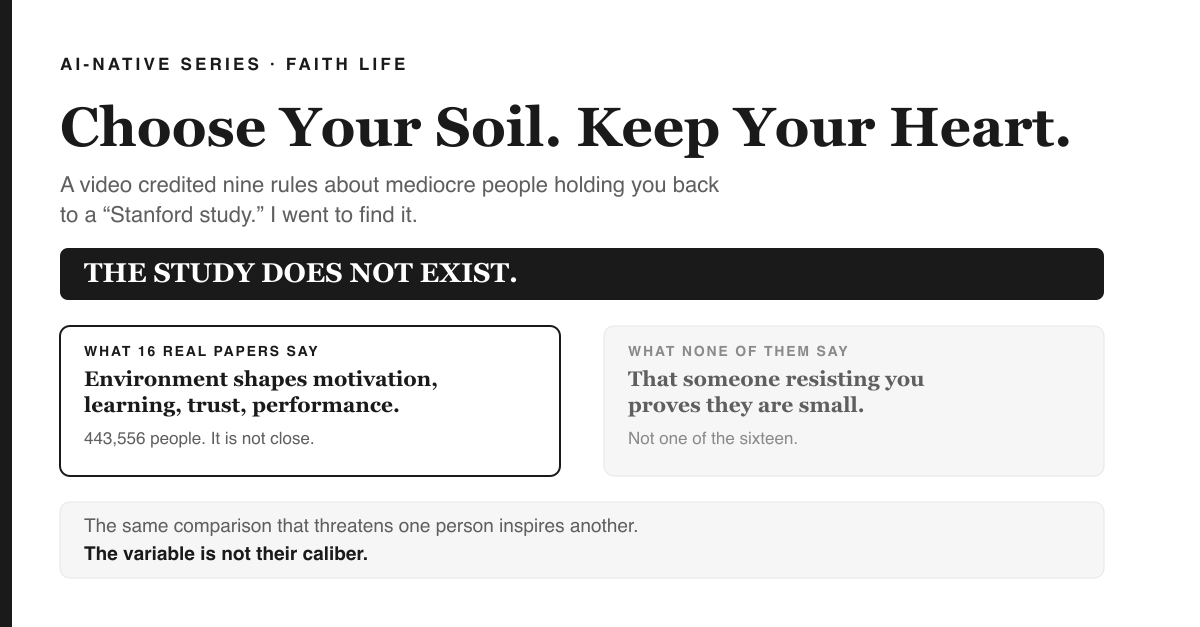
1-minute takeaway — what you'll walk away with
A video told me a "Stanford study" proved that when people resist your excellence, it exposes their mediocrity. I went looking for that study. It does not exist. What does exist is better: roughly 443,556 people's worth of evidence that environments really do shape us — and not one finding that licenses the conclusion the video wanted. The same upward comparison that threatens one person inspires another, and what decides which is whether improvement looks reachable. So the question is not "are these people mediocre?" but "what does this system reward?" — because fruit is observable and motive is not. The protocol is ROOT: Read the fruit for 30 days with no motive words, Own your part, Offer truth with grace, Transplant deliberately. And the sting in the tail: there is one danger worse than staying too long in bad soil, which is leaving it while carrying its spirit out with you.
Someone sent me a video. It was good — the way a well-made thing is good, all momentum and certainty. Nine principles for surviving people who resent your growth. Crab Effect. Mirror Effect. Stealth Growth. Soil Matching.
And a citation: a Stanford University study.
I went to find it.
The study does not exist
I searched for the nine-part theory. I searched for the quoted language. I searched for each construct by name — "Crab Effect," "Mirror Effect," "Stealth Growth," "Soil Matching."
Nothing. No Stanford paper, no paper anywhere, containing that framework.
And read those four names again in order, because the escalation is doing something. Crab Effect — fine, crabs, that is at least an animal doing a thing. Mirror Effect — sure, optics, we are still in the physical world. Stealth Growth — now we have gone military. Soil Matching — and now we are gardening, apparently on the same axis as the submarine.
Four metaphors from four unrelated domains, presented as one integrated theory, attributed to a university that has never heard of it. The tell was in the naming the whole time.
Which does not make the video worthless. It makes those four phrases metaphors, and metaphors are allowed. What is not allowed is a metaphor wearing a university's name to borrow its authority.
So I did the thing the video skipped, and read the actual literature. Sixteen papers. Every DOI resolved, every headline number checked against the paper's own abstract.
Here is what I found, and it is more demanding than the video — not less.
Environment matters. That part is real.
A 2024 meta-analysis pooled 4,561 effect sizes from 881 independent samples covering 443,556 people. When the people around you support your autonomy, your competence, and your sense of belonging, psychological need satisfaction and well-being rise substantially; performance rises too, though more modestly.[R1]
A longitudinal study following adolescents' peer networks found that peer-group context predicted later changes in how much they enjoyed school and how well they did — even after the researchers worked to separate genuine influence from the fact that people pick friends who are already like them.[R2]
Chronic exclusion is not imaginary either. A 2021 meta-analysis of 95 independent samples, 26,767 people, found workplace ostracism — which the authors flatly call "social death" — significantly related to people's attitudes, well-being, and behavior, belongingness and job satisfaction among them.[R11]
And fit matters: 172 studies and 836 effect sizes tie person–job, person–organization, person–group and person–supervisor fit to attitudes, performance, strain, withdrawal and how long people stay.[R12]
So: choose your soil. The research supports it.
But Scripture asks a harder question than the video did. Not only what is this place doing to me — also who am I becoming while I am in it?
"One who walks with wise men grows wise, but a companion of fools suffers harm."
— Proverbs 13:20, WEB
Note the second half. The video quoted proverbs like this one constantly and always stopped at the comma. The warning is in the part after it.
The mechanism: threat and inspiration are the same input
Here is the finding that dismantles the video's entire thesis, and it is not a soft one.
Sixty-plus years of social-comparison research, meta-analyzed, confirms that comparing yourself with someone better off often does make you evaluate yourself worse.[R3] And it stings worst in a specific place: being outperformed by someone close to you, in a domain you have built your identity on. Tesser and colleagues named that pattern self-evaluation maintenance.[R4]
So the video's kernel is true. Your excellence can make someone's insecurity more visible.
But it does not follow — and this is where the video jumps a canyon — that a negative reaction proves anything about the other person's caliber.
Because the identical comparison produces the opposite result under one condition. Lockwood and Kunda found that outstanding role models were inspiring rather than deflating when people believed comparable success was actually attainable for them.[R5] Van de Ven and colleagues showed experimentally that upward comparison can generate a benign form of envy that raises motivation and subsequent performance — again, when improvement looks reachable.[R6]
Read that again. Same stimulus. Opposite outcome. The variable is not the other person's mediocrity.
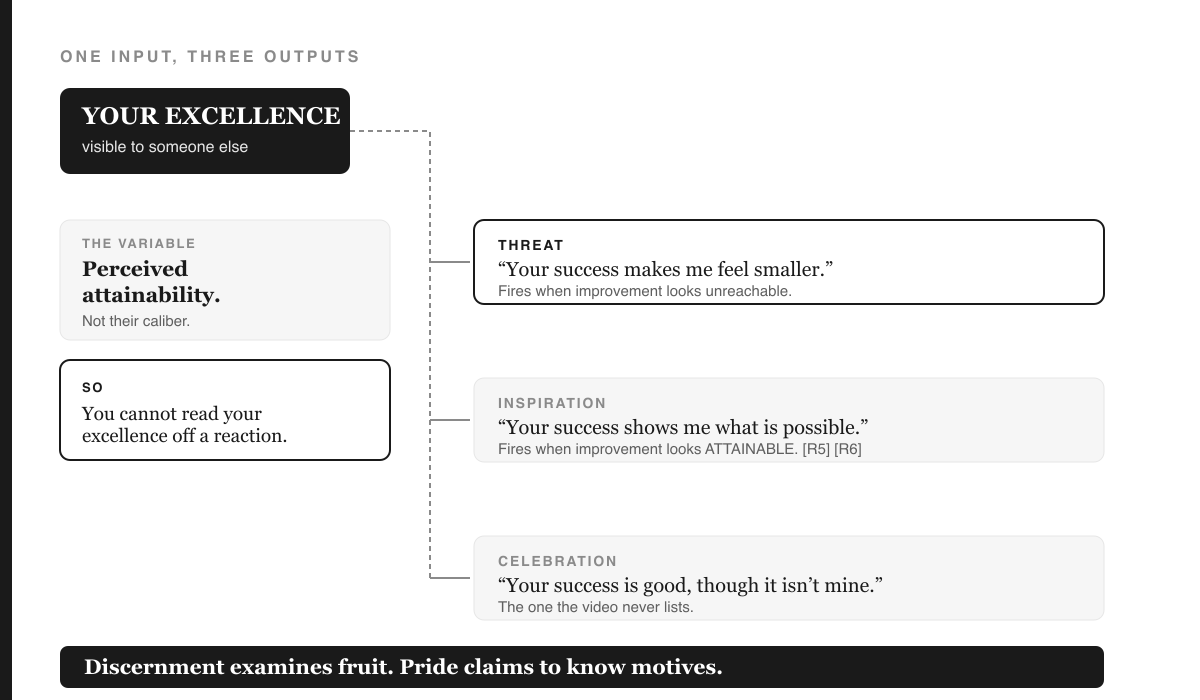
And we are terrible at reading which branch fired. Gilbert and Malone's review of correspondence bias documents how readily people infer permanent character from behavior when the situation explains it perfectly well.[R7]
So when someone criticizes you, "they're jealous" is the one interpretation you have not earned yet. Before it, in order: Is the criticism true? Did I explain it badly? Are our incentives different? Am I simply wrong?
"So, then, my beloved brothers, let every man be swift to hear, slow to speak, and slow to anger"
— James 1:19, WEB
Discernment examines fruit. Pride claims to know motives.
Stop grading people. Grade the system.
"High-level people" and "low-level people" is a satisfying vocabulary and a useless one. It cannot be measured, and it slides into contempt on its own momentum.
Replace it with a question you can actually answer: what behavior does this place reward, over and over? Truth or image. Learning or defensiveness. Responsibility or blame. Disagreement or retaliation.
Those are observable, and they matter enormously. Canning, Murphy, Emerson, Chatman, Dweck and Kray studied organizational mindsets across multiple studies, including more than 500 employees at seven Fortune 1000 companies: where employees saw their organization as treating ability as fixed, they reported less collaboration, less innovation, less integrity, and lower trust and commitment.[R8]
Amy Edmondson's foundational field study of 51 work teams introduced the construct that has since eaten the management world — team psychological safety, which she defines as
"a shared belief held by members of a team that the team is safe for interpersonal risk taking"
— Edmondson, 1999[R9]
Her mechanism is the part people skip when they quote her. Psychological safety did not improve performance directly. Learning behavior mediated it. Safety let people ask, admit, and experiment; the asking is what produced the performance. Team efficacy, tested alongside it, did not survive the control.[R9] A later meta-analysis across 136 independent samples, more than 22,000 individuals and nearly 5,000 groups, put substantial weight behind the construct.[R10]
Jesus gave the same instruction, and it is startlingly empirical:
"By their fruits you will know them."
— Matthew 7:16, WEB
Fruit is observable. Motive usually is not.
The 30-day log, and the moment it humiliates you
So run it. For 30 days, record what happened. One rule: no motive words.
I want to be honest about how this goes, because mine went like this. My first entry was:
"He sabotaged me in the review because he is threatened by anyone competent."
Strip the motive words and you are left with: "He."
Fourteen words, and I had recorded a diagnosis, a motive, a character assessment, and a compliment to myself. What I had not recorded was anything that happened.
The rewrite took four minutes and it was devastating: "He removed my name from the analysis after I submitted it. I asked why. No explanation was given."
That version is worse for my ego and infinitely better for my decision-making, because it is the only version anyone else can evaluate — including me, in a calmer month. Do this thirty times and you stop having opinions about people and start having evidence about a system.
Data before diagnosis.
A gym also hurts
The exclusion research is real. But it gets misused to license an exit from anything unpleasant, so the distinction has to be said plainly: uncomfortable is not the same as toxic.
A demanding mentor frustrates you and improves you. An honest colleague attacks your favorite idea and saves your project. A team shows you a weakness you would have paid to keep hidden.
"knowing that the testing of your faith produces endurance."
— James 1:3, WEB
And sometimes withdrawal is exactly right. When opposition to Paul's teaching hardened into public slander, Acts 19:9 records that he "departed from them, and separated the disciples, reasoning daily in the school of Tyrannus" — he moved the venue and kept the mission. The room changed. The calling did not.
So ask what the difficulty is producing. Competence, patience, humility, courage, clearer thinking? Or fear, concealment, dishonesty, exhaustion, and the collapse of your primary obligations?
Both a gym and a poison hurt. Only one is making you stronger.
"They can't understand me" is usually a speaking problem
The video says communication is capped by the listener's framework. Half true, and the half it omits is the speaker's job.
Clark and Brennan's foundational account describes conversation as the continuous construction of common ground — success comes from coordination, not transmission.[R13] Understanding is co-created. Which means "they are incapable of understanding my vision" is a claim you have to earn, and here is the four-step toll you pay first:
Sentence. Say it in one. Example. Give one concrete case. Picture. Draw the system. Check. Ask what they heard.
Then act on the answer: confusion means simplify; disagreement means investigate; a better argument means change your mind. Only after repeated good-faith attempts meet nothing but mockery or deliberate distortion do you stop spending unlimited energy there.
Jesus explained, told stories, asked questions, confronted, and sometimes said nothing. Wisdom is not endless explanation. But it is never "they're too low-level to follow me."
Kindness needs a spine, not fangs
"Your kindness must grow teeth" is a memorable line and a slightly feral one. The instruction it is reaching for is more precise:
"Therefore be wise as serpents, and harmless as doves."
— Matthew 10:16, WEB
Both at once. Not naïve kindness, not cynical strength. Boundaries in this key sound unremarkable: I want to help, and I can't own this. I forgive you, and I won't participate in it. I love you, and the answer is no. And sometimes just: no. You do not owe a closing argument after each one.
Galatians holds the tension three verses apart — "Bear one another's burdens, and so fulfill the law of Christ" (6:2), then "For each man will bear his own burden" (6:5). Sometimes love carries. Sometimes love refuses to carry what another person has to learn to carry. Neither people-pleasing nor people-punishing: love governed by truth.
Steward the door
"Hide your vulnerabilities" prevents some betrayal and all intimacy.
Collins and Miller's meta-analysis found self-disclosure and liking reliably linked in several directions at once: we disclose more to people we like, people who disclose appropriately are liked more, and disclosing can itself increase liking.[R14] So the answer is neither everything nor nothing. It is that disclosure should track demonstrated trustworthiness.
John's gospel gives the model, and it is bracing: Jesus loved people relentlessly and "didn't entrust himself to them, because he knew everyone" (John 2:24). Love can be universal. Trust is earned. Those are different words and the video collapsed them.
So: values and mission in public. Context with acquaintances. Real weakness with trusted friends. Wounds with the few who have shown they can steward them. Not lock your heart — steward the door.
Grow quietly. Do not vanish.
There are seasons when announcing your plans is foolish and building in silence is wisdom. Fine. But "stealth growth" curdles into isolation faster than anyone expects — and the same 443,556-person meta-analysis says why: people function better when others support their autonomy, competence and relatedness.[R1] Withdrawal removes the thing the evidence says you run on.
"Iron sharpens iron; so a man sharpens his friend's countenance."
— Proverbs 27:17, WEB
You need people who can say "that is brilliant" and people who can say "that makes no sense." Ideally the same people. Not everyone. But someone.
Both ways of staying enslaved to the old room
Wanting the old crowd to certify the new you is powerful, and there are two versions of it:
"Please tell me I made it."
"One day I'll be so successful you'll regret doubting me."
They feel like opposites. They are the same architecture: the audience is still holding the scorecard. Revenge fantasies are not freedom; they are a subscription.
"But let each man examine his own work, and then he will have reason to boast in himself, and not in someone else."
— Galatians 6:4, WEB
This does not kill ambition. It launders it. Someone else's success stops shrinking you, their criticism stops defining you, and their excellence becomes information instead of injury. You can enjoy people again.
The turn: you are not only a plant
Here the research becomes almost embarrassing in how directly it answers the video.
Crocker and Canevello followed 199 college freshmen and compared two kinds of relational goal: compassionate goals, aimed at supporting others, versus self-image goals, aimed at managing how one is seen. Compassionate goals predicted greater closeness and rising social support and trust over time. Self-image goals did not.[R15] Follow-up dyadic studies of roommate pairs found reciprocal cycles: compassionate goals predicted responsiveness between partners, which fed relationship quality for both people.[R16]
Which means the soil is not only weather that happens to you. Within real limits, you are one of the things making it.
So every question in the video inverts:
| The video asks | Ask instead |
|---|---|
| Who celebrates my excellence? | Whose excellence did I celebrate this week? |
| Who nourishes me? | Whom did I strengthen? |
| Why does nobody understand my vision? | Whose vision did I take time to understand? |
| Who is pulling me down? | Am I making courage and truth easier for the people near me? |
| How do I escape mediocre people? | How do I refuse mediocrity without losing love for people? |
That last one is the whole discipline, and it is the hardest sentence in this essay.
The ROOT protocol
When a place worries you, do not condemn it and do not endure it silently. Run ROOT.
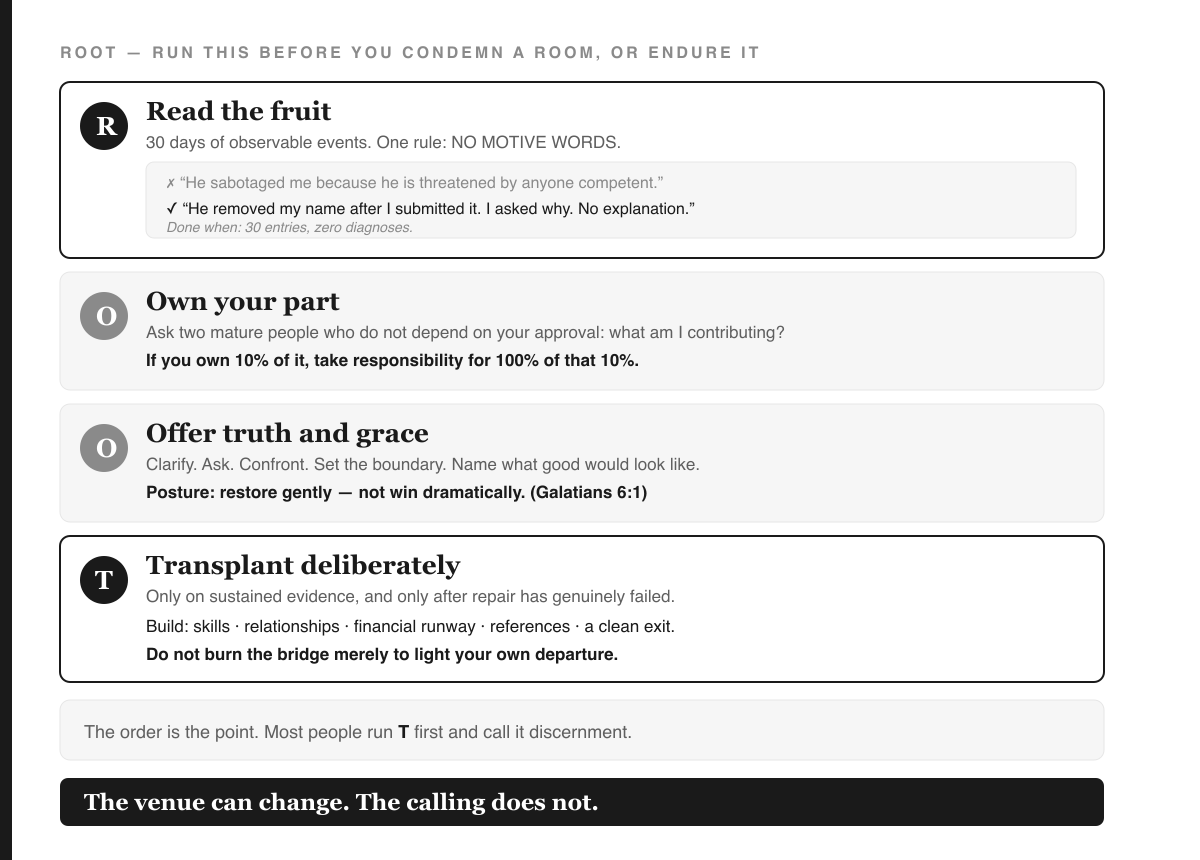
R — Read the fruit. Thirty days of observable events. Truthfulness, encouragement, gossip, retaliation, learning, blame, commitments kept and broken. No motive words. You are done when you have thirty entries and zero diagnoses.
O — Own your part. Ask two mature people who do not depend on your approval what you are contributing. Then listen without defending yourself. The goal is not to conclude it is all your fault. It is smaller and harder: if you own 10% of it, take responsibility for 100% of that 10%.
"You hypocrite! First remove the beam out of your own eye, and then you can see clearly to remove the speck out of your brother's eye."
— Matthew 7:5, WEB
O — Offer truth and grace. Before you leave, give truth a real attempt. Clarify, ask, confront, set the boundary, define what good would look like. With the posture Galatians 6:1 names — "restore such a one in a spirit of gentleness". Restore gently, not win dramatically.
T — Transplant deliberately. If sustained evidence shows the place chronically undermines truth, health, or your primary obligations, and repair has genuinely failed, then leave — in order. Skills, relationships, financial runway, references, a clean exit. Do not burn the bridge merely to light your own departure.
Patterns and anti-patterns
| Anti-pattern | Pattern |
|---|---|
| "They resist me, so they are mediocre." | "They resist me. Which of six explanations fits the evidence?" |
| Grading people high-level and low-level. | Grading the behavior the system repeatedly rewards. |
| Treating discomfort as proof of toxicity. | Asking what the discomfort is producing in you. |
| "They can't understand my vision." | Sentence, example, picture, check — then judge. |
| Hiding everything from everyone. | Disclosure that tracks demonstrated trustworthiness. |
| Stealth growth that becomes disappearance. | Quietly capable, openly teachable. |
| Leaving to prove them wrong. | Leaving because the calling needs a different room. |
The first principle
One sentence, and everything above is downstream of it:
Fruit is observable and motive is not — so judge systems by what they reward, judge yourself by what you produce, and never build your greatness on a verdict about someone else's inferiority.
Every finding here supports taking environment seriously. Comparison shapes self-evaluation.[R3] Peers shape motivation.[R2] Safety shapes learning.[R9][R10] Fixed-ability cultures erode trust.[R8] Ostracism does real damage.[R11] Fit predicts outcomes.[R12]
Not one of them supports "I am excellent, therefore my critics are small."
"Don't be overcome by evil, but overcome evil with good."
— Romans 12:21, WEB
So choose wise companions. Protect the calling. Set boundaries. Leave destructive systems when wisdom requires it. Stop asking rooms for permission to become who you are being called to become.
And know the danger the video never mentions, which is worse than staying too long in bad soil:
escaping the room while carrying its spirit out with you.
Grow fiercely. Grow quietly when you must. Grow through correction and through adversity. Grow rooted deeply enough that you can enter a room without needing its applause, stay without surrendering your convictions, leave without needing revenge — and improve it, because love and truth and courage walked in with you.
Do not only find good soil.
Become good soil.
How this article was checked
Because the essay begins by refusing an unverifiable citation, it owes you the same standard.
All 16 references were resolved by DOI against Crossref: authors, year, journal, volume and page range. Two initially looked wrong and were not — Canning et al.[R8] and Frazier et al.[R10] appeared online in 2019 and 2016 but belong to 2020 and 2017 print issues, which is what the citation should say. Every headline figure quoted here — 4,561 effect sizes, 881 samples, 443,556 people, 95 samples, 26,767 people, 51 teams, 136 samples, 172 studies, 836 effect sizes, 199 freshmen — was checked against the paper's own abstract, not a secondary summary.
Scripture is quoted from the World English Bible, and that is a deliberate choice with a cost. The wording I had first drafted was ESV, which is a better read in several of these verses. I could not verify ESV text against a licensed source, and quoting a translation I cannot check is the same failure as citing a study I cannot find. The WEB is public domain, so every quotation above was pulled verbatim and is reproducible. Where I trimmed a verse I said so, and where the second half of a verse carried a warning — Proverbs 13:20 — I kept it in.
One note for readers of the translated editions. The verses there are rendered from this WEB text into your language; they are not quotations of your language's standard Bible — not the 和合本, the 개역개정, or the 新改訳. If a verse matters to you, read it in your own translation. I would rather tell you that than let a rendering pass for a citation.
References
- [R1] Slemp, G. R., Field, J. G., Ryan, R. M., Forner, V. W., Van den Broeck, A., & Lewis, K. J. (2024). Interpersonal supports for basic psychological needs and their relations with motivation, well-being, and performance: A meta-analysis. Journal of Personality and Social Psychology, 127(5), 1012–1037. DOI: 10.1037/pspi0000459 Meta-analysis: 4,561 effect sizes, 881 independent samples, N=443,556.
- [R2] Ryan, A. M. (2001). The peer group as a context for the development of young adolescent motivation and achievement. Child Development, 72(4), 1135–1150. DOI: 10.1111/1467-8624.00338 Longitudinal social-network study, N=331.
- [R3] Gerber, J. P., Wheeler, L., & Suls, J. (2018). A social comparison theory meta-analysis 60+ years on. Psychological Bulletin, 144(2), 177–197. DOI: 10.1037/bul0000127
- [R4] Tesser, A., Millar, M., & Moore, J. (1988). Some affective consequences of social comparison and reflection processes: The pain and pleasure of being close. Journal of Personality and Social Psychology, 54(1), 49–61. DOI: 10.1037/0022-3514.54.1.49
- [R5] Lockwood, P., & Kunda, Z. (1997). Superstars and me: Predicting the impact of role models on the self. Journal of Personality and Social Psychology, 73(1), 91–103. DOI: 10.1037/0022-3514.73.1.91
- [R6] van de Ven, N., Zeelenberg, M., & Pieters, R. (2011). Why envy outperforms admiration. Personality and Social Psychology Bulletin, 37(6), 784–795. DOI: 10.1177/0146167211400421 Four experimental studies.
- [R7] Gilbert, D. T., & Malone, P. S. (1995). The correspondence bias. Psychological Bulletin, 117(1), 21–38. DOI: 10.1037/0033-2909.117.1.21
- [R8] Canning, E. A., Murphy, M. C., Emerson, K. T. U., Chatman, J. A., Dweck, C. S., & Kray, L. J. (2020). Cultures of genius at work: Organizational mindsets predict cultural norms, trust, and commitment. Personality and Social Psychology Bulletin, 46(4), 626–642. DOI: 10.1177/0146167219872473 Includes >500 employees at seven Fortune 1000 companies. Published online 2019-09-10; print issue April 2020.
- [R9] Edmondson, A. (1999). Psychological safety and learning behavior in work teams. Administrative Science Quarterly, 44(2), 350–383. DOI: 10.2307/2666999 Multimethod field study of 51 work teams.
- [R10] Frazier, M. L., Fainshmidt, S., Klinger, R. L., Pezeshkan, A., & Vracheva, V. (2017). Psychological safety: A meta-analytic review and extension. Personnel Psychology, 70(1), 113–165. DOI: 10.1111/peps.12183 136 independent samples; >22,000 individuals; nearly 5,000 groups. Online 2016-10-14; print issue February 2017.
- [R11] Li, M., Xu, X., & Kwan, H. K. (2021). Consequences of workplace ostracism: A meta-analytic review. Frontiers in Psychology, 12, 641302. DOI: 10.3389/fpsyg.2021.641302 95 independent samples, N=26,767. Open access.
- [R12] Kristof-Brown, A. L., Zimmerman, R. D., & Johnson, E. C. (2005). Consequences of individuals' fit at work: A meta-analysis of person–job, person–organization, person–group, and person–supervisor fit. Personnel Psychology, 58(2), 281–342. DOI: 10.1111/j.1744-6570.2005.00672.x 172 studies; 836 effect sizes.
- [R13] Clark, H. H., & Brennan, S. E. (1991). Grounding in communication. In Perspectives on Socially Shared Cognition, 127–149. DOI: 10.1037/10096-006 Foundational common-ground framework.
- [R14] Collins, N. L., & Miller, L. C. (1994). Self-disclosure and liking: A meta-analytic review. Psychological Bulletin, 116(3), 457–475. DOI: 10.1037/0033-2909.116.3.457
- [R15] Crocker, J., & Canevello, A. (2008). Creating and undermining social support in communal relationships: The role of compassionate and self-image goals. Journal of Personality and Social Psychology, 95(3), 555–575. DOI: 10.1037/0022-3514.95.3.555 Longitudinal study of 199 college freshmen.
- [R16] Canevello, A., & Crocker, J. (2010). Creating good relationships: Responsiveness, relationship quality, and interpersonal goals. Journal of Personality and Social Psychology, 99(1), 78–106. DOI: 10.1037/a0018186 Longitudinal dyadic studies.
Related
Part of an AI-Native series on faith life and building honestly. Scripture quoted from the World English Bible (public domain) so every quotation is reproducible. All 16 references DOI-verified against Crossref; every headline figure checked against the source abstract. The "Stanford study" the source video cites could not be located — see "How this article was checked."