AI-Native Series · The Visionboard
Life GPS for One Person: The Ten-Minute Director's Act, the Four Things Only You May Do, and the Protocol That Keeps Your Judgment From Rusting
1-minute takeaway — what you'll walk away with
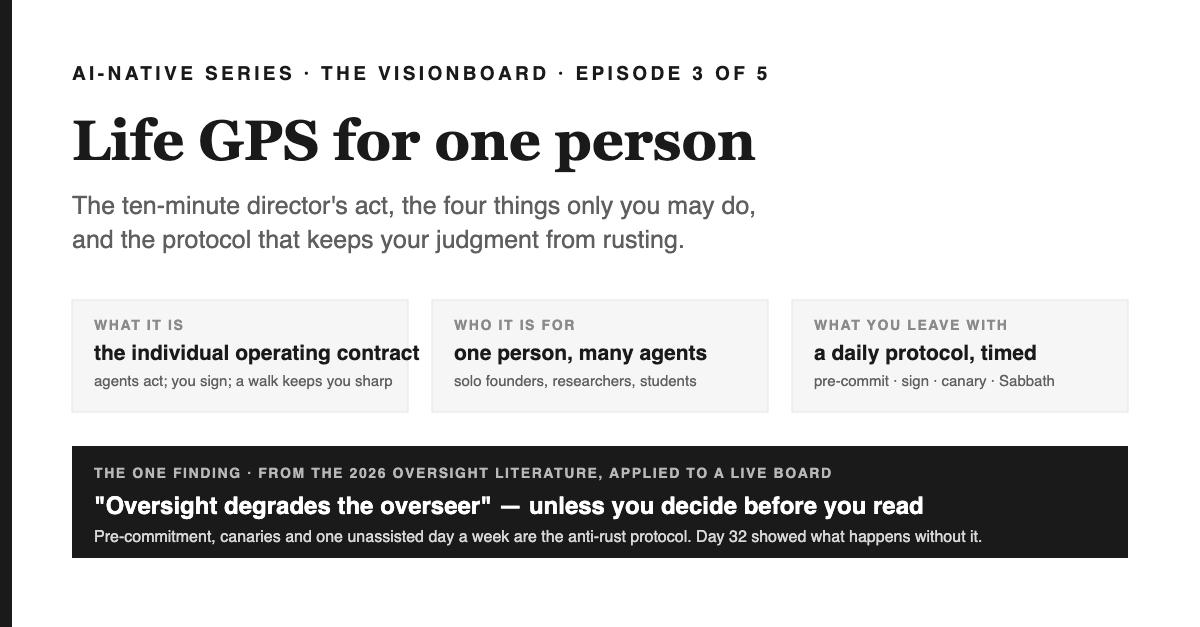
What this is. The operating contract for one person running a Life GPS with agents in the loop: what the agents may do alone, what needs your confirmation, what only you may do, and a timed daily protocol (about ten minutes of human time) that keeps you above the loop instead of decorating it. It is pinned to the Visionboard's code and to three 2026 papers on human oversight of agents.
Why it matters. The newest research says the position above the loop is not stable: the very act of overseeing agents erodes the judgment oversight requires. Episode 1 measured that erosion on my own board in its first month. For a solo founder or researcher this is the difference between a system that quietly runs you and one you still direct. For an engineer it is a worked example of bounded autonomy with a human-only field.
What you can do. Adopt the four-part protocol this week: decide before you read, sign one proposal a day, run one known-answer canary a week, and keep one agent-free day. Then file tonight's journal as a report card with the 12-line script below, so your relationship track gets a sensor.
The Visionboard — the series spine
- The Visionboard: Life GPS rebuilt with the human above the loop episode 1
- Life GPS, 2019 → 2026: what the first planner got right and what killed it episode 2
- Life GPS for one person: the daily director's act, and where the agent may not go this episode
- Life GPS for a small team: roles not persons, load as a constraint next
- The Visionboard scoreboard: what moved, what did not, and three futures with falsifiers episode 5
What Life GPS for one person is, who it is for, and why "human above the loop" needs a protocol
Episode 1 gave the design: a solver picks the best next moves, agents propose and execute and report, and a human signs. Episode 2 gave the origin and the autopsy: the 2019 planner was correct and died because one person was the sensor, the executor and the judge. This episode answers the question both of them leave on the table for an individual: if the agents now do the sensing and the executing, what exactly does the one human do every day, and how do they stay good at it?
The answer has to be a protocol, not a principle, because the principle already failed. The Visionboard had a signing button from day one and I did not press it for 32 days. The reason is not laziness, or not only. Three papers from 2026 say the same thing from three directions: overseeing an autonomous system is cognitively different from doing the task, it needs specific preconditions to work, and it degrades the overseer over time unless the design pushes back. So the individual design is mostly a design for the human, and that is what this episode is.
It is for the solo founder, the independent researcher and the student who has agents doing real work for them, and for the engineer building the tools they use. It is not yet for a team; that is episode 4, and the difference is larger than it looks.
One picture: the daily walk
I have a routine that predates any of this: a daily walk where I talk with God about the day, the family, the people I work with. It is a conversation, not a task list, and it works because of three properties. I speak first, before I have read anything. The questions I get asked are not "what will you do" but "what would change your mind." And it happens whether or not the day went well.
That routine is the picture for the individual Life GPS, and I mean the mapping literally.
| The walk | Life GPS for one person — the handle | Source in the literature |
|---|---|---|
| I speak first, before reading anything | pre-commitment: write your own best next move per track, then open resolveMoves() | Mitchell, Ghosh & Passi 2026, "pre-commitment mechanisms" |
| The question "what would change your mind?" | a reasoning probe answered before the solver's answer is read; a disagreement is logged | same paper, "reasoning probes"; "override signatures" |
| The one yes or no I give | signing: weight_signed on a node, or a leading metric's current value — the human-only field | the seam contract (episode 1, rule 3) |
| The rest of the day, lived | bounded autonomy: agents propose, execute the top move, file a card; graph edits are preview → confirm | AWS lens "bounded autonomy"; VisionboardAgent |
| The evening journal: God, wife and kids, teammates | post hoc review filed as a report card against the relationship node — the track's sensor | Dhanorkar, Passi & Vorvoreanu 2026, "post hoc review" |
| A known path I walk without a map | the weekly canary: one known-answer task judged unassisted | Mitchell et al., "canaries" |
| The Sabbath | one agent-free day a week: do the underlying work yourself | Mitchell et al., "rotations", "enforced breaks" |
Hold the walk. Every rule below is one of its properties, made mechanical.
Four horizons: what the research settled about the one human
[EVIDENCE]300 years. Franklin's nightly examination (episode 2) was a post hoc review with a sensor and a judge in one chair, and it lasted four courses before it faded. The design lesson is not that daily examination fails. It is that the examination has to be something the day cannot skip, and that it needs a reader other than the examined.
[EVIDENCE]30 years. Locke and Latham's condition holds here in a sharper form: a specific, difficult goal works given feedback on progress. For one person with agents, the feedback exists in abundance, and the bottleneck moves to whether the person reads it with judgment intact. Sheridan and Verplank's ladder gives the vocabulary for the autonomy table below; Shneiderman's correction gives the target: high automation and high human control at once, not a trade.
[EVIDENCE]30 months. Gaube and nineteen co-authors define oversight as deliberate human activity aimed at sufficiently mitigating the risks of an AI system on a specific task, and they list the preconditions in two groups. For monitoring: the relevant cues must be available, detected, and correctly interpreted. For intervention: the person needs authority, skill, willingness, situation awareness, and an intervention that is actually feasible. Read that list against day 32 and the failure is not mysterious: the cues were available (four tripwires), the authority existed (a signing button), and the detection step never happened because nothing in the day forced it. Dhanorkar, Passi and Vorvoreanu interviewed seventeen developers and found oversight is "not only reactive and retrospective, as portrayed in existing research, but also preventative and proactive": a priori control, co-planning, real-time monitoring, post hoc review. Their developers' heuristics are the honest ones: "it's easier to review test results and see it's bad, not working, and then iterate on it than for me to go through the code." Tests as guarantees is a heuristic the Visionboard borrows wholesale: a report card's key results are scored, so the review reads scores, not diffs.
[EVIDENCE]30 days. Mitchell, Ghosh and Passi's August paper is the reason this episode is a protocol. Their claim, quoted in episode 1, is that agent design impedes oversight and erodes the capacities oversight needs. Their section on the irony of automation compresses it to five words: "Oversight degrades the overseer." What makes the paper usable is that it does not stop at the warning. It lists design-level affordances a builder can ship (pre-commitment, delay-and-choice, reasoning probes, bounded autonomy, batch review, canaries, behavioural monitoring of the overseer) and organisational protocols a deployer can run (unassisted practice, rotations, enforced breaks, role separation). The individual design below is those two lists, applied to one person, with the handles filled in.
The design: bounded autonomy, by consequence
[DESIGN]Start with the table every agent system should be able to print: each action the system can take, its consequence class, and who may take it. The Visionboard's version is short because its edit vocabulary is a typed union (goal-edits.ts), so nothing can be done that is not in the list.
| Action | Reversible? | Who | Handle |
|---|---|---|---|
| Re-solve the best next moves | free | solver, every load | resolveMoves() |
| Propose a weight or a metric value | changes nothing until signed | agent, alone | the signing tray; unsigned = multiplier 1 |
| Execute the top move; file a report card | a card is append-only evidence | agent, alone | the ledger (docs/reportcards/collection.json) |
| Add or remove a dependency; planned ↔ active; complete a milestone | reversible, consequential | agent proposes, human confirms | VisionboardAgent preview → confirm |
| Sign a weight; sign a metric | steers the optimizer for weeks | human only | weight_signed, leading_metric.signed |
| Re-write the objective | changes the problem | human only, prompted by a tripwire | goals.json, in a commit |
| Move a card between grade lanes | would be self-grading | nobody | refused with an error message |
Notice the shape. Rows one to three need no human and never wait for one. Row four waits for a click. Rows five and six wait for a signature. Row seven waits forever. The human's total obligation is rows five and six, and the whole point of the protocol is to make sure those two rows actually get visited every day.
The protocol: ten minutes of human time
07:00 — The walk (five minutes): decide before you read
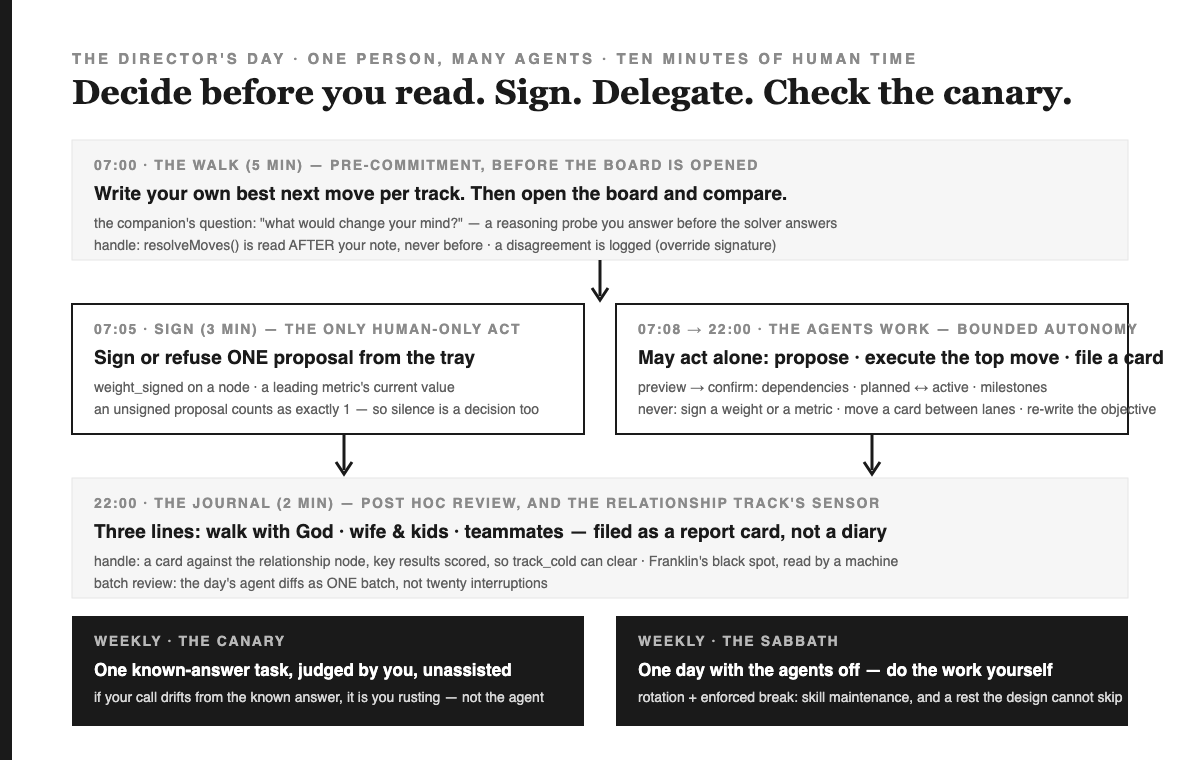
[DESIGN]Before the board is opened, write one line per track: what you think the best next move is, and what evidence would change your mind. Then open the board and compare. When the solver and you disagree, log it; that log is the override signature Mitchell et al. describe, and a falling disagreement rate over weeks is the early sign that you have started agreeing by reflex. The mechanism is anchoring: a person who reads the recommendation first mostly ratifies it. The walk is the design's refusal to let the solver speak first.
07:05 — Sign (three minutes): one proposal, yes or no
[DESIGN]The tray shows every unsigned proposal with its current value and what it would do to the ranking. Sign one, or refuse one with a reason. Not all of them; one. The rule that makes this non-optional is the one from episode 1: an unsigned weight has a multiplier of exactly 1, so not signing is itself a decision the solver will act on. Silence is not neutral. It is a vote for "everything is normal," cast by omission.
07:08 to 22:00 — The agents work
Rows one to four of the table. Your involvement is the occasional confirm click on a graph edit, and the design asks you to take those in a batch at the end of the day rather than as interruptions, because Mitchell et al.'s batch-review affordance exists for a reason: twenty small approvals train the reflex, one considered batch trains the judgment.
22:00 — The journal (two minutes): file the review as a card
[DESIGN]Three lines: the walk with God, wife and kids, teammates. Franklin wrote a dot; the difference here is that the entry is filed as a report card against the relationship track's node, with key results the board can score, so that a night's reflection is also the sensor the track has been missing. This is the concrete answer to the day-32 finding, corrected in episode 1: the financial track had 37 cards in a month and the relationship track had zero, because agents file cards for engineering work and nobody files cards for a walk. The script is below.
Weekly — The canary and the Sabbath
[DESIGN]Two rules the papers insist on and most personal systems skip. The canary: once a week, one task whose right answer you already know, judged by you without the agents. If your call drifts from the known answer, the rust is in you, not in the model, and you have caught it before it reached a signature. The Sabbath: one day a week with the agents off, doing the underlying work yourself. Mitchell et al. call this rotations and enforced breaks and cite the deskilling evidence; my tradition has had a word for it for three thousand years, and the design does not get to skip it either.
The worked case: my three tracks, and what each one's director's act is
[MEASURED]Here is the tray as the board shows it today, with the "decision needed" note the proposing agent attached to each metric, and what the ten-minute protocol does with it.
| Track | Proposed leading metric | The decision the agent is asking for | The director's act |
|---|---|---|---|
| Revenue ($1M in 90 days) | qualified revenue conversations per week; current 0 | which offer gets priced first (the solver suggests loop) | sign the metric; write the falsifier: three weeks below +12% means the offer is wrong, not the effort |
| Research (RSI-os, QMS-os) | leaderboard gap to the credibility gate; current unmeasured | confirm the leaderboard bet as the 90-day research metric, or replace it with one RSI-os can move | sign one of the two; "unmeasured" after 34 days is the tripwire's whole complaint |
| Relationship (daily walk, weekly 1:1, monthly talk) | founding-family applications; current 0 | is the existing cohort the first cohort? | sign it, and file tonight's journal as the first card the track has ever had |
Notice what the protocol does not ask. It does not ask me to reconsider the $1M objective, though episode 1 showed the odds at the floor. That is a re-write of the problem, and a re-write is prompted by a tripwire, which has fired, and is done in a commit, deliberately, not in the five-minute walk. The walk decides the day. The tripwire decides the quarter.
Build it in 30 minutes: the contract
THE INDIVIDUAL CONTRACT
  human-only fields   : weight_signed (per node) · leading_metric.signed (per track) · the objective file
  agent-alone actions : propose · execute the top move · file a card
  confirm actions     : graph edits (deps, status, milestones) — preview → confirm, batched nightly
  forbidden           : any write to a grade; any write to a human-only field
THE PROTOCOL (per day, ≤ 10 min human)
  07:00 pre-commit   : one line per track BEFORE reading resolveMoves(); log disagreement
  07:05 sign         : exactly one proposal → signed | refused-with-reason
  22:00 journal      : 3 lines → a report card on the relationship node (script below)
  weekly canary      : one known-answer task, judged unassisted; drift ⇒ flag yourself
  weekly sabbath     : agents off; do the underlying work
INVARIANTS (tests first)
  unsigned ⇒ multiplier 1 · no signed metric ⇒ odds null · a card never changes a grade
  the pre-commit note is timestamped BEFORE the first resolveMoves() read of the day
STOP RULE
  a fired tripwire ⇒ re-write the objective in a commit, not in the walk
DELIBERATELY MISSING
  any automation of the four human-only rows; any "auto-sign after N days"
The 12-line journal script
The relationship track's node is kingdom-come. The board reads ledgers from a fixed list of repositories (this episode adds kingdom-come to that list), so the card has to land in that repository's ledger; the script below splices one card, in the ledger's shape, into the JSON array, and the reality mission is to commit it.
node scripts/journal-card.mjs --ledger docs/reportcards/collection.json \
  --walk "40 min; prayed for the FDE-os client meeting" \
  --family "dinner + bedtime, no laptop" \
  --team "1:1 with a teammate about ownership" \
  --score 1,1,0.5        # run inside the kingdom-come checkout, then commit the ledger
Each line becomes a key result with a score in [0, 1]; the card carries objective: "daily journal", a UTC timestamp, and the three scores, so the palace grades it like any engineering card and the cold-track tripwire can clear on evidence rather than on a promise.
Same story, five exits
| Reader | The decision this episode hands you | The one action |
|---|---|---|
| Student | Being above the loop is a skill that rusts, not a seat you keep | Do the pre-commit for one week; count how often you and the tool disagree |
| Engineer | Print the autonomy-by-consequence table for your system; if you cannot, it has no oversight design | Add the table to the README; make the human-only fields unwritable by the agent |
| Founder | Ten minutes a day is the price of staying the director; silence is a vote | Sign one metric tomorrow morning, with its falsifier |
| Executive | Approval fatigue is measurable: review time down, approvals flat, disagreement falling | Instrument those three signals for your approvers before you add more approvals |
| Investor | A founder who runs canaries on themselves is managing the risk the papers name | Ask what the founder does without the agents once a week |
Patterns, anti-patterns, and the mechanism
Patterns. Decide before you read. One signature a day, or a refusal with a reason. Batch the confirms. File the reflection as evidence. Test yourself with a canary. Keep a day without the agents.
Anti-patterns. Reading the recommendation first. A tray nobody is required to visit. Auto-sign after N days of silence. Twenty approvals a day. A journal nobody but you can read.
The mechanism. Anchoring and automation complacency are both time-integrated; a protocol that forces an independent judgment before every exposure, and measures the disagreement rate, keeps the integral from going to zero.
The first principle, in one sentence. The human above the loop is a daily act, not a role, and a design that does not schedule the act will measure its absence.
Exit test
- Why must the pre-commit note be timestamped before the first read of the solver's moves? (anchoring: a judgment made after reading is mostly ratification)
- What does the board do with a proposal you never sign, and why is that a decision? (multiplier 1; the solver acts on "normal" by your omission)
- Name the two weekly rules and the paper each comes from.
Reality Mission
Mine: tonight's journal goes in as the relationship track's first card, with the script above, and tomorrow's walk is written down before the board is opened. Episode 5 will show the disagreement log and whether the cold-track tripwire cleared.
Yours: before you open whatever agent you use tomorrow, write one line predicting what it will recommend and one line on what would change your mind. Then read. If you agreed with it every day for a week, that is the finding.
Read next
Episode 3 of The Visionboard. Claims are tagged by class — definition, design choice, evidence, measurement, open question. The walk is the picture; the papers are the evidence; the code is the handle. Sources and live readings are logged in the repository's research dossier under docs/plans/, read from production per the series' measurement rule.
References
- Margaret Mitchell, Avijit Ghosh, Samir Passi, "AI Agents Push Humans Out of the Loop," arXiv:2608.23642, v2 2026-09-02 — §4 "The Irony of Automation"; design-level affordances (pre-commitment, delay-and-choice, reasoning probes, bounded autonomy, batch review, canaries, time-based and override signatures) and organisational protocols (unassisted practice, rotations, enforced breaks, role separation). Quoted verbatim; full text fetched 2026-09-07.
- Susanne Gaube et al. (20 authors), "Keeping an Eye on AI: A Framework for Effective Human Oversight of AI Systems," arXiv:2605.16278, 2026-04-09 — §2 working definition; §3.1 task and oversight layers; §3.2 monitor → assess → decide → intervene; §3.3 preconditions (availability, detection, interpretation; capability, feasibility). Full text fetched 2026-09-07.
- Shipi Dhanorkar, Samir Passi, Mihaela Vorvoreanu, "Human oversight of agentic systems in practice," arXiv:2606.05391, 2026-06-03 — §4.1 four forms of oversight work and their challenges; §4.2 heuristics. Quoted verbatim; full text fetched 2026-09-07.
- AWS Well-Architected Framework, Agentic AI Lens — Design principles, docs.aws.amazon.com — autonomy levels and proportionate oversight. Fetched 2026-09-05.
- Ben Shneiderman, "Human-Centered Artificial Intelligence: Reliable, Safe & Trustworthy," IJHCI 2020; arXiv:2002.04087.
- Thomas B. Sheridan and William L. Verplank, Human and Computer Control of Undersea Teleoperators, MIT, 1978.
- Edwin A. Locke and Gary P. Latham, A Theory of Goal Setting and Task Performance, 1990 — the feedback condition.
- Benjamin Franklin, Autobiography, Part Two, Project Gutenberg #20203 — the nightly examination (quoted in episode 2).
- This repository:
packages/core/src/goal-edits.ts(the typed edit vocabulary — the autonomy table is its rows),components/VisionboardAgent.tsx(preview → confirm; the re-grade refusal),lib/gps.mjs(unsigned = 1; odds null without a metric; tripwires),lib/ledgers.ts(which repositories' ledgers the board reads),scripts/journal-card.mjs(this episode's script),content/goals.json(the three "decision needed" notes, read from production 2026-09-07).