AI-Native Series · Agentic Design
The Visionboard: Life GPS Rebuilt as an Agent-Driven Roadmap, With the Human Above the Loop
1-minute takeaway — what you'll walk away with
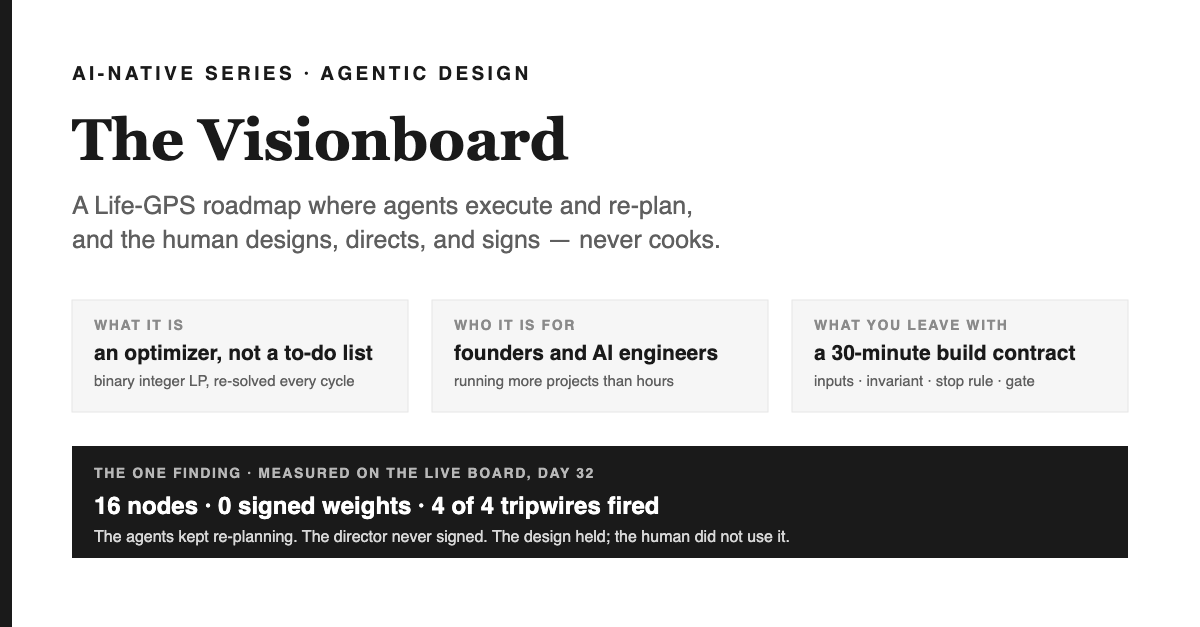
What this is. A design write-up of the Visionboard: my 2019 Life GPS (a solver that re-plans your week when reality changes) rebuilt so that AI agents do the proposing, executing and reporting, a solver picks the best next moves, and the human sits above the loop as designer and director. Nothing is signed by a machine.
Why it matters. For a founder or engineer running more projects than hours, this is the difference between a dashboard that flatters you and an instrument that tells you the odds. For a student, it is the cleanest small example of what "human oversight of agents" means when it is code and not a slogan. The live board's own reading is included, including the month it caught its owner not showing up.
What you can do. Build the loop in 30 minutes from the contract below, in any domain; run the exit test; and do the one act the whole design depends on — sign one weight — before the next weekly review.
The Visionboard — the series spine
- The Visionboard: Life GPS rebuilt with the human above the loop this episode
- Life GPS, 2019 → 2026: what the first planner got right and what killed it next · 2026-09-09
- Life GPS for one person: the daily director's act, and where the agent may not go 2026-09-13
- Life GPS for a small team: roles not persons, load as a constraint 2026-09-17
- The Visionboard scoreboard: what moved, what did not, and three futures with falsifiers 2026-09-21
What the Visionboard is, who it is for, and why this series exists
The Visionboard is the private page on this portfolio where I steer my own ventures. It holds three long-horizon tracks — revenue, research, relationships — a graph of sixteen projects that feed them, and a solver that re-computes the three best next moves every time the page loads. AI agents propose numbers, do work, and file report cards. I am allowed to do exactly three things: write the objective, sign a number, and re-write the objective when a pre-registered assumption breaks.
It grew out of Life GPS, a planner I wrote in R in April 2019 and described in a Medium post the same spring: you give it tasks with weights, floors and ceilings, it packs your week as a binary integer program, and when you report that Tuesday went sideways, it freezes the past and re-solves the rest. I rewrote it in Python in July 2026 and, in the company-scale article, admitted I had built a control loop and mistaken it for a to-do list.
This series answers the question that admission raises. Once the executor is no longer you but a set of agents, what has to change in the design so the human stays in charge without becoming the bottleneck, and without the skill of judgment quietly rotting? Episode 1 is the design and its first measurement. Episodes 2 to 5 cover the 2019 origin, the version for one person, the version for a small team, and the scoreboard.
It is written for three readers at once: the AI engineer who wants the handles, the founder who wants the operating contract, and the talented high-schooler who wants one picture they can re-run tomorrow. The picture comes next, and it is a kitchen.
One picture will carry the series: the executive chef who never cooks
Think of the rung on the cooking ladder where you stop being a cook. A home cook designs the meal and cooks it. A line cook executes tickets. An executive chef running a restaurant, or a chain, writes the menu, sets the standards, tastes the plate, and signs off. If the chef is working the line at 8 p.m., the restaurant has no chef.
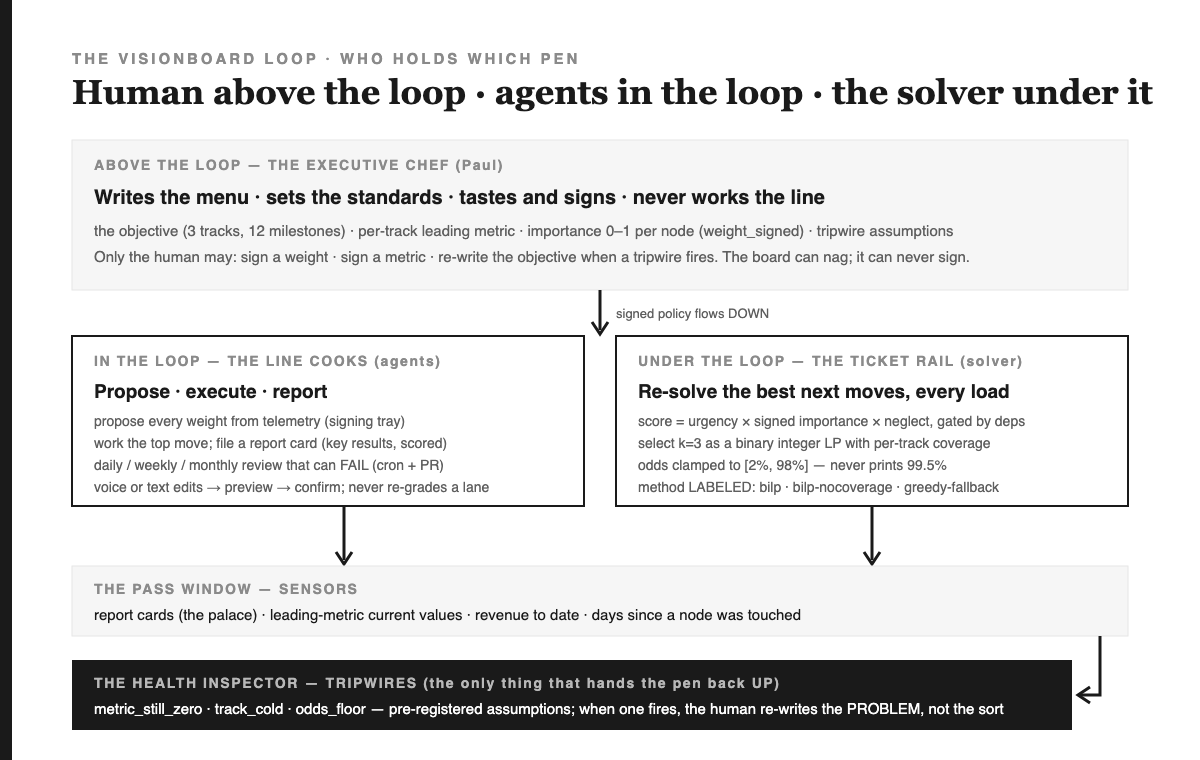
The Visionboard is the kitchen with the chef kept out of it on purpose. The map below is one-to-one, and every row points at real code.
| Kitchen | Visionboard handle | Who holds the pen |
|---|---|---|
| The menu | the objective: three tracks, twelve milestones (content/goals.json) | human |
| The standard for each dish | a per-track leading metric with a weekly delta target | human signs, agent proposes |
| Tasting and signing a dish | weight_signed: true on a node — importance 0 to 1, neutral at 0.5 | human only |
| The ticket rail | resolveMoves() in lib/gps.mjs — the re-solved top-3 moves | solver |
| Line cooks | agents: propose weights, work the top move, file a report card | agents |
| The pass window | report cards (the palace) and metric readings — the sensors | agents write, humans read |
| The health inspector | checkTripwires() — pre-registered assumptions that hand the pen back up | code fires, human re-writes |
| A cook re-grading their own plate | moving a card between grade lanes — refused by VisionboardAgent | nobody |
Hold that picture. Every design rule below is a kitchen rule first.
Four horizons of research: 300 years, 30 years, 30 months, 30 days
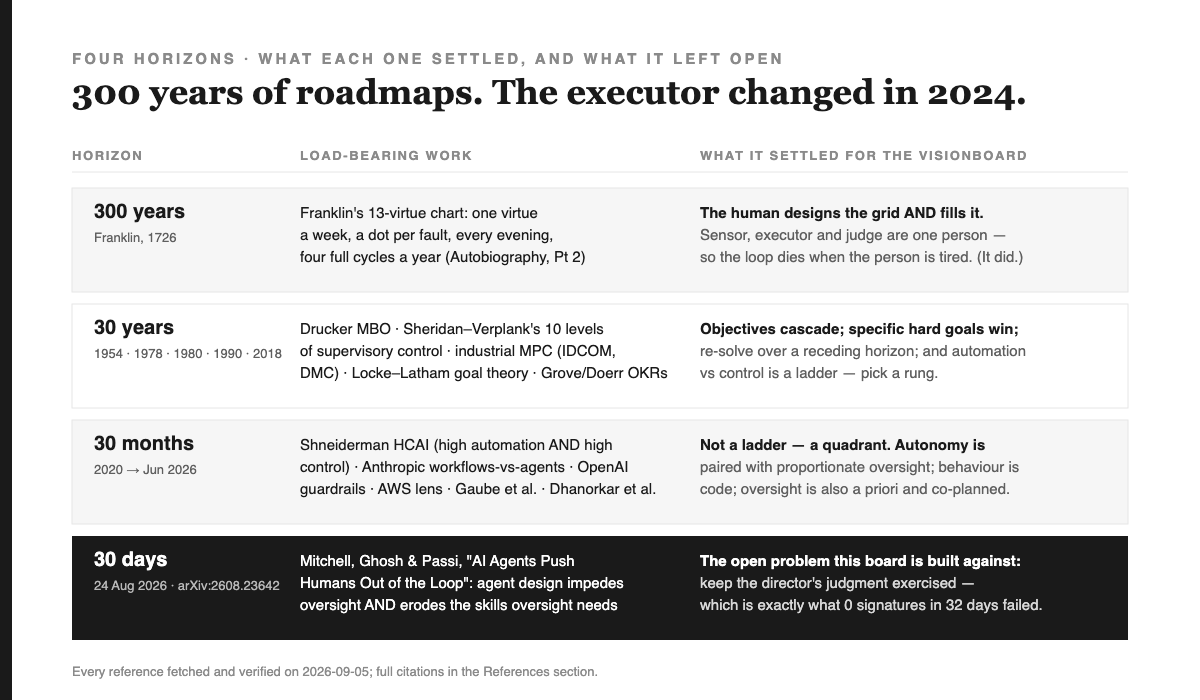
[EVIDENCE]300 years. Benjamin Franklin's thirteen-virtue chart, conceived on the 1726 voyage home and described in Part Two of his Autobiography, is the oldest personal control loop I can find with all four parts: a designed grid, a nightly sensor reading (a dot per fault), an executor, and a judge. All four were the same man. He reports that the loop ran four full cycles a year and then, in his own telling, faded. That is the first finding and it is three centuries old: when sensor, executor and judge are one tired person, the loop dies with the person's attention.
[EVIDENCE]30 years. Four things got settled. Drucker (1954) made objectives cascade and let the executor help set them. Sheridan and Verplank (1978) drew the ten-rung ladder from fully manual to fully autonomous that every "levels of autonomy" chart still copies. Industrial model predictive control (Richalet et al. 1978; Cutler and Ramaker 1980) made "re-solve the remaining horizon every cycle" a refinery's normal Tuesday, which is exactly what Life GPS does to a week. Locke and Latham (1990) showed that specific, difficult goals beat "do your best" across dozens of tasks, provided there is feedback and commitment. Grove and later Doerr turned that into OKRs with a review cadence.
[EVIDENCE]30 months. The ladder became a quadrant. Shneiderman (2020) argued that automation and human control are two axes, and that good systems are high on both. Anthropic's Building Effective Agents (December 2024) drew the line between workflows, where code decides the path, and agents, where the model decides. OpenAI's practical guide (2025) layered guardrails and put human-approval pauses in front of consequential actions. AWS's Agentic AI Lens states the principle the Visionboard is built on, verbatim: "Human review depth scales with the consequence of the action, by design rather than by reaction." Two 2026 papers turned oversight from a slogan into a workable object: Gaube and nineteen co-authors give it a definition and an architecture; Dhanorkar, Passi and Vorvoreanu interviewed seventeen developers and found oversight is "not only reactive and retrospective, as portrayed in existing research, but also preventative and proactive." Their four forms — a priori control, co-planning, real-time monitoring, post hoc review — map onto the four things the Visionboard lets a human do.
[EVIDENCE]30 days. On 24 August 2026 Mitchell, Ghosh and Passi posted the paper this board is built against. Their thesis: "Not only do current approaches to AI agent design impede effective human oversight, but the cognitive capacities required for it are also themselves degraded by extended use of AI systems." Read that twice. It says the human above the loop is not a stable position; it erodes unless the design makes the human exercise judgment. Keep it in mind for the worked case, because the board measured exactly that erosion in its first month, and the human was me.
The design: seven rules, each pinned to the code that enforces it
Rule 1. Decompose into bounded agents, and give the human the smallest surface that still governs
[DESIGN]Four roles, four scopes. The proposer reads telemetry and suggests every weight in a signing tray. The executor works the top move and files a report card. The reviewer runs on a cron (daily 13:47 UTC, weekly Monday, monthly on the first) and opens a pull request that can fail. The steering agent (components/VisionboardAgent.tsx) takes a spoken or typed edit and returns a diff and a button. None of the four can sign. This is the AWS principle of declared scope and explicit limits, applied to a one-person company.
Rule 2. Selection is a solver's job, and the solver says how it solved
[DEF]Each project node gets a score: track urgency (rising as a milestone approaches) times signed importance times a neglect boost (valuable-but-cooling nodes rise), gated by dependencies. Then the top three are not a sort. They are a binary integer program: maximize total score, at most three picks, and every track with an upcoming milestone gets at least one move. That coverage constraint is why day 32's three moves span all three tracks. The method is labeled on the output — bilp, bilp-nocoverage when coverage was infeasible, greedy-fallback when the solver threw — so a reader never mistakes a fallback for an optimum.
Rule 3. An unsigned number is a proposal, and a proposal has exactly no power
[DESIGN]This is the seam contract from the solver article, now enforced in one line of code: a node's importance multiplies its score only if weight_signed is true. Unsigned, the multiplier is exactly 1. The human's number is 0 to 1 with 0.5 meaning normal, and the coefficient is that number divided by 0.5, so a person can check the arithmetic by eye. The output names every unsigned node. Feeding an optimizer unsigned weights is how guesses launder themselves into authority; the fix is structural, not a reminder.
Rule 4. The instrument may not flatter
[DESIGN]Odds are computed from needed versus observed velocity and clamped to the range 2 to 98 percent. The board can never print 99.5 percent. A track with no numeric metric reports null and the words "not measurable yet," never an invented number. A planned node can only be recommended as "stand it up." Every one of these is a refusal to do something a dashboard would happily do.
Rule 5. Autonomy is paired with proportionate oversight, by consequence
[DESIGN]Map the actions to their consequence. Re-solving the moves is free to undo, so the solver does it alone on every load. Proposing a weight changes nothing until signed, so the agent does it alone. Editing the graph (a dependency, a milestone, a status) is reversible but consequential, so it is preview then confirm. Signing a weight or a metric changes what the optimizer will do for weeks, so it is human-only. Re-grading a card is never allowed, because a grade is the output of an independent grader and a self-issued grade is worth nothing. That last refusal has its own error message in the steering agent, and it is the one line of the design I am proudest of.
Rule 6. Tripwires are the only path that hands the pen back up
[DESIGN]The solver re-solves the allocation. It never re-writes the problem. Only a fired tripwire does that, and a tripwire is data: a named assumption, a machine-checkable condition, and the action "hand the pen back to the strategist." Three types exist today: a leading metric still at zero after N days, a milestone-bearing track with no cards in fourteen days, and odds sitting on the honesty floor. The health inspector does not cook; the inspector writes a ticket and the chef re-writes the menu.
Rule 7. Behaviour is code, and the review can fail
[DESIGN]The objective, the tripwires, the weights and the metrics live in a JSON file under version control. The agent's edit vocabulary is a typed union with a test file. The review cadence is a workflow that opens a pull request when it runs and opens an issue when it cannot. In Dhanorkar et al.'s vocabulary, this is a priori control and post hoc review built into the substrate, so the human's monitoring load is the exception path, not the default.
The worked case: the live board on day 32
[MEASURED]The plan started on 4 August 2026 with three tracks: revenue to $1M in 90 days, a research bet (self-improving agentic systems and their application to a quality-management system), and a relationship track with a daily reflection routine, weekly discipleship, and a monthly talk. Sixteen project nodes, each with a proposed importance between 0.5 and 1. Four tripwires pre-registered. Three leading metrics proposed by the agent, each with the note "decision needed" and the decision spelled out: which offer gets priced first; whether the research bet is the leaderboard submission; whether the existing cohort is the first cohort.
On day 32 the solver reports: financial odds 2 percent, the floor, because the milestone needs about $17,500 a day and observed velocity is $0 a day. Research and relationship odds: null, not measurable, because no metric was signed. All four tripwires fired: the revenue metric still at zero past its fourteen-day limit, the research metric still unmeasured, the relationship track cold with a milestone 57 days out, and odds on the floor. Thirteen of sixteen nodes carry a weight that would tilt the solver if it were signed. None is signed.
And the sensor, read from the production ledgers rather than from my laptop: 211 report cards exist, 37 of them filed since the plan started, the newest on 30 August. Every one of those 37 landed on a node whose primary track is financial. The research and relationship tracks received zero cards in the whole month, which is exactly the condition the cold-track tripwire fired on. One station in the kitchen kept cooking. The inspector wrote four tickets. Nobody above the loop read them.
Correction, 2026-09-07. The first published version of the paragraph above said the newest card was dated 4 August and that the feed had gone dark on day 0. That was my laptop's view of the board, and my laptop cannot read the private ledgers; the production board can, and the numbers now shown are its reading. The headline finding, zero signatures and four fired tripwires, did not change. The mistake stays on the page rather than being erased, because the series' rule is that the instrument may not flatter, and neither may its author.
Here is what that does and does not prove. It does not prove the solver is wrong; every number it printed is the honest reading of the data it had. It does prove the design's own thesis in the least flattering direction: a human above the loop is a position you have to keep occupying. Mitchell, Ghosh and Passi predicted the failure mode in August. The board recorded it in September. I built a signing button and did not press it for 32 days, which is the most expensive way to confirm a paper.
[OPEN]What is not settled is the fix. Two candidates, each with a falsifier, are Episode 5's job: make the signature the first thing the page asks for (a Level-0 affordance, not a tray at the bottom), and make a silent sensor impossible (a feed that has not produced a card in seven days is itself a fired tripwire). If a month after those ship the signature count is still zero, the problem is not the interface.
Build it in 30 minutes: the contract
You do not need my code. You need the shape. Any domain with a few long-horizon goals, a handful of projects, and some evidence feed will do.
INPUTS
  tracks[]     : {id, milestones[{days, target?}], leading_metric{name, current, signed}}
  nodes[]      : {id, tracks[], weight 0..1, weight_signed, deps[], status planned|active}
  cards[]      : {repo, created_at, key_results[{text, score}]}   # the sensor
  tripwires[]  : {id, type, track, params, assumption, action}
OUTPUTS
  moves[k]     : {id, score, why, next}     with method ∈ {bilp, bilp-nocoverage, greedy-fallback}
  status[]     : {track, odds ∈ [0.02,0.98] | null, to_raise}
  tripwires[]  : {id, fired, why}
INVARIANTS (the tests you write first)
  unsigned weight ⇒ multiplier == 1          # no signature, no coefficient
  no metric      ⇒ odds == null              # never an invented number
  every track with a milestone and a candidate gets ≥1 move, or the method says it could not
  the agent can propose, edit-with-confirm, report; it can never set weight_signed or move a grade
STOP RULE
  a fired tripwire stops the allocation loop and asks a human to re-write the objective
CI THRESHOLD
  all invariants pass; a selftest re-introduces each violation and proves the gate exits 1
DELIBERATELY MISSING
  any forecast beyond observed velocity; any autonomous signature; any re-grade
Pick a solver you can call from a test (PuLP with CBC, or a JavaScript LP package as this board uses). Keep the scoring function pure. Put the human's numbers in a file under version control and make the coefficient a division the human can check by eye.
Same story, five exits
| Reader | The decision this episode hands you | The one action |
|---|---|---|
| Student | Optimization, not traversal, is the right frame for allocating a scarce budget | Re-implement the 30-minute contract for your own week; make the unsigned-weight test pass first |
| Engineer | Oversight is an interface contract, not a review meeting | Find the one field in your agent system that grants authority; make it human-only and label every fallback |
| Founder | An instrument that reports 2 percent is worth more than a dashboard that reports green | Sign one leading metric per track this week; write its falsifier next to it |
| Executive | Autonomy should be granted by consequence of action, not by team enthusiasm | List your agents' actions by reversibility; move the irreversible ones behind a signature |
| Investor | A founder's own instrument telling on them is a positive signal about the instrument | Ask to see the tripwire log, not the roadmap |
Patterns, anti-patterns, and the mechanism
Patterns. Sign before you weigh. Clamp before you print. Label the method. Pre-register the assumption and let code check it. Preview, then confirm. Let the review fail loudly.
Anti-patterns. A dashboard that computes odds from an unsigned coefficient. A tray of proposals that scrolls below the fold. A "human in the loop" who approves each action until they approve by reflex. A sensor that can stay silent on two of three tracks without anyone noticing, which is the one I shipped.
The mechanism. Authority flows down only through signatures; evidence flows up only through sensors; the two meet in a solver that can be audited because its inputs are signed and its method is named.
The first principle, in one sentence. A roadmap driven by agents stays honest exactly as long as the only thing a machine cannot do is the thing that grants authority.
Exit test
You can leave this episode when you can answer all three without scrolling up.
- What is the multiplier of an unsigned weight, and why is it that number? (exactly 1, so that not signing changes nothing)
- Name the only path by which the solver hands the pen back to the human. (a fired tripwire)
- On day 32, which of the board's readings was a defect in the design, and which was a defect in the director?
Reality Mission
Mine first, because the series' rule is that every episode changes the live board or its data. Before the next weekly review I sign one leading metric, the financial one, with its falsifier: three consecutive weeks below a 12 percent delta means the offer is wrong, not the effort. Episode 5 reports whether I did.
Yours: take one thing you are "overseeing" and find the field that grants it authority. If a machine can set that field, you are not above the loop. You are decoration.
Read next
Episode 1 of The Visionboard. Claims are tagged by class — definition, design choice, evidence, measurement, open question — and the kitchen may introduce a claim but never serves as evidence for it. The series' sources and live measurements are logged in the repository under docs/plans/2026-09-06-visionboard-research-dossier.md; an article may cite only what is in that file.
References
- Paul Wu, Life GPS — repository github.com/wjlgatech/life_GPS (created 2019-04-25 in R; Python rewrite pushed 2026-07-06). The 2019 Medium write-up is linked from its README; Medium serves it to browsers only. Verified 2026-09-06.
- Benjamin Franklin, The Autobiography of Benjamin Franklin, Part Two — the thirteen virtues and the weekly chart. Public domain, Project Gutenberg #20203.
- Peter F. Drucker, The Practice of Management, Harper, 1954 — management by objectives and self-control.
- Thomas B. Sheridan and William L. Verplank, Human and Computer Control of Undersea Teleoperators, MIT Man-Machine Systems Laboratory, 1978 — the ten levels of automation.
- J. Richalet, A. Rault, J. L. Testud, J. Papon, "Model predictive heuristic control: Applications to industrial processes," Automatica 14(5), 1978; C. R. Cutler and B. L. Ramaker, "Dynamic matrix control — a computer control algorithm," Joint Automatic Control Conference, 1980.
- Edwin A. Locke and Gary P. Latham, A Theory of Goal Setting and Task Performance, Prentice Hall, 1990.
- Andrew S. Grove, High Output Management, 1983; John Doerr, Measure What Matters, Portfolio, 2018.
- Ben Shneiderman, "Human-Centered Artificial Intelligence: Reliable, Safe & Trustworthy," International Journal of Human–Computer Interaction, 2020; arXiv:2002.04087.
- Anthropic, Building Effective Agents, December 2024. anthropic.com/engineering/building-effective-agents.
- OpenAI, A practical guide to building agents, 2025. PDF.
- AWS Well-Architected Framework, Agentic AI Lens — Design principles. docs.aws.amazon.com. Quoted verbatim; fetched 2026-09-05.
- Susanne Gaube et al. (20 authors), "Keeping an Eye on AI: A Framework for Effective Human Oversight of AI Systems," arXiv:2605.16278, submitted 2026-04-09. Fetched 2026-09-05.
- Shipi Dhanorkar, Samir Passi, Mihaela Vorvoreanu, "Human oversight of agentic systems in practice: Examining the oversight work, challenges, and heuristics of developers using software agents," arXiv:2606.05391, submitted 2026-06-03. Quoted verbatim; fetched 2026-09-05.
- Margaret Mitchell, Avijit Ghosh, Samir Passi, "AI Agents Push Humans Out of the Loop," arXiv:2608.23642, v1 2026-08-24, v2 2026-09-02. Quoted verbatim; fetched 2026-09-05.
- Sayash Kapoor, Benedikt Stroebl, Zachary S. Siegel, Nitya Nadgir, Arvind Narayanan, "AI Agents That Matter," arXiv:2407.01502, 2024 — agent evaluation must co-optimize cost with accuracy.
- EU Artificial Intelligence Act, Article 14 — Human oversight; implementation timeline: Annex III high-risk obligations apply from 2 December 2027. Fetched 2026-09-05.
- This repository:
lib/gps.mjs(scoring, BILP selection, odds clamp, tripwires),packages/core/src/goal-edits.ts(the agent's typed edit vocabulary),components/VisionboardAgent.tsx(preview → confirm; the re-grade refusal),content/goals.json(the objective, day-32 state),.github/workflows/visionboard-review.yml(a review that can fail). Measurements taken 2026-09-05 by running the production solver on the committed data.