AI-Native Series · Control for Agentic Systems
The Governor
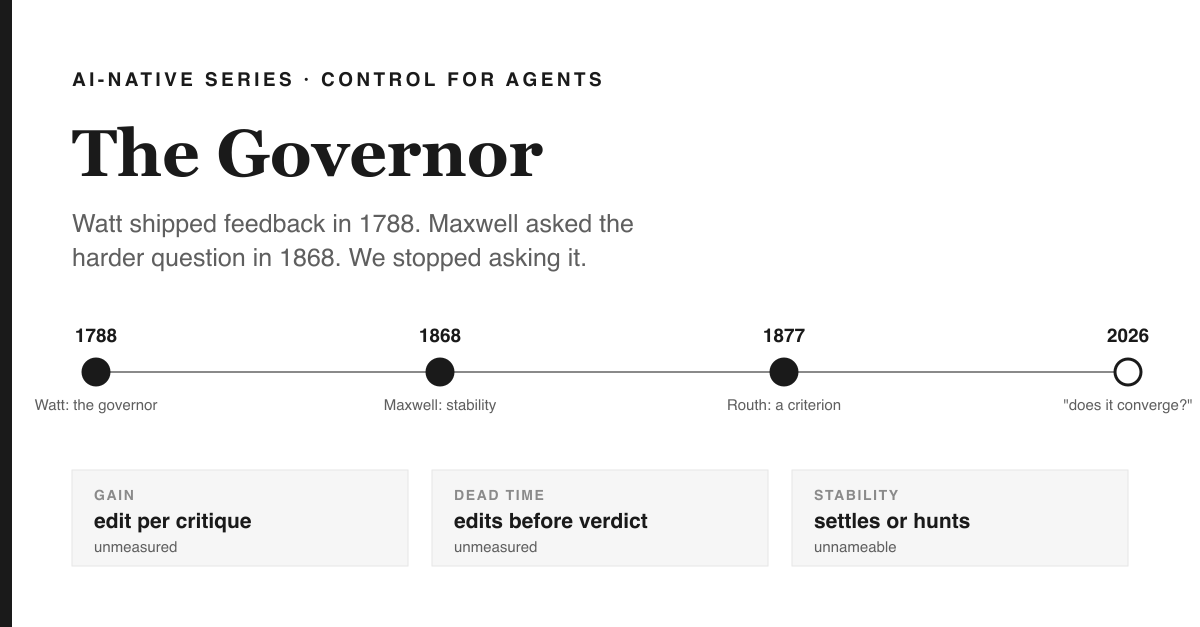
1-minute takeaway — what you'll walk away with
This is the season's core. Feedback is 238 years old; its stability analysis is 158; a decidable criterion for it is 149. Along the way the founding paper was ignored for eighty years, which is a warning for anyone naming a new discipline. The transferable result is diagnostic: a grade sequence like C, A, C, A is not a broken evaluator, it is oscillation — too much correction for the delay — and the three standard remedies (less gain, more damping, less dead time) are knobs almost no agent framework exposes. You will leave with two numbers to measure on your own loop tonight, and one honestly open problem: nobody has published a stability criterion for an LLM loop.
Cold open
1788. A steam engine with two iron balls spinning on arms. As the engine speeds up, centrifugal force throws the balls outward; the linkage closes the steam valve; the engine slows. Slow down and the balls drop, the valve opens, it speeds up again.
Nobody told it the target speed in words. The correction is the mechanism. Watt is usually given the credit, and he did not invent it — Thomas Mead's British patent No. 1628 of 1787 already combined a lift-tenter with a centrifugal pendulum, and Watt never patented a governor. Which makes the point harder, not softer: the topology is even older than the famous date.
Eighty years later a physicist looked at the same device and asked a question that had not been asked, and that your agent stack still cannot express.
The question the 19th century added
[DEF] James Clerk Maxwell's On Governors (Maxwell, 1868), in the Proceedings of the Royal Society, is recognised as the first significant paper on control theory. Its contribution is not "use feedback" — Watt had shipped that in 1788. Maxwell's contribution was to model the governor as differential equations and ask under what conditions the correction settles instead of oscillating or running away.
That is stability, and it is a different question from "does it work."
[EVIDENCE] The reception is the finding here, and I had it wrong in the first draft of this episode. The convenient story — "ignored for eighty years until Wiener rescued it in 1948" — is false, and the paragraph below refutes it: Routh published first results on Maxwell's problem in 1874, six years later, and won the 1877 Adams Prize on a topic Maxwell had posed and for which Maxwell served as an examiner. Vyshnegradskii worked the same ground independently in 1876. What is true is narrower and more interesting: the paper was little noticed by practising engineers, while the mathematical line picked it up almost immediately, and Wiener (1948) canonised Maxwell rather than rediscovering him (Bennett, 1996).
[DERIVATION] What followed is the part worth stealing. Routh (1877) and, independently, Hurwitz (1895) turned Maxwell's question into a decidable criterion: from the coefficients of a system's characteristic equation you can determine whether every root lies in the stable half-plane — without solving for the roots. Nyquist (1932) gave a graphical criterion that survives as gain margin and phase margin, still taught and still shipped in tuning tools.
So by 1932 the loop had: a mechanism (1788), a theory (1868), a decision procedure (1877/1895), and engineering margins (1932).
[EVIDENCE] And the practical form won completely — in a scope worth stating precisely, because the usual "90–97% of industrial control loops" is looser than its sources. PID control (Minorsky, 1922; tuned by Ziegler & Nichols, 1942) dominates regulatory loops in continuous process industries: Desborough & Miller (2002) surveyed 11,600 controllers across 18 refining, chemicals and pulp-and-paper facilities and report a 97% site median for PID feedback — a median across sites, not a pooled loop count. Separately, Bialkowski's paper-mill audits found ~97% PI in mills typically running 2,000+ loops. None of these surveys covers discrete manufacturing, motion/servo, robotics or PLC interlock logic, and all of them are 1989–2002 data. Åström and Hägglund put it plainly in Advanced PID Control (Ch. 1): "The PID controller is by far the most common form of feedback."
1:1 technical map
| Governor | Control theory | Agent loop | Do we measure it? |
|---|---|---|---|
| Target speed | setpoint | the goal / target grade | yes |
| Ball position | measured variable | the evaluator's verdict | yes |
| Valve | actuator | the refiner / the edit | yes |
| How hard the valve moves per unit error | gain | how large an edit per unit of criticism | no |
| Delay between valve and speed change | dead time | turns between an edit and its verdict | no |
| Settles vs hunts vs runs away | stability | ...we say "converges" | no |
| Wobble that never settles | oscillation / limit cycle | "it keeps rewriting the same file" | anecdotally |
| Steady error that never closes | offset | "it plateaus just below the bar" | as a stop rule |
Read the right-hand column. Three of eight rows say no outright — gain, dead time, stability — and two more say only "anecdotally" or "as a stop rule". A 1932 engineer measured all five as a matter of course.
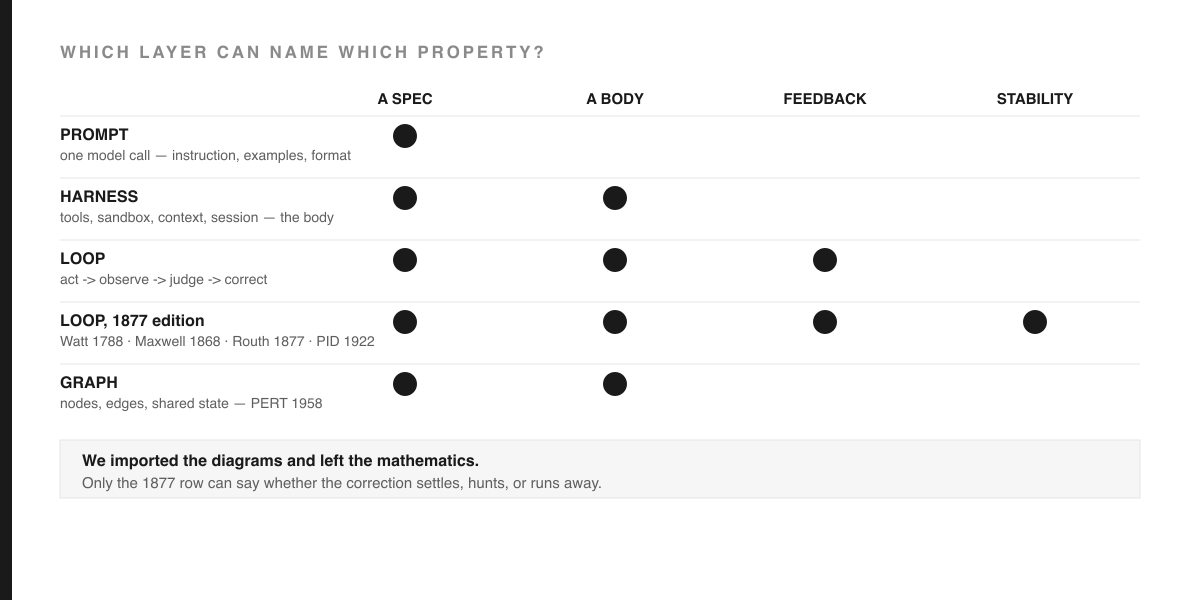
The claims, classed
[DESIGN] "Does it converge?" — which is what every agent framework asks, mine included — is a weaker question than "is it stable?" Convergence is an observation about one run. Stability is a property of the system that predicts all runs. You can observe convergence on twenty runs of an unstable loop and be wrong about the twenty-first.
[EVIDENCE] The loop's third survivor shows what an audited loop looks like. Shewhart's cycle (1939), popularised by Deming, is not merely alive: ISO 9001:2015 names Plan-Do-Check-Act in Clause 0.3.2, and its Figure 2 groups clauses 6 → Plan, 7–8 → Do, 9 → Check, 10 → Act, with Clause 4 as the enclosing context and Clause 5 (Leadership) at the hub spanning all four phases. The standard's own wording is deliberately loose — the figure shows how clauses "can be grouped" — but the shape is a live international standard whose table of contents is the loop, with an external auditor checking that your Check phase happened. No agentic loop has an equivalent.
[DESIGN] Which brings us to the skeptics, who are more right than they are given credit for. Loop Engineering: New Idea or Old Automation? (Movva, Hasib & Reganti, Aug 19, 2026) puts the question without ruling on it. It reports that "Skeptics ask the basic question of whether Loop Engineering is just traditional software automation rebranded under a fancy new name," notes that "Traditional software systems have also used cron jobs, hooks, workflow engines and DAGs to automate repeated work for a long time," and observes that "At a workflow level, it feels very similar to ReAct agents." It closes by leaving the matter open, and hedges rather than predicts: even if the pattern holds, "there is a good chance much of it will simply get absorbed into the tooling." The old verdict in this season is mine, not theirs.
Here is the steel-manned version, which is stronger than either camp usually states: the topology is old — 238 years old. What is genuinely new is that the plant is now stochastic and the actuator argues back. A steam valve does not reinterpret its instruction. That difference is real, and it makes stability harder, not irrelevant — which is precisely why abandoning the analysis while keeping the diagram is the worst of both worlds.
[OPEN] Nobody, as far as I can find, has published a stability criterion for an LLM control loop. What would a Routh–Hurwitz for agent loops even range over — edit size per unit of critic disagreement? verdict variance? turns of dead time? This is the season's central open problem and I do not have it.
Prediction Gate
Commit before reading on.
An agent loop is given a target grade of A. Over 12 iterations its grades run:F, C, A, C, A, C, A, C, ...— it reaches the target repeatedly and then loses it again.
Bet: is this (a) a bad evaluator, (b) a bad refiner, or (c) a correctly-working loop with too much gain?
A control engineer recognises C, A, C, A on sight: that is not a broken component, it is oscillation — the correction is too large for the delay, so every fix overshoots and the next fix overshoots back. The standard remedies are to reduce gain (smaller edits), add damping, or reduce dead time (judge sooner). Almost no agent framework exposes any of the three as a knob. Mine exposes iteration caps and plateau detection, which are ways of surviving oscillation rather than diagnosing it.
Failure Room
Break it deliberately: remove the delay, then add too much of it.
Take a loop that works. First, judge after every micro-edit (dead time → near zero) and watch cost explode while quality barely moves. Then judge only every fifth edit (dead time → 5) and watch it overshoot: by the time the verdict arrives, four more changes have landed on top of the one being judged, and the loop is now correcting a state that no longer exists.
Diagnosis: you have just built, by hand, the two ends of the classic dead-time tradeoff, and neither end is a component defect. This is the failure mode that has no name in the agentic vocabulary and a century of literature elsewhere.
Lab — 15 minutes
Measure loop gain on a real agent loop.
- Instrument one refine loop. Per iteration, record: the evaluator's score before, the size of the applied diff (lines changed), and the score after.
- Plot Δscore against diff size. You are estimating gain — output change per unit of input effort.
- Now find your dead time: how many edits land between an observation and the verdict that responds to it? In most agent loops the honest answer is 1; in fleets and async setups it is higher, and usually unmeasured.
- Bin runs by diff size and compare oscillation rate (score going down then up then down) between the smallest and largest bins.
If large edits oscillate more than small ones, you have measured loop gain on an LLM system, which as far as I know is not a standard practice. Report the plot; that is a contribution.
Reality Mission
Add one number to the loop you actually run: dead time, in iterations, between an edit and the verdict that judges it. Then write down, honestly, what your system does when it oscillates. If the answer is "hits the iteration cap and stops," you have a survival mechanism, not a control system — which is worth knowing and is where my own engine sits. Its stop conditions and the plateau guard are described in An AI Reviewed My Repo and Told Me to Make It Worse.
Research Challenge
The season's central open problem, made concrete for an agent to attack: construct the smallest useful stability criterion for an LLM refine loop. Candidate ingredients — mean edit magnitude per unit critic disagreement (gain), verdict variance on an unchanged artifact (sensor noise; measurable today with a re-judge probe), and dead time in iterations. Hypothesis to test: loops with gain × dead-time above some threshold oscillate at a materially higher rate. Even a crude empirical threshold would be more than the field currently has. [OPEN]
Exit test
- What did Maxwell add in 1868 that Watt's 1788 governor did not have? (a stability analysis, not feedback)
- Name the three standard remedies for oscillation. (reduce gain, add damping, reduce dead time)
- Why is "it converged" not evidence of stability?
- What does ISO 9001:2015 have that no agent loop has? (an external auditor of the Check phase)
Cliffhanger
You now have one governor, and you can at least name what is wrong with it.
Then someone asks for a planner, an implementer, a test agent, a security reviewer and a merge gate — running in parallel, sharing state, handing off, and re-entering a repair loop when a review fails. You reach for a graph.
And you are about to find that the graph layer's prior art is the youngest in this whole season — younger than the loop's mathematics by ninety years — and that the shape everyone draws for it cannot express the one thing you most need it to.
→ Episode 4 — The Critical Path
Read next
Episode 3 of Intelligence Engineering Adventures, Season 6 — The Governor Engine. Claims in the series source are tagged by class — definition, derivation, evidence, engineering choice, open question — and a metaphor may introduce a claim but never serves as evidence for it. The season takes the four-label diagram seriously enough to check it against its own primary sources, and it does not survive: Anthropic's definition makes the harness the loop rather than a layer above it. Every claim is tagged by class, and the one genuinely open problem is stated as open — nobody has published a stability criterion for an LLM control loop. This article contains no material from any employer or client. — Paul Jialiang Wu · agentic-portfolio-lovat.vercel.app
References
- Maxwell, J.C. (1868), On Governors, Proceedings of the Royal Society, Vol. XVI, no. 100. Recognised as the first significant paper on control theory; overlooked for ~80 years until Wiener (1948) drew attention to it.
- Kang, C.-G. (2016), Origin of Stability Analysis: "On Governors" by J.C. Maxwell [Historical Perspectives], IEEE Control Systems Magazine 36(5), pp. 77–88, doi:10.1109/MCS.2016.2584358. Its abstract says the paper was "overlooked for a long time"; the explicit ~80-year figure is not in it, and this episode no longer makes that claim.
- Bennett, S. (1996), A Brief History of Automatic Control, IEEE Control Systems Magazine — records Routh taking up Maxwell's problem with first results published in 1874.
- Desborough, L. & Miller, R. (2002), Increasing Customer Value of Industrial Control Performance Monitoring — Honeywell's Experience, CPC-6, AIChE Symposium Series 326, vol. 98, pp. 172–192 — the 11,600-controller survey and the 97% site median.
- Routh (1877); Hurwitz (1895) — the stability criterion. Nyquist (1932) — the graphical criterion behind gain and phase margin.
- Minorsky (1922); Ziegler & Nichols (1942) — PID and its tuning rules. Åström & Hägglund, Advanced PID Control (ISA), Ch. 1 — "The PID controller is by far the most common form of feedback." (An earlier draft of this episode rendered that sentence as "by far the most widely used form of feedback control" inside quotation marks. That wording appears in none of Åström & Hägglund's texts; it was my paraphrase wearing quote marks, and it is corrected here rather than quietly deleted.)
- Shewhart (1939), the cycle popularised by Deming; ISO 9001:2015, Clause 0.3.2 and Figure 2 — PDCA named explicitly, with clauses 6 / 7–8 / 9 / 10 grouped onto Plan / Do / Check / Act, Clause 4 as context and Clause 5 at the hub.
- Wiener, N. (1948), Cybernetics — the rescue of Maxwell, and a cautionary case: the field's name did not survive as an institution even though its content did.
- Movva, P., Hasib, A. & Reganti, A.N. (Aug 19, 2026), Loop Engineering: New Idea or Old Automation?, The Nuanced Perspective. Quoted verbatim above; verdict: old. https://thenuancedperspective.substack.com/p/loop-engineering-new-idea-or-old
- LangChain, The Art of Loop Engineering; Osmani, A., Loop Engineering — practitioner framings of the loop above a single-agent harness.