AI-Native Series · Fair Housing & Agents
Redlining Was Never a Sentence. It Was a Map.
My checker was a spell-checker with a law degree, and I was very proud of it.
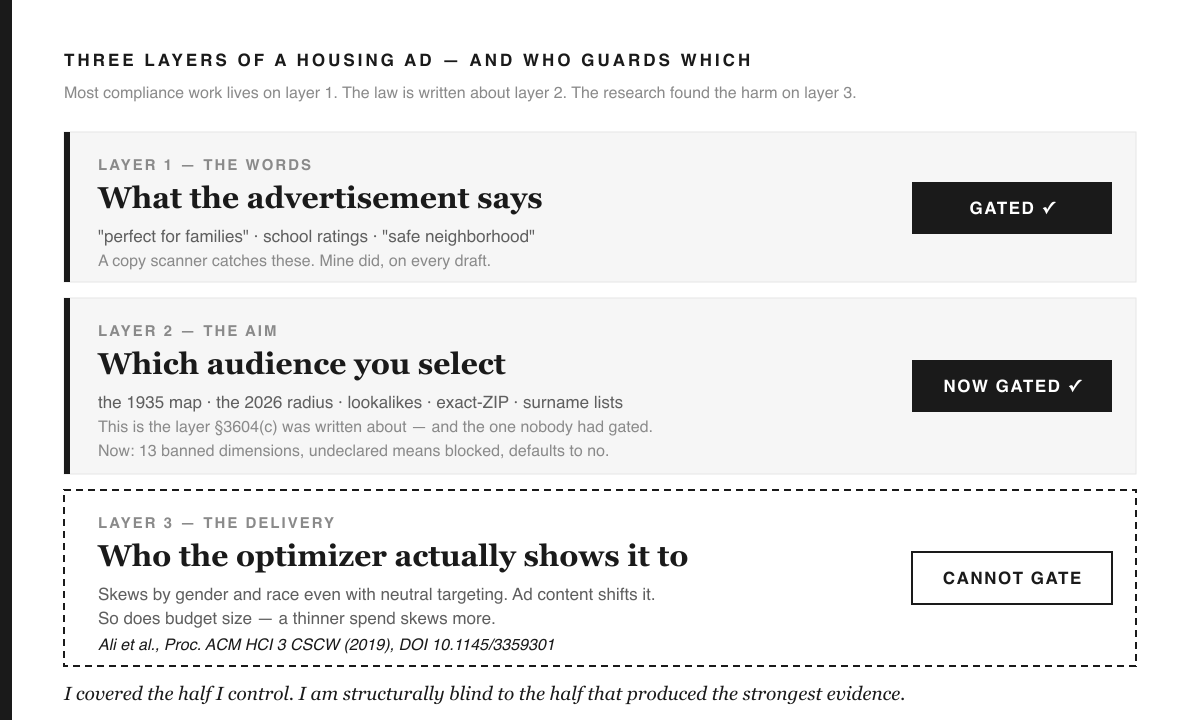
I was helping sell a house without an agent. I’d written a small program that read my listing copy and refused to ship anything with a fair-housing problem in it. No “perfect for families.” No school ratings. No “safe neighborhood.” It ran on every draft and went green.
Then I asked it to help me reach buyers, and it had nothing to say. Not “no.” Nothing — it had no opinion, because I’d never given it one. That silence was the whole problem.
The one idea: discrimination is a map, not a sentence
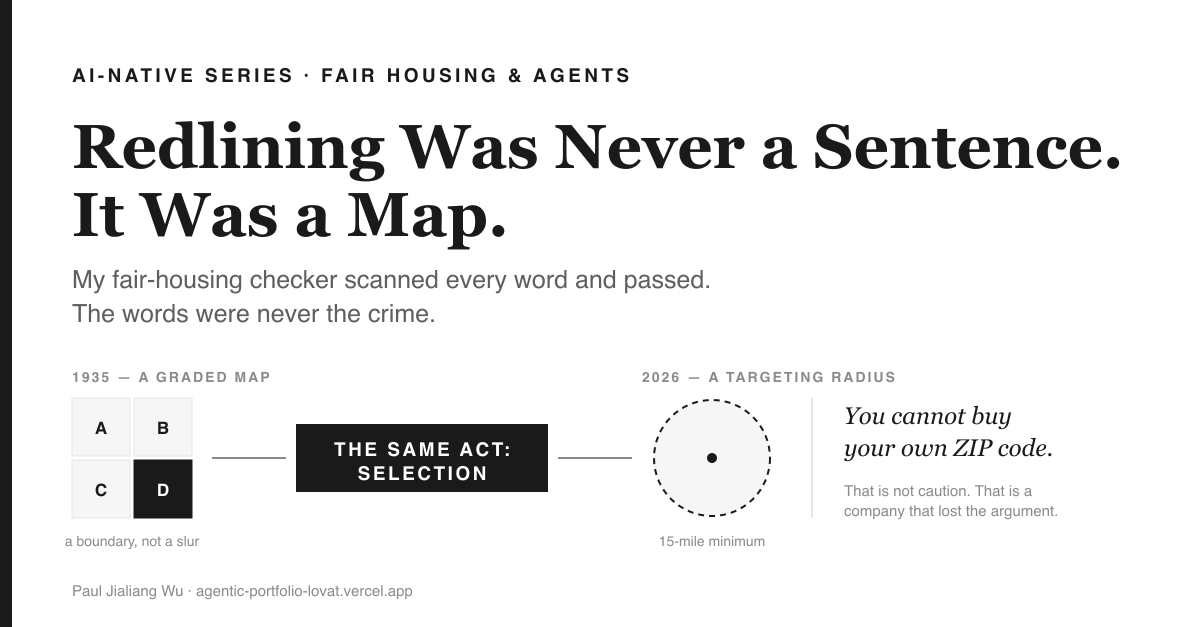
Between 1935 and 1940, the Home Owners’ Loan Corporation surveyed 239 American cities with populations over 40,000 and graded their neighborhoods for mortgage risk — A green, B blue, C yellow, D red. Surveyors were told to weigh the “invasion” of “negro, foreign-born or lower grade” residents (NCRC’s HOLC project; the maps are browsable at Richmond’s Mapping Inequality).
Look at what that machinery is. Nobody wrote a slur in an advertisement. They drew a boundary and let the boundary do the work. The discriminatory act was a selection, not a statement.
Which is why the Fair Housing Act reads as it does. Section 3604(c) bans any advertisement that indicates a preference based on race, colour, religion, sex, disability, familial status or national origin — and courts apply an “ordinary reader” test, so no intent is required. Familial status and disability arrived in the 1988 Amendments (42 U.S.C. § 3604). The law doesn’t ask what you meant. It asks what your choices indicated.
My checker audited sentences. The statute exists because sentences were never where the harm lived.
The part I had backwards
In April 2024, HUD published guidance applying the Act to advertising through digital platforms, and it says the quiet part out loud: including or excluding particular audiences or neighborhoods in the ad settings can itself be discriminatory. The setting is the map.
The platforms already believe this. Housing is a restricted ad category: under its 2022 settlement with the Department of Justice, Meta retired lookalike audiences for housing, dropped targeting tied to protected characteristics, and now enforces a 15-mile minimum radius on US housing ads. You cannot buy your own ZIP code. That’s not caution — that’s a company that lost the argument.
So “approach high-potential buyers” — the most ordinary sentence in sales — is, in housing, not a purchasable product. And on a sale by owner, the liability lands on a private individual, not a brokerage compliance department.
Now commit to an answer
Here’s the part worth being wrong about. Suppose you do everything right. Zero protected-class language. Targeting is a neutral 15-mile radius — no age, no gender, no interests.
Does your ad reach a demographically representative audience? Pick one before reading on.
No.
In 2019, Ali, Sapiezynski, Bogen, Korolova, Mislove and Rieke ran real housing and employment ads with deliberately inclusive targeting and measured who actually saw them. They found significant skew along gender and racial lines despite neutral targeting parameters — produced by the platform’s own relevance predictions and market optimization, not the advertiser’s settings (DOI 10.1145/3359301; preprint arXiv:1904.02095).
Two findings I can’t stop thinking about. The content of the ad shifts delivery even with targeting fixed. And so does the budget — a smaller budget skews delivery more, because a thin spend goes to whoever is cheapest to reach.
Read that again with a private seller in mind. Someone with a $396 marketing budget is more exposed to skewed delivery than a developer spending $396,000. The cheapest ad discriminates the hardest. No compliance training mentions this.
What I built instead, and why it’s better anyway
I stopped targeting buyers and started targeting the people who bring them.
Nine in ten buyers arrive with an agent, so the highest-leverage move isn’t an ad — it’s calling the fifty-odd buyer-side agents who closed in that price band last year. That’s a business-to-business call, not a housing ad aimed at a consumer. Then corporate relocation desks: employer isn’t a protected class, and those buyers arrive pre-qualified and on a deadline. Then flyers to an unbroken radius, which has no optimizer to skew. And the winning message targets a monthly payment, because money isn’t a protected class. Total added ad spend: zero dollars.
Then I wrote the gate I should have written first. It refuses to contact anyone until an audience declares what dimension it selects on, and it defaults to no. Thirteen dimensions are banned outright — protected classes plus documented proxies: exact-ZIP, school ratings, surname lists, lookalike audiences. Undeclared means blocked, because “we didn’t think about it” is exactly the state those 1930s surveyors were in.
It went red on its first run and it’s still red — it blocked my two best channels because nobody had confirmed the buyer credit was offered to every inquirer on identical terms. A credit offered selectively stops being marketing and becomes inducement. That’s a human’s call, so the gate holds until a human makes it. Fourteen mutation tests prove it can fail, including one confirming the human sign-off does not rescue an audience still carrying a protected class.
What it can’t do yet
The honest limit is bigger than the build.
My gate cannot see delivery. It checks the audience I specify. Ali and colleagues found the harm arriving through the platform’s optimizer — which I cannot observe, audit, or gate from outside. I’ve covered the half I control and I’m structurally blind to the half that produced the strongest evidence in the literature.
It is not a legal opinion. It encodes a reading of one statute, one HUD guidance document, and published platform policy. Kansas has its own discrimination act with an extra protected category. This is a list of questions for a lawyer, not counsel.
Nothing has sold. Zero contacts, zero offers, one house. A gate never carried into a real negotiation hasn’t been tested — it’s been written.
The frontier
Every agent we point at customers performs selection. Ranking, routing, prioritising, “high-intent,” lookalikes — the vocabulary changed, the act didn’t. Housing has a statute that noticed; hiring, lending and insurance have others. Most of what we ship this year has nothing at all.
So: what is your agent selecting on, and could you say it out loud to the person who didn’t get selected?
I’d rather be asked that by a test than by a plaintiff.
Build it — learn by doing
- anthropics/claude-cookbooks — tool-use patterns for putting a hard gate in front of an agent’s action instead of reviewing it after. First step: take one tool your agent can call and give it a required “what am I selecting on?” argument that defaults to refuse.
- openai/evals — write the eval that must fail before you trust what it guards. First step: before your next guardrail ships, write the test that breaks it and watch it go red first.
Related
References
- Ali, M., Sapiezynski, P., Bogen, M., Korolova, A., Mislove, A. & Rieke, A. (2019). Discrimination through Optimization: How Facebook’s Ad Delivery Can Lead to Skewed Outcomes. Proc. ACM Human-Computer Interaction 3 (CSCW). Skew along gender and racial lines for real housing and employment ads despite neutral targeting; ad content and budget both contribute. doi.org/10.1145/3359301 · arxiv.org/abs/1904.02095
- Fair Housing Act, 42 U.S.C. § 3604(c); Fair Housing Amendments Act of 1988 (added familial status and handicap). govinfo.gov
- U.S. Department of Housing and Urban Development, Office of Fair Housing and Equal Opportunity (April 2024). Guidance on Application of the Fair Housing Act to Advertising through Digital Platforms. archives.hud.gov
- U.S. Department of Justice (June 2022). Settlement Agreement with Meta Platforms, Inc. Retirement of the Special Ad Audience tool; removal of protected-characteristic targeting for housing. justice.gov
- National Community Reinvestment Coalition. HOLC “redlining” maps: the persistent structure of segregation and economic inequality. HOLC City Survey, 1935–1940, 239 cities. ncrc.org/holc
- Nelson, R. K. et al. Mapping Inequality: Redlining in New Deal America. Digital Scholarship Lab, University of Richmond. dsl.richmond.edu/panorama/redlining
Not legal advice. This article describes a reading of a statute, one guidance document and published platform policy, applied to one house. Consult a licensed attorney in your jurisdiction — state law adds protected categories the federal statute does not.