AI-NATIVE SERIES · PITCHING AGENTIC AI, PART 1 OF 3
Principles That Outlast Every Pitch: Why the Workflow Comes First
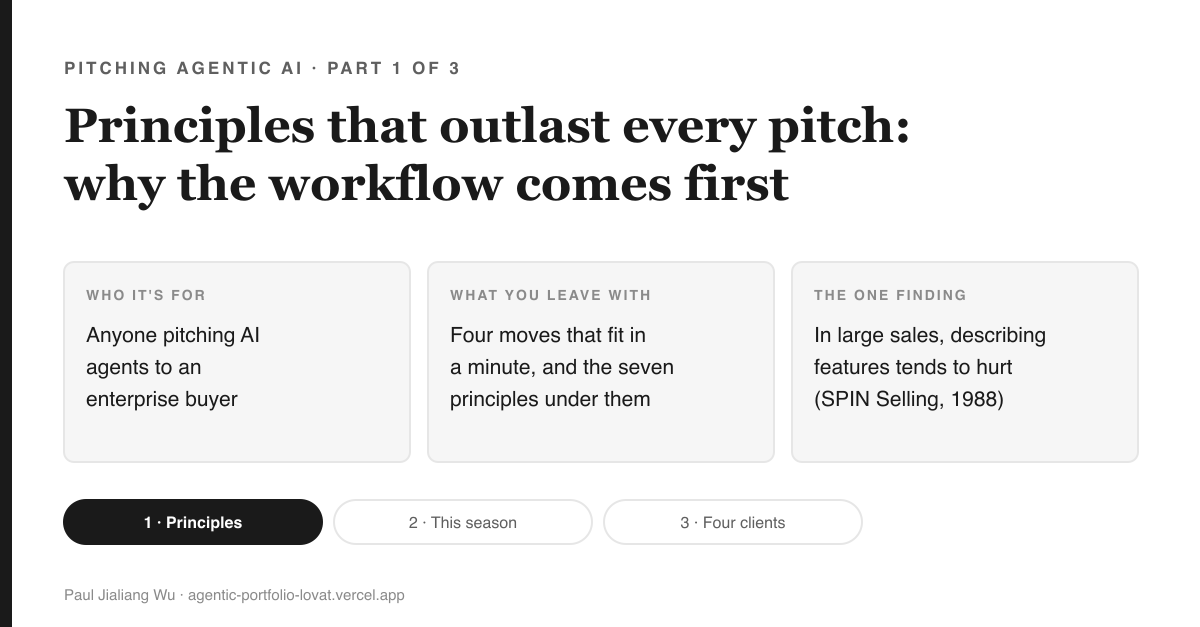
1-minute takeaway
What this is. Part 1 of a three-part series on pitching AI agents to enterprises. It derives four moves (listen, locate, limit, prove) from seven principles that held long before AI.
Why it matters. In large sales, describing features tends to hurt (SPIN Selling, 1988). AI pitches mostly lead with features, which is one reason buyers tune out.
What you can do after reading. For one live opportunity, write one line per move. Read it aloud. If it takes more than a minute, cut, don't rush.
Pitching Agentic AI — the series spine
- Principles that outlast every pitch this episode
- Selling agents this season episode 2
- Four clients, four first workflows episode 3
How to read the labels: EVIDENCE is sourced, DESIGN is a recommended practice, OPEN is not yet tested, and LENS is my own conviction.
Buyers tune out AI promises. Seven principles, each decades old, turn the pitch into four moves about their stuck work: listen to how they describe it, locate its cost, limit a trial they can watch, prove it with evidence agreed first. The surprise, in the bet below: one of a seller's most natural habits works against them.
What this episode covers: the principles under a good AI pitch
Every AI pitch I have sat through has a slide 7. It lists forty capabilities in two columns, each with an icon. Slide 7 is where the buyer starts checking their phone.
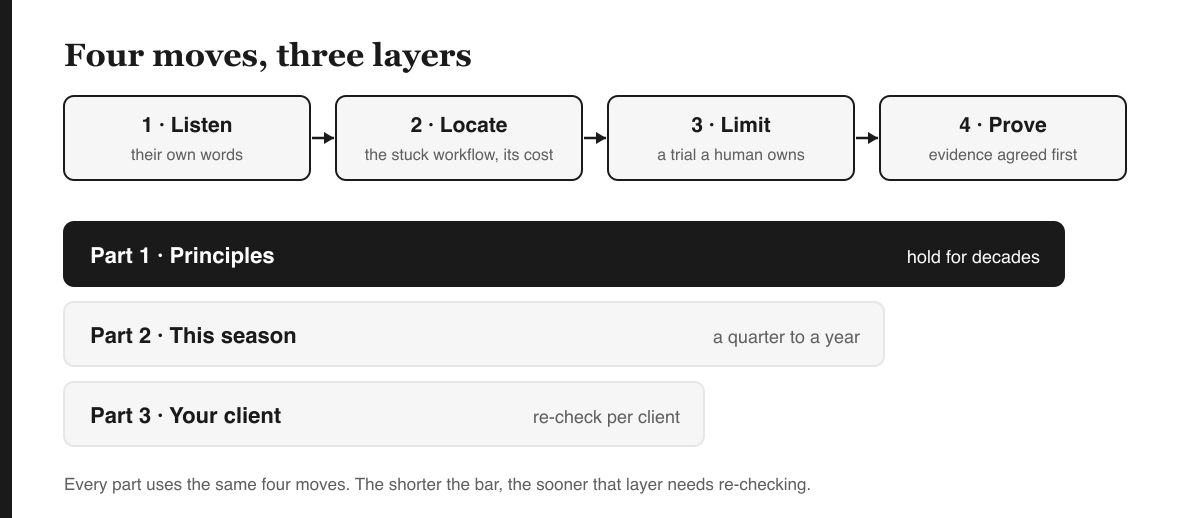
This series is about pitching AI agents to enterprises without a slide 7. It was prompted by an enablement session I attended on positioning coding agents, which left me with one conviction: the pitch should start from the customer's work, not the tool. The framework below is my own synthesis. I derived each of its four moves from a principle that was true long before AI, which is why I expect it to outlive this year's tools:
- Listen: say back how the customer describes the problem, in their words.
- Locate: find the recurring workflow underneath it, and what it costs now.
- Limit: shape a trial small enough to try and visible enough to judge, with a person accountable.
- Prove: agree, before starting, what evidence would make it worth expanding.
Part 2 covers this season's practice. Part 3 tailors a first workflow for four industries where mistakes are most expensive.
Make a bet first
Huthwaite's research behind SPIN Selling observed more than 35,000 sales calls. In large, complex sales, which seller behaviour went with success?
- A. Explaining the product's features and advantages clearly.
- B. Handling the customer's objections well.
- C. Asking about the consequences of the customer's problem, and what solving it would be worth.
Hold your answer. Principle 1 has it.
Principle 1: ask about consequences, not features (Locate)
EVIDENCE Huthwaite reports that in large sales, questions about the implications of a problem and the payoff of solving it went with success, while describing features and advantages did not (Huthwaite International, SPIN Selling). Rackham goes further in the book (SPIN Selling, 1988): he argues that sellers who are good at handling objections are often the ones who caused them, by describing features too early. The answer to the bet is C. Slide 7 is option A, with icons.
A caveat that matters: Huthwaite ran the research and sells the training, and the dataset has never been independently published. Treat it as long-standing practitioner evidence, not settled science.
DESIGN "Developer productivity" is a feature-level promise. "Release readiness slips because review across three teams is inconsistent, and each slip moves the roadmap" is an implication. One invites a demo. The other invites a conversation about what the delay costs. I have given the first version. The customer asked a polite question about pricing, which in large sales is how a meeting ends.
Principle 2: people buy progress on a job, not a product (Listen)
EVIDENCE Clayton Christensen and colleagues argued that customers "hire" a product to make progress in a particular circumstance, and that understanding that job predicts purchase better than demographics or product attributes (Christensen et al., Know Your Customers' "Jobs to Be Done", HBR, 2016).
DESIGN Before reframing anything, say back the job in the customer's own words. A platform lead who says "our CI keeps breaking and nobody owns it" has told you the job: get a change from merged to trusted without someone losing an afternoon to it. Start there.
Principle 3: the status quo has a price, so name it (Locate)
EVIDENCE Prospect theory showed that people judge outcomes as gains or losses from a reference point, and that losses tend to weigh more than equal gains (Kahneman & Tversky, Prospect Theory, Econometrica, 1979). How strong and how general loss aversion is remains contested; a 2018 review argued it is narrower than often assumed (Gal & Rucker, The Loss of Loss Aversion, 2018).
DESIGN Use the robust part, not the contested part. Don't sell fear. Do make the cost of the current workflow visible, because doing nothing has a price nobody has written down: the review hours, the re-runs, the slipped date. A buyer who sees that price compares your proposal with a real alternative, not with zero.
Principle 4: a trial people can watch beats a promise they must trust (Limit)
EVIDENCE Everett Rogers' Diffusion of Innovations (1962) names five attributes that shape how fast an innovation spreads: relative advantage, compatibility, complexity, trialability and observability (Rogers, Diffusion of Innovations, 5th ed., 2003, ch. 6). Figures are often quoted for how much of adoption these attributes explain; I haven't verified them against the book, so I leave them out.
DESIGN One team's pull-request review for six weeks is trialable (small enough to try without a programme) and observable (the team can see review time and rework change). "Company-wide engineering automation" is neither. Small and visible is a design choice, not a lack of ambition.
Principle 5: trust falls when the seller is the point (Limit)
EVIDENCE The Trusted Advisor (2000) expressed trust as credibility plus reliability plus intimacy, divided by self-orientation (Maister, Green & Galford, the trust equation). It is a heuristic, not a measured model, but the denominator explains a lot: the more a pitch is about the seller, the less it is believed.
DESIGN Two habits follow. Say "this may be worth evaluating", not "this will transform your engineering". And say what the tool should not own: your engineers keep responsibility for quality and approvals. Admitting a limit raises credibility; slide 7 raises self-orientation.
Principle 6: agree the measure before you see the result (Prove)
EVIDENCE Science learned this the hard way. Deciding how a study will be analysed before seeing the data is now a recognised defence against finding what you hoped to find (Nosek et al., The preregistration revolution, PNAS, 2018). Goodhart's law carries the same warning from the other side; in Marilyn Strathern's popular phrasing, when a measure becomes a target, it ceases to be a good measure.
DESIGN In a pitch, the buyer signs off the signal and the bar before the trial starts. A seller who proposes the measure shows they expect to meet it, and nobody can later call the result cherry-picked.
A seventh, used with care: teach, but listen first (Locate)
EVIDENCE The Challenger Sale (2011) reported, from a large survey of reps, that top performers in complex sales tended to teach customers something new about their own business (Dixon & Adamson, The Challenger Sale, 2011, ch. 2). The study was run by the firm that sold the training and is correlational; the percentages often quoted are unverified, so I leave them out.
LENS Locating the deeper workflow problem is teaching. Doing it before you've listened is lecturing. Order matters.
The four moves in under a minute
You've told me release dates slip when review backs up (Listen). Underneath, the same review rework repeats every sprint, and it costs the roadmap a week each time (Locate). One team, six weeks, an agent drafting first-pass reviews, your engineers approving every merge (Limit). If review time drops and rework doesn't rise, it may be worth a second team (Prove).
DESIGN If it doesn't fit in a minute, simplify. Don't speak faster. A pitch that needs speed to fit has too many ideas in it, which is slide 7 again, read aloud.
How this could fail
- Applied as a script. These principles describe what good sellers notice. Recited mechanically ("and what's the implication of that?") they feel like an interrogation, and the trust equation's denominator goes up.
- The evidence is older and narrower than it sounds. SPIN and Challenger rest on studies run by the firms that sold them. We don't know how well either transfers to AI agents, which carry a credibility problem the 1980s didn't.
- Locating can be presumptuous. A seller who names "the deeper problem" after one meeting may be wrong. That is why Prove exists: it makes the seller's diagnosis falsifiable.
- Small can stay small. A limited trial that succeeds with no owner for the next step ends as an anecdote. Part 2 covers qualification, which is how you check for that owner before starting.
- Slide 7 comes back. Under pressure, everyone reaches for the feature list. Count your feature mentions in your next pitch.
Your move this week
Take one live opportunity and write four lines, one per move: Listen (their words), Locate (the recurring workflow and its cost), Limit (the trial, and who stays accountable), Prove (the signal and the bar). Read them aloud. If it takes more than a minute, cut.
Next
Part 2 moves from principles to this season: how enterprises buy AI in 2025–26, why pilots stall, what the best evidence on AI coding tools says (it disagrees with itself, instructively), and four checks every agent pitch should pass.
Sources
- Huthwaite International, SPIN Selling (research summary). Rackham, N., SPIN Selling, McGraw-Hill, 1988.
- Christensen, C., Hall, T., Dillon, K., Duncan, D. "Know Your Customers' 'Jobs to Be Done'." Harvard Business Review, September 2016.
- Kahneman, D., Tversky, A. "Prospect Theory: An Analysis of Decision under Risk." Econometrica 47(2), 1979.
- Gal, D., Rucker, D. "The Loss of Loss Aversion: Will It Loom Larger Than Its Gain?" Journal of Consumer Psychology 28(3), 2018.
- Rogers, E. Diffusion of Innovations. Free Press, 1962 (5th ed. 2003).
- Maister, D., Green, C., Galford, R. The Trusted Advisor. Free Press, 2000.
- Nosek, B., Ebersole, C., DeHaven, A., Mellor, D. "The preregistration revolution." PNAS 115(11), 2018. Goodhart, C. "Problems of Monetary Management: The U.K. Experience," 1975. Strathern, M. "'Improving ratings': audit in the British University system." European Review 5(3), 1997.
- Dixon, M., Adamson, B. The Challenger Sale. Portfolio, 2011.
- Provenance: the series was prompted by a coding-agent enablement session the author attended in 2026. The framework here is the author's own synthesis from the public sources above.